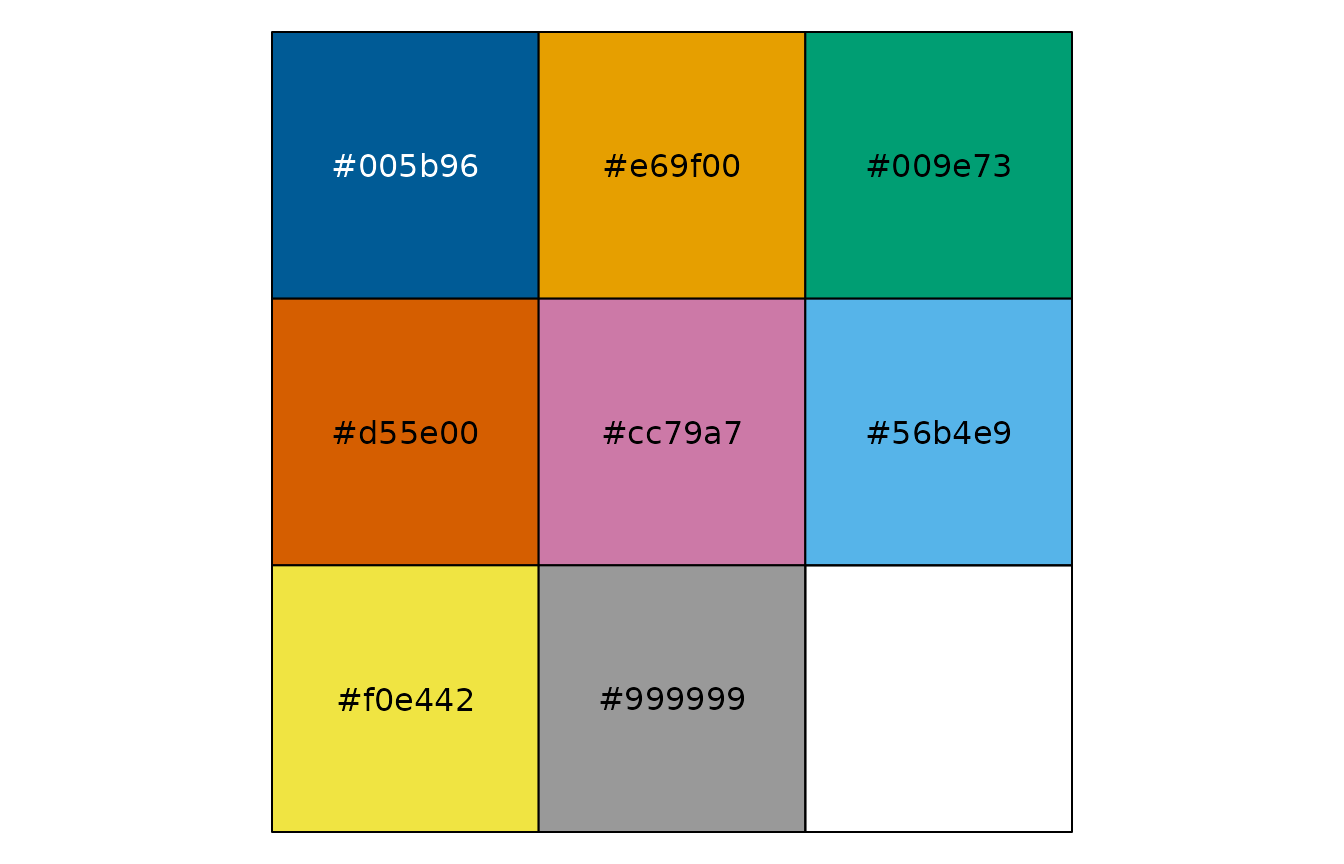
Colourblind-aware palettes shared by every depictr plot. The qualitative palette is based on the Okabe-Ito set (Okabe & Ito, 2008), a widely recommended categorical palette that stays distinguishable under the common forms of colour-vision deficiency, with the depictr brand blue leading. The sequential and diverging palettes are perceptually ordered single-hue and red-blue ramps.
Arguments
- n
Number of colours to return. If
NULL(the default), the qualitative palette returns all of its base colours, the eight Okabe-Ito colours unlessoptions(depictr.palette = )supplies another set, and the sequential and diverging ramps return seven. For the qualitative palette annlarger than the available base colours is interpolated; the sequential and diverging palettes are ramps and accept anyn. Interpolating the built-in qualitative palette beyond its eight base colours loses the colour-vision-deficiency guarantee and warns, so facet the groups or use the sequential ramp when many groups are needed.- type
Palette type:
"qualitative"(categorical groups),"sequential"(ordered low-to-high) or"diverging"(a midpoint with two directions).- order
The order of the built-in qualitative palette:
"default", or"contrast"for the contrast-first order described below. The ramps have an order of their own and refuse"contrast".
Details
The guarantee belongs to the eight Okabe-Ito colours themselves, not to any number of colours: past eight the qualitative palette has to interpolate between them, and the interpolated colours sit close enough together to fail the package's own colour-distance check. That case warns rather than handing back colours under a guarantee it cannot keep.
The qualitative palette can be overridden globally with
options(depictr.palette = ) (see depictr_options()); when set, that
custom palette replaces the built-in Okabe-Ito set and is interpolated when
more colours are requested than it provides. The sequential and diverging
ramps are unaffected.
The contrast-first order
In the default order the second colour is the orange (#e69f00), at 2.25:1
against white. Any figure on white whose colour tells two or more groups
apart therefore fails the geometry_contrast row of check_figure(). No
more than three of the eight colours pass every colour row of that audit
together.
order = "contrast" puts those three first: the brand blue, the vermillion
(#d55e00) and the reddish purple (#cc79a7), then the bluish green
(#009e73) and the other four in their default order. Up to three groups
then pass every colour row, contrast against white included. They stay at
least 14.01 apart in CIEDE2000 under every vision type, 6.86 apart in
lightness and 3.06:1 against white. Four groups keep 3:1 against white, but
the bluish green and the vermillion are 3.31 apart in lightness, which fails
greyscale_separability. Asking for more than four colours warns, since the
fifth, the orange, falls below 3:1.
Under this order, the second group is drawn in the vermillion. That is also
the accent (depictr_options()) that depictr uses for single highlights,
such as the flagged points of outlier_plot() and the missing cells of
missingness_map(). The default order is unchanged.
The order applies to the built-in palette alone. A palette set with
depictr_options(palette = ) is the user's own, so it is returned in the
order it was set, with a warning. That is also how to make the order the
default for every later plot:
depictr_options(palette = depictr_palette(order = "contrast")). The
palette is then the user's own, so asking for more than four colours no
longer warns. scale_colour_depictr() and scale_fill_depictr() take
order for a single plot.
References
Okabe M, Ito K (2008). “Color Universal Design (CUD): How to make figures and presentations that are friendly to colorblind people.” https://jfly.uni-koeln.de/color/. Accessed 2026-06-14.
World Wide Web Consortium (2023). “Web Content Accessibility Guidelines (WCAG) 2.2.” W3C Recommendation, https://www.w3.org/TR/WCAG22/. Accessed 2026-08-18.
Examples
depictr_palette(3)
#> [1] "#005b96" "#e69f00" "#009e73"
depictr_palette(3, order = "contrast")
#> [1] "#005b96" "#d55e00" "#cc79a7"
depictr_palette(7, type = "sequential")
#> [1] "#E6EFF5" "#98BFDA" "#4A8FC0" "#2475AB" "#005B96" "#034678" "#08315A"
scales::show_col(depictr_palette())