Language and vision in conceptual processing: Multilevel analysis and statistical power
Preprint

Abstract
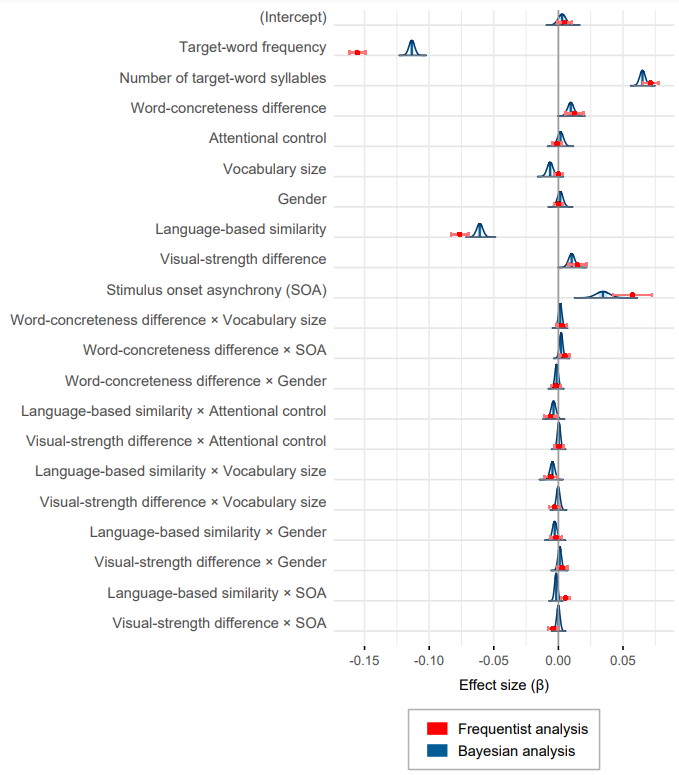
Research has suggested that conceptual processing depends on both language-based and vision-based information. We tested this interplay at three levels of the experimental structure: individuals, words and tasks. To this end, we drew on three existing, large data sets that implemented the paradigms of semantic priming, semantic decision and lexical decision. We extended these data sets with measures of language-based and vision-based information, and analysed how the latter variables interacted with participants’ vocabulary size and gender, and also with presentation speed in the semantic priming study. We performed the analysis using mixed-effects models that included a comprehensive array of fixed effects—including covariates—and random effects. First, we found that language-based information was more important than vision-based information. Second, in the semantic priming study—whose task required distinguishing between words and nonwords—, both language-based and vision-based information were more influential when words were presented faster. Third, a ‘task-relevance advantage’ was identified in higher-vocabulary participants. Specifically, in lexical decision, higher-vocabulary participants were more sensitive to language-based information than lower-vocabulary participants. In contrast, in semantic decision, higher-vocabulary participants were more sensitive to word concreteness. Fourth, we demonstrated the influence of the analytical method on the results. These findings support the interplay between language and vision in conceptual processing, and demonstrate the influence of measurement instruments on the results. Last, we estimated the sample size required to reliably investigate various effects. We found that 300 participants were sufficient to examine the effect of language-based information contained in words, whereas more than 1,000 participants were necessary to examine the effect of vision-based information and the interactions of both former variables with vocabulary size, gender and presentation speed. In conclusion, this power analysis reveals the need to increase sample sizes when conducting research on perceptual simulation and individual differences.
View full textStudy at a glance
priming, semantic
decision, lexical decision"] --> B["Add language-based and
vision-based measures"] B --> C["Mixed-effects models
across individuals,
words and tasks"] C --> D["Language-based
information more
important than
vision-based"] C --> E["Priming: both stronger
when words shown faster"] C --> F["Higher-vocabulary readers
show a task-relevance
advantage"] C --> G["Power: 300 participants
for language effects;
over 1,000 for
vision effects"]
Related podcasts
Created using NotebookLM, with all the benefits and blind spots of human editing.
Reference
Bernabeu, P., Lynott, D., & Connell, L. (2022). Language and vision in conceptual processing: Multilevel analysis and statistical power. OSF. https://osf.io/dnskh
Related references
Abramski, K., Improta, R., Rossetti, G., & Stella, M. (2025). The “LLM World of Words” English free association norms generated by large language models. Scientific Data, 12(1). https://doi.org/10.1038/s41597-025-05156-9
Al-Azary, H., & Katz, A. N. (2020). Do metaphorical sharks bite? Simulation and abstraction in metaphor processing. Memory & Cognition, 49(3), 557–570. https://doi.org/10.3758/s13421-020-01109-2
Al-Azary, H., & Katz, A. N. (2023). On choosing the vehicles of metaphors 2.0: the interactive effects of semantic neighborhood density and body-object interaction on metaphor production. Frontiers in Psychology, 14. https://doi.org/10.3389/fpsyg.2023.1216561
Alessandro Lenci. (2023). Understanding natural language understanding systems [JB]. Sistemi intelligenti, 2, 277–302. https://doi.org/10.1422/107438
Alonso González, M. (2024). Principios cognitivos de la recepción de la lírica: sistematización teórica, metodologías y análisis. Anuario de Estudios Filológicos, 47, 5–26. https://doi.org/10.17398/2660-7301.47.5
AlSuwat, M., Al-Shareef, S., & AlGhamdi, M. (2025). Audio–visual self-supervised representation learning: A survey. Neurocomputing, 634, 129750. https://doi.org/10.1016/j.neucom.2025.129750
Altın, E., Okur, N., Yalçın, E., Eraçıkbaş, A. F., & Aktan-Erciyes, A. (2022). Relations Between L2 Proficiency and L1 Lexical Property Evaluations. Frontiers in Psychology, 13. https://doi.org/10.3389/fpsyg.2022.820702
Alvarado, J. A., Velasco, C., & Salgado, A. (2024). The organization of semantic associations between senses in language. Language and Cognition, 16(4), 1588–1617. https://doi.org/10.1017/langcog.2024.19
Alves, C. L., Ciba, M., de O. Toutain, T. G. L., Augusto Moura Porto, J., Pondé de Sena, E., Thielemann, C., & Rodrigues, F. A. (2024). On the advances in machine learning and complex network measures to an EEG dataset from DMT experiments. Journal of Physics: Complexity, 5(1), 015002. https://doi.org/10.1088/2632-072X/ad1c68
Alyahya, M., & McLean, G. (2021). Examining Tourism Consumers’ Attitudes and the Role of Sensory Information in Virtual Reality Experiences of a Tourist Destination. Journal of Travel Research, 61(7), 1666–1681. https://doi.org/10.1177/00472875211037745
Alzahrani, S. I. (2021). Implementation of P300 based BCI Using a Consumer-grade EEG Neuroheadset. 2021 IEEE National Biomedical Engineering Conference (NBEC), 59–64. https://doi.org/10.1109/NBEC53282.2021.9618750
Ambridge, B. (2021). A Computational Simulation of Children’s Language Acquisition (Crazy New Idea). In D. Gromann, G. Sérasset, T. Declerck, J. P. McCrae, J. Gracia, J. Bosque-Gil, F. Bobillo, & B. Heinisch (Eds.), OASIcs, Volume 93, LDK 2021 (No.4; Vol. 93, pp. 4:1–4:3). Schloss Dagstuhl – Leibniz-Zentrum für Informatik. https://doi.org/10.4230/OASIcs.LDK.2021.4
Amenta, S., Crepaldi, D., & Marelli, M. (2020). Consistency measures individuate dissociating semantic modulations in priming paradigms: A new look on semantics in the processing of (complex) words. Quarterly Journal of Experimental Psychology, 73(10), 1546–1563. https://doi.org/10.1177/1747021820927663
Amenta, S., de Varda, A. G., Mandera, P., Keuleers, E., Brysbaert, M., & Marelli, M. (2024). The Italian Crowdsourcing Project: Visual word recognition times for 130,495 Italian words. Behavior Research Methods, 57(1). https://doi.org/10.3758/s13428-024-02548-4
Amenta, S., Loca, G., Gianfreda, G., Rinaldi, P., & Pavani, F. (2024). Exploring conceptual representation and grounding through perceptual strength norms in deaf individuals. Language and Cognition, 16(4), 1448–1477. https://doi.org/10.1017/langcog.2024.13
Amoruso, L., Moguilner, S., Castillo, E. M., Kleineschay, T., Geng, S., Ibáñez, A., & García, A. M. (2024). Neural dynamics of social verb processing: an MEG study. Social Cognitive and Affective Neuroscience, 20(1). https://doi.org/10.1093/scan/nsae066
Anceresi, G., Gatti, D., Vecchi, T., Marelli, M., & Rinaldi, L. (2024). Visual experience modulates the sensitivity to the distributional history of words in natural language. Psychonomic Bulletin & Review, 32(1), 472–481. https://doi.org/10.3758/s13423-024-02557-6
Anceresi, G., Gatti, D., Vecchi, T., Marelli, M., & Rinaldi, L. (2025). A map of words: Retrieving the spatial layout of medium-scale geographical maps through distributional semantics. Neuropsychologia, 217, 109190. https://doi.org/10.1016/j.neuropsychologia.2025.109190
Anderson, A. J., Kiela, D., Binder, J. R., Fernandino, L., Humphries, C. J., Conant, L. L., Raizada, R. D. S., Grimm, S., & Lalor, E. C. (2021). Deep Artificial Neural Networks Reveal a Distributed Cortical Network Encoding Propositional Sentence-Level Meaning. The Journal of Neuroscience, 41(18), 4100–4119. https://doi.org/10.1523/JNEUROSCI.1152-20.2021
Andreou, M., Themistocleous, C. K., & Peristeri, E. (2026). Integrating artificial intelligence and natural language processing to investigate lexical errors in autistic preschoolers. Research in Autism, 130, 202771. https://doi.org/10.1016/j.reia.2025.202771
Andrews, S., Veldre, A., & Clarke, I. E. (2020). Measuring Lexical Quality: The Role of Spelling Ability. Behavior Research Methods, 52(6), 2257–2282. https://doi.org/10.3758/s13428-020-01387-3
Anjum, J., Niharika, M. K., Scoggins, K., & Apple, B. (2025). Semantic priming in aphasia: a primer and a systematic review. Aphasiology, 1–42. https://doi.org/10.1080/02687038.2025.2542308
Anna M. Borghi. (2022). Embodied e grounded cognition e oltre: una rivoluzione all’inizio [JB]. Giornale italiano di psicologia, 2, 423–427. https://doi.org/10.1421/105152
Antal, C., & de Almeida, R. G. (2024). Grasping the Concept of an Object at a Glance: Category Information Accessed by Brief Dichoptic Presentation. Cognitive Science, 48(10). Portico. https://doi.org/10.1111/cogs.70002
Argiris, G., Rumiati, R. I., & Crepaldi, D. (2021). No fruits without color: Cross-modal priming and EEG reveal different roles for different features across semantic categories. PLOS ONE, 16(4), e0234219. https://doi.org/10.1371/journal.pone.0234219
Armstrong, S. R., Copland, D. A., Escudero, P., & Angwin, A. J. (2024). Tracking the acquisition and retention of novel word representations: an ERP study. Language, Cognition and Neuroscience, 39(4), 401–422. https://doi.org/10.1080/23273798.2024.2310549
Arseniev-Koehler, A. (2022). Theoretical Foundations and Limits of Word Embeddings: What Types of Meaning can They Capture? Sociological Methods & Research, 53(4), 1753–1793. https://doi.org/10.1177/00491241221140142
Arshamian, A., Manko, P., & Majid, A. (2020). Limitations in odour simulation may originate from differential sensory embodiment. Philosophical Transactions of the Royal Society B: Biological Sciences, 375(1800), 20190273. https://doi.org/10.1098/rstb.2019.0273
Astarte, T. K. (2025). Conceptualising Programming Language Semantics. Philosophies, 10(4), 90. https://doi.org/10.3390/philosophies10040090
Aveni, K., McRae, K., Borovsky, A., Katz, B., & Roberts, A. (2025). Action and event-based lexical-semantic processing in Parkinson’s disease. Language, Cognition and Neuroscience, 41(1), 2–26. https://doi.org/10.1080/23273798.2025.2580970
Avery, J. E., Goldstone, R. L., & Jones, M. N. (2021). Reconstructing maps from text. Cognitive Systems Research, 70, 101–108. https://doi.org/10.1016/j.cogsys.2021.07.007
Baddeley, A. D., Xu, Z., Tung Ho, S., & Hitch, G. J. (2023). On verbal memory span in Chinese speakers: Evidence for employment of an articulation-resistant phonological component. Journal of Memory and Language, 129, 104389. https://doi.org/10.1016/j.jml.2022.104389
Bagli, M. (2023). How to Point with Language: English Source-Based Language to Describe Taste Qualities. Lublin Studies in Modern Languages and Literature, 42(2), 31–46. https://doi.org/10.17951/lsmll.2023.47.2.31-46
Bakarov, A. (2022). Distributional Word Vectors as Semantic Maps Framework. Computación y Sistemas, 26(3). https://doi.org/10.13053/CYS-26-3-4356
Ballesteros-Mejía, M., & Madero, M. A. (2024). Mapping visual-based methods: an interdisciplinary approach. Journal of Visual Literacy, 43(4), 285–307. https://doi.org/10.1080/1051144X.2024.2420304
Banks, B., & Connell, L. (2022). Category production norms for 117 concrete and abstract categories. Behavior Research Methods, 55(3), 1292–1313. https://doi.org/10.3758/s13428-021-01787-z
Banks, B., & Connell, L. (2022). Multi-dimensional sensorimotor grounding of concrete and abstract categories. Philosophical Transactions of the Royal Society B, 378(1870). https://doi.org/10.1098/rstb.2021.0366
Banks, B., & Connell, L. (2024). Access to inner language enhances memory for events. Journal of Experimental Psychology: Learning, Memory, and Cognition, 50(10), 1592–1615. https://doi.org/10.1037/xlm0001351
Banks, B., Borghi, A. M., Fargier, R., Fini, C., Jonauskaite, D., Mazzuca, C., Montalti, M., Villani, C., & Woodin, G. (2023). Consensus Paper: Current Perspectives on Abstract Concepts and Future Research Directions. Journal of Cognition, 6(1). https://doi.org/10.5334/JOC.238
Banks, B., Wingfield, C., & Connell, L. (2021). Linguistic Distributional Knowledge and Sensorimotor Grounding both Contribute to Semantic Category Production. Cognitive Science, 45(10). Portico. https://doi.org/10.1111/cogs.13055
Baranyiné Kóczy, J. (2023). Cultural conceptualizations of sight and cultural values. Cognitive Linguistic Studies, 10(2), 313–341. Portico. https://doi.org/10.1075/cogls.00103.bar
Barattieri di San Pietro, C., Luzzatti, C., Ferrari, E., de Girolamo, G., & Marelli, M. (2023). Automated clustering and switching algorithms applied to semantic verbal fluency data in schizophrenia spectrum disorders. Language, Cognition and Neuroscience, 38(7), 950–965. https://doi.org/10.1080/23273798.2023.2178662
Barca, L., Diana, S. M., Duarte, D. C., Porciello, G., & Borghi, A. M. (2026). Interoceptive grounding of conceptual knowledge: new insight from an interoceptive-exteroceptive categorization task of concepts. Psychological Research, 90(1). https://doi.org/10.1007/s00426-025-02155-8
Barsalou, L. W. (2020). Challenges and Opportunities for Grounding Cognition. Journal of Cognition, 3(1). https://doi.org/10.5334/joc.116
Batterink, L. J., Hsiung, S., Herrera-Chaves, D., & Köhler, S. (2025). Implicit prediction as a consequence of statistical learning. Cognition, 258, 106088. https://doi.org/10.1016/j.cognition.2025.106088
Baumann, A., Hofmann, K., Marakasova, A., Neidhardt, J., & Wissik, T. (2023). Semantic micro-dynamics as a reflex of occurrence frequency: a semantic networks approach. Cognitive Linguistics, 34(3–4), 533–568. https://doi.org/10.1515/cog-2022-0008
Bayram, M., Palluel-Germain, R., Lebon, F., Durand, E., Harquel, S., & Perrone-Bertolotti, M. (2023). Motor imagery training to improve language processing: What are the arguments? Frontiers in Human Neuroscience, 17. https://doi.org/10.3389/fnhum.2023.982849
Bechtold, L., Cosper, S. H., Malyshevskaya, A., Montefinese, M., Morucci, P., Niccolai, V., Repetto, C., Zappa, A., & Shtyrov, Y. (2023). Brain Signatures of Embodied Semantics and Language: A Consensus Paper. Journal of Cognition, 6(1). https://doi.org/10.5334/JOC.237
Beinborn, L., & Hollenstein, N. (2023). Representational Structure. Cognitive Plausibility in Natural Language Processing, 89–119. https://doi.org/10.1007/978-3-031-43260-6_5
Berger, J., Moe, W. W., & Schweidel, D. A. (2023). What Holds Attention? Linguistic Drivers of Engagement. Journal of Marketing, 87(5), 793–809. https://doi.org/10.1177/00222429231152880
Berio, L. (2021). Linguistic Relativity and Flexibility of Mental Representations: Color Terms in a Frame Based Analysis. Concepts, Frames and Cascades in Semantics, Cognition and Ontology, 121–141. https://doi.org/10.1007/978-3-030-50200-3_6
Bianchi, I., Paradis, C., & van de Weijer, J. (2025). Perceptual structure of opposites across sensory modalities. Language and Cognition, 17. https://doi.org/10.1017/langcog.2025.10016
Bidelman, G. M., York, A., & Pearson, C. (2025). Neural correlates of phonetic categorization under auditory (phoneme) and visual (grapheme) modalities. Neuroscience, 565, 182–191. https://doi.org/10.1016/j.neuroscience.2024.11.079
Boghrati, R., & Berger, J. (2026). What Leads to Longer Word of Mouth Discussion? Journal of the Association for Consumer Research, 000–000. https://doi.org/10.1086/740059
Bogunović, I., Ćoso, B., Guasch, M., Pavlinušić Vilus, E., Ferré, P., & Hinojosa, J. A. (2024). How do we feel about borrowed words? Affective and lexico-semantic norms for most frequent unadapted English loanwords in Croatian (ENGRI CROWD). International Journal of Bilingualism, 29(5), 1309–1334. https://doi.org/10.1177/13670069241280355
Bolognesi, M. (2025). Beyond concreteness: why word specificity is the missing piece in theories on embodied language comprehension. Frontiers in Psychology, 16. https://doi.org/10.3389/fpsyg.2025.1718655
Bolognesi, M., Burgers, C., & Caselli, T. (2020). On abstraction: decoupling conceptual concreteness and categorical specificity. Cognitive Processing, 21(3), 365–381. https://doi.org/10.1007/s10339-020-00965-9
Bolognesi, M., Strik-Lievers, F., Yao, B., & Citron, F. M. M. (2025). Metaphor and multisensoriality drive appreciation in print advertising: an experimental study of visual and linguistic synaesthetic metaphors. Language and Cognition, 18. https://doi.org/10.1017/langcog.2025.10052
Bond, G. D., Gill, L. A., Aragon, A. F., Jayce Victor, & Jiménez, J. C. (2024). How Cultural Practices Influence the Understanding and Emotional Intensity of Mexican Children’s Memories of Death Events. Psychological Reports. https://doi.org/10.1177/00332941241277926
Bonnet, C., Bayram, M., El Bouzaïdi Tiali, S., Lebon, F., Harquel, S., Palluel-Germain, R., & Perrone-Bertolotti, M. (2022). Kinesthetic motor-imagery training improves performance on lexical-semantic access. PLOS ONE, 17(6), e0270352. https://doi.org/10.1371/journal.pone.0270352
Borghesani, V., Armoza, J., Hebart, M. N., Bellec, P., & Brambati, S. M. (2023). The Three Terms Task - an open benchmark to compare human and artificial semantic representations. Scientific Data, 10(1). https://doi.org/10.1038/s41597-023-02015-3
Borghi, A. M. (2020). A Future of Words: Language and the Challenge of Abstract Concepts. Journal of Cognition, 3(1). https://doi.org/10.5334/joc.134
Borghi, A. M., & Barsalou, L. (2019). Perspective in the conceptualization of categories. Psychological Research, 85(2), 697–719. https://doi.org/10.1007/s00426-019-01269-0
Borghi, A. M., & Fernyhough, C. (2022). Concepts, abstractness and inner speech. Philosophical Transactions of the Royal Society B, 378(1870). https://doi.org/10.1098/rstb.2021.0371
Borghi, A. M., Fini, C., & Mazzuca, C. (2022). Abstract Concepts, Social Interaction, and Beliefs. Frontiers in Psychology, 13. https://doi.org/10.3389/fpsyg.2022.919808
Borghi, A. M., Mazzuca, C., Gervasi, A. M., Mannella, F., & Tummolini, L. (2023). Grounded cognition can be multimodal all the way down. Language, Cognition and Neuroscience, 39(7), 838–842. https://doi.org/10.1080/23273798.2023.2210238
Borghi, A. M., Osińska, A., Roepstorff, A., & Raczaszek-Leonardi, J. (2022). Concepts in interaction: social engagement and inner experiences. Philosophical Transactions of the Royal Society B, 378(1870). https://doi.org/10.1098/rstb.2021.0351
Borghi, A. M., Shaki, S., & Fischer, M. H. (2022). Abstract concepts: external influences, internal constraints, and methodological issues. Psychological Research, 86(8), 2370–2388. https://doi.org/10.1007/s00426-022-01698-4
Borsa, V. M., Arioli, M., Verni, R., Canessa, N., Cappa, S. F., & Catricalà, E. (2025). Quantifying the Multidimensionality of Abstract Concepts: An Italian Database. Brain Sciences, 15(3), 222. https://doi.org/10.3390/brainsci15030222
Bosco, F. A. (2022). Accumulating Knowledge in the Organizational Sciences. Annual Review of Organizational Psychology and Organizational Behavior, 9(1), 441–464. https://doi.org/10.1146/annurev-orgpsych-012420-090657
Bottini, R., Morucci, P., D’Urso, A., Collignon, O., & Crepaldi, D. (2022). The concreteness advantage in lexical decision does not depend on perceptual simulations. Journal of Experimental Psychology: General, 151(3), 731–738. https://doi.org/10.1037/xge0001090
Boucher, V. J. (2021). The Study of Speech Processes. https://doi.org/10.1017/9781316882764
Bourne, J. (2025). Who Listens? Oxford University PressNew York, NY. https://doi.org/10.1093/9780197797204.001.0001
Brainerd, C. J., Chang, M., Bialer, D. M., & Toglia, M. P. (2021). Semantic ambiguity and memory. Journal of Memory and Language, 121, 104286. https://doi.org/10.1016/j.jml.2021.104286
Bratman, G. N., Bembibre, C., Daily, G. C., Doty, R. L., Hummel, T., Jacobs, L. F., Kahn, P. H., Lashus, C., Majid, A., Miller, J. D., Oleszkiewicz, A., Olvera-Alvarez, H., Parma, V., Riederer, A. M., Sieber, N. L., Williams, J., Xiao, J., Yu, C.-P., & Spengler, J. D. (2024). Nature and human well-being: The olfactory pathway. Science Advances, 10(20). https://doi.org/10.1126/sciadv.adn3028
Bromberek-Dyzman, K., Jończyk, R., Vasileanu, M., Niculescu-Gorpin, A.-G., & Bąk, H. (2021). Cross-linguistic differences affect emotion and emotion-laden word processing: Evidence from Polish-English and Romanian-English bilinguals. International Journal of Bilingualism, 25(5), 1161–1182. https://doi.org/10.1177/1367006920987306
Brown, K. S., Yee, E., Joergensen, G., Troyer, M., Saltzman, E., Rueckl, J., Magnuson, J. S., & McRae, K. (2023). Investigating the Extent to which Distributional Semantic Models Capture a Broad Range of Semantic Relations. Cognitive Science, 47(5). Portico. https://doi.org/10.1111/cogs.13291
Bruera, A., & Poesio, M. (2024). Family lexicon: Using language models to encode memories of personally familiar and famous people and places in the brain. PLOS ONE, 19(11), e0291099. https://doi.org/10.1371/journal.pone.0291099
Bruera, A., Zamani, F., & Poesio, M. (2024). Polysemy through the lens of psycholinguistic variables: a dataset and an evaluation of static and contextualized language models. Proceedings of the 13th Joint Conference on Lexical and Computational Semantics (*SEM 2024), 35–48. https://doi.org/10.18653/v1/2024.starsem-1.3
Buchanan, E. M., Crain, S. E., Cunningham, A. L., Johnson, H. R., Stash, H., Papadatou-Pastou, M., Isager, P. M., Carlsson, R., & Aczel, B. (2021). Getting Started Creating Data Dictionaries: How to Create a Shareable Data Set. Advances in Methods and Practices in Psychological Science, 4(1). https://doi.org/10.1177/2515245920928007
Buchanan, E. M., Cuccolo, K., Heyman, T., van Berkel, N., Coles, N. A., Iyer, A., Peters, K., van ’t Veer, A. E., Montefinese, M., Maxwell, N. P., Taylor, J. E., Valentine, K. D., Arriaga, P., Barzykowski, K., Boucher, L., Collins, W. M., Vaidis, D. C., Aczel, B., Al-Hoorie, A. H., … Lewis, S. C. (2025). Measuring the semantic priming effect across many languages. Nature Human Behaviour, 10(1), 182–201. https://doi.org/10.1038/s41562-025-02254-x
Bucur, M., & Papagno, C. (2021). An ALE meta-analytical review of the neural correlates of abstract and concrete words. Scientific Reports, 11(1). https://doi.org/10.1038/s41598-021-94506-9
Caballero, R., & Paradis, C. (2020). Soundscapes in English and Spanish: a corpus investigation of verb constructions. Language and Cognition, 12(4), 705–728. https://doi.org/10.1017/langcog.2020.19
Caballero, R., & Paradis, C. (2023). Sharing Perceptual Experiences through Language. Journal of Intelligence, 11(7), 129. https://doi.org/10.3390/jintelligence11070129
Caballero, R., & Paradis, C. (2025). touch in language. Review of Cognitive Linguistics. https://doi.org/10.1075/rcl.00211.cab
Cakmak, Y. O., Daniel, B. K., Hammer, N., Yilmaz, O., Irmak, E. C., & Khwaounjoo, P. (2020). The Human Muscular Arm Avatar as an Interactive Visualization Tool in Learning Anatomy: Medical Students’ Perspectives. IEEE Transactions on Learning Technologies, 13(3), 593–603. https://doi.org/10.1109/TLT.2020.2995163
Calignano, G., Lorenzoni, A., Semeraro, G., & Navarrete, E. (2024). Words before pictures: the role of language in biasing visual attention. Frontiers in Psychology, 15. https://doi.org/10.3389/fpsyg.2024.1439397
Calzavarini, F. (2023). Rethinking modality-specificity in the cognitive neuroscience of concrete word meaning: a position paper. Language, Cognition and Neuroscience, 39(7), 815–837. https://doi.org/10.1080/23273798.2023.2173789
Calzavarini, F. (2024). Rethinking modality-specificity in the cognitive neuroscience of concrete word meaning: responses to commentators. Language, Cognition and Neuroscience, 39(7), 878–890. https://doi.org/10.1080/23273798.2024.2370027
Calzavarini, F. (2025). From cognitive semantics to neurosemantics. Neurocognitive Foundations of Mind, 222–245. https://doi.org/10.4324/9781003458531-11
Calzavarini, F. (2025). The Conceptual Format Debate and the Challenge from (Global) Supramodality. The British Journal for the Philosophy of Science, 76(1), 45–74. https://doi.org/10.1086/717564
Campbell, E. E., & Bergelson, E. (2022). Making sense of sensory language: Acquisition of sensory knowledge by individuals with congenital sensory impairments. Neuropsychologia, 174, 108320. https://doi.org/10.1016/j.neuropsychologia.2022.108320
Campbell, E., Casillas, R., & Bergelson, E. (2024). The role of vision in the acquisition of words: Vocabulary development in blind toddlers. Developmental Science, 27(4). Portico. https://doi.org/10.1111/desc.13475
Cancer, A., Maietti, A., Caldana, M., & Repetto, C. (2026). First-person perspective gesture observation in virtual reality: A novel approach for anomia rehabilitation in post-stroke aphasia. Neuropsychologia, 226, 109432. https://doi.org/10.1016/j.neuropsychologia.2026.109432
Canessa, E., & Chaigneau, S. E. (2020). Mathematical regularities of data from the property listing task. Journal of Mathematical Psychology, 97, 102376. https://doi.org/10.1016/j.jmp.2020.102376
Canessa, E., Chaigneau, S. E., & Moreno, S. (2021). Language Processing Differences Between Blind and Sighted Individuals and the Abstract Versus Concrete Concept Difference. Cognitive Science, 45(10). Portico. https://doi.org/10.1111/cogs.13044
Canessa, E., Chaigneau, S. E., & Moreno, S. (2022). Using agreement probability to study differences in types of concepts and conceptualizers. Behavior Research Methods, 56(1), 93–112. https://doi.org/10.3758/s13428-022-02030-z
Carney, J. (2020). Thinking avant la lettre: A Review of 4E Cognition. Evolutionary Studies in Imaginative Culture, 4(1), 77–90. https://doi.org/10.26613/esic.4.1.172
Carney, J. (2025). Counterfactual imaginative culture as evidence hallucination in support of anxiety reduction. New Ideas in Psychology, 79, 101179. https://doi.org/10.1016/j.newideapsych.2025.101179
Carney, J., & Robertson, C. (2022). Five studies evaluating the impact on mental health and mood of recalling, reading, and discussing fiction. PLOS ONE, 17(4), e0266323. https://doi.org/10.1371/journal.pone.0266323
Carota, F., Nili, H., Kriegeskorte, N., & Pulvermüller, F. (2023). Experientially-grounded and distributional semantic vectors uncover dissociable representations of conceptual categories. Language, Cognition and Neuroscience, 39(8), 1020–1044. https://doi.org/10.1080/23273798.2023.2232481
Carroll-Duhigg, C., Hubbard, H. I., Smith, T., Youkhana, E., Van Horn, L., Adair, J. C., & Richardson, J. D. (2025). Psycholinguistic variables and spelling accuracy for people with logopenic variant primary progressive aphasia: a cross-sectional study. Aphasiology, 1–23. https://doi.org/10.1080/02687038.2025.2516821
Carter, G., Keller, F., & Hoffman, P. (2025). Leveraging Context for Perceptual Prediction Using Word Embeddings. Cognitive Science, 49(6). Portico. https://doi.org/10.1111/cogs.70072
Cayol, Z., & Nazir, T. A. (2020). Why Language Processing Recruits Modality Specific Brain Regions: It Is Not About Understanding Words, but About Modelling Situations. Journal of Cognition, 3(1). https://doi.org/10.5334/joc.124
Cayol, Z., Rotival, C., Paulignan, Y., & Nazir, T. A. (2020). “Embodied” language processing: Mental motor imagery aptitude predicts word-definition skill for high but not for low imageable words in adolescents. Brain and Cognition, 145, 105628. https://doi.org/10.1016/j.bandc.2020.105628
Cerda, V. R., & Heredia, R. R. (2026). Bilingual memory revisited (again). Journal of Neurolinguistics, 78, 101310. https://doi.org/10.1016/j.jneuroling.2026.101310
Cereghetti, D., Coppin, G., Porcherot, C., Cayeux, I., Sander, D., & Delplanque, S. (2024). Beyond self-report measures of arousal: A new priming task to capture activation of relaxing and energizing feelings elicited by odors. Food Quality and Preference, 119, 105227. https://doi.org/10.1016/j.foodqual.2024.105227
Chaigneau, S. E., Marchant, N., Canessa, E., & Aldunate, N. (2024). A mathematical model of semantic access in lexical and semantic decisions. Language and Cognition, 16(4), 1541–1563. https://doi.org/10.1017/langcog.2024.17
Chang, M., & Brainerd, C. J. (2023). The recognition effects of attribute ambiguity. Psychonomic Bulletin & Review, 30(6), 2315–2327. https://doi.org/10.3758/s13423-023-02291-5
Charitonidis, C. (2022). Context concreteness for the second constituent slows down compound-word processing. Lexis, 20. https://doi.org/10.4000/LEXIS.6769
Chen, C., & Monroy, C. (2026). Moving, Seeing, Hearing, Smelling and Tasting: How Sensory–Motor Experiences Shape Early Cognitive Development. Behavioral Sciences, 16(2), 255. https://doi.org/10.3390/bs16020255
Chen, L. (2024). Synesthetic Correspondence: An Overview. Advances of Multisensory Integration in the Brain, 101–119. https://doi.org/10.1007/978-981-99-7611-9_7
Chen, R., Huang, L., Perea, M., & Li, X. (2024). The role of semantic information in Chinese word segmentation. Language, Cognition and Neuroscience, 40(1), 41–55. https://doi.org/10.1080/23273798.2024.2390003
Chen, S.-C., Buchanan, E. M., Kekecs, Z., Miller, J. K., Szabelska, A., Aczel, B., Bernabeu, P., Forscher, P., Szuts, A., Vally, Z., Al-Hoorie, A. H., Helmy, M., da Silva, C. S. A., da Silva, L. O., de Moraes, Y. L., Hsu, R. M. C. S., Mafra, A. L., Valentova, J. V., Varella, M. A. C., … Chartier, C. R. (2025). Investigating object orientation effects across 18 languages. Current Psychology, 44(24), 19148–19174. https://doi.org/10.1007/s12144-025-08304-x
Chenain, L., Riad, R., Fraisse, N., Jubin, C., Morgado, G., Youssov, K., Lunven, M., & Bachoud-Levi, A.-C. (2024). Graph methods to infer spatial disturbances: Application to Huntington’s Disease’s speech. Cortex, 176, 144–160. https://doi.org/10.1016/j.cortex.2024.04.014
Chiara De Livio, & Anna M. Borghi. (2025). Multimodal abstract concepts: the transformative role of gestures and language [JB]. Sistemi intelligenti, 2, 229–244. https://doi.org/10.1422/117533
Chien, S.-E., Chang, W.-C., Chen, Y.-C., Huang, S.-L., & Yeh, S.-L. (2022). The limits of unconscious semantic priming. Current Psychology, 42(30), 26824–26835. https://doi.org/10.1007/s12144-022-03590-1
Chwilla, D. J. (2022). Context effects in language comprehension: The role of emotional state and attention on semantic and syntactic processing. Frontiers in Human Neuroscience, 16. https://doi.org/10.3389/fnhum.2022.1014547
Ciaglia, F., Stella, M., & Kennington, C. (2023). Investigating preferential acquisition and attachment in early word learning through cognitive, visual and latent multiplex lexical networks. Physica A: Statistical Mechanics and Its Applications, 612, 128468. https://doi.org/10.1016/j.physa.2023.128468
Cichy, I., Kruszwicka, A., Palus, P., Przybyla, T., Schliermann, R., Wawrzyniak, S., Klichowski, M., & Rokita, A. (2022). Physical Education with Eduball Stimulates Non-Native Language Learning in Primary School Students. International Journal of Environmental Research and Public Health, 19(13), 8192. https://doi.org/10.3390/ijerph19138192
Clariana, R. B., Tang, H., & Chen, X. (2022). Corroborating a sorting task measure of individual and of local collective knowledge structure. Educational Technology Research and Development, 70(4), 1195–1219. https://doi.org/10.1007/s11423-022-10123-x
Cohn, N., & Schilperoord, J. (2022). Reimagining Language. Cognitive Science, 46(7). Portico. https://doi.org/10.1111/cogs.13174
Colla, D., Mensa, E., & Radicioni, D. P. (2020). LessLex: Linking Multilingual Embeddings to SenSe Representations of LEXical Items. Computational Linguistics, 46(2), 289–333. https://doi.org/10.1162/coli_a_00375
Combs, A., Dametto, D., Blaison, C., Leung, R., Malhotra, A., Schröder, T., Hoey, J., & Smith-Lovin, L. (2025). Affective connotations according to LLMs: implications for meaning measurement and cultural bias. Cognition and Emotion, 1–17. https://doi.org/10.1080/02699931.2025.2568551
Conca, F., Gibbons, D. M., Bayram, B., Incesoy, E. I., Tacchini, M., Düzel, E., Cappa, S. F., & Catricalà, E. (2024). TACO: A Turkish database for abstract concepts. Behavior Research Methods, 56(7), 7427–7439. https://doi.org/10.3758/s13428-024-02428-x
Conca, F., Mattavelli, G., Gianelli, C., Canessa, N., & Catricalà, E. (2025). Space and time in words: exploring neural overlap and specificity. Behavioral and Brain Functions, 22(1). https://doi.org/10.1186/s12993-025-00315-9
Conde, J., Martínez, G., Grandury, M., Arriaga, C., Haro, J., Schroeder, S., Hintz, F., Reviriego, P., & Brysbaert, M. (2026). Updating the German Psycholinguistic Word Toolbox with AI-Generated Estimates of Concreteness, Valence, Arousal, Age of Acquisition, and Familiarity. Journal of Cognition, 9(1). https://doi.org/10.5334/joc.482
Connell, L., & Lynott, D. (2024). What Can Language Models Tell Us About Human Cognition? Current Directions in Psychological Science, 33(3), 181–189. https://doi.org/10.1177/09637214241242746
Contreras Kallens, P., & Christiansen, M. H. (2024). Distributional Semantics: Meaning Through Culture and Interaction. Topics in Cognitive Science, 17(3), 739–769. Portico. https://doi.org/10.1111/tops.12771
Corciulo, S., Bioglio, L., Basile, V., Patti, V., & Damiano, R. (2023). The DEEP Sensorium: a multidimensional approach to sensory domain labelling. Companion Proceedings of the ACM Web Conference 2023, 661–668. https://doi.org/10.1145/3543873.3587631
Cordero, E., Rodríguez, E., & Barraza, P. (2025). EEG alpha power during creative ideation of graphic symbols. Neuroscience Letters, 855, 138221. https://doi.org/10.1016/j.neulet.2025.138221
Corenblum, H. T., & Pexman, P. M. (2026). Individual differences in mentalizing skills and their relationship to concept processing. Acta Psychologica, 263, 106362. https://doi.org/10.1016/j.actpsy.2026.106362
Cosgrove, A. L., Beaty, R. E., Diaz, M. T., & Kenett, Y. N. (2023). Age differences in semantic network structure: Acquiring knowledge shapes semantic memory. Psychology and Aging, 38(2), 87–102. https://doi.org/10.1037/pag0000721
Cosper, S. H., Männel, C., & Mueller, J. L. (2020). In the absence of visual input: Electrophysiological evidence of infants’ mapping of labels onto auditory objects. Developmental Cognitive Neuroscience, 45, 100821. https://doi.org/10.1016/j.dcn.2020.100821
Cosper, S. H., Männel, C., & Mueller, J. L. (2022). Mechanisms of associative word learning: Benefits from the visual modality and synchrony of labeled objects. Cortex, 152, 36–52. https://doi.org/10.1016/j.cortex.2022.03.020
Cosper, S. H., Männel, C., & Mueller, J. L. (2024). Auditory associative word learning in adults: The effects of musical experience and stimulus ordering. Brain and Cognition, 180, 106207. https://doi.org/10.1016/j.bandc.2024.106207
Costello, M. C., MacCormack, J. K., Paek, E. J., Jalloh, U., & Borghi, A. M. (2025). Evidence of Embodiment-based changes in older Adult Language. Psychological Research, 89(5). https://doi.org/10.1007/s00426-025-02173-6
Croijmans, I., de Groot, J., & Sadowski, S. (2025). Come to Your Senses: Initial Evidence That Scents but Not Pronouns Inspire Charitability. Journal of Applied Social Psychology, 55(11), 900–913. Portico. https://doi.org/10.1111/jasp.70022
Currier, E. (2022). Decontextualized Instruction or Disembodied Reading? Vetus Testamentum, 74(1), 28–59. https://doi.org/10.1163/15685330-bja10120
Cutler, R. A., Mirjalili, S., Pham, P., Devulapalli, H., Zafar, S., & Duarte, A. (2025). Semantic memory space becomes denser with age. Neuropsychologia, 208, 109083. https://doi.org/10.1016/j.neuropsychologia.2025.109083
Dahò, M., & Monzani, D. (2025). The multifaceted nature of inner speech: Phenomenology, neural correlates, and implications for aphasia and psychopathology. Cognitive Neuropsychology, 42(1–2), 1–21. https://doi.org/10.1080/02643294.2025.2527983
Dai, Y., & Wu, Y. (2024). The colexification of vision and cognition in Mandarin: controlled activity surpasses uncontrolled experience. Cognitive Linguistics, 35(3), 345–375. https://doi.org/10.1515/cog-2023-0045
Dai, Y., & Wu, Y. (2026). The semantic change of Mandarin basic vision verbs: a dynamic behavioral profile analysis. Corpus Linguistics and Linguistic Theory. https://doi.org/10.1515/cllt-2024-0104
Dale, R., & Contreras Kallens, P. A. (2022). Dissipation, integration and practical pluralism. Multidisciplinary Perspectives on Representational Pluralism in Human Cognition, 250–269. https://doi.org/10.4324/9781003189930-17
Daradkeh, M., Mansoor, W., Atalla, S., Himeur, Y., & Kerdjidj, O. (2023). Lifelong Machine Learning for Topic Modeling Based on Hellinger Distance. 2023 International Joint Conference on Neural Networks (IJCNN), 01–08. https://doi.org/10.1109/IJCNN54540.2023.10191745
Davis, C. P. (2023). Emergence of Covid‐19 as a Novel Concept Shifts Existing Semantic Spaces. Cognitive Science, 47(1). Portico. https://doi.org/10.1111/cogs.13237
Davis, C. P., & Yee, E. (2021). Building semantic memory from embodied and distributional language experience. WIREs Cognitive Science, 12(5). Portico. https://doi.org/10.1002/wcs.1555
Davis, C. P., & Yee, E. (2023). Is time an embodied property of concepts? PLOS ONE, 18(9), e0290997. https://doi.org/10.1371/journal.pone.0290997
Davis, C. P., Joergensen, G. H., Boddy, P., Dowling, C., & Yee, E. (2020). Making It Harder to “See” Meaning: The More You See Something, the More Its Conceptual Representation Is Susceptible to Visual Interference. Psychological Science, 31(5), 505–517. https://doi.org/10.1177/0956797620910748
De Deyne, S., Brysbaert, M., & Elgort, I. (2023). Cross-language influences in L2 semantic and conceptual representation and processing. Cross-Language Influences in Bilingual Processing and Second Language Acquisition, 152–186. Portico. https://doi.org/10.1075/bpa.16.07ded
De Deyne, S., Navarro, D. J., Collell, G., & Perfors, A. (2021). Visual and Affective Multimodal Models of Word Meaning in Language and Mind. Cognitive Science, 45(1). Portico. https://doi.org/10.1111/cogs.12922
De Marco, M., Wright, L. M., & Makovac, E. (2025). Item-Level Analysis of Category Fluency Test Performance: A Systematic Review and Meta-Analysis of Studies of Normal and Neurologically Abnormal Ageing. Neuropsychology Review, 35(4), 644–687. https://doi.org/10.1007/s11065-024-09657-z
de Varda, A. G., & Marelli, M. (2025). Cracking arbitrariness: A data-driven study of auditory iconicity in spoken English. Psychonomic Bulletin & Review, 32(3), 1425–1442. https://doi.org/10.3758/s13423-024-02630-0
de Varda, A. G., & Strapparava, C. (2022). A Cross‐Modal and Cross‐lingual Study of Iconicity in Language: Insights From Deep Learning. Cognitive Science, 46(6). Portico. https://doi.org/10.1111/cogs.13147
de Varda, A. G., Gatti, D., Marelli, M., & Günther, F. (2024). Meaning Beyond Lexicality: Capturing Pseudoword Definitions with Language Models. Computational Linguistics, 50(4), 1313–1343. https://doi.org/10.1162/coli_a_00527
de Varda, A. G., Marelli, M., & Amenta, S. (2023). Cloze probability, predictability ratings, and computational estimates for 205 English sentences, aligned with existing EEG and reading time data. Behavior Research Methods, 56(5), 5190–5213. https://doi.org/10.3758/s13428-023-02261-8
de Varda, A. G., Petilli, M., & Marelli, M. (2025). A distributional model of concepts grounded in the spatial organization of objects. Journal of Memory and Language, 142, 104624. https://doi.org/10.1016/j.jml.2025.104624
de Varda, A., & Marelli, M. (2023). Scaling in Cognitive Modelling: a Multilingual Approach to Human Reading Times. Proceedings of the 61st Annual Meeting of the Association for Computational Linguistics (Volume 2: Short Papers), 139–149. https://doi.org/10.18653/v1/2023.acl-short.14
de Vega, M. (2021). Revisitando la corporeidad del lenguaje narrativo. Revista Signos, 54(107), 985–1003. https://doi.org/10.4067/S0718-09342021000300985
de Zubicaray, G. I., Arciuli, J., Guenther, F. H., McMahon, K. L., & Kearney, E. (2023). Non-arbitrary mappings between size and sound of English words: Form typicality effects during lexical access and memory. Quarterly Journal of Experimental Psychology, 77(5), 943–963. https://doi.org/10.1177/17470218231184940
de Zubicaray, G. I., Arciuli, J., Kearney, E., Guenther, F., & McMahon, K. L. (2023). On the roles of form systematicity and sensorimotor effects in language processing. Journal of Experimental Psychology: Learning, Memory, and Cognition, 49(3), 431–444. https://doi.org/10.1037/xlm0001201
de Zubicaray, G. I., Kearney, E., Guenther, F., McMahon, K. L., & Arciuli, J. (2024). Statistical relationships between surface form and sensory meanings of English words influence lexical processing. Journal of Experimental Psychology: Human Perception and Performance, 50(7), 723–739. https://doi.org/10.1037/xhp0001209
de Zubicaray, G. I., McMahon, K. L., & Arciuli, J. (2021). A Sound Explanation for Motor Cortex Engagement during Action Word Comprehension. Journal of Cognitive Neuroscience, 33(1), 129–145. https://doi.org/10.1162/jocn_a_01640
Delaby, G., & Colleman, T. (2026). Constructions are influenced in their realization by the degree of activation of horizontally linked constructions: using BERT sentence embeddings to test contamination between constructions. Corpus Linguistics and Linguistic Theory. https://doi.org/10.1515/cllt-2025-0069
Deng, Y., Li, J., Niu, M., Wang, Y., Fu, W., Gong, Y., Ding, S., Li, W., He, W., & Cao, L. (2023). A Chinese verb semantic feature dataset (CVFD). Behavior Research Methods, 56(1), 342–361. https://doi.org/10.3758/s13428-022-02047-4
Destéfano, M. (2021). Las representaciones conceptuales en la ciencia cognitiva. Quaderns de Filosofia, 8(1), 11–35. https://doi.org/10.7203/qfia.8.1.15786
Díaz-García, L. L., & Flores-Lázaro, J. C. (2025). Adaptación de un paradigma de denominación para evaluar semántica motora en población mayor mexicana. Archivos de Neurociencias, 30(3). https://doi.org/10.24875/ANC.24000011
Dickinson, D., & Yates, M. (2026). Grounding verbs in action: The facilitative effect of potential physical interactions with verbs. Psychonomic Bulletin & Review, 33(1). https://doi.org/10.3758/s13423-025-02776-5
Digutsch, J., & Kosinski, M. (2023). Overlap in meaning is a stronger predictor of semantic activation in GPT-3 than in humans. Scientific Reports, 13(1). https://doi.org/10.1038/s41598-023-32248-6
Dijkstra, T., & Peeters, D. (2023). The New Psychology of Language. https://doi.org/10.4324/9781003326274
Diveica, V., Muraki, E. J., Binney, R. J., & Pexman, P. M. (2024). Mapping semantic space: Exploring the higher-order structure of word meaning. Cognition, 248, 105794. https://doi.org/10.1016/j.cognition.2024.105794
Diveica, V., Muraki, E. J., Binney, R. J., & Pexman, P. M. (2024). Socialness effects in lexical–semantic processing. Journal of Experimental Psychology: Learning, Memory, and Cognition, 50(8), 1329–1343. https://doi.org/10.1037/xlm0001328
Diveica, V., Muraki, E. J., Binney, R. J., & Pexman, P. M. (2025). Contrasting the organization of concrete and abstract word meanings. Psychonomic Bulletin & Review, 32(4), 1814–1826. https://doi.org/10.3758/s13423-025-02671-z
Diveica, V., Muraki, E. J., Binney, R. J., & Pexman, P. M. (2025). The multidimensionality, variability and flexibility of concepts: Opening editorial. Cortex, 188, A7–A14. https://doi.org/10.1016/j.cortex.2025.05.011
Diveica, V., Pexman, P. M., & Binney, R. J. (2022). Quantifying social semantics: An inclusive definition of socialness and ratings for 8388 English words. Behavior Research Methods, 55(2), 461–473. https://doi.org/10.3758/s13428-022-01810-x
Divjak, D., & Milin, P. (2023). Using Computational Cognitive Modeling in Usage‐Based Linguistics. The Handbook of Usage‐Based Linguistics, 305–324. Portico. https://doi.org/10.1002/9781119839859.ch17
Dolatabadi, M. (2023). Predicting English word concreteness through its multidimensional perceptual and action strength norms. Australian Journal of Applied Linguistics, 6(3), 176–187. https://doi.org/10.29140/ajal.v6n3.1003
Dove, G. (2019). More than a scaffold: Language is a neuroenhancement. Cognitive Neuropsychology, 37(5–6), 288–311. https://doi.org/10.1080/02643294.2019.1637338
Dove, G. (2021). The Challenges of Abstract Concepts. Handbook of Embodied Psychology, 171–195. https://doi.org/10.1007/978-3-030-78471-3_8
Dove, G. (2023). Concepts require flexible grounding. Brain and Language, 245, 105322. https://doi.org/10.1016/j.bandl.2023.105322
Dove, G. O. (2022). Rethinking the role of language in embodied cognition. Philosophical Transactions of the Royal Society B, 378(1870). https://doi.org/10.1098/rstb.2021.0375
Dove, G., Barca, L., Tummolini, L., & Borghi, A. M. (2020). Words have a weight: language as a source of inner grounding and flexibility in abstract concepts. Psychological Research, 86(8), 2451–2467. https://doi.org/10.1007/s00426-020-01438-6
Dudschig, C., Günther, F., & Mackenzie, I. G. (2026). Cognitive plausibility of count-based versus prediction-based word embeddings: A large-scale N400 study. Biological Psychology, 204, 109079. https://doi.org/10.1016/j.biopsycho.2025.109079
Dutriaux, L., & Bottini, R. (2025). Memory and Representation of Vision-Related Verbs in Early Blind Individuals. Journal of Cognition, 8(1). https://doi.org/10.5334/joc.458
Dymarska, A. (2025). Frequency over semantic richness: word recognition in non-native English speakers. Bilingualism: Language and Cognition, 29(1), 160–170. https://doi.org/10.1017/S1366728925000239
Dymarska, A., & Connell, L. (2025). Free word association is driven by local response chaining of linguistic and sensorimotor relationships. Cognition, 260, 106127. https://doi.org/10.1016/j.cognition.2025.106127
Dymarska, A., & Connell, L. (2025). Sensorimotor effects in surprise word memory – A registered report. Cortex, 186, 99–115. https://doi.org/10.1016/j.cortex.2025.03.010
Dymarska, A., Connell, L., & Banks, B. (2022). Linguistic Bootstrapping Allows More Real-world Object Concepts to Be Held in Mind. Collabra: Psychology, 8(1). https://doi.org/10.1525/collabra.40171
Dymarska, A., Connell, L., & Banks, B. (2023). More is not necessarily better: How different aspects of sensorimotor experience affect recognition memory for words. Journal of Experimental Psychology: Learning, Memory, and Cognition, 49(10), 1572–1587. https://doi.org/10.1037/xlm0001265
Dymarska, A., Connell, L., & Banks, B. (2023). Weaker than you might imagine: Determining imageability effects on word recognition. Journal of Memory and Language, 129, 104398. https://doi.org/10.1016/j.jml.2022.104398
Dyson, L., Morgan, J., & Herbert, R. (2020). Semantic processing in aphasia: evidence from semantic priming and semantic interference. Language, Cognition and Neuroscience, 36(4), 491–516. https://doi.org/10.1080/23273798.2020.1849749
Eidinow, E. (2024). The Relationality of Darkness in Thucydides. Conversing with Chaos in Graeco-Roman Antiquity, 75–88. https://doi.org/10.5040/9781350344228.ch-005
El Namaki, M. S. S. (2023). Neo Strategic Management. Springer Nature Switzerland. https://doi.org/10.1007/978-3-031-37208-7
Ellis, D. A., Towse, J., Brown, O., Cork, A., Davidson, B. I., Devereux, S., Hinds, J., Ivory, M., Nightingale, S., Parry, D. A., Piwek, L., Shaw, H., & Towse, A. S. (2024). Assessing computational reproducibility in Behavior Research Methods. Behavior Research Methods, 56(8), 8745–8760. https://doi.org/10.3758/s13428-024-02501-5
Eskioğlu, E. İ., Şenol, N. E. G., & Bulut, T. (2025). Action and object picture naming in Turkish: A psycholinguistic database. Behavior Research Methods, 57(8). https://doi.org/10.3758/s13428-025-02764-6
Espey, L., Ghio, M., Bellebaum, C., & Bechtold, L. (2024). That means something to me: How linguistic and emotional experience affect the acquisition, representation, and processing of novel abstract concepts. Journal of Experimental Psychology: Learning, Memory, and Cognition, 50(4), 622–636. https://doi.org/10.1037/xlm0001236
Eviatar, Z., Binur, N., & Peleg, O. (2023). Interactions of lexical and conceptual representations: Evidence from EEG. Brain and Language, 243, 105302. https://doi.org/10.1016/j.bandl.2023.105302
Eysenck, M. W., & Brysbaert, M. (2023). Fundamentals of Cognition. https://doi.org/10.4324/9781003384694
Fabrizio Calzavarini. (2023). Comprensione e cervello [JB]. Sistemi intelligenti, 2, 251–276. https://doi.org/10.1422/107149
Falcinelli, I., Fini, C., Mazzuca, C., & Borghi, A. M. (2024). The TECo Database: Ecological and Technological Concepts at the Interface Between Abstractness and Concreteness. Collabra: Psychology, 10(1). https://doi.org/10.1525/collabra.120327
Falcinelli, I., Fini, C., Mazzuca, C., Alessandri, G., Alivernini, F., Baiocco, R., Chirico, A., Filosa, L., Palombi, T., Pistella, J., Tavolucci, S., Lucidi, F., & Borghi, A. M. (2024). What does “Internet” mean to us as we age? A multi-task investigation on the conceptualization of the technological domain across generations. Computers in Human Behavior Reports, 16, 100531. https://doi.org/10.1016/j.chbr.2024.100531
Falcinelli, I., Fini, C., Mazzuca, C., Alessandri, G., Alivernini, F., Baiocco, R., Chirico, A., Filosa, L., Palombi, T., Pistella, J., Tavolucci, S., Lucidi, F., & Borghi, A. M. (2025). Thinking climate change through the lens of abstractness: a multi-task and multi-setting investigation into generational differences in the conceptualization of ecology. Cognitive Research: Principles and Implications, 10(1). https://doi.org/10.1186/s41235-025-00689-4
Fedorenko, E., Piantadosi, S. T., & Gibson, E. A. F. (2024). Language is primarily a tool for communication rather than thought. Nature, 630(8017), 575–586. https://doi.org/10.1038/s41586-024-07522-w
Feng, X., & Liu, J. (2021). The structure of L2 lexical-semantic networks as seen from a social network perspective. International Review of Applied Linguistics in Language Teaching, 61(3), 967–994. https://doi.org/10.1515/iral-2020-0181
Feng, Y., Li, A., Su, X., Zhu, H., Cao, Y., & Mei, L. (2025). Lexical Representations in the Common and Specific Neural Networks for Visual, Phonological, and Semantic Processing in Chinese Reading. Human Brain Mapping, 46(17). Portico. https://doi.org/10.1002/hbm.70430
Fernandino, L., & Conant, L. L. (2024). The primacy of experience in language processing: Semantic priming is driven primarily by experiential similarity. Neuropsychologia, 201, 108939. https://doi.org/10.1016/j.neuropsychologia.2024.108939
Fernandino, L., Tong, J.-Q., Conant, L. L., Humphries, C. J., & Binder, J. R. (2022). Decoding the information structure underlying the neural representation of concepts. Proceedings of the National Academy of Sciences, 119(6). https://doi.org/10.1073/pnas.2108091119
Fernyhough, C., & Borghi, A. M. (2023). Inner speech as language process and cognitive tool. Trends in Cognitive Sciences, 27(12), 1180–1193. https://doi.org/10.1016/j.tics.2023.08.014
Ferré, P., Guasch, M., & Herbert, C. (2025). Does self-reference modulate the processing of all emotional words? The distinction between emotion-label and emotion-laden words. Acta Psychologica, 260, 105689. https://doi.org/10.1016/j.actpsy.2025.105689
Ferrer Aragon, J., Tellez-Alanis, B., Hernandez-Galvan, A., & Sosa Ortiz, A. L. (2025). Effects of Cognitive Demand and Imaginability on Semantic Cognition in Patients with Primary Progressive Aphasia. Current Alzheimer Research, 22(11), 850–863. https://doi.org/10.2174/0115672050395866250904102045
Filipović Đurđević, D., Sekulić Sović, M., Erdeljac, V., Mimica, N., Ostojić, D., Kalinić, D., Vukojević, J., … Savić, A. (2024). SENSORY RATINGS AND SENSITIVITY TO PERCEPTUAL VARIABLES: NOVEL APPROACH TO EVALUATING SEMANTIC MEMORY IN MILD COGNITIVE IMPAIRMENT. PSYCHIATRIA DANUBINA, 36(1), 33–46. https://doi.org/10.24869/psyd.2024.33
Filipović Đurđević, D., Sekulić Sović, M., Erdeljac, V., Mimica, N., Ostojić, D., Kalinić, D., Vukojević, J., … Savić, A. (2025). Sensory ratings and sensitivity to perceptual variables: Novel approach to evaluating semantic memory in mild cognitive impairment. PSYCHIATRIA DANUBINA, 37(2), 180–193. https://doi.org/10.24869/psyd.2025.180
Fini, C., Era, V., Da Rold, F., Candidi, M., & Borghi, A. M. (2021). Abstract concepts in interaction: the need of others when guessing abstract concepts smooths dyadic motor interactions. Royal Society Open Science, 8(7), 201205. https://doi.org/10.1098/rsos.201205
Fini, C., Falcinelli, I., Cuomo, G., Era, V., Candidi, M., Tummolini, L., Mazzuca, C., & Borghi, A. M. (2023). Breaking the ice in a conversation: abstract words prompt dialogs more easily than concrete ones. Language and Cognition, 15(4), 629–650. https://doi.org/10.1017/langcog.2023.3
Fini, C., Zannino, G. D., Orsoni, M., Carlesimo, G. A., Benassi, M., & Borghi, A. M. (2021). Articulatory suppression delays processing of abstract words: The role of inner speech. Quarterly Journal of Experimental Psychology, 75(7), 1343–1354. https://doi.org/10.1177/17470218211053623
Fisher, M. N., Casenhiser, D. M., & Paek, E. J. (2023). Objective and Subjective Clustering Methods for Verb Fluency Responses From Individuals With Alzheimer’s Dementia and Cognitively Healthy Older Adults. American Journal of Speech-Language Pathology, 32(5S), 2589–2601. https://doi.org/10.1044/2023_AJSLP-22-00290
Fitzpatrick, T., & Thwaites, P. (2020). Word association research and the L2 lexicon. Language Teaching, 53(3), 237–274. https://doi.org/10.1017/S0261444820000105
Flores-Núñez, A. M., Marino-Jiménez, M., & Casimiro-Dionicio, R. L. (2023). A study of the neurobiological basis to explain the theories of semantic processes (2002-2022). Literatura y Lingüística, 47. https://doi.org/10.29344/0717621X.47.3351
Folyi, T., Rohr, M., Peuckmann, L., & Wentura, D. (2025). Semantically congruent auditory primes enhance visual search efficiency: Direct evidence by varying set size. Journal of Experimental Psychology: Human Perception and Performance, 51(1), 113–141. https://doi.org/10.1037/xhp0001252
Foroni, F. (2022). 17 Multimodality, facial expression, and emotional language. Handbücher Zur Sprach- Und Kommunikationswissenschaft / Handbooks of Linguistics and Communication Science [HSK] 46/1, 364–384. https://doi.org/10.1515/9783110347524-017
Francesca Rodio, Marco Petilli, Daniele Gatti, Luca Rinaldi, & Marco Marelli. (2024). Predire falsi ricordi con una rete neurale convoluzionale: l’effetto della somiglianza visiva in un paradigma DRM con stimoli visivi [JB]. Sistemi intelligenti, 1, 73–96. https://doi.org/10.1422/112960
Francesco Ianì, Cosimo Tuena, & Claudia Repetto. (2024). Effetti di embodiment durante la comprensione di informazioni linguistiche: il ruolo delle differenze culturali [JB]. Giornale italiano di psicologia, 2, 341–346. https://doi.org/10.1421/113579
Frau, F., Bischetti, L., Campidelli, L., Tonini, E., Muraki, E. J., Pexman, P. M., & Bambini, V. (2025). Understanding with the body? Testing the role of verb relative embodiment across tasks at the interface of language and memory. Journal of Memory and Language, 140, 104566. https://doi.org/10.1016/j.jml.2024.104566
Friedrich, J., Fischer, M. H., & Raab, M. (2024). Invariant representations in abstract concept grounding – the physical world in grounded cognition. Psychonomic Bulletin & Review, 31(6), 2558–2580. https://doi.org/10.3758/s13423-024-02522-3
Friedrich, J., Fischer, M. H., & Raab, M. (2025). Issues in Grounded Cognition and How to Solve Them – the Minimalist Account. Journal of Cognition, 8(1). https://doi.org/10.5334/joc.444
Friedrich, J., Raab, M., & Voigt, L. (2025). Grounded cognition and the representation of momentum: abstract concepts modulate mislocalization. Psychological Research, 89(1). https://doi.org/10.1007/s00426-025-02076-6
Frith, E., Miller, S. E., & Loprinzi, P. D. (2020). Effects of Verbal Priming With Acute Exercise on Convergent Creativity. Psychological Reports, 125(1), 375–397. https://doi.org/10.1177/0033294120981925
Futrell, R., & Hahn, M. (2025). Linguistic structure from a bottleneck on sequential information processing. Nature Human Behaviour, 10(3), 589–600. https://doi.org/10.1038/s41562-025-02336-w
Galac, Á., & Zayniev, D. (2023). Paths of linguistic synesthesia across cultures. Cognitive Linguistic Studies, 10(2), 450–479. Portico. https://doi.org/10.1075/cogls.00108.gal
Galeote, M., Arias-Trejo, N., Angulo-Chavira, A. Q., & Checa, E. (2023). The role of imageability in noun and verb acquisition in children with Down syndrome and their peers with typical development. Journal of Child Language, 51(3), 616–636. https://doi.org/10.1017/S0305000923000673
Gallant, J., & Libben, G. (2020). Can the maze task be even more amazing? The Mental Lexicon, 15(2), 366–383. Portico. https://doi.org/10.1075/ml.20027.gal
Gambino, R., & Pulvirenti, G. (2021). “The Boundless Realm Where All Form Lies”. Representing Imagination at the Crossway Between Literary and Neurocognitive Studies. Frontiers in Integrative Neuroscience, 14. https://doi.org/10.3389/fnint.2020.618605
Gambino, R., & Pulvirenti, G. (2021). Burke’s “sensitive” sublime rooted in brain and body versus Kant’s transcendental concept in the German Romantic discourse. PsyCh Journal, 10(2), 210–223. Portico. https://doi.org/10.1002/pchj.414
Gandhi, N., Zou, W., Meyer, C., Bhatia, S., & Walasek, L. (2022). Computational Methods for Predicting and Understanding Food Judgment. Psychological Science, 33(4), 579–594. https://doi.org/10.1177/09567976211043426
Gao, C., Shinkareva, S. V., & Desai, R. H. (2022). SCOPE: The South Carolina psycholinguistic metabase. Behavior Research Methods, 55(6), 2853–2884. https://doi.org/10.3758/s13428-022-01934-0
Gao, X., Wang, W., Song, F., & Liu, F. (2022). Exploring the effect of visual and auditory information in haptic experience. DRS2022: Bilbao. https://doi.org/10.21606/drs.2022.496
Garrido, M. V., Farias, A. R., Horchak, O. V., & Semin, G. R. (2022). The spatial grounding of politics. Psychological Research, 87(1), 84–95. https://doi.org/10.1007/s00426-022-01654-2
Gatti, D., Anceresi, G., Marelli, M., Vecchi, T., & Rinaldi, L. (2024). Decomposing geographical judgments into spatial, temporal and linguistic components. Psychological Research, 88(5), 1590–1601. https://doi.org/10.1007/s00426-024-01980-7
Gatti, D., Günther, F., & Rinaldi, L. (2024). A Body Map Beyond Perceptual Experience. Journal of Cognition, 7(1). https://doi.org/10.5334/joc.347
Gatti, D., Marelli, M., & Rinaldi, L. (2023). Out-of-vocabulary but not meaningless: Evidence for semantic-priming effects in pseudoword processing. Journal of Experimental Psychology: General, 152(3), 851–863. https://doi.org/10.1037/xge0001304
Gatti, D., Marelli, M., Vecchi, T., & Rinaldi, L. (2022). Spatial Representations Without Spatial Computations. Psychological Science, 33(11), 1947–1958. https://doi.org/10.1177/09567976221094863
Gatti, D., Rinaldi, L., Mazzoni, G., & Vecchi, T. (2024). Semantic and episodic processes differently predict false memories in the DRM task. Scientific Reports, 14(1). https://doi.org/10.1038/s41598-023-50687-z
Gatti, D., Stagnitto, S. M., Basile, C., Mazzoni, G., Vecchi, T., Rinaldi, L., & Lecce, S. (2022). Individual differences in theory of mind correlate with the occurrence of false memory: A study with the DRM task. Quarterly Journal of Experimental Psychology, 76(9), 2107–2121. https://doi.org/10.1177/17470218221135178
Gaudet, L. A., Rybka, L., Mandonnet, E., Volle, E., Barberis, M., Jonkers, R., & Rofes, A. (2024). Leveraging relatedness‐based measures in people with language disorders: A scoping review. Journal of Neuropsychology, 19(2), 299–337. Portico. https://doi.org/10.1111/jnp.12405
Gayler, T., Sas, C., & Kalnikaite, V. (2022). “It took me back 25 years in one bound”: self-generated flavor-based cues for self-defining memories in later life. Human–Computer Interaction, 38(5–6), 417–458. https://doi.org/10.1080/07370024.2022.2107518
Gentry, H. (2025). Constructing Memories, Episodic and Semantic. Cognitive Science, 49(9). Portico. https://doi.org/10.1111/cogs.70113
Georgakopoulos, T., Grossman, E., Nikolaev, D., & Polis, S. (2021). Universal and macro-areal patterns in the lexicon. Linguistic Typology, 26(2), 439–487. https://doi.org/10.1515/lingty-2021-2088
Gerwien, J., Filip, M., & Smolík, F. (2023). Noun imageability and the processing of sensory-based information. Quarterly Journal of Experimental Psychology, 77(10), 2137–2150. https://doi.org/10.1177/17470218231216304
Ghandhari, M., Fini, C., Da Rold, F., & Borghi, A. M. (2020). Different kinds of embodied language: A comparison between Italian and Persian languages. Brain and Cognition, 142, 105581. https://doi.org/10.1016/j.bandc.2020.105581
Gianelli, C., & Kühne, K. (2021). Location, Timing, and Magnitude of Embodied Language Processing: Methods and Results. Handbook of Embodied Psychology, 245–263. https://doi.org/10.1007/978-3-030-78471-3_11
Giannini, F., Marelli, M., Stella, F., Monzani, D., & Pancani, L. (2024). Surfing the
Gijssels, T., & Casasanto, D. (2020). Hand-use norms for Dutch and English manual action verbs: Implicit measures from a pantomime task. Behavior Research Methods, 52(4), 1744–1767. https://doi.org/10.3758/s13428-020-01347-x
Gil Tejeda, J., & Olmos Pineda, L. (2023). Exploration of Intercultural Mechanism of Language through the Interaction with Sensitive Qualities of Artistic Objects. Human Interaction and Emerging Technologies (IHIET-AI 2023): Artificial Intelligence and Future Applications. https://doi.org/10.54941/ahfe1002929
Giorgi, I., Golosio, B., Esposito, M., Cangelosi, A., & Masala, G. L. (2023). Conceptual development from the perspective of a brain-inspired robotic architecture. Cognitive Systems Research, 82, 101151. https://doi.org/10.1016/j.cogsys.2023.101151
Giurgea, D.-I., Pexman, P. M., & Binney, R. J. (2025). Reward as a facet of word meaning: Ratings of motivation for 8,601 English words. Behavior Research Methods, 57(9). https://doi.org/10.3758/s13428-025-02762-8
Glebkin, V. V., & Evchuk, E. A. (2024). Experimental Study of Lexical Choice Situation (on the Material of the Constructions otkryvat’ butylku ‘open a bottle’ and otkuporivat’ butylku ‘uncork a bottle’). Russkaia Rech, 1, 7–20. https://doi.org/10.31857/S0131611724010015
Goldenstein, J., & Walgenbach, P. (2024). Sayings and Doings in Practices: Enhancing practice-driven institutionalism with insights from the philosophy of embodiment. Organization Studies, 45(9), 1373–1398. https://doi.org/10.1177/01708406241266314
González-Arias, M., & Aracena, D. (2022). Are the concepts of emotion special? A comparison between basic-emotion, secondary-emotion, abstract, and concrete words. Frontiers in Psychology, 13. https://doi.org/10.3389/fpsyg.2022.915165
Goriachun, D., Strijkers, K., Gala, N., & Ziegler, J. C. (2025). The role of social and emotional experience in representing abstract words. Journal of Experimental Psychology: General, 154(8), 2076–2104. https://doi.org/10.1037/xge0001771
Granato, G., Borghi, A. M., & Baldassarre, G. (2020). A computational model of language functions in flexible goal-directed behaviour. Scientific Reports, 10(1). https://doi.org/10.1038/s41598-020-78252-y
Grmusa, L. G., & Oklopcic, B. (2022). Memory and Identity in Modern and Postmodern American Literature. Springer Nature Singapore. https://doi.org/10.1007/978-981-19-5025-4
Gruenenfelder, T. M. (2020). The Representation of Coordinate Relations in Lexical Semantic Memory. Frontiers in Psychology, 11. https://doi.org/10.3389/fpsyg.2020.00098
Gruhn, S., Segers, E., & Verhoeven, L. (2019). Moderating role of reading comprehension in children’s word learning with context versus pictures. Journal of Computer Assisted Learning, 36(1), 29–45. Portico. https://doi.org/10.1111/jcal.12387
Gu, J., Wang, X., Liu, C., Yang, L., Fan, J., Sun, J., Kenett, Y. N., & Qiu, J. (2025). Cognitive and neural mechanisms of mental imagery supporting creative cognition. Communications Biology, 8(1). https://doi.org/10.1038/s42003-025-08513-x
Guilbeault, D., Nadler, E. O., Chu, M., Lo Sardo, D. R., Kar, A. A., & Desikan, B. S. (2020). Color associations in abstract semantic domains. Cognition, 201, 104306. https://doi.org/10.1016/j.cognition.2020.104306
Günther, F., & Rinaldi, L. (2022). Language statistics as a window into mental representations. Scientific Reports, 12(1). https://doi.org/10.1038/s41598-022-12027-5
Günther, F., Marelli, M., Tureski, S., & Petilli, M. A. (2023). ViSpa (Vision Spaces): A computer-vision-based representation system for individual images and concept prototypes, with large-scale evaluation. Psychological Review, 130(4), 896–934. https://doi.org/10.1037/rev0000392
Günther, F., Nguyen, T., Chen, L., Dudschig, C., Kaup, B., & Glenberg, A. M. (2020). Immediate sensorimotor grounding of novel concepts learned from language alone. Journal of Memory and Language, 115, 104172. https://doi.org/10.1016/j.jml.2020.104172
Günther, F., Petilli, M. A., & Marelli, M. (2020). Semantic transparency is not invisibility: A computational model of perceptually-grounded conceptual combination in word processing. Journal of Memory and Language, 112, 104104. https://doi.org/10.1016/j.jml.2020.104104
Günther, F., Petilli, M. A., Vergallito, A., & Marelli, M. (2020). Images of the unseen: extrapolating visual representations for abstract and concrete words in a data-driven computational model. Psychological Research, 86(8), 2512–2532. https://doi.org/10.1007/s00426-020-01429-7
Habibi, M., Verbeke, P., Senoussi, M., & Braem, S. (2025). Semantic anchors facilitate task encoding in continual learning. https://doi.org/10.31234/osf.io/wy7c4_v2
Hagihara, H., & Miyazawa, K. (2026). How well do large language models mirror human cognition of word concepts?: A comparison of psychological ratings for early-acquired English words. Behavior Research Methods, 58(2). https://doi.org/10.3758/s13428-025-02938-2
Hahn, W., Tsalouchidou, P.-E., Nagels, A., & Straube, B. (2024). Neural activation during natural speech and rests in patients with schizophrenia and schizophrenia spectrum disorders—an fMRI pilot trial. Frontiers in Psychiatry, 15. https://doi.org/10.3389/fpsyt.2024.1402818
Haley, C., Goldwater, S., & Ponti, E. (2025). A Grounded Typology of Word Classes. Proceedings of the 2025 Conference of the Nations of the Americas Chapter of the Association for Computational Linguistics: Human Language Technologies (Volume 1: Long Papers), 10380–10399. https://doi.org/10.18653/v1/2025.naacl-long.521
Hall, M. C., Rempe, M. P., Casagrande, C. C., Glesinger, R. J., Petro, N. M., Garrison, G. M., John, J. A., Dietz, S. M., Schantell, M., Bai, H., Arif, Y., Embury, C. M., Bashford, S., Okelberry, H. J., Petts, A. J., Keifer, E. L., May-Weeks, P. E., Picci, G., Heinrichs-Graham, E., & Wilson, T. W. (2025). Age-related alterations in alpha and beta oscillations support preservation of semantic processing in healthy aging. Npj Aging, 11(1). https://doi.org/10.1038/s41514-025-00263-8
Harel, E. V., Shetreet, E., Tennyson, R., Fava, M., & Bar, M. (2022). Constricted semantic relations in acute depression. Journal of Affective Disorders, 311, 565–571. https://doi.org/10.1016/j.jad.2022.05.100
Harpaintner, M., Sim, E.-J., Trumpp, N. M., Ulrich, M., & Kiefer, M. (2020). The grounding of abstract concepts in the motor and visual system: An fMRI study. Cortex, 124, 1–22. https://doi.org/10.1016/j.cortex.2019.10.014
Harpaintner, M., Trumpp, N. M., & Kiefer, M. (2020). Time course of brain activity during the processing of motor- and vision-related abstract concepts: flexibility and task dependency. Psychological Research, 86(8), 2560–2582. https://doi.org/10.1007/s00426-020-01374-5
Hartman, J., & Paradis, C. (2023). The language of sound: events and meaning multitasking of words. Cognitive Linguistics, 34(3–4), 445–477. https://doi.org/10.1515/cog-2022-0006
Harvill, J., Girju, R., & Hasegawa-Johnson, M. (2022). Syn2Vec: Synset Colexification Graphs for Lexical Semantic Similarity. Proceedings of the 2022 Conference of the North American Chapter of the Association for Computational Linguistics: Human Language Technologies, 5259–5270. https://doi.org/10.18653/v1/2022.naacl-main.386
Haslett, D. A., & Cai, Z. G. (2024). Wayward associations: When and why people think of similar-sounding words. Journal of Memory and Language, 138, 104537. https://doi.org/10.1016/j.jml.2024.104537
Hauf, J. E. K., Nieding, G., & Seger, B. T. (2020). The development of dynamic perceptual simulations during sentence comprehension. Cognitive Processing, 21(2), 197–208. https://doi.org/10.1007/s10339-020-00959-7
Hauptman, M., Elli, G., Pant, R., & Bedny, M. (2025). Neural specialization for ‘visual’ concepts emerges in the absence of vision. Cognition, 257, 106058. https://doi.org/10.1016/j.cognition.2024.106058
He, S., & Hani Shaari, A. (2025). Hot spots and emerging trends in ‘event’ research in linguistics (2001–2023): a bibliometric analysis. Cogent Arts & Humanities, 12(1). https://doi.org/10.1080/23311983.2025.2488086
Hemelstrand, S., & Inoue, T. (2025). A tale of two scripts: Applying the principle of least complexity to simplified and traditional Chinese. Journal of Cultural Cognitive Science, 9(2), 255–271. https://doi.org/10.1007/s41809-025-00174-w
Henningsen-Schomers, M. R., & Pulvermüller, F. (2021). Modelling concrete and abstract concepts using brain-constrained deep neural networks. Psychological Research, 86(8), 2533–2559. https://doi.org/10.1007/s00426-021-01591-6
Herbert, C. (2022). Early, emotional and embodied? Processing of emotional words and body words in the native and a second language – evidence from early event-related brain potential modulation and rapid serial visual presentation. Language, Cognition and Neuroscience, 38(10), 1384–1411. https://doi.org/10.1080/23273798.2022.2137210
Herranz-Hernández, P., & Naranjo-Crespo, M. (2023). Teaching Inclusive Thinking through an Embodied Metaphor: A Developmental Study. Social Sciences, 12(5), 267. https://doi.org/10.3390/socsci12050267
Hills, T. T. (2024). Behavioral Network Science. https://doi.org/10.1017/9781108883894
Hilpert, M., & Flach, S. (2023). 9 Modals in the network model of Construction Grammar. Models of Modals, 254–270. https://doi.org/10.1515/9783110734157-010
Hoeben Mannaert, L. N., Dijkstra, K., & Zwaan, R. A. (2020). Is color continuously activated in mental simulations across a broader discourse context? Memory & Cognition, 49(1), 127–147. https://doi.org/10.3758/s13421-020-01078-6
Hoeben Mannaert, L. N., Dijkstra, K., & Zwaan, R. A. (2020). Object combination in mental simulations. Quarterly Journal of Experimental Psychology, 73(11), 1796–1806. https://doi.org/10.1177/1747021820933214
Hoemann, K., Warfel, E., Mills, C., Allen, L., Kuppens, P., & Wormwood, J. B. (2024). Using Freely Generated Labels Instead of Rating Scales to Assess Emotion in Everyday Life. Assessment, 32(6), 859–877. https://doi.org/10.1177/10731911241283623
Hoffman, P., & Bair, M. (2025). How do brain regions specialised for concrete and abstract concepts align with functional brain networks? A neuroimaging meta-analysis. Neuroscience & Biobehavioral Reviews, 174, 106214. https://doi.org/10.1016/j.neubiorev.2025.106214
Hofmann, K., & Baumann, A. (2020). Trochaic bias overrides stress typicality in English lexical development. Journal of Child Language, 48(4), 645–669. https://doi.org/10.1017/S030500092000046X
Hollander, J., & Olney, A. (2024). Raising the Roof: Situating Verbs in Symbolic and Embodied Language Processing. Cognitive Science, 48(4). Portico. https://doi.org/10.1111/cogs.13442
Holm, A. (2024). The Stylistics of Embodiment. Springer Nature Switzerland. https://doi.org/10.1007/978-3-031-78230-5
Hörberg, T., Kurfalı, M., & Olofsson, J. K. (2025). Chemosensory vocabulary in wine, perfume and food product reviews: Insights from language modeling. Food Quality and Preference, 124, 105357. https://doi.org/10.1016/j.foodqual.2024.105357
Hörberg, T., Kurfalı, M., Larsson, M., J. Laukka, E., Herman, P., & Olofsson, J. K. (2024). A Rose by Another Name? Odor Misnaming is Associated with Linguistic Properties. Cognitive Science, 48(10). Portico. https://doi.org/10.1111/cogs.70003
Hörberg, T., Larsson, M., & Olofsson, J. K. (2022). The Semantic Organization of the English Odor Vocabulary. Cognitive Science, 46(11). Portico. https://doi.org/10.1111/cogs.13205
Hörberg, T., Sekine, R., Overbeck, C., Hummel, T., & Olofsson, J. K. (2023). A parosmia severity index based on word-classification predicts olfactory abilities and impairment. European Archives of Oto-Rhino-Laryngology, 280(8), 3695–3706. https://doi.org/10.1007/s00405-023-07893-2
Horchak, O. V., & Garrido, M. V. (2025). Spiky anger, round peace: examining valence, arousal, and linguistic associations in emotion-eliciting concepts. Cognition and Emotion, 1–19. https://doi.org/10.1080/02699931.2025.2566304
Hou, L. (2022). LOOKing for multi-word expressions in American Sign Language. Cognitive Linguistics, 33(2), 291–337. https://doi.org/10.1515/cog-2020-0086
Houghton, K. J., & Klin, C. M. (2019). Do Readers Remember What Story Characters Remember? Discourse Processes, 57(1), 1–16. https://doi.org/10.1080/0163853X.2019.1571782
Hu, D., Pilgrim, C., Zhao, W., & Hills, T. T. (2025). Concrete language enhances sharing of social media posts on Twitter, Reddit, and experimentally. Quarterly Journal of Experimental Psychology. https://doi.org/10.1177/17470218251392831
Hu, J., Sosa, F., & Ullman, T. (2025). Shades of zero: Distinguishing impossibility from inconceivability. Journal of Memory and Language, 143, 104640. https://doi.org/10.1016/j.jml.2025.104640
Hu, Z., Luo, J., Zhang, C., & Li, W. (2020). A Natural Language Process-Based Framework for Automatic Association Word Extraction. IEEE Access, 8, 1986–1997. https://doi.org/10.1109/ACCESS.2019.2962154
Huang, C.-R., Dong, S., Yang, Y., & Ren, H. (2021). From language to meteorology: kinesis in weather events and weather verbs across Sinitic languages. Humanities and Social Sciences Communications, 8(1). https://doi.org/10.1057/s41599-020-00682-w
Huang, C.-R., Zhao, Q., Ahrens, K., Wang, Z., & Long, Y. (2025). Linguistic synesthesia and embodiment: A study based on Mandarin modality exclusivity norms. Language Sciences, 109, 101715. https://doi.org/10.1016/j.langsci.2025.101715
Huete-Pérez, D., Davies, R., Rodríguez-Ferreiro, J., & Ferré, P. (2025). Individual differences in associative/semantic priming: Spreading of activation in semantic memory and epistemically unwarranted beliefs. PLOS One, 20(2), e0313239. https://doi.org/10.1371/journal.pone.0313239
Hui, Q., Kong, F., Lin, S., Li, Y., & You, X. (2023). Can orange colour facilitate the processing of happiness? An exploration study on happiness metaphor. International Journal of Psychology, 59(1), 111–120. Portico. https://doi.org/10.1002/ijop.12954
Hultén, A., van Vliet, M., Kivisaari, S., Lammi, L., Lindh‐Knuutila, T., Faisal, A., & Salmelin, R. (2021). The neural representation of abstract words may arise through grounding word meaning in language itself. Human Brain Mapping, 42(15), 4973–4984. Portico. https://doi.org/10.1002/hbm.25593
Humphries, S., Holler, J., Crawford, T., & Poliakoff, E. (2021). Cospeech gestures are a window into the effects of Parkinson’s disease on action representations. Journal of Experimental Psychology: General, 150(8), 1581–1597. https://doi.org/10.1037/xge0001002
Ianì, F., Schaeken, W., Ras, I. N., & Bucciarelli, M. (2022). Motor imagery and engagement favour spatial reasoning. Memory & Cognition, 51(5), 1103–1114. https://doi.org/10.3758/s13421-022-01383-2
Ibáñez, A., Kühne, K., Miklashevsky, A., Monaco, E., Muraki, E., Ranzini, M., Speed, L. J., & Tuena, C. (2023). Ecological Meanings: A Consensus Paper on Individual Differences and Contextual Influences in Embodied Language. Journal of Cognition, 6(1). https://doi.org/10.5334/JOC.228
Ihnaini, B., Abuhaija, B., Mills, E. A., & Mahmuddin, M. (2024). Semantic similarity on multimodal data: A comprehensive survey with applications. Journal of King Saud University - Computer and Information Sciences, 36(10), 102263. https://doi.org/10.1016/j.jksuci.2024.102263
Iida, H., & Akita, K. (2024). Iconicity Emerges From Language Experience: Evidence From Japanese Ideophones and Their English Equivalents. Cognitive Science, 48(12). Portico. https://doi.org/10.1111/cogs.70031
Ingendahl, M., & Vogel, T. (2022). The articulatory in-out effect: Driven by consonant preferences? Journal of Personality and Social Psychology, 122(2), e1–e10. https://doi.org/10.1037/pspa0000276
Invernizzi, S., Gilis, S., Bodart, A., Lefebvre, L., & Simoes Loureiro, I. (2026). The processing of ambiguous words without context: Semantic activation, inhibition, selection and controlled retrieval in younger and older adults. Acta Psychologica, 263, 106221. https://doi.org/10.1016/j.actpsy.2026.106221
Iosifyan, M., Wolfe, J., & Wolfe, B. (2025). Meaning making in an art context affects semantic distance: The case of semantic inconsistencies in written language. Thinking Skills and Creativity, 56, 101788. https://doi.org/10.1016/j.tsc.2025.101788
Jacobs, A. M., & Kinder, A. (2022). Computational Models of Readers’ Apperceptive Mass. Frontiers in Artificial Intelligence, 5. https://doi.org/10.3389/frai.2022.718690
Jacobs, C. L. (2022). Quantifying Context With and Without Statistical Language Models. Handbook of Cognitive Mathematics, 1053–1081. https://doi.org/10.1007/978-3-031-03945-4_17
James, E., Gaskell, M. G., Murphy, G., Tulip, J., & Henderson, L. M. (2022). Word learning in the context of semantic prior knowledge: evidence of interference from feature-based neighbours in children and adults. Language, Cognition and Neuroscience, 38(2), 157–174. https://doi.org/10.1080/23273798.2022.2102198
Janjić, P., Spencer, J. P., & Coventry, K. R. (2026). Second language vocabulary learning: The interplay between learning mode, testing mode and word class. Cognition, 270, 106381. https://doi.org/10.1016/j.cognition.2025.106381
Jiang, M., Qu, D., Luo, Q., & Wang, X. (2026). The aging effect in the processing of Chinese interoceptive- and exteroceptive- reaction affective verbs. Applied Neuropsychology: Adult, 1–9. https://doi.org/10.1080/23279095.2026.2628131
Jin, H., Zhou, G., & Li, X. (2024). The influence of sentence focus on mental simulation: A possible cause of ACE instability. Memory & Cognition, 52(6), 1368–1386. https://doi.org/10.3758/s13421-024-01549-0
Jindal, V., Ju, H., & Lyu, Z. (2025). Bridging the Embodiment Gap in Agricultural Knowledge Representation for Language Models. Proceedings of the 63rd Annual Meeting of the Association for Computational Linguistics (Volume 4: Student Research Workshop), 929–938. https://doi.org/10.18653/v1/2025.acl-srw.68
Jo, C. (2022). Linguistic Synesthesia in Korean: Universality and Variation. Sage Open, 12(3). https://doi.org/10.1177/21582440221117804
Jóhannsdóttir, K. R., Ferretti, D., Árnadóttir, B. S., & Jónsdóttir, M. K. (2021). Objective Measures of Cognitive Performance in Sleep Disorder Research. Sleep Medicine Clinics, 16(4), 575–593. https://doi.org/10.1016/j.jsmc.2021.08.002
Johns, B. T. (2021). Accounting for item-level variance in recognition memory: Comparing word frequency and contextual diversity. Memory & Cognition, 50(5), 1013–1032. https://doi.org/10.3758/s13421-021-01249-z
Johns, B. T. (2021). Distributional social semantics: Inferring word meanings from communication patterns. Cognitive Psychology, 131, 101441. https://doi.org/10.1016/j.cogpsych.2021.101441
Johns, B. T. (2024). Determining the Relativity of Word Meanings Through the Construction of Individualized Models of Semantic Memory. Cognitive Science, 48(2). Portico. https://doi.org/10.1111/cogs.13413
Johns, B. T., Jamieson, R. K., & Jones, M. N. (2023). Scalable cognitive modelling: Putting Simon’s (1969) ant back on the beach. Canadian Journal of Experimental Psychology / Revue Canadienne de Psychologie Expérimentale, 77(3), 185–201. https://doi.org/10.1037/cep0000306
Jonauskaite, D., Epicoco, D., Meziane, M. B., Burton, B., Corona, V., Fonseca-Pedrero, E., González-Dávila, C., Havelka, J., Laurent, E., Lenggenhager, B., Loetscher, T., Castiñeira, S. L., Manni, L., Mefoh, P., Oberfeld, D., Oguz, M., Özduran, R. Y., Perchtold-Stefan, C., Quant, P., … Mohr, C. (2025). Free Association Database for a 62-Word Dataset Including Emotion and Colour Terms in English, Estonian, French, German, Italian, Lithuanian, and Spanish: Data from 14 Countries. Journal of Open Psychology Data, 13(1), 4. https://doi.org/10.5334/jopd.140
Jonauskaite, D., Sutton, A., Cristianini, N., & Mohr, C. (2021). English colour terms carry gender and valence biases: A corpus study using word embeddings. PLOS ONE, 16(6), e0251559. https://doi.org/10.1371/journal.pone.0251559
Jones, C. R., & Bergen, B. (2024). Does word knowledge account for the effect of world knowledge on pronoun interpretation? Language and Cognition, 16(4), 1182–1213. https://doi.org/10.1017/langcog.2024.2
Jorge-Botana, G., Olmos, R., & Luzón, J. M. (2019). Bridging the theoretical gap between semantic representation models without the pressure of a ranking: some lessons learnt from LSA. Cognitive Processing, 21(1), 1–21. https://doi.org/10.1007/s10339-019-00934-x
Julich-Warpakowski, N., & Pérez Sobrino, P. (2023). Introduction. Metaphor and the Social World, 13(1), 1–15. Portico. https://doi.org/10.1075/msw.00026.jul
Jun, J., Zain, A., Wen, T., Alharbi, K., & Thrasher, J. (2025). The Influence of the US FDA Authorized Modified Exposure Claim on Heuristic Processing of Tobacco Risk Information and Marketing Message Among Young Adults. Health Communication, 1–11. https://doi.org/10.1080/10410236.2025.2543575
Kabbach, A., & Herbelot, A. (2021). Avoiding Conflict: When Speaker Coordination Does Not Require Conceptual Agreement. Frontiers in Artificial Intelligence, 3. https://doi.org/10.3389/frai.2020.523920
Kaiser, E. (2021). Consequences of Sensory Modality for Perspective-Taking: Comparing Visual, Olfactory and Gustatory Perception. Frontiers in Psychology, 12. https://doi.org/10.3389/fpsyg.2021.701486
Kalénine, S., Ott, L., & Casalis, S. (2025). Improving lexico-semantic integration with gesture-enriched pictures: A word-learning study using the Picture-Word Interference paradigm. Memory & Cognition, 53(7), 2111–2125. https://doi.org/10.3758/s13421-025-01701-4
Kallia, M., & Cutts, Q. (2022). Conceptual development in early-years computing education: a grounded cognition and action based conceptual framework. Computer Science Education, 33(4), 485–511. https://doi.org/10.1080/08993408.2022.2140527
Kamza, A. (2026). The cognitive compass of attachment: how primed security and insecurity navigate mental representations. Frontiers in Psychology, 17. https://doi.org/10.3389/fpsyg.2026.1713752
Kanerva, O., & Viimaranta, J. (2025). Multisensory and synaesthetic features in Russian onomatopoeias. Review of Cognitive Linguistics. https://doi.org/10.1075/rcl.00246.kan
Karimkhani, F., Rahmani, H., Zare, A., Sahebnassagh, R., & Aghakasiri, K. (2021). Tarvajeh: Word Association Norms for Persian Words. Journal of Psycholinguistic Research, 50(4), 863–882. https://doi.org/10.1007/s10936-020-09751-2
Kaschak, M. P., & Madden, J. (2021). Embodiment in the Lab: Theory, Measurement, and Reproducibility. Handbook of Embodied Psychology, 619–635. https://doi.org/10.1007/978-3-030-78471-3_27
Kauf, C., Ivanova, A. A., Rambelli, G., Chersoni, E., She, J. S., Chowdhury, Z., Fedorenko, E., & Lenci, A. (2023). Event Knowledge in Large Language Models: The Gap Between the Impossible and the Unlikely. Cognitive Science, 47(11). Portico. https://doi.org/10.1111/cogs.13386
Kearney, E., McMahon, K. L., Guenther, F., Arciuli, J., & de Zubicaray, G. I. (2025). Revisiting the concreteness effect: Non-arbitrary mappings between form and concreteness of English words influence lexical processing. Cognition, 254, 105972. https://doi.org/10.1016/j.cognition.2024.105972
Kello, C. T., Bruna, P., & Thao, K. (2025). Contextual assembly of lexical functions in large language models. Behavior Research Methods, 58(1). https://doi.org/10.3758/s13428-025-02898-7
Kemmerer, D. (2022). Grounded Cognition Entails Linguistic Relativity: A Neglected Implication of a Major Semantic Theory. Topics in Cognitive Science, 15(4), 615–647. Portico. https://doi.org/10.1111/tops.12628
Kemmerer, D. (2023). Grounded Cognition Entails Linguistic Relativity: Response to Commentators. Topics in Cognitive Science, 15(4), 698–708. Portico. https://doi.org/10.1111/tops.12687
Kemmerer, D., & Dove, G. (2026). The default mode network: A transmodal cortical system for enhancing cognition and sharing mental worlds in language-specific, culturally diverse ways. Cortex, 197, 115–138. https://doi.org/10.1016/j.cortex.2026.02.008
Kennington, C. (2021). Enriching Language Models with Visually-grounded Word Vectors and the Lancaster Sensorimotor Norms. Proceedings of the 25th Conference on Computational Natural Language Learning. https://doi.org/10.18653/v1/2021.conll-1.11
Kezar, L., Munikote, N., Zeng, Z., Sehyr, Z., Caselli, N., & Thomason, J. (2025). The American Sign Language Knowledge Graph: Infusing ASL Models with Linguistic Knowledge. Findings of the Association for Computational Linguistics: NAACL 2025, 7017–7029. https://doi.org/10.18653/v1/2025.findings-naacl.389
Khanna, M. M., & Cortese, M. J. (2021). How well imageability, concreteness, perceptual strength, and action strength predict recognition memory, lexical decision, and reading aloud performance. Memory, 29(5), 622–636. https://doi.org/10.1080/09658211.2021.1924789
Khanzhyn, D., van Heuven, W. J. B., & Rataj, K. (2023). The impact of spatial and verbal working memory load on semantic relatedness judgements. Psychonomic Bulletin & Review, 31(2), 781–789. https://doi.org/10.3758/s13423-023-02323-0
Khatin-Zadeh, O. (2021). How does Representational Transformation Enhance Mathematical Thinking? Axiomathes, 32(S2), 283–292. https://doi.org/10.1007/s10516-021-09602-2
Khatin-Zadeh, O., Eskandari, Z., Cervera-Torres, S., Ruiz Fernández, S., Farzi, R., & Marmolejo-Ramos, F. (2021). The strong versions of embodied cognition: Three challenges faced. Psychology & Neuroscience, 14(1), 16–33. https://doi.org/10.1037/pne0000252
Khatin-Zadeh, O., Eskandari, Z., Reali, F., Banaruee, H., & Marmolejo-Ramos, F. (2023). Are metaphorical classes essentially abstract? Cognitive Linguistic Studies, 10(1), 85–98. Portico. https://doi.org/10.1075/cogls.00095.kha
Khatin-Zadeh, O., Eskandari, Z., Yazdani-Fazlabadi, B., & Marmolejo-Ramos, F. (2022). Four Functions of Gesture in Promoting Thought Processes. Psychological Studies, 67(4), 411–418. https://doi.org/10.1007/s12646-022-00680-9
Khatin-Zadeh, O., Farsani, D., & Breda, A. (2023). How can transforming representation of mathematical entities help us employ more cognitive resources? Frontiers in Psychology, 14. https://doi.org/10.3389/fpsyg.2023.1091678
Khatin-Zadeh, O., Farsani, D., Hu, J., & Marmolejo-Ramos, F. (2023). The role of perceptual and action effector strength of graphs and bases of mathematical metaphors in the metaphorical processing of mathematical concepts. Frontiers in Psychology, 14. https://doi.org/10.3389/fpsyg.2023.1178095
Khatin-Zadeh, O., Farsani, D., Hu, J., Eskandari, Z., Zhu, Y., & Banaruee, H. (2023). A Review of Studies Supporting Metaphorical Embodiment. Behavioral Sciences, 13(7), 585. https://doi.org/10.3390/bs13070585
Khatin-Zadeh, O., Hu, J., & Farsani, D. (2024). Motor strength as a feature of concepts and visual representations. Frontiers in Psychology, 15. https://doi.org/10.3389/fpsyg.2024.1164836
Khatin-Zadeh, O., Hu, J., Banaruee, H., & Marmolejo-Ramos, F. (2023). How emotions are metaphorically embodied: measuring hand and head action strengths of typical emotional states. Cognition and Emotion, 37(3), 486–498. https://doi.org/10.1080/02699931.2023.2181314
Khatin-Zadeh, O., Marmolejo-Ramos, F., & Trenholm, S. (2022). The Role of Motion-Based Metaphors in Enhancing Mathematical Thought: a Perspective from Embodiment Theories of Cognition. Journal of Cognitive Enhancement, 6(4), 455–462. https://doi.org/10.1007/s41465-022-00247-6
Khishigsuren, T., Regier, T., Vylomova, E., & Kemp, C. (2025). A computational analysis of lexical elaboration across languages. Proceedings of the National Academy of Sciences, 122(15). https://doi.org/10.1073/pnas.2417304122
Khorisantono, P. A., Veldhuizen, M. G., & Seubert, J. (2025). Tastes and retronasal odours evoke a shared flavour-specific neural code in the human insula. Nature Communications, 16(1). https://doi.org/10.1038/s41467-025-63803-6
Kiefer, M., Kuhnke, P., & Hartwigsen, G. (2023). Distinguishing modality-specificity at the representational and input level: a commentary on Calzavarini (2024). Language, Cognition and Neuroscience, 39(7), 862–866. https://doi.org/10.1080/23273798.2023.2209928
Kiefer, M., Pielke, L., & Trumpp, N. M. (2022). Differential temporo-spatial pattern of electrical brain activity during the processing of abstract concepts related to mental states and verbal associations. NeuroImage, 252, 119036. https://doi.org/10.1016/j.neuroimage.2022.119036
Kim, J. M., Sidhu, D. M., & Pexman, P. M. (2020). Effects of Emotional Valence and Concreteness on Children’s Recognition Memory. Frontiers in Psychology, 11. https://doi.org/10.3389/fpsyg.2020.615041
Kim, M.-K., Müller, H. M., & Weiss, S. (2021). What you “mean” is not what I “mean”: Categorization of verbs by Germans and Koreans using the semantic differential. Lingua, 252, 103012. https://doi.org/10.1016/j.lingua.2020.103012
Kim, S., & Magnini, V. P. (2020). The impacts of descriptive food names on consumer impressions. International Journal of Hospitality Management, 88, 102533. https://doi.org/10.1016/j.ijhm.2020.102533
Kim, S., Binder, J. R., Humphries, C., & Conant, L. L. (2024). Decomposing unaccusativity: a statistical modelling approach. Language, Cognition and Neuroscience, 39(9), 1189–1211. https://doi.org/10.1080/23273798.2024.2368119
Knoeferle, P. (2025). Modeling effects of comprehenders’ world knowledge on sentence processing. Language and Knowledge, 155–194. https://doi.org/10.1016/bs.plm.2025.07.001
Knuples, U., Frassinelli, D., & Schulte im Walde, S. (2023). Investigating the Nature of Disagreements on Mid-Scale Ratings: A Case Study on the Abstractness-Concreteness Continuum. Proceedings of the 27th Conference on Computational Natural Language Learning (CoNLL), 70–86. https://doi.org/10.18653/v1/2023.conll-1.6
Koblet, O., & Purves, R. S. (2020). From online texts to Landscape Character Assessment: Collecting and analysing first-person landscape perception computationally. Landscape and Urban Planning, 197, 103757. https://doi.org/10.1016/j.landurbplan.2020.103757
Kompa, N. A., & Mueller, J. L. (2020). How Abstract (Non-embodied) Linguistic Representations Augment Cognitive Control. Frontiers in Psychology, 11. https://doi.org/10.3389/fpsyg.2020.01597
Körner, A., Castillo, M., Drijvers, L., Fischer, M. H., Günther, F., Marelli, M., Platonova, O., Rinaldi, L., Shaki, S., Trujillo, J. P., Tsaregorodtseva, O., & Glenberg, A. M. (2023). Embodied Processing at Six Linguistic Granularity Levels: A Consensus Paper. Journal of Cognition, 6(1). https://doi.org/10.5334/JOC.231
Krautz, A. E., & Keuleers, E. (2021). LinguaPix database: A megastudy of picture-naming norms. Behavior Research Methods, 54(2), 941–954. https://doi.org/10.3758/s13428-021-01651-0
Krieger-Redwood, K., Wang, X., Souter, N., Gonzalez Alam, T. R. del J., Smallwood, J., Jackson, R. L., & Jefferies, E. (2024). Graded and sharp transitions in semantic function in left temporal lobe. Brain and Language, 251, 105402. https://doi.org/10.1016/j.bandl.2024.105402
Kumar, A. A. (2020). Semantic memory: A review of methods, models, and current challenges. Psychonomic Bulletin & Review, 28(1), 40–80. https://doi.org/10.3758/s13423-020-01792-x
Kumar, A. A., Balota, D. A., & Steyvers, M. (2020). Distant connectivity and multiple-step priming in large-scale semantic networks. Journal of Experimental Psychology: Learning, Memory, and Cognition, 46(12), 2261–2276. https://doi.org/10.1037/xlm0000793
Kumar, A. A., Steyvers, M., & Balota, D. A. (2021). A Critical Review of Network‐Based and Distributional Approaches to Semantic Memory Structure and Processes. Topics in Cognitive Science, 14(1), 54–77. Portico. https://doi.org/10.1111/tops.12548
Kumcu, A. (2021). Linguistic Synesthesia in Turkish: A Corpus-based Study of Crossmodal Directionality. Metaphor and Symbol, 36(4), 241–255. https://doi.org/10.1080/10926488.2021.1921557
Kurada, H. Z., Jiménez-Bravo, M., Giacobbe, C., & Obeso, I. (2024). Context, transparency and culture in motor resonance phenomena: Causal evidence of the motor cortex. Cortex, 179, 25–34. https://doi.org/10.1016/j.cortex.2024.07.002
Kurfalı, M., Herman, P., Pierzchajlo, S., Olofsson, J., & Hörberg, T. (2025). Representations of smells: The next frontier for language models? Cognition, 264, 106243. https://doi.org/10.1016/j.cognition.2025.106243
Lai, V. T., Hubbard, R., Ku, L.-C., & Pfeifer, V. (2023). Electrophysiology of Non-Literal Language. Language Electrified, 613–646. https://doi.org/10.1007/978-1-0716-3263-5_19
Lakhzoum, D., Izaute, M., & Ferrand, L. (2020). Semantic similarity and associated abstractness norms for 630 French word pairs. Behavior Research Methods, 53(3), 1166–1178. https://doi.org/10.3758/s13428-020-01488-z
Lakhzoum, D., Izaute, M., & Ferrand, L. (2023). Word-association norms for 1,100 French words with varying levels of concreteness. Quarterly Journal of Experimental Psychology, 76(12), 2794–2803. https://doi.org/10.1177/17470218231154454
Lalancette, A., Garneau, É., Cochrane, A., & Wilson, M. A. (2024). Body–object interaction ratings for 3600 French nouns. Behavior Research Methods, 56(7), 8009–8021. https://doi.org/10.3758/s13428-024-02466-5
Lamarra, T., Villani, C., & Bolognesi, M. M. (2025). Specificity effect in concrete/abstract semantic categorization task. Cognitive Processing, 27(1), 25–43. https://doi.org/10.1007/s10339-025-01286-5
Langland-Hassan, P., & Davis, C. P. (2022). A context-sensitive and non-linguistic approach to abstract concepts. Philosophical Transactions of the Royal Society B, 378(1870). https://doi.org/10.1098/rstb.2021.0355
Langland‐Hassan, P. (2020). Inner speech. WIREs Cognitive Science, 12(2). Portico. https://doi.org/10.1002/wcs.1544
Lansue, B., & Buchanan, L. (2024). A psycholinguistic analysis of clinical list-learning tests. The Mental Lexicon, 19(1), 6–24. Portico. https://doi.org/10.1075/ml.24023.lan
Lavitskaya, Y., Sedelkina, Y., Korotaevskaya, E., Tkacheva, L., Flaksman, M., & Nasledov, A. (2022). Does De-Iconization Affect Visual Recognition of Russian and English Iconic Words? Languages, 7(2), 97. https://doi.org/10.3390/languages7020097
Leake, M., Shin, H. V., Kim, J. O., & Agrawala, M. (2020). Generating Audio-Visual Slideshows from Text Articles Using Word Concreteness. Proceedings of the 2020 CHI Conference on Human Factors in Computing Systems, 1–11. https://doi.org/10.1145/3313831.3376519
Lee, J., & Shin, J.-A. (2023). The cross-linguistic comparison of perceptual strength norms for Korean, English and L2 English. Frontiers in Psychology, 14. https://doi.org/10.3389/fpsyg.2023.1188909
Lee, J., Park, D., Lee, J., Choi, H., & Lee, S.-E. (2025). Exploring Multimodal Perception in Large Language Models Through Perceptual Strength Ratings. IEEE Access, 13, 176751–176769. https://doi.org/10.1109/ACCESS.2025.3618700
Lenci, A., & Sahlgren, M. (2023). Distributional Semantics. https://doi.org/10.1017/9780511783692
León, J. A., Martínez‐Huertas, J. Á., Moreno, J. D., & Martín, L. A. (2023). Strong versus weak embodiment: Spatial iconicity in physical, abstract, and social semantic categories. Scandinavian Journal of Psychology, 64(5), 574–581. Portico. https://doi.org/10.1111/sjop.12909
Levari, T., & Snedeker, J. (2024). Understanding words in context: A naturalistic EEG study of children’s lexical processing. Journal of Memory and Language, 137, 104512. https://doi.org/10.1016/j.jml.2024.104512
Li, D., Song, D., & Wang, T. (2020). Concreteness and imageability and their influences on Chinese two-character word recognition. Reading and Writing, 33(6), 1443–1476. https://doi.org/10.1007/s11145-020-10016-6
Li, F., Chao, W., Li, Y., Fu, B., Ji, Y., Wu, H., & Shi, G. (2021). Decoding imagined speech from EEG signals using hybrid-scale spatial-temporal dilated convolution network. Journal of Neural Engineering, 18(4), 0460c4. https://doi.org/10.1088/1741-2552/ac13c0
Li, H., Heise, K.-F., Chalavi, S., Puts, N. A. J., Edden, R. A. E., & Swinnen, S. P. (2022). The role of MRS-assessed GABA in human behavioral performance. Progress in Neurobiology, 212, 102247. https://doi.org/10.1016/j.pneurobio.2022.102247
Li, J., Zhang, S., Sun, L., Wu, J., Song, J., Wang, X., & Li, J. (2025). Enhancing product concept image generation through semantic feature prompts and LoRA training. Scientific Reports, 15(1). https://doi.org/10.1038/s41598-025-24600-9
Li, X., Luo, D., Wang, C., Xia, Y., & Jin, H. (2022). Motor features of abstract verbs determine their representations in the motor system. Frontiers in Psychology, 13. https://doi.org/10.3389/fpsyg.2022.957426
Li, Y. X., Peng, B., Hsu, Y.-Y., & Huang, C.-R. (2024). EmbodiedBERT: Cognitively Informed Metaphor Detection Incorporating Sensorimotor Information. Findings of the Association for Computational Linguistics: EMNLP 2024, 16868–16876. https://doi.org/10.18653/v1/2024.findings-emnlp.982
Li, Y., Breithaupt, F., Hills, T., Lin, Z., Chen, Y., Siew, C. S. Q., & Hertwig, R. (2023). How cognitive selection affects language change. Proceedings of the National Academy of Sciences, 121(1). https://doi.org/10.1073/pnas.2220898120
Liang, J.-C., & Hwang, G.-J. (2025). Embodied social agency in human-robot collaboration for promoting EFL learners’ persuasive communication and bodily-emotional awareness: A functional linguistics perspective. Education and Information Technologies, 30(17), 24291–24335. https://doi.org/10.1007/s10639-025-13747-7
Liang, Y., Xu, K., & Ran, Q. (2024). Shared structure of fundamental human experience revealed by polysemy network of basic vocabularies across languages. Scientific Reports, 14(1). https://doi.org/10.1038/s41598-024-56571-8
Lim, R. Y., Yap, M. J., & Tse, C.-S. (2020). Individual differences in Cantonese Chinese word recognition: Insights from the Chinese Lexicon Project. Quarterly Journal of Experimental Psychology, 73(4), 504–518. https://doi.org/10.1177/1747021820906566
Lin, Y. C., Yu, S.-L., Zhuang, A.-Y., Lee, C., Ting, Y. A., Lee, S.-K., Lin, B.-J., & Kuo, P.-C. (2024). Representing scents: An evaluation framework of scent-related experiences through associations between grounded and psychophysiological data. International Journal of Human-Computer Studies, 192, 103357. https://doi.org/10.1016/j.ijhcs.2024.103357
Linders, G. M., & Louwerse, M. M. (2023). Lingualyzer: A computational linguistic tool for multilingual and multidimensional text analysis. Behavior Research Methods, 56(6), 5501–5528. https://doi.org/10.3758/s13428-023-02284-1
Lindstromberg, S. (2022). The compositionality of English phrasal verbs in terms of imageability. Lingua, 275, 103373. https://doi.org/10.1016/j.lingua.2022.103373
Lindstromberg, S. (2024). Imageability norms for 90 English spatio-temporal prepositions and semantically similar expressions. Lingua, 298, 103653. https://doi.org/10.1016/j.lingua.2023.103653
Lindstromberg, S., & Eyckmans, J. (2020). THE RETRIEVABILITY OF L2 ENGLISH MULTIWORD ITEMS IN A CONTEXT OF STRONGLY FORM-FOCUSED EXPOSURE. Studies in Second Language Acquisition, 43(5), 1040–1067. https://doi.org/10.1017/S0272263120000315
Litovsky, C. P., Finley, A. M., Zuckerman, B., Sayers, M., Schoenhard, J. A., Kenett, Y. N., & Reilly, J. (2022). Semantic flow and its relation to controlled semantic retrieval deficits in the narrative production of people with aphasia. Neuropsychologia, 170, 108235. https://doi.org/10.1016/j.neuropsychologia.2022.108235
Liu, J., Jiang, H., & Wang, S. (2023). Physicians’ Online Writing Language Style and Patient Satisfaction: The Mediator of Depth of Physician–Patient Interactions. Healthcare, 11(11), 1569. https://doi.org/10.3390/healthcare11111569
Liu, J., Zhou, Y., Wang, H., Yang, L.-Z., & Li, H. (2025). Rank labels scaffold social cognitive maps in the hippocampal-entorhinal system. NeuroImage, 317, 121366. https://doi.org/10.1016/j.neuroimage.2025.121366
Liu, Q., & Lupyan, G. (2022). Cross-domain semantic alignment: concrete concepts are more abstract than you think. Philosophical Transactions of the Royal Society B, 378(1870). https://doi.org/10.1098/rstb.2021.0372
Liu, W., Bansal, D., Daruna, A., & Chernova, S. (2021). Learning Instance-Level N-Ary Semantic Knowledge At Scale For Robots Operating in Everyday Environments. Robotics: Science and Systems XVII. https://doi.org/10.15607/RSS.2021.XVII.035
Liu, W., Bansal, D., Daruna, A., & Chernova, S. (2023). Learning instance-level N-ary semantic knowledge at scale for robots operating in everyday environments. Autonomous Robots, 47(5), 529–547. https://doi.org/10.1007/s10514-023-10099-4
Liu, Y., & Lu, X. (2024). Development of verb argument constructions in L2 English learners: A close replication of research question 3 in Römer and Berger (2019). Studies in Second Language Acquisition, 46(5), 1373–1391. https://doi.org/10.1017/S027226312400024X
Liu, Y., Chen, S., Marelli, M., & Qin, Y. (2026). Knowing a translation pair by the cross-linguistic company it keeps: cross-linguistic context consistency shapes semantic overlap in bilingual conceptual representation. Journal of Memory and Language, 148, 104729. https://doi.org/10.1016/j.jml.2025.104729
Liuzzi, A. G., Meersmans, K., Storms, G., De Deyne, S., Dupont, P., & Vandenberghe, R. (2023). Independency of Coding for Affective Similarities and for Word Co-occurrences in Temporal Perisylvian Neocortex. Neurobiology of Language, 4(2), 257–279. https://doi.org/10.1162/nol_a_00095
Loenneker, H. D., Buchanan, E. M., Martinovici, A., Primbs, M. A., Elsherif, M. M., Baker, B. J., Dudda, L. A., Đurđević, D. F., Mišić, K., Peetz, H. K., Röer, J. P., Schulze, L., Wagner, L., Wolska, J. K., Kührt, C., & Pronizius, E. (2024). We don’t know what you did last summer. On the importance of transparent reporting of reaction time data pre-processing. Cortex, 172, 14–37. https://doi.org/10.1016/j.cortex.2023.11.012
Löhr, G. (2021). What Are Abstract Concepts? On Lexical Ambiguity and Concreteness Ratings. Review of Philosophy and Psychology, 13(3), 549–566. https://doi.org/10.1007/s13164-021-00542-9
Löhr, G. (2023). Does the mind care about whether a word is abstract or concrete? Why concreteness is probably not a natural kind. Mind & Language, 39(5), 627–646. Portico. https://doi.org/10.1111/mila.12473
Löhr, G., & Michel, C. (2022). Copredication in Context: A Predictive Processing Approach. Cognitive Science, 46(5). Portico. https://doi.org/10.1111/cogs.13138
Long, Y., Xiang, R., Lu, Q., Huang, C.-R., & Li, M. (2021). Improving Attention Model Based on Cognition Grounded Data for Sentiment Analysis. IEEE Transactions on Affective Computing, 12(4), 900–912. https://doi.org/10.1109/TAFFC.2019.2903056
Lopez-Ozieblo, R. (2022). Observations on the Progression of Gestures with L2 Proficiency: A Call for Further Research. Journal of Psycholinguistic Research, 52(2), 381–404. https://doi.org/10.1007/s10936-022-09862-y
Louwerse, M. M. (2021). Mapping out the road from corpus linguistics to psycholinguistics. Revista Signos, 54(107), 971–984. https://doi.org/10.4067/S0718-09342021000300971
Lux, V., Non, A. L., Pexman, P. M., Stadler, W., Weber, L. A. E., & Krüger, M. (2021). A Developmental Framework for Embodiment Research: The Next Step Toward Integrating Concepts and Methods. Frontiers in Systems Neuroscience, 15. https://doi.org/10.3389/fnsys.2021.672740
Lynott, D., Connell, L., Brysbaert, M., Brand, J., & Carney, J. (2019). The Lancaster Sensorimotor Norms: multidimensional measures of perceptual and action strength for 40,000 English words. Behavior Research Methods, 52(3), 1271–1291. https://doi.org/10.3758/s13428-019-01316-z
Macedo, M. N., Yerro, M., Vivas, J., Castillo, M., Meliande, M., de León, A., Fojo, A., & Aguirre, R. (2023). Contrasting the semantic typology biases of Deaf and hearing nonsigners in their conceptualization of time and space. Applied Psycholinguistics, 44(6), 1090–1123. https://doi.org/10.1017/S0142716423000413
MacNiven, S., & Tench, R. (2024). Keystrokes: A practical exploration of semantic drift in timed word association tasks. PLOS ONE, 19(7), e0305568. https://doi.org/10.1371/journal.pone.0305568
MacNiven, S., Lennon, J. J., Roberts, J., & MacNiven, M. (2023). The language of marketing hyperbole and consumer perception–The case of Glasgow. PLOS ONE, 18(12), e0295132. https://doi.org/10.1371/journal.pone.0295132
MacRae, S., & Matheson, H. E. (2025). Juggling with rubber hands, leaping with rubber feet: Sensorimotor reuse during verb comprehension. Brain and Language, 271, 105639. https://doi.org/10.1016/j.bandl.2025.105639
MacRae, S., Duffels, B., Duchesne, A., Siakaluk, P. D., & Matheson, H. E. (2022). God in body and space: Investigating the sensorimotor grounding of abstract concepts. Frontiers in Psychology, 13. https://doi.org/10.3389/fpsyg.2022.972193
MacVittie, A., Kochanowska, E., Kam, J. W. Y., Allen, L., Mills, C., & Wormwood, J. B. (2024). First-person thought is associated with body awareness in daily life. Scientific Reports, 14(1). https://doi.org/10.1038/s41598-024-75885-1
Madhyastha, P. (2022). Towards Integration of Embodiment Features for Prosodic Prominence Prediction from Text. INTERNATIONAL CONFERENCE ON MULTIMODAL INTERACTION, 42–45. https://doi.org/10.1145/3536220.3558540
Magnabosco, F., & Hauk, O. (2023). An eye on semantics: a study on the influence of concreteness and predictability on early fixation durations. Language, Cognition and Neuroscience, 39(3), 302–316. https://doi.org/10.1080/23273798.2023.2274558
Magyari, L., Mangen, A., Kuzmičová, A., Jacobs, A. M., & Lüdtke, J. (2020). Eye movements and mental imagery during reading of literary texts with different narrative styles. Journal of Eye Movement Research, 13(3). https://doi.org/10.16910/jemr.13.3.3
Mahecha Mahecha, V., & Mateus Ferro, G. (2020). Tipología de mecanismos cognitivos y lingüísticos que caracterizan el léxico disponible. Círculo de Lingüística Aplicada a La Comunicación, 82, 165–178. https://doi.org/10.5209/CLAC.68971
Majid, A. (2021). Human Olfaction at the Intersection of Language, Culture, and Biology. Trends in Cognitive Sciences, 25(2), 111–123. https://doi.org/10.1016/j.tics.2020.11.005
Majid, A., & Norcliffe, E. (2026). The Lexical Typology of Sensory Perception. Annual Review of Linguistics, 12(1), 367–385. https://doi.org/10.1146/annurev-linguistics-011425-091857
Malhi, S. K., Kost, C., & Buchanan, L. (2020). Does visualisation help or hinder concrete word processing? Quarterly Journal of Experimental Psychology, 74(2), 277–294. https://doi.org/10.1177/1747021820956462
Malyshevskaya, A., Miklashevsky, A., Fischer, M. H., Scheepers, C., Shtyrov, Y., & Myachykov, A. (2023). Keeping track of time: Horizontal spatial biases for hours, days, and months. Memory & Cognition, 52(4), 894–908. https://doi.org/10.3758/s13421-023-01508-1
Mamus, E., Speed, L. J., Ortega, G., Majid, A., & Özyürek, A. (2025). Gestural and Verbal Evidence of Conceptual Representation Differences in Blind and Sighted Individuals. Cognitive Science, 49(10). Portico. https://doi.org/10.1111/cogs.70125
Mamus, E., Speed, L. J., Özyürek, A., & Majid, A. (2022). The effect of input sensory modality on the multimodal encoding of motion events. Language, Cognition and Neuroscience, 38(5), 711–723. https://doi.org/10.1080/23273798.2022.2141282
Mamus, E., Speed, L. J., Rissman, L., Majid, A., & Özyürek, A. (2023). Lack of Visual Experience Affects Multimodal Language Production: Evidence From Congenitally Blind and Sighted People. Cognitive Science, 47(1). Portico. https://doi.org/10.1111/cogs.13228
Mancano, M., & Papagno, C. (2023). Concrete and Abstract Concepts in Primary Progressive Aphasia and Alzheimer’s Disease: A Scoping Review. Brain Sciences, 13(5), 765. https://doi.org/10.3390/brainsci13050765
Mandera, P., Keuleers, E., & Brysbaert, M. (2019). Recognition times for 62 thousand English words: Data from the English Crowdsourcing Project. Behavior Research Methods, 52(2), 741–760. https://doi.org/10.3758/s13428-019-01272-8
Mangat, A., & Taikh, A. (2024). The influence of semantic primes on the typing of word targets. The Mental Lexicon, 19(1), 126–134. Portico. https://doi.org/10.1075/ml.24015.man
Mangat, A., Taikh, A., Gagne, C., & Spalding, T. L. (2026). The influence of prime characteristics in semantic priming. Frontiers in Psychology, 17. https://doi.org/10.3389/fpsyg.2026.1680365
Mangelschots, K., Ugen, S., & Weth, C. (2023). Profiles of poor and good spellers in German noun capitalization. L1-Educational Studies in Language and Literature, 23, 1–21. https://doi.org/10.21248/L1ESLL.2023.23.1.460
Marchal, M., Scholman, M. C. J., & Demberg, V. (2024). How statistical correlations influence discourse-level processing: Clause type as a cue for discourse relations. Journal of Experimental Psychology: Learning, Memory, and Cognition, 50(5), 796–807. https://doi.org/10.1037/xlm0001270
Markostamou, I., & Coventry, K. R. (2022). Naming spatial relations across the adult lifespan: At the crossroads of language and perception. Neuropsychology, 36(3), 216–230. https://doi.org/10.1037/neu0000789
Marozzi, M., & Marmolejo-Ramos, F. (2019). Composite indicators in experimental psychology. An example with the semantic space of taste and shape stimuli stimuli. Communications in Statistics - Simulation and Computation, 51(1), 154–163. https://doi.org/10.1080/03610918.2019.1648823
Marre, Q., Huet, N., & Labeye, E. (2021). Embodied mental imagery improves memory. Quarterly Journal of Experimental Psychology, 74(8), 1396–1405. https://doi.org/10.1177/17470218211009227
Marre, Q., Huet, N., & Labeye, E. (2024). Imagining abstractness: The role of embodied simulations and language in memory for abstract concepts. Visual Cognition, 32(1), 24–47. https://doi.org/10.1080/13506285.2024.2375202
Marson, F., Naor-Ziv, R., Paoletti, P., Glicksohn, J., Harris, T., Elliott, M. A., Carducci, F., & Ben-Soussan, T. D. (2024). When the body fosters empathy: The interconnectivity between bodily reactivity, meditation, and embodied abstract concepts. The Neurophysiology of Silence (C): Creativity, Aesthetic Experience and Time, 217–245. https://doi.org/10.1016/bs.pbr.2024.05.004
Martínez-Huertas, J. Á., Jorge-Botana, G., Luzón, J. M., & Olmos, R. (2020). Redundancy, isomorphism, and propagative mechanisms between emotional and amodal representations of words: A computational study. Memory & Cognition, 49(2), 219–234. https://doi.org/10.3758/s13421-020-01086-6
Martínez‐Huertas, J. Á., Jorge‐Botana, G., & Olmos, R. (2021). Emotional Valence Precedes Semantic Maturation of Words: A Longitudinal Computational Study of Early Verbal Emotional Anchoring. Cognitive Science, 45(7). Portico. https://doi.org/10.1111/cogs.13026
Martínez, G., Conde, J., Reviriego, P., & Brysbaert, M. (2024). AI-generated estimates of familiarity, concreteness, valence, and arousal for over 100,000 Spanish words. Quarterly Journal of Experimental Psychology, 78(10), 2272–2283. https://doi.org/10.1177/17470218241306694
Mason, C. J., Hameau, S., & Nickels, L. (2024). What can emotion and abstract words tell us about context availability ratings? The Mental Lexicon, 19(1), 68–77. Portico. https://doi.org/10.1075/ml.24013.mas
Maxwell, N. P., Huff, M. J., & Buchanan, E. M. (2021). The lrd package: An R package and Shiny application for processing lexical data. Behavior Research Methods, 54(4), 2001–2024. https://doi.org/10.3758/s13428-021-01718-y
Maxwell, N. P., Huff, M. J., Hajnal, A., Namias, J. M., Blau, J. J. C., Day, B., Marsh, K. L., Meagher, B. R., Shelley-Tremblay, J. F., Thomas, G. F., & Wagman, J. B. (2024). Affordance norms for 2825 concrete nouns. Behavior Research Methods, 56(8), 8480–8491. https://doi.org/10.3758/s13428-024-02486-1
Mazzuca, C., & Majid, A. (2023). The semantic representation of food is shaped by cultural experience. Language and Cognition, 15(4), 651–669. https://doi.org/10.1017/langcog.2023.4
Mazzuca, C., Fini, C., De Livio, C., Falcinelli, I., Maggio, F., Tummolini, L., & Borghi, A. M. (2025). Words as social tools (WAT): A reprise. Physics of Life Reviews, 52, 109–128. https://doi.org/10.1016/j.plrev.2024.12.011
Mazzuca, C., Fini, C., Michalland, A. H., Falcinelli, I., Da Rold, F., Tummolini, L., & Borghi, A. M. (2021). From Affordances to Abstract Words: The Flexibility of Sensorimotor Grounding. Brain Sciences, 11(10), 1304. https://doi.org/10.3390/brainsci11101304
Mazzuca, C., Villani, C., Lamarra, T., Bolognesi, M. M., & Borghi, A. M. (2025). Abstractness impacts conversational dynamics. Cognition, 258, 106084. https://doi.org/10.1016/j.cognition.2025.106084
McLean, B., & Dingemanse, M. (2025). A multi-methods toolkit for documentary research on ideophones. Capturing Expressivity, 74–107. https://doi.org/10.1093/oso/9780192858931.003.0005
McManus, K. (2021). Crosslinguistic Influence and Second Language Learning. https://doi.org/10.4324/9780429341663
McManus, K. (2024). Replication studies in second language acquisition research: Definitions, issues, resources, and future directions. Studies in Second Language Acquisition, 46(5), 1299–1319. https://doi.org/10.1017/S0272263124000652
Meersmans, K., Bruffaerts, R., Jamoulle, T., Liuzzi, A. G., De Deyne, S., Storms, G., Dupont, P., & Vandenberghe, R. (2020). Representation of associative and affective semantic similarity of abstract words in the lateral temporal perisylvian language regions. NeuroImage, 217, 116892. https://doi.org/10.1016/j.neuroimage.2020.116892
Meghdadi, M., Duff, J., & Demberg, V. (2026). Integrating language model embeddings into the ACT-R cognitive modeling framework. Frontiers in Language Sciences, 5. https://doi.org/10.3389/flang.2026.1721326
Mehler, A., Gleim, R., Gaitsch, R., Hemati, W., & Uslu, T. (2020). From Topic Networks to Distributed Cognitive Maps: Zipfian Topic Universes in the Area of Volunteered Geographic Information. Complexity, 2020, 1–47. https://doi.org/10.1155/2020/4607025
Merkx, D., Frank, S., & Ernestus, M. (2022). Seeing the advantage: visually grounding word embeddings to better capture human semantic knowledge. Proceedings of the Workshop on Cognitive Modeling and Computational Linguistics, 1–11. https://doi.org/10.18653/v1/2022.cmcl-1.1
Metz, C., & Savill, N. (2025). Lexical-semantic support of verbal short-term memory under phonological demand: evidence for persistent imageability effects in immediate serial recall under rapid presentation and in dyslexic adults. Memory, 33(8), 909–922. https://doi.org/10.1080/09658211.2025.2536691
Meyer, P., Baeuchl, C., & Hoppstädter, M. (2024). Insights from simultaneous EEG-fMRI and patient data illuminate the role of the anterior medial temporal lobe in N400 generation. Neuropsychologia, 193, 108762. https://doi.org/10.1016/j.neuropsychologia.2023.108762
Miceli, A., Wauthia, E., Kandana Arachchige, K., Lefebvre, L., Ris, L., & Simoes Loureiro, I. (2023). Perceptual strength influences lexical decision in Alzheimer’s disease. Journal of Neurolinguistics, 68, 101144. https://doi.org/10.1016/j.jneuroling.2023.101144
Miceli, A., Wauthia, E., Lefebvre, L., Ris, L., & Simoes Loureiro, I. (2021). Perceptual and Interoceptive Strength Norms for 270 French Words. Frontiers in Psychology, 12. https://doi.org/10.3389/fpsyg.2021.667271
Miceli, A., Wauthia, E., Lefebvre, L., Vallet, G. T., Ris, L., & Loureiro, I. S. (2022). Differences related to aging in sensorimotor knowledge: Investigation of perceptual strength and body object interaction. Archives of Gerontology and Geriatrics, 102, 104715. https://doi.org/10.1016/j.archger.2022.104715
Michaelov, J. A., Bardolph, M. D., Van Petten, C. K., Bergen, B. K., & Coulson, S. (2024). Strong Prediction: Language Model Surprisal Explains Multiple N400 Effects. Neurobiology of Language, 5(1), 107–135. https://doi.org/10.1162/nol_a_00105
Michel, C. (2020). Overcoming the modal/amodal dichotomy of concepts. Phenomenology and the Cognitive Sciences, 20(4), 655–677. https://doi.org/10.1007/s11097-020-09678-y
Michel, C. (2022). Scaling up Predictive Processing to language with Construction Grammar. Philosophical Psychology, 36(3), 553–579. https://doi.org/10.1080/09515089.2022.2050198
Miklashevsky, A., & Jeglinski-Mende, M. A. (2023). Non-experimental psychological methods. Experimental Methods in Embodied Cognition, 151–165. https://doi.org/10.4324/9781003290698-13
Miklashevsky, A., Reifegerste, J., García, A. M., Pulvermüller, F., Balota, D. A., Veríssimo, J., & Ullman, M. T. (2024). Embodied cognition comes of age: A processing advantage for action words is modulated by aging and the task. Journal of Experimental Psychology: General, 153(7), 1725–1764. https://doi.org/10.1037/xge0001555
Miller, J. (2020). Percentile rank pooling: A simple nonparametric method for comparing group reaction time distributions with few trials. Behavior Research Methods, 53(2), 781–791. https://doi.org/10.3758/s13428-020-01466-5
Miller, J. (2023). How Many Participants? How Many Trials? Maximizing the Power of Reaction Time Studies. Behavior Research Methods, 56(3), 2398–2421. https://doi.org/10.3758/s13428-023-02155-9
Miller, J. (2023). Outlier exclusion procedures for reaction time analysis: The cures are generally worse than the disease. Journal of Experimental Psychology: General, 152(11), 3189–3217. https://doi.org/10.1037/xge0001450
Miller, J. (2024). Estimating the proportions and latencies of reaction time outliers: A pooling method and case study of lexical decision tasks. Behavior Research Methods, 56(7), 7280–7306. https://doi.org/10.3758/s13428-024-02419-y
Milshtein, D., & Henik, A. (2023). Why Should Reading (Books) Be Preferable to Watching (Television)? Applying the Science of Learning to Education, 115–133. https://doi.org/10.1007/978-981-99-5378-3_6
Minto-García, A., Flores-Coronado, M. A., Vargas-García, E. M., Aguilar-Navarro, S. G., & Arias-Trejo, N. (2025). Lexical relation processes and reaction times in Spanish-speaking older adults. Linguistics, 64(2), 377–398. https://doi.org/10.1515/ling-2023-0176
Mochizuki, M., & Ota, N. (2026). Collection of body–object interaction ratings for 5,637 Japanese words. Behavior Research Methods, 58(3). https://doi.org/10.3758/s13428-025-02939-1
Moretti, S., & Greco, A. (2020). Nodding and shaking of the head as simulated approach and avoidance responses. Acta Psychologica, 203, 102988. https://doi.org/10.1016/j.actpsy.2019.102988
Morras Cortés, J. A., & Wen, X. (2021). Unweaving the embodied nature of English temporal prepositions. Cognitive Linguistic Studies, 8(1), 60–84. Portico. https://doi.org/10.1075/cogls.00066.mor
Motoki, K., Saito, T., & Velasco, C. (2022). Spontaneous crossmodal correspondences grounded in contexts. Food Quality and Preference, 100, 104619. https://doi.org/10.1016/j.foodqual.2022.104619
Müller, N., Nagels, A., & Kauschke, C. (2021). Metaphorical expressions originating from human senses: Psycholinguistic and affective norms for German metaphors for internal state terms (MIST database). Behavior Research Methods, 54(1), 365–377. https://doi.org/10.3758/s13428-021-01639-w
Munroe, W. (2025). Talking to ourselves. Neurocognitive Foundations of Mind, 246–274. https://doi.org/10.4324/9781003458531-12
Muraki, E. J., & Pexman, P. M. (2021). Simulating semantics: Are individual differences in motor imagery related to sensorimotor effects in language processing? Journal of Experimental Psychology: Learning, Memory, and Cognition, 47(12), 1939–1957. https://doi.org/10.1037/xlm0001039
Muraki, E. J., & Pexman, P. M. (2024). Incorporating individual differences into a mechanistic embodied cognitive neuroscience. Cognitive Neuroscience, 15(3–4), 117–118. https://doi.org/10.1080/17588928.2024.2405190
Muraki, E. J., & Pexman, P. M. (2025). English verbs semantic norms database: Concreteness, embodiment, imageability, valence and arousal ratings for 3,500 verbs. Behavior Research Methods, 57(5). https://doi.org/10.3758/s13428-025-02675-6
Muraki, E. J., & Pexman, P. M. (2025). Simulation in the ‘Blind’ mind: Examining unconscious mental imagery in aphantasia. Neuropsychologia, 217, 109218. https://doi.org/10.1016/j.neuropsychologia.2025.109218
Muraki, E. J., Abdalla, S., Brysbaert, M., & Pexman, P. M. (2022). Concreteness ratings for 62,000 English multiword expressions. Behavior Research Methods, 55(5), 2522–2531. https://doi.org/10.3758/s13428-022-01912-6
Muraki, E. J., Cortese, F., Protzner, A. B., & Pexman, P. M. (2020). Heterogeneity in abstract verbs: An ERP study. Brain and Language, 211, 104863. https://doi.org/10.1016/j.bandl.2020.104863
Muraki, E. J., Dahm, S. F., & Pexman, P. M. (2023). Meaning in hand: Investigating shared mechanisms of motor imagery and sensorimotor simulation in language processing. Cognition, 240, 105589. https://doi.org/10.1016/j.cognition.2023.105589
Muraki, E. J., Doyle, A., Protzner, A. B., & Pexman, P. M. (2023). Context matters: How do task demands modulate the recruitment of sensorimotor information during language processing? Frontiers in Human Neuroscience, 16. https://doi.org/10.3389/fnhum.2022.976954
Muraki, E. J., Reggin, L. D., Feddema, C. Y., & Pexman, P. M. (2023). The Development of Abstract Word Meanings. Journal of Child Language, 52(1), 195–207. https://doi.org/10.1017/S0305000923000569
Muraki, E. J., Siddiqui, I. A., & Pexman, P. M. (2022). Quantifying children’s sensorimotor experience: Child body–object interaction ratings for 3359 English words. Behavior Research Methods, 54(6), 2864–2877. https://doi.org/10.3758/s13428-022-01798-4
Muraki, E. J., Sidhu, D. M., & Pexman, P. M. (2019). Mapping semantic space: property norms and semantic richness. Cognitive Processing, 21(4), 637–649. https://doi.org/10.1007/s10339-019-00933-y
Muraki, E. J., Sidhu, D. M., & Pexman, P. M. (2020). Heterogenous abstract concepts: is “ponder” different from “dissolve”? Psychological Research, 86(8), 2478–2494. https://doi.org/10.1007/s00426-020-01398-x
Muraki, E. J., Speed, L. J., & Pexman, P. M. (2023). Insights into embodied cognition and mental imagery from aphantasia. Nature Reviews Psychology, 2(10), 591–605. https://doi.org/10.1038/s44159-023-00221-9
Nah, J. C., & Geng, J. J. (2022). Thematic object pairs produce stronger and faster grouping than taxonomic pairs. Journal of Experimental Psychology: Human Perception and Performance, 48(12), 1325–1335. https://doi.org/10.1037/xhp0001031
Nash, K., & Leota, J. (2021). Political Orientation as Psychological Defense or Basic Disposition? A Social Neuroscience Examination. Cognitive, Affective, & Behavioral Neuroscience, 22(3), 586–599. https://doi.org/10.3758/s13415-021-00965-y
Nickels, L., Lampe, L. F., Mason, C., & Hameau, S. (2022). Investigating the influence of semantic factors on word retrieval: Reservations, results and recommendations. Cognitive Neuropsychology, 39(3–4), 113–154. https://doi.org/10.1080/02643294.2022.2109958
Niess, G., & Kern, R. (2025). Ensemble Watermarks for Large Language Models. Proceedings of the 63rd Annual Meeting of the Association for Computational Linguistics (Volume 1: Long Papers), 2903–2916. https://doi.org/10.18653/v1/2025.acl-long.145
Nikitina, L., & Furuoka, F. (2023). Words of scents: a linguistic analysis of online perfume reviews. Linguistics Vanguard, 9(1), 205–214. https://doi.org/10.1515/lingvan-2022-0135
Nishide, T., Zhao, H., & De Deyne, S. (2025). Cross-linguistic L1–L2 dis/similarity effect on mental imagery in incremental motion event processing. Bilingualism: Language and Cognition, 1–17. https://doi.org/10.1017/S1366728925100801
Nölle, J., Hartmann, S., & Tinits, P. (2020). Language evolution research in the year 2020. Language Dynamics and Change, 10(1), 3–26. https://doi.org/10.1163/22105832-bja10005
Norcliffe, E., & Majid, A. (2024). Verbs of Perception: A Quantitative Typological Study. Language, 100(1), 81–123. https://doi.org/10.1353/lan.2024.a922000
Norcliffe, E., & Majid, A. (2024). Word formation patterns in the perception domain: a typological study of cross-modal semantic associations. Linguistic Typology, 28(3), 419–459. https://doi.org/10.1515/lingty-2023-0038
Norman, T., & Peleg, O. (2021). The reduced embodiment of a second language. Bilingualism: Language and Cognition, 25(3), 406–416. https://doi.org/10.1017/S1366728921001115
Norman, T., & Peleg, O. (2023). Visual simulations in the two cerebral hemispheres: A bilingual perspective. Brain and Language, 242, 105291. https://doi.org/10.1016/j.bandl.2023.105291
O’Leary, I. (2025). Dynamic Processes and Reading Novels. https://doi.org/10.4324/9781003463733
Okada, M., Nagata, K., Watanabe, N., & Tada, M. (2024). Computational Learning Analytics to Estimate Location-Based Self-Regulation Process of Real-World Experiences. IEEE Transactions on Learning Technologies, 17, 445–461. https://doi.org/10.1109/TLT.2023.3262598
Okuno, H. Y., & Guedes, G. (2020). Automatic XML creation for Multisensorial Books. 2020 XV Conferencia Latinoamericana de Tecnologias de Aprendizaje (LACLO), 1–6. https://doi.org/10.1109/LACLO50806.2020.9381139
Orenes, I., García-Marco, E., de Vega, M., & García, A. M. (2025). See what i mean? Reading visual verbs modulates ocular dynamics. Language, Cognition and Neuroscience, 40(10), 1281–1290. https://doi.org/10.1080/23273798.2025.2529333
Orr, R. I., & Gilead, M. (2022). Development and validation of the Mental-Physical Verb Norms (MPVN): A text analysis measure of mental state attribution. Behavior Research Methods, 55(5), 2501–2521. https://doi.org/10.3758/s13428-022-01911-7
Ota, N., & Mochizuki, M. (2025). JALEX: Japanese version of lexical decision database. Frontiers in Language Sciences, 3. https://doi.org/10.3389/flang.2024.1506509
Pacini, A. M., & Barnard, P. J. (2021). Exocentric coding of the mapping between valence and regions of space: Implications for embodied cognition. Acta Psychologica, 214, 103264. https://doi.org/10.1016/j.actpsy.2021.103264
Page, J., Broady, T., Kumar, S., & de Leeuw, E. (2022). Exploratory Visuals and Text in Qualitative Research Interviews: How Do We Respond? International Journal of Qualitative Methods, 21. https://doi.org/10.1177/16094069221110302
Pagrut, S., & Jawandhiya, P. (2025). SyVCO-RSYv5: Rolling Shutter Based Deep Learning Model for Obstacle Detection and Distance Measurement for Low-Flying Drones. International Journal of Image and Graphics. https://doi.org/10.1142/S0219467827500859
Paisios, D., Huet, N., & Labeye, E. (2023). Addressing the Elephant in the Middle: Implications of the Midscale Disagreement Problem Through the Lens of Body-Object Interaction Ratings. Collabra: Psychology, 9(1). https://doi.org/10.1525/collabra.84564
Pan, X., Liang, B., & Li, X. (2024). Flexible and fine-grained simulation of speed in language processing. Frontiers in Psychology, 15. https://doi.org/10.3389/fpsyg.2024.1333598
Pan, X., Xiong, A., Jouravlev, O., & Jared, D. (2021). Conceptual representations in bicultural bilinguals: An ERP approach. Bilingualism: Language and Cognition, 24(5), 932–944. https://doi.org/10.1017/S1366728921000262
Pandiani, D. S. M. (2024). Bridging the Gap: Decoding Abstract Concepts in Cultural Heritage Images. Decoding Cultural Heritage, 157–189. https://doi.org/10.1007/978-3-031-57675-1_8
Papafragou, A., Trueswell, J. C., & Gleitman, L. R. (Eds.). (2022). The Oxford Handbook of the Mental Lexicon. https://doi.org/10.1093/oxfordhb/9780198845003.001.0001
Patel, T., Morales, M., Pickering, M. J., & Hoffman, P. (2023). A common neural code for meaning in discourse production and comprehension. NeuroImage, 279, 120295. https://doi.org/10.1016/j.neuroimage.2023.120295
Patterson, A. (2021). Predicting second language listening functor comprehension probability with usage-based and embodiment approaches. International Journal of Bilingualism, 25(3), 772–788. https://doi.org/10.1177/13670069211000851
Patterson, A. (2022). The shape of a word: single word characteristics’ effect on novice L2 listening comprehension. Applied Linguistics Review, 15(2), 585–610. https://doi.org/10.1515/applirev-2021-0157
Pedrotti, A., Rambelli, G., Villani, C., & Bolognesi, M. (2025). How Humans and LLMs Organize Conceptual Knowledge: Exploring Subordinate Categories in Italian. Proceedings of the 63rd Annual Meeting of the Association for Computational Linguistics (Volume 1: Long Papers), 4464–4482. https://doi.org/10.18653/v1/2025.acl-long.224
Pellegrino, R., Hörberg, T., Olofsson, J., & Luckett, C. R. (2021). Duality of Smell: Route-Dependent Effects on Olfactory Perception and Language. Chemical Senses, 46. https://doi.org/10.1093/chemse/bjab025
Peng, B., Hsu, Y., Chersoni, E., Qiu, L., & Huang, C.-R. (2025). Multilingual prediction of semantic norms with language models: a study on English and Chinese. Language Resources and Evaluation, 59(4), 3911–3937. https://doi.org/10.1007/s10579-025-09866-9
Peper, A. (2022). A general theory of consciousness II: The language problem. Communicative & Integrative Biology, 15(1), 182–189. https://doi.org/10.1080/19420889.2022.2101194
Peper, A. (2024). A general theory of consciousness III: The human catastrophe. Communicative & Integrative Biology, 17(1). https://doi.org/10.1080/19420889.2024.2353197
Pérez-Sánchez, M. Á., Stadthagen-Gonzalez, H., Guasch, M., Hinojosa, J. A., Fraga, I., Marín, J., & Ferré, P. (2021). EmoPro – Emotional prototypicality for 1286 Spanish words: Relationships with affective and psycholinguistic variables. Behavior Research Methods, 53(5), 1857–1875. https://doi.org/10.3758/s13428-020-01519-9
Periñán-Pascual, C. (2021). Measuring associational thinking through word embeddings. Artificial Intelligence Review, 55(3), 2065–2102. https://doi.org/10.1007/s10462-021-10056-6
Perry, C. (2022). Using electrophysiological correlates of early semantic priming to test models of reading aloud. Scientific Reports, 12(1). https://doi.org/10.1038/s41598-022-09279-6
Persichetti, A. S., Shao, J., Denning, J. M., Gotts, S. J., & Martin, A. (2024). Taxonomic structure in a set of abstract concepts. Frontiers in Psychology, 14. https://doi.org/10.3389/fpsyg.2023.1278744
Petersen, L. S., Vestergaard, M., Meisner, M. W., Foldager, M., & Simonsen, E. (2024). Atypical semantic cognition in schizotypal personality disorder and borderline personality disorder. Journal of Clinical and Experimental Neuropsychology, 46(3), 218–232. https://doi.org/10.1080/13803395.2024.2340813
Petilli, M. A., & Marelli, M. (2024). Visual Intuitions in the Absence of Visual Experience: The Role of Direct Experience in Concreteness and Imageability Judgements. Journal of Cognition, 7(1). https://doi.org/10.5334/joc.328
Petilli, M. A., Günther, F., & Marelli, M. (2022). The Flickr frequency norms: What 17 years of images tagged online tell us about lexical processing. Behavior Research Methods, 56(1), 126–147. https://doi.org/10.3758/s13428-022-02031-y
Petilli, M. A., Günther, F., Vergallito, A., Ciapparelli, M., & Marelli, M. (2021). Data-driven computational models reveal perceptual simulation in word processing. Journal of Memory and Language, 117, 104194. https://doi.org/10.1016/j.jml.2020.104194
Petilli, M. A., Marelli, M., Mazzoni, G., Marchetti, M., Rinaldi, L., & Gatti, D. (2024). From vector spaces to DRM lists: False Memory Generator, a software for automated generation of lists of stimuli inducing false memories. Behavior Research Methods, 56(4), 3779–3793. https://doi.org/10.3758/s13428-024-02425-0
Petilli, M. A., Rodio, F. M., Gatti, D., Marelli, M., & Rinaldi, L. (2026). Multimodal prior knowledge determines false memory formation. Journal of Experimental Psychology: General, 155(2), 327–343. https://doi.org/10.1037/xge0001852
Petilli, M. A., Rodio, F. M., Günther, F., & Marelli, M. (2024). Visual search and real-image similarity: An empirical assessment through the lens of deep learning. Psychonomic Bulletin & Review, 32(2), 822–838. https://doi.org/10.3758/s13423-024-02583-4
Pexman, P. M. (2020). How does meaning come to mind? Four broad principles of semantic processing. Canadian Journal of Experimental Psychology / Revue Canadienne de Psychologie Expérimentale, 74(4), 275–283. https://doi.org/10.1037/cep0000235
Pexman, P. M., Diveica, V., & Binney, R. J. (2022). Social semantics: the organization and grounding of abstract concepts. Philosophical Transactions of the Royal Society B, 378(1870). https://doi.org/10.1098/rstb.2021.0363
Pezzuti, L., Dawe, J., & Borghi, A. M. (2021). Does mastering of abstract words decline with age? Educational Gerontology, 47(12), 527–542. https://doi.org/10.1080/03601277.2021.2008709
Pillaud, N., Ballot, C., Robert, C., Mathey, S., & Ric, F. (2023). Is the approach avoidance compatibility effect moderated by word imageability? Quarterly Journal of Experimental Psychology, 77(6), 1281–1294. https://doi.org/10.1177/17470218231194499
Pistolas, E., Smets, L., & Wagemans, J. (2025). Wave after wave: The suggestibility of noise in the experience of multisensory hallucinations under multimodal Ganzfeld stimulation. I-Perception, 16(5). https://doi.org/10.1177/20416695251376600
Platonova, O., & Miklashevsky, A. (2025). Warm and fuzzy: Perceptual semantics can be activated even during shallow lexical processing. Journal of Experimental Psychology: Learning, Memory, and Cognition, 51(9), 1471–1496. https://doi.org/10.1037/xlm0001429
Pohl, J., & Miklashevsky, A. (2025). Vertical and horizontal space-valence associations: A meta-analysis. Neuroscience & Biobehavioral Reviews, 170, 106054. https://doi.org/10.1016/j.neubiorev.2025.106054
Ponari, M., Norbury, C. F., & Vigliocco, G. (2020). The role of emotional valence in learning novel abstract concepts. Developmental Psychology, 56(10), 1855–1865. https://doi.org/10.1037/dev0001091
Popović Stijačić, M., & Filipović Đurđević, D. (2022). Perceptual richness of words and its role in free and cued recall. Primenjena Psihologija, 15(3), 355–381. https://doi.org/10.19090/pp.v15i3.2400
Pordel, M. (2024). Toward an Embodied Theory of Understanding Literary Text. Folia Linguistica et Litteraria. https://doi.org/10.31902/fll.46.2023.9
Poulton, T. (2022). Things we smell and things they smell like. International Journal of Corpus Linguistics, 28(3), 291–317. Portico. https://doi.org/10.1075/ijcl.21028.pou
Poulton, T., & Hill, C. (2023). Linguistic descriptions and cultural models of olfaction in Umpila and English. Language Sciences, 96, 101533. https://doi.org/10.1016/j.langsci.2022.101533
Preininger, M., Brand, J., Kříž, A., & Ceháková, M. (2025). SocioLex-CZ: Normative estimates for socio-semantic dimensions of meaning for 2,999 words and 1,000 images. Behavior Research Methods, 58(1). https://doi.org/10.3758/s13428-025-02907-9
Proietti, R., Pezzulo, G., & Tessari, A. (2023). An active inference model of hierarchical action understanding, learning and imitation. Physics of Life Reviews, 46, 92–118. https://doi.org/10.1016/j.plrev.2023.05.012
Proos, M. (2020). Feeling your neighbour: an experimental approach to the polysemy of tundma ‘to feel’ in Estonian. Language and Cognition, 12(2), 282–309. https://doi.org/10.1017/langcog.2019.44
Purkart, R., Delem, M., Ranson, V., Andrey, C., Versace, R., Cavalli, E., & Plancher, G. (2025). Are there unconscious visual images in aphantasia? Development of an implicit priming paradigm. Cognition, 256, 106059. https://doi.org/10.1016/j.cognition.2024.106059
Purves, R. S., Striedl, P., Kong, I., & Majid, A. (2023). Conceptualizing Landscapes Through Language: The Role of Native Language and Expertise in the Representation of Waterbody Related Terms. Topics in Cognitive Science, 15(3), 560–583. Portico. https://doi.org/10.1111/tops.12652
Qi, R., Zheng, Y., Yang, Y., Cao, C. C., & Hsiao, J. H. (2024). Explanation strategies in humans versus current explainable artificial intelligence: Insights from image classification. British Journal of Psychology, 117(2), 479–502. Portico. https://doi.org/10.1111/bjop.12714
Qi, Y., Chen, Y., Chen, L., & Zou, L. (2026). Development of Chinese children’s olfactory concepts and their association with olfactory processing and dietary frequency. Food Quality and Preference, 137, 105793. https://doi.org/10.1016/j.foodqual.2025.105793
Qian, Z., & Goh, W. D. (2025). A megastudy of lexico-semantic effects in single-word shadowing. Quarterly Journal of Experimental Psychology, 78(11), 2557–2569. https://doi.org/10.1177/17470218251320371
Rabagliati, H., Moors, P., & Heyman, T. (2020). Can Item Effects Explain Away the Evidence for Unconscious Sound Symbolism? An Adversarial Commentary on Heyman, Maerten, Vankrunkelsven, Voorspoels, and Moors (2019). Psychological Science, 31(9), 1200–1204. https://doi.org/10.1177/0956797620949461
Rabinovich, E., & Carmeli, B. (2022). Exploration of the Usage of Color Terms by Color-blind Participants in Online Discussion Platforms. Proceedings of the 2022 Conference on Empirical Methods in Natural Language Processing, 6673–6685. https://doi.org/10.18653/v1/2022.emnlp-main.447
Rafikova, A., & Voronin, A. (2026). ChatGPT as a research proxy: simulating human attitudes in social science research. Journal of Computational Social Science, 9(1). https://doi.org/10.1007/s42001-025-00452-1
Raghunath, B. L., Mulatti, C., Neoh, M. J.-Y., Bornstein, M. H., & Esposito, G. (2021). The Associations between Imageability of Positive and Negative Valence Words and Fear Reactivity. Psychiatry International, 2(1), 32–47. https://doi.org/10.3390/psychiatryint2010003
Raj S R, K., Chakravarthy V, S., & Sahoo, A. (2024). From Pixels to Prepositions: Linking Visual Perception with Spatial Prepositions Far and Near. Cognitive Computation, 16(6), 3319–3343. https://doi.org/10.1007/s12559-024-10329-6
Raj, R., Hörberg, T., Lindroos, R., Larsson, M., Herman, P., Laukka, E. J., & Olofsson, J. K. (2023). Odor identification errors reveal cognitive aspects of age-associated smell loss. Cognition, 236, 105445. https://doi.org/10.1016/j.cognition.2023.105445
Ramotowska, S., Steinert‐Threlkeld, S., van Maanen, L., & Szymanik, J. (2023). Uncovering the Structure of Semantic Representations Using a Computational Model of Decision‐Making. Cognitive Science, 47(1). Portico. https://doi.org/10.1111/cogs.13234
Rataj, K., Kakuba, P., Mandera, P., & van Heuven, W. J. B. (2023). Establishing semantic relatedness through ratings, reaction times, and semantic vectors: A database in Polish. PLOS ONE, 18(4), e0284801. https://doi.org/10.1371/journal.pone.0284801
Ravelli, A. A., Bolognesi, M. M., & Caselli, T. (2024). Specificity ratings for English data. Cognitive Processing, 26(2), 283–302. https://doi.org/10.1007/s10339-024-01239-4
Reggin, L. D., Gómez Franco, L. E., Horchak, O. V., Labrecque, D., Lana, N., Rio, L., & Vigliocco, G. (2023). Consensus Paper: Situated and Embodied Language Acquisition. Journal of Cognition, 6(1). https://doi.org/10.5334/joc.308
Reggin, L. D., Muraki, E. J., & Pexman, P. M. (2021). Development of Abstract Word Knowledge. Frontiers in Psychology, 12. https://doi.org/10.3389/fpsyg.2021.686478
Reichle, E. D., & Yu, L. (2024). The Psychology of Reading. https://doi.org/10.1017/9781009272780
Reilly, J., Finley, A. M., Kelly, A., Zuckerman, B., & Flurie, M. (2021). Olfactory language and semantic processing in anosmia: a neuropsychological case control study. Neurocase, 27(1), 86–96. https://doi.org/10.1080/13554794.2020.1871491
Reilly, J., Finley, A. M., Litovsky, C. P., & Kenett, Y. N. (2023). Bigram semantic distance as an index of continuous semantic flow in natural language: Theory, tools, and applications. Journal of Experimental Psychology: General, 152(9), 2578–2590. https://doi.org/10.1037/xge0001389
Reilly, J., Flurie, M., & Peelle, J. E. (2020). The English lexicon mirrors functional brain activation for a sensory hierarchy dominated by vision and audition: Point-counterpoint. Journal of Neurolinguistics, 55, 100895. https://doi.org/10.1016/j.jneuroling.2020.100895
Reilly, J., Shain, C., Borghesani, V., Kuhnke, P., Vigliocco, G., Peelle, J. E., Mahon, B. Z., Buxbaum, L. J., Majid, A., Brysbaert, M., Borghi, A. M., De Deyne, S., Dove, G., Papeo, L., Pexman, P. M., Poeppel, D., Lupyan, G., Boggio, P., Hickok, G., … Vinson, D. (2024). What we mean when we say semantic: Toward a multidisciplinary semantic glossary. Psychonomic Bulletin & Review, 32(1), 243–280. https://doi.org/10.3758/s13423-024-02556-7
Reinboth, T., & Farkaš, I. (2022). Ultimate Grounding of Abstract Concepts: A Graded Account. Journal of Cognition, 5(1). https://doi.org/10.5334/JOC.214
Rempe, M. P., Casagrande, C. C., Embury, C. M., Arif, Y., Bashford, S., Garrison, G. M., Glesinger, R. J., Okelberry, H. J., Keifer, E. L., Picci, G., Heinrichs‐Graham, E., & Wilson, T. W. (2025). Hippocampal and cortical oscillatory dynamics reflect semantic processing and predict behavioural performance. The Journal of Physiology, 603(10), 3089–3106. Portico. https://doi.org/10.1113/JP287373
Ren, H., Cheng, L., Zhang, J., Wang, Q., & Zhang, L. (2024). Emotional Design and Validation Study of Human–Landscape Visual Interaction. Buildings, 14(7), 1966. https://doi.org/10.3390/buildings14071966
Ren, W., Yang, T., & Wang, H. (2024). Different effects of linguistic and perceptual symbolic representations on foreign language vocabulary learning: Evidence from behavioral and EEG data. Acta Psychologica Sinica, 56(5), 542. https://doi.org/10.3724/SP.J.1041.2024.00542
Repetto, C. (2026). VR in the embodied language framework: Leveraging embodiment and virtual actions. Psychology of Learning and Motivation. https://doi.org/10.1016/bs.plm.2026.02.004
Repetto, C., Rodella, C., Conca, F., Santi, G. C., & Catricalà, E. (2022). The Italian Sensorimotor Norms: Perception and action strength measures for 959 words. Behavior Research Methods, 55(8), 4035–4047. https://doi.org/10.3758/s13428-022-02004-1
Repetto, C., Scerrati, E., Amighetti, G., & Cancer, A. (2026). Linking action and language for anomia rehabilitation: validation of videos to improve actions and objects naming. Aphasiology, 1–21. https://doi.org/10.1080/02687038.2026.2627314
Reymore, L. (2021). Characterizing prototypical musical instrument timbres with timbre trait profiles. Musicae Scientiae, 26(3), 648–674. https://doi.org/10.1177/10298649211001523
Rezanova, Z. I., Vladimirova, V. E., & Makhmudov, U. R. (2024). Language symbolization of sensory perceptions (Slavic-Turkic correspondences). Rusin, 75, 247–262. https://doi.org/10.17223/18572685/75/13
Ribeiro, P. F. R., & Tsunoda, D. F. (2025). Geração de textos dinâmicos e criativos com Grandes Modelos de Linguagem (LLMs): uma revisão sistemática. Texto Livre, 18. https://doi.org/10.1590/1983-3652.2025.60103
Richie, R., White, B., Bhatia, S., & Hout, M. C. (2020). The spatial arrangement method of measuring similarity can capture high-dimensional semantic structures. Behavior Research Methods, 52(5), 1906–1928. https://doi.org/10.3758/s13428-020-01362-y
Rinaldi, L., & Marelli, M. (2020). The use of number words in natural language obeys Weber’s law. Journal of Experimental Psychology: General, 149(7), 1215–1230. https://doi.org/10.1037/xge0000715
Rinaldi, L., Parente, L., & Marelli, M. (2021). Toward a unified account of nonsymbolic and symbolic representations of number: Insights from a combined psychophysical-computational approach. Psychonomic Bulletin & Review, 29(3), 985–994. https://doi.org/10.3758/s13423-021-02043-3
Rocca, R., & Wallentin, M. (2020). Demonstrative Reference and Semantic Space: A Large-Scale Demonstrative Choice Task Study. Frontiers in Psychology, 11. https://doi.org/10.3389/fpsyg.2020.00629
Rocca, R., & Yarkoni, T. (2021). Putting Psychology to the Test: Rethinking Model Evaluation Through Benchmarking and Prediction. Advances in Methods and Practices in Psychological Science, 4(3). https://doi.org/10.1177/25152459211026864
Rodríguez-Ferreiro, J., Aguilera, M., & Davies, R. (2020). Semantic priming and schizotypal personality: reassessing the link between thought disorder and enhanced spreading of semantic activation. PeerJ, 8, e9511. Portico. https://doi.org/10.7717/peerj.9511
Romanchuk, S., Yuhan, N., Chernyakova, A., Torchynskyi, M., & Vysotskyi, A. (2025). RETRACTED ARTICLE: Semantic Priming in the Process of Learning English: Peculiarities of Bilinguals and Monolinguals. Journal of Intercultural Communication, 25(1), 121–130. https://doi.org/10.36923/jicc.v25i1.1013
Ronando, E., & Inoue, S. (2025). Few-Shot Optimization for Sensor Data Using Large Language Models: A Case Study on Fatigue Detection. Sensors, 25(11), 3324. https://doi.org/10.3390/s25113324
Rotaru, A. (2021). ANDI at SemEval-2021 Task 1: Predicting complexity in context using distributional models, behavioural norms, and lexical resources. Proceedings of the 15th International Workshop on Semantic Evaluation (SemEval-2021), 655–660. https://doi.org/10.18653/v1/2021.semeval-1.84
Rotaru, A. S. (2020). ANDI @ CONcreTEXT: Predicting concreteness in context for English and Italian using distributional models and behavioural norms. EVALITA Evaluation of NLP and Speech Tools for Italian - December 17th, 2020, 319–326. https://doi.org/10.4000/books.aaccademia.7465
Roxburgh, A., Grasso, F., & Payne, T. R. (2023). A Multi-relationship Language Acquisition Model for Predicting Child Vocabulary Growth. Engineering Applications of Neural Networks, 155–167. https://doi.org/10.1007/978-3-031-34204-2_14
Roxburgh, A., Grasso, F., & R. Payne, T. (2025). Spatio-Temporal Graph Neural Networks for Infant Language Acquisition Prediction. Neural Information Processing, 133–148. https://doi.org/10.1007/978-981-96-6606-5_10
Saad, G. (2023). The Effects of Language Contact on Lexical Semantics: The Case of Abui. Traces of Contact in the Lexicon, 392–420. https://doi.org/10.1163/9789004529458_012
Sacks, B., Ulichney, V., Duncan, A., Helion, C., Weinstein, S. M., Giovannetti, T., Cooney, G., & Reilly, J. (2026). ConversationAlign: Open-source software for analyzing patterns of lexical use and alignment in conversation transcripts. Behavior Research Methods, 58(3). https://doi.org/10.3758/s13428-026-02954-w
Salas-Herrera, J. L., Urrutia Martínez, M., Melipillan Araneda, R., & Veliz De Vos, M. (2021). Comprensión de oraciones de esfuerzo en jóvenes y adultos mayores desde una perspectiva corpórea. Universitas Psychologica, 19, 1–14. https://doi.org/10.11144/JAVERIANA.UPSY19.COEJ
Samur, D., Tops, M., Slapšinskaitė, R., & Koole, S. L. (2020). Getting lost in a story: how narrative engagement emerges from narrative perspective and individual differences in alexithymia. Cognition and Emotion, 35(3), 576–588. https://doi.org/10.1080/02699931.2020.1732876
San Roque, L., Norcliffe, E., & Majid, A. (2024). Vision Verbs Emerge First in English Acquisition but Touch, not Audition, Follows Second. Cognitive Science, 48(6). Portico. https://doi.org/10.1111/cogs.13469
Sánchez-Borges, I., & Álvarez, C. J. (2022). Iconic gestures serve as primes for both auditory and visual word forms. Gesture, 21(2–3), 296–319. Portico. https://doi.org/10.1075/gest.20019.san
Sanz-Valdivieso, L., & López Arroyo, B. (2024). Figurative Language and Sensory Perception: Corpus-Based Computer-Assisted Study of the Nature and Motivation of Synesthetic Metaphors in Olive Oil Tasting Notes. Metaphor and Symbol, 39(4), 260–280. https://doi.org/10.1080/10926488.2024.2377535
Sassenhagen, J., & Fiebach, C. J. (2020). Traces of Meaning Itself: Encoding Distributional Word Vectors in Brain Activity. Neurobiology of Language, 1(1), 54–76. https://doi.org/10.1162/nol_a_00003
Satpute, A. B., & Lindquist, K. A. (2021). At the Neural Intersection Between Language and Emotion. Affective Science, 2(2), 207–220. https://doi.org/10.1007/s42761-021-00032-2
Savic, O., Unger, L., & Sloutsky, V. M. (2022). Exposure to co-occurrence regularities in language drives semantic integration of new words. Journal of Experimental Psychology: Learning, Memory, and Cognition, 48(7), 1064–1081. https://doi.org/10.1037/xlm0001122
Scaltritti, M., Job, R., & Sulpizio, S. (2022). Different types of semantic interference, same lapses of attention: Evidence from Stroop tasks. Memory & Cognition, 50(5), 898–910. https://doi.org/10.3758/s13421-021-01256-0
Scerrati, E., & Estes, Z. (2025). Words can interfere with perception at their associated locations: the role of orthography in spatial interference. Language and Cognition, 17. https://doi.org/10.1017/langcog.2025.10031
Schippers, A. M., Klucken, T., Sperl, M. F. J., Lipp, O. V., & Finke, J. B. (2026). Disgust acquisition in Pavlovian conditioning: A systematic review and meta-analysis. Neuroscience & Biobehavioral Reviews, 181, 106499. https://doi.org/10.1016/j.neubiorev.2025.106499
Schubert, E. (2022). A Special Class of Experience: Positive Affect Evoked by Music and the Arts. International Journal of Environmental Research and Public Health, 19(8), 4735. https://doi.org/10.3390/ijerph19084735
Schubert, E. (2023). The Aesthetic Emotion Lexicon: A Literature Review of Emotion Words Used by Researchers to Describe Aesthetic Experiences. Empirical Studies of the Arts, 42(1), 3–37. https://doi.org/10.1177/02762374221143728
Schubert, E. (2023). Unexpected Aspects of Expectancy in Music. Psihologijske Teme, 32(1), 35–55. https://doi.org/10.31820/pt.32.1.3
Schulte im Walde, S., & Frassinelli, D. (2022). Distributional Measures of Semantic Abstraction. Frontiers in Artificial Intelligence, 4. https://doi.org/10.3389/frai.2021.796756
Sealey, A. (2025). How We Talk About Animals, and Why it Matters. Bloomsbury Publishing Plc. https://doi.org/10.5040/9781350519671
Šetić Beg, M. (2021). Uloga utjelovljenja u razumijevanju pojmova. Psihologijske Teme, 30(2), 371–395. https://doi.org/10.31820/PT.30.2.12
Shah, S., Reddy, S., & Bhattacharyya, P. (2022). Affective Retrofitted Word Embeddings. Proceedings of the 2nd Conference of the Asia-Pacific Chapter of the Association for Computational Linguistics and the 12th International Joint Conference on Natural Language Processing (Volume 1: Long Papers), 550–561. https://doi.org/10.18653/v1/2022.aacl-main.42
Shahmohammadi, H., Heitmeier, M., Shafaei-Bajestan, E., Lensch, H. P. A., & Baayen, R. H. (2023). How direct is the link between words and images? The Mental Lexicon, 18(3), 472–511. Portico. https://doi.org/10.1075/ml.22010.sha
Shahmohammadi, H., Heitmeier, M., Shafaei-Bajestan, E., Lensch, H. P. A., & Baayen, R. H. (2023). Language with vision: A study on grounded word and sentence embeddings. Behavior Research Methods, 56(6), 5622–5646. https://doi.org/10.3758/s13428-023-02294-z
Shaki, J., Kraus, S., & Wooldridge, M. (2023). Cognitive Effects in Large Language Models. ECAI 2023. https://doi.org/10.3233/FAIA230505
Shen, Z., Chen, T., Wang, Y., Li, M., Chen, J., & Hu, Z. (2024). Skeuomorphic or flat? The effects of icon style on visual search and recognition performance. Displays, 84, 102813. https://doi.org/10.1016/j.displa.2024.102813
Shepherd, D. A., Seyb, S. K., & George, G. (2023). Grounding Business Models: Cognition, Boundary Objects, and Business Model Change. Academy of Management Review, 48(1), 100–122. https://doi.org/10.5465/amr.2020.0173
Sidhu, D. M., & Pexman, P. M. (2021). Implications of the “Language as Situated” View for Written Iconicity. Journal of Cognition, 4(1). https://doi.org/10.5334/JOC.159
Sidhu, D. M., Khachatoorian, N., & Vigliocco, G. (2023). Effects of Iconicity in Recognition Memory. Cognitive Science, 47(11). Portico. https://doi.org/10.1111/cogs.13382
Sieland, S. S. (Ed.). (2020). Cultures and Materialities of Imagination. https://doi.org/10.1108/978-1-64802-278-4
Siew, C. S. Q., Chang, F., & Wong, J. J. (2025). Investigating the Effects of Valence, Arousal, Concreteness, and Humor on Words Unique to Singapore English. Journal of Cognition, 8(1). https://doi.org/10.5334/joc.470
Simeon, K. M., & Grieco-Calub, T. M. (2021). The Impact of Hearing Experience on Children’s Use of Phonological and Semantic Information During Lexical Access. Journal of Speech, Language, and Hearing Research, 64(7), 2825–2844. https://doi.org/10.1044/2021_JSLHR-20-00547
Simonenko, M. A., & Kazaryan, S. Y. (2023). Synaesthetic metaphor and its reproduction in Russian-to-English translation: a frame-based study. RESEARCH RESULT Theoretical and Applied Linguistics, 9(3). https://doi.org/10.18413/2313-8912-2023-9-3-0-2
Slivac, K., Hagoort, P., & Flecken, M. (2025). Cognitive and neural mechanisms of linguistic influence on perception. Psychological Review, 132(2), 364–379. https://doi.org/10.1037/rev0000546
Snefjella, B., Lana, N., & Kuperman, V. (2020). How emotion is learned: Semantic learning of novel words in emotional contexts. Journal of Memory and Language, 115, 104171. https://doi.org/10.1016/j.jml.2020.104171
Sonnenhauser, B. (2025). Ways of knowing in Slavic. Languages in Contrast, 26(1), 55–84. Portico. https://doi.org/10.1075/lic.00055.son
Spätgens, T., & Schoonen, R. (2019). Single, but Not Unrelated. The Routledge Handbook of Vocabulary Studies, 511–528. https://doi.org/10.4324/9780429291586-32
Speed, L. J., & Brybaert, M. (2021). Dutch sensory modality norms. Behavior Research Methods, 54(3), 1306–1318. https://doi.org/10.3758/s13428-021-01656-9
Speed, L. J., & Majid, A. (2019). Grounding language in the neglected senses of touch, taste, and smell. Cognitive Neuropsychology, 37(5–6), 363–392. https://doi.org/10.1080/02643294.2019.1623188
Speed, L. J., Atkinson, H., Wnuk, E., & Majid, A. (2021). The Sound of Smell: Associating Odor Valence With Disgust Sounds. Cognitive Science, 45(5). Portico. https://doi.org/10.1111/cogs.12980
Speed, L. J., Geraerds, E. M. E., & McRae, K. (2025). Dissociating voluntary mental imagery and mental simulation: Evidence from aphantasia. Memory & Cognition, 53(8), 2674–2685. https://doi.org/10.3758/s13421-025-01731-y
Speed, L. J., Iravani, B., Lundström, J. N., & Majid, A. (2022). Losing the sense of smell does not disrupt processing of odor words. Brain and Language, 235, 105200. https://doi.org/10.1016/j.bandl.2022.105200
Speed, L. J., Papies, E. K., & Majid, A. (2023). Mental simulation across sensory modalities predicts attractiveness of food concepts. Journal of Experimental Psychology: Applied, 29(3), 557–571. https://doi.org/10.1037/xap0000461
Speed, L. J., Poort, E. D., Duiker, T. P., Baseler, H., & Majid, A. (2025). Haptic Compensation in Blind People’s Conceptual Representations. Open Mind, 9, 1786–1801. https://doi.org/10.1162/OPMI.a.250
Spence, C., & Di Stefano, N. (2023). Sensory translation between audition and vision. Psychonomic Bulletin & Review, 31(2), 599–626. https://doi.org/10.3758/s13423-023-02343-w
Spinelli, G., & Lupker, S. J. (2023). Robust evidence for proactive conflict adaptation in the proportion-congruent paradigm. Journal of Experimental Psychology: Learning, Memory, and Cognition, 49(5), 675–700. https://doi.org/10.1037/xlm0001144
Spotorno, S., & Tatler, B. W. (2025). What’s left of the leftward bias in scene viewing? Lateral asymmetries in information processing during early search guidance. Cognition, 254, 106009. https://doi.org/10.1016/j.cognition.2024.106009
Stockner, M., Mazzoni, G., Perrin, D., & Ianì, F. (2025). The same label, different processes: What lies behind the term “mental simulation” in the embodied cognition literature? Brain and Cognition, 188, 106335. https://doi.org/10.1016/j.bandc.2025.106335
Stoltz, D. S., Taylor, M. A., & Dudley, J. S. K. (2024). A Tool Kit for Relation Induction in Text Analysis. Sociological Methods & Research, 54(2), 565–604. https://doi.org/10.1177/00491241241233242
Striedl, P., Majid, A., & Purves, R. S. (2024). Sensory, motor, and emotion associations for landscape concepts differ across neighbouring speech communities. Landscape Research, 49(5), 704–721. https://doi.org/10.1080/01426397.2024.2334055
Su, Y., Li, Y., & Li, H. (2022). Imageability ratings for 10,426 Chinese two-character words and their contribution to lexical processing. Current Psychology, 42(27), 23265–23276. https://doi.org/10.1007/s12144-022-03404-4
Suggate, S. P., & Martzog, P. (2020). Screen‐time influences children’s mental imagery performance. Developmental Science, 23(6). Portico. https://doi.org/10.1111/desc.12978
Suggate, S. P., Milton, F., & Tree, J. (2026). Multimodal mental comparisons in those with and without aphantasia. Neuropsychologia, 222, 109373. https://doi.org/10.1016/j.neuropsychologia.2026.109373
Sui, X.-Y., Niu, J.-W., Liu, X., & Rao, L.-L. (2025). Bridging numerical and verbal probabilities: Construction and application of the Chinese Lexicon of Verbal Probability. Behavior Research Methods, 57(12). https://doi.org/10.3758/s13428-025-02853-6
Sulpizio, S., Arcara, G., Lago, S., Marelli, M., & Amenta, S. (2022). Very early and late form-to-meaning computations during visual word recognition as revealed by electrophysiology. Cortex, 157, 167–193. https://doi.org/10.1016/j.cortex.2022.07.016
Sulpizio, S., Job, R., Leoni, P., & Scaltritti, M. (2021). Prepotent task-irrelevant semantic information is dampened by domain-specific control mechanisms during visual word recognition. Quarterly Journal of Experimental Psychology, 75(3), 390–405. https://doi.org/10.1177/17470218211030863
Sun, K., & Wang, R. (2022). The Evolutionary Pattern of Language in English Fiction Over the Last Two Centuries: Insights From Linguistic Concreteness and Imageability. Sage Open, 12(1). https://doi.org/10.1177/21582440211069386
Surber, T., Huff, M. J., & Hajnal, A. (2023). The Affordance Directive: Affordance Priming Facilitates Object Detection Similar to Semantic Priming. Psychological Reports, 128(3), 2021–2054. https://doi.org/10.1177/00332941231174393
Suri, G., Slater, L. R., Ziaee, A., & Nguyen, M. (2024). Do large language models show decision heuristics similar to humans? A case study using GPT-3.5. Journal of Experimental Psychology: General, 153(4), 1066–1075. https://doi.org/10.1037/xge0001547
Suzuki, Y., Ueno, N., Nakahashi, K., & Nagai, M. (2024). Crossmodal correspondences between visual and speech angularity and tactile jaggedness of response key. Scientific Reports, 14(1). https://doi.org/10.1038/s41598-024-79400-4
Taler, V., & Johns, B. (2022). Using big data to understand bilingual performance in semantic fluency: Findings from the Canadian Longitudinal Study on Aging. PLOS ONE, 17(11), e0277660. https://doi.org/10.1371/journal.pone.0277660
Tallapragada, M., Hardy, B. W., Lybrand, E., & Hallman, W. K. (2020). Impact of Abstract Versus Concrete Conceptualization of Genetic Modification (GM) Technology on Public Perceptions. Risk Analysis, 41(6), 976–991. Portico. https://doi.org/10.1111/risa.13591
Tarai, S., Bit, A., Kumar, R., & Savekar, A. (2021). Processing of party symbols and names predicts the results of 2019 Indian parliamentary election: Analysing psycholinguistic behavioural incongruency effects. Psychology of Language and Communication, 25(1), 264–295. https://doi.org/10.2478/plc-2021-0012
Tater, T., Schulte Im Walde, S., & Frassinelli, D. (2024). Unveiling the mystery of visual attributes of concrete and abstract concepts: Variability, nearest neighbors, and challenging categories. Proceedings of the 2024 Conference on Empirical Methods in Natural Language Processing, 21581–21597. https://doi.org/10.18653/v1/2024.emnlp-main.1203
Tatiya, G., Hosseini, R., Hughes, M. C., & Sinapov, J. (2020). A Framework for Sensorimotor Cross-Perception and Cross-Behavior Knowledge Transfer for Object Categorization. Frontiers in Robotics and AI, 7. https://doi.org/10.3389/frobt.2020.522141
Taylor, J. E., Rousselet, G. A., Scheepers, C., & Sereno, S. C. (2022). Rating norms should be calculated from cumulative link mixed effects models. Behavior Research Methods, 55(5), 2175–2196. https://doi.org/10.3758/s13428-022-01814-7
Taylor, L. J., & Kardzhieva, D. (2026). Lean in: Posture affects judgment and memory of emotional language. Acta Psychologica, 262, 106102. https://doi.org/10.1016/j.actpsy.2025.106102
The interplay of modal and amodal processes in language comprehension at the word level and beyond. (2025). Language and Knowledge, 97–154. https://doi.org/10.1016/bs.plm.2025.08.001
The neural correlates of abstract and concrete words. (2022). The Temporal Lobe, 263–275. https://doi.org/10.1016/B978-0-12-823493-8.00018-3
Thierfelder, P., Cai, Z. G., Huang, S., & Lin, H. (2023). The Chinese lexicon of deaf readers: A database of character decisions and a comparison between deaf and hearing readers. Behavior Research Methods, 56(6), 5732–5753. https://doi.org/10.3758/s13428-023-02305-z
Thomason, J., Padmakumar, A., Sinapov, J., Walker, N., Jiang, Y., Yedidsion, H., Hart, J., Stone, P., & Mooney, R. (2020). Jointly Improving Parsing and Perception for Natural Language Commands through Human-Robot Dialog. Journal of Artificial Intelligence Research, 67, 327–374. https://doi.org/10.1613/JAIR.1.11485
Thompson, B., Roberts, S. G., & Lupyan, G. (2020). Cultural influences on word meanings revealed through large-scale semantic alignment. Nature Human Behaviour, 4(10), 1029–1038. https://doi.org/10.1038/s41562-020-0924-8
Tian, L., Chen, H., Heikkinen, P. P., Liu, W., & Parviainen, T. (2023). Spatiotemporal Dynamics of Activation in Motor and Language Areas Suggest a Compensatory Role of the Motor Cortex in Second Language Processing. Neurobiology of Language, 4(1), 178–197. https://doi.org/10.1162/nol_a_00093
Tian, L., Chen, H., Zhao, W., Wu, J., Zhang, Q., De, A., Leppänen, P., Cong, F., & Parviainen, T. (2020). The role of motor system in action-related language comprehension in L1 and L2: An fMRI study. Brain and Language, 201, 104714. https://doi.org/10.1016/j.bandl.2019.104714
Tiba, A. (2020). Embodied Hot Cognitive Vulnerability to Emotional Disorders. Springer International Publishing. https://doi.org/10.1007/978-3-030-53989-4
Tincheva, N. (2023). ‘Narrative structure’, ‘rhetorical structure’, ‘text structure.’ English Text Construction, 16(1), 30–58. Portico. https://doi.org/10.1075/etc.21016.tin
Tjuka, A. (2024). Objects as human bodies: cross-linguistic colexifications between words for body parts and objects. Linguistic Typology, 28(3), 379–418. https://doi.org/10.1515/lingty-2023-0032
Tjuka, A., Forkel, R., & List, J.-M. (2021). Linking norms, ratings, and relations of words and concepts across multiple language varieties. Behavior Research Methods, 54(2), 864–884. https://doi.org/10.3758/s13428-021-01650-1
Tjuka, A., Forkel, R., & List, J.-M. (2023). Curating and extending data for language comparison in Concepticon and NoRaRe. Open Research Europe, 2, 141. https://doi.org/10.12688/openreseurope.15380.2
Töberg, J.-P., & Cimiano, P. (2023). Generation of Robot Manipulation Plans Using Generative Large Language Models. 2023 Seventh IEEE International Conference on Robotic Computing (IRC), 190–197. https://doi.org/10.1109/IRC59093.2023.00039
Töberg, J.-P., Frese, P., & Cimiano, P. (2025). Generation of Robot Manipulation Plans Using Generative Large Language Models. International Journal of Semantic Computing, 19(01), 79–103. https://doi.org/10.1142/S1793351X25410041
Todisco, E., & Wallentin, M. (2026). Este hombre or el hombre este? Semantic factors defining pre- or postnominal demonstrative constructions. Glossa: A Journal of General Linguistics, 11(1). https://doi.org/10.16995/glossa.18506
Todisco, E., Rocca, R., & Wallentin, M. (2021). The semantics of spatial demonstratives in Spanish: a Demonstrative Choice Task study. Language and Cognition, 13(4), 503–533. https://doi.org/10.1017/langcog.2021.11
Todisco, E., Rocca, R., & Wallentin, M. (2022). Aqueix Caught in the Middle. A Demonstrative Choice Task Study of Catalan Demonstratives. Probus, 35(1), 31–59. https://doi.org/10.1515/probus-2022-0011
Todisco, S., Magrelli, A., Stramba-Badiale, C., & Riva, G. (2025). VEGI GRASP: A Virtual Reality Platform for Integrated Cognitive-Motor Assessment in Frail Older Adults. Cyberpsychology, Behavior, and Social Networking, 28(2), 138–140. https://doi.org/10.1089/cyber.2025.18562.ceu
Togo, R., Nakagawa, N., Ogawa, T., & Haseyama, M. (2025). ConcVAE: Conceptual Representation Learning. IEEE Transactions on Neural Networks and Learning Systems, 36(4), 7529–7541. https://doi.org/10.1109/TNNLS.2024.3404496
Tonelli, S. (2021). A Smell is Worth a Thousand Words: Olfactory Information Extraction and Semantic Processing in a Multilingual Perspective (Invited Talk). In D. Gromann, G. Sérasset, T. Declerck, J. P. McCrae, J. Gracia, J. Bosque-Gil, F. Bobillo, & B. Heinisch (Eds.), OASIcs, Volume 93, LDK 2021 (No.2; Vol. 93, pp. 2:1–2:1). Schloss Dagstuhl – Leibniz-Zentrum für Informatik. https://doi.org/10.4230/OASIcs.LDK.2021.2
Toon, J., Bisson, M.-J., Scase, M., & Kukona, A. (2022). Continuous cursor-captured conceptual competition: Investigating the spatiotemporal dynamics of spoken word comprehension. Memory & Cognition, 51(2), 290–306. https://doi.org/10.3758/s13421-022-01358-3
Tóth, M. (2023). A case for metonymic synesthesia. Review of Cognitive Linguistics, 22(1), 70–99. Portico. https://doi.org/10.1075/rcl.00151.tot
Trklja, A. (2024). Linguistic Precedent as a Form of Linguistic Replication. International Journal of Language & Law (JLL), Vol. 13 (2024): Precedent in EU Law: The Linguistic Aspect. https://doi.org/10.14762/jll.2024.097
Troscianko, E. T., Holman, E., & Carney, J. (2024). Quantitative methods for group bibliotherapy research: a pilot study. Wellcome Open Research, 7, 79. https://doi.org/10.12688/wellcomeopenres.17469.2
Troscianko, E. T., Riestra-Camacho, R., & Carney, J. (2024). Ethics-testing an eating disorder recovery memoir: a pre-publication experiment. Journal of Eating Disorders, 12(1). https://doi.org/10.1186/s40337-024-01060-6
Trott, S. (2024). Can large language models help augment English psycholinguistic datasets? Behavior Research Methods, 56(6), 6082–6100. https://doi.org/10.3758/s13428-024-02337-z
Trott, S. (2024). Large Language Models and the Wisdom of Small Crowds. Open Mind, 8, 723–738. https://doi.org/10.1162/opmi_a_00144
Trott, S., Bergen, B., & Wittenberg, E. (2022). Spontaneous, controlled acts of reference between friends and strangers. Language Resources and Evaluation, 57(3), 1081–1105. https://doi.org/10.1007/s10579-022-09619-y
Troyer, M., & McRae, K. (2021). Thematic and other semantic relations central to abstract (and concrete) concepts. Psychological Research, 86(8), 2399–2416. https://doi.org/10.1007/s00426-021-01484-8
Uchida, M., Pathak, A., & Motoki, K. (2021). Smelling speech sounds: Association of odors with texture‐related ideophones. Journal of Sensory Studies, 36(5). Portico. https://doi.org/10.1111/joss.12691
Ulanov, M., Kopytin, G., Bermúdez-Margaretto, B., Ntoumanis, I., Gorin, A., Moiseenko, O., Blagovechtchenski, E., Moiseeva, V., Shestakova, A., Jääskeläinen, I., & Shtyrov, Y. (2024). Regionally specific cortical lateralization of abstract and concrete verb processing: Magnetic mismatch negativity study. Neuropsychologia, 195, 108800. https://doi.org/10.1016/j.neuropsychologia.2024.108800
Ulrich, M., Harpaintner, M., Trumpp, N. M., Berger, A., Günther, F., & Kiefer, M. (2025). Indirect experiential grounding: semantic similarity of abstract scientific concepts is reflected in activity patterns in visual and motor cortex. Scientific Reports, 15(1). https://doi.org/10.1038/s41598-025-32189-2
Unger, L., & Fisher, A. V. (2021). The emergence of richly organized semantic knowledge from simple statistics: A synthetic review. Developmental Review, 60, 100949. https://doi.org/10.1016/j.dr.2021.100949
Urquiza-Haas, E. G., & Kotrschal, K. (2022). Human-Animal Similarity and the Imageability of Mental State Concepts for Mentalizing Animals. Journal of Cognition and Culture, 22(3–4), 220–245. https://doi.org/10.1163/15685373-12340133
Utsumi, A. (2022). A test of indirect grounding of abstract concepts using multimodal distributional semantics. Frontiers in Psychology, 13. https://doi.org/10.3389/fpsyg.2022.906181
V S, A., Bizotto, B. L. S., & Sathiyanarayanan, M. (2023). Human Intelligence and Value of Machine Advancements in Cognitive Science A Design thinking Approach. Journal of Machine and Computing, 159–170. Internet Archive. https://doi.org/10.53759/7669/jmc202303015
Valencia, G. N., Khoo, S., Wong, T., Ta, J., Hou, B., Barsalou, L. W., Hazen, K., Lin, H. H., Wang, S., Brefczynski-Lewis, J. A., Frum, C. A., & Lewis, J. W. (2021). Chinese-English bilinguals show linguistic-perceptual links in the brain associating short spoken phrases with corresponding real-world natural action sounds by semantic category. Language, Cognition and Neuroscience, 36(6), 773–790. https://doi.org/10.1080/23273798.2021.1883073
van Boxtel, W. S., Rainey, K. M., Ferreira, V., Martin, N., Bauman, E., & Lee, J. (2025). Structural Priming Treatment in Aphasia: The Role of Lexical and Abstract Syntactic Representations. American Journal of Speech-Language Pathology, 34(6), 3318–3342. https://doi.org/10.1044/2025_AJSLP-25-00095
van de Weijer, J., Bianchi, I., & Paradis, C. (2023). Sensory modality profiles of antonyms. Language and Cognition, 16(1), 93–107. https://doi.org/10.1017/langcog.2023.20
van Hoef, R., Connell, L., & Lynott, D. (2023). The effects of sensorimotor and linguistic information on the basic-level advantage. Cognition, 241, 105606. https://doi.org/10.1016/j.cognition.2023.105606
van Hoef, R., Lynott, D., & Connell, L. (2024). Timed picture naming norms for 800 photographs of 200 objects in English. Behavior Research Methods, 56(7), 6655–6672. https://doi.org/10.3758/s13428-024-02380-w
van Paridon, J., & Thompson, B. (2020). subs2vec: Word embeddings from subtitles in 55 languages. Behavior Research Methods, 53(2), 629–655. https://doi.org/10.3758/s13428-020-01406-3
Vanek, N., Matić Škorić, A., Košutar, S., Matějka, Š., & Stone, K. (2024). Mental simulation of the factual and the illusory in negation processing: evidence from anticipatory eye movements on a blank screen. Scientific Reports, 14(1). https://doi.org/10.1038/s41598-024-53353-0
Vergallito, A., Petilli, M. A., & Marelli, M. (2020). Perceptual modality norms for 1,121 Italian words: A comparison with concreteness and imageability scores and an analysis of their impact in word processing tasks. Behavior Research Methods, 52(4), 1599–1616. https://doi.org/10.3758/s13428-019-01337-8
Verheyen, S., De Deyne, S., Linsen, S., & Storms, G. (2019). Lexicosemantic, affective, and distributional norms for 1,000 Dutch adjectives. Behavior Research Methods, 52(3), 1108–1121. https://doi.org/10.3758/s13428-019-01303-4
Vidal-Gran, C., Sokoliuk, R., Bowman, H., & Cruse, D. (2020). Strategic and Non-Strategic Semantic Expectations Hierarchically Modulate Neural Processing. Eneuro, 7(5), ENEURO.0229-20.2020. https://doi.org/10.1523/ENEURO.0229-20.2020
Vigliocco, G., Zhang, Y., Del Maschio, N., Todd, R., & Tuomainen, J. (2019). Electrophysiological signatures of English onomatopoeia. Language and Cognition, 12(1), 15–35. https://doi.org/10.1017/langcog.2019.38
Vignali, L., Xu, Y., Turini, J., Collignon, O., Crepaldi, D., & Bottini, R. (2023). Spatiotemporal dynamics of abstract and concrete semantic representations. Brain and Language, 243, 105298. https://doi.org/10.1016/j.bandl.2023.105298
Villani, C., D’Ascenzo, S., Borghi, A. M., Roversi, C., Benassi, M., & Lugli, L. (2021). Is justice grounded? How expertise shapes conceptual representation of institutional concepts. Psychological Research, 86(8), 2434–2450. https://doi.org/10.1007/s00426-021-01492-8
Villani, C., Loia, A., & Bolognesi, M. M. (2024). The semantic content of concrete, abstract, specific, and generic concepts. Language and Cognition, 16(4), 867–894. https://doi.org/10.1017/langcog.2023.64
Vinaya, H., Trott, S., Pecher, D., Zeelenberg, R., & Coulson, S. (2025). Words and Worlds Both: Dynamic Effects of Distributional and Sensorimotor Information in Semantic Processing. Open Mind, 9, 2149–2174. https://doi.org/10.1162/OPMI.a.316
Vitale, F., Monti, I., Padrón, I., Avenanti, A., & de Vega, M. (2022). The neural inhibition network is causally involved in the disembodiment effect of linguistic negation. Cortex, 147, 72–82. https://doi.org/10.1016/j.cortex.2021.11.015
Vitale, F., Padrón, I., Avenanti, A., & de Vega, M. (2020). Enhancing Motor Brain Activity Improves Memory for Action Language: A tDCS Study. Cerebral Cortex, 31(3), 1569–1581. https://doi.org/10.1093/cercor/bhaa309
Vivas, J. R., Yerro Avincetto, M. M., García Coni Bosch, A., Andrés, M. L., & Calcopietro, M. (2022). El significado de los conceptos que aluden a emociones básicas en niños y adultos. Interdisciplinaria. Revista de Psicología y Ciencias Afines, 39(3). https://doi.org/10.16888/INTERD.2022.39.3.11
Vladimirova, V. E., Rezanova, Z. I., & Korshunova, I. S. (2022). Ethno-linguistic contact as reflected in language cognition: Does bilingualism affect subjective assessments of perceptual semantics?*. Rusin, 70, 214–231. https://doi.org/10.17223/18572685/70/12
Vogt, A., Ganter, I., Kaup, B., & Abdel Rahman, R. (2025). Expressing experiences: Sensorimotor activations and interoceptive sensibility influence which words we choose when speaking. Acta Psychologica, 260, 105498. https://doi.org/10.1016/j.actpsy.2025.105498
Vogt, A., Kaup, B., & Abdel Rahman, R. (2022). Experience-driven meaning affects lexical choices during language production. Quarterly Journal of Experimental Psychology, 76(7), 1561–1584. https://doi.org/10.1177/17470218221125425
Voloshchuk, I. P., & Glinka, N. V. (2023). MULTIMODALITY AND NEUROCOPYWRITING AS DIGITAL COMMERCIAL NARRATIVE STRATEGIES. Alfred Nobel University Journal of Philology, 2(26/2), 91–107. https://doi.org/10.32342/2523-4463-2023-2-26/2-6
Vorano, A., Vivas, L., & Menegotto, A. (2021). What comes to mind first? Feature type and order of production in a property generation task. Language and Cognition, 13(3), 337–366. https://doi.org/10.1017/langcog.2021.6
Walsh, E., & Oakley, D. A. (2022). Editing reality in the brain. Neuroscience of Consciousness, 2022(1). https://doi.org/10.1093/nc/niac009
Wan, M., & Xing, B. (2020). Modality Enriched Neural Network for Metaphor Detection. Proceedings of the 28th International Conference on Computational Linguistics, 3036–3042. https://doi.org/10.18653/v1/2020.coling-main.270
Wan, M., Su, Q., Ahrens, K., & Huang, C.-R. (2023). Perceptional and actional enrichment for metaphor detection with sensorimotor norms. Natural Language Engineering, 30(6), 1181–1209. https://doi.org/10.1017/S135132492300044X
Wang, L., Chen, Y., & Yue, Y. (2021). Is motor activity the key to the observation-inflation effect? The role of action simulation. Memory & Cognition, 50(5), 1048–1060. https://doi.org/10.3758/s13421-021-01259-x
Wang, T., & Xu, X. (2023). The good, the bad, and the ambivalent: Extrapolating affective values for 38,000+ Chinese words via a computational model. Behavior Research Methods, 56(6), 5386–5405. https://doi.org/10.3758/s13428-023-02274-3
Wang, T., & Xu, X. (2025). A generative approach to extrapolate word concreteness ratings. Quarterly Journal of Experimental Psychology, 78(11), 2490–2509. https://doi.org/10.1177/17470218251320641
Wang, T., Xu, X., Xie, X., & Ng, M. L. (2023). Probing Lexical Ambiguity in Chinese Characters via Their Word Formations: Convergence of Perceived and Computed Metrics. Cognitive Science, 47(11). Portico. https://doi.org/10.1111/cogs.13379
Wang, X. (2022). Research on Open Oral English Scoring System Based on Neural Network. Computational Intelligence and Neuroscience, 2022, 1–9. https://doi.org/10.1155/2022/1346543
Wang, Y. (2023). Phonological and Lexical Change in English Linguistics Applying the Dominance Relatedness Approach. Applied Mathematics and Nonlinear Sciences, 9(1). https://doi.org/10.2478/amns.2023.2.01004
Wang, Y., & Zeng, Y. (2022). Multisensory Concept Learning Framework Based on Spiking Neural Networks. Frontiers in Systems Neuroscience, 16. https://doi.org/10.3389/fnsys.2022.845177
Wang, Y., & Zeng, Y. (2022). Statistical Analysis of Multisensory and Text-Derived Representations on Concept Learning. Frontiers in Computational Neuroscience, 16. https://doi.org/10.3389/fncom.2022.861265
Wang, Y., Solnosky, R., & Clariana, R. B. (2025). The Effectiveness of Full and Focused Structural Feedback on Students’ Knowledge Structure and Learning. Technology, Knowledge and Learning. https://doi.org/10.1007/s10758-025-09892-0
Wang, Z., & Zhao, Q. (2025). The Mapping Directionality of Mandarin Synaesthesia: A Study Based on the Self-paced Reading Task. Chinese Lexical Semantics, 65–75. https://doi.org/10.1007/978-981-96-3509-2_5
Watson, M. K., Barrella, E., & Anderson, R. (2023). Cognitive advantages of sustainability concept mapping. Journal of Cleaner Production, 414, 137427. https://doi.org/10.1016/j.jclepro.2023.137427
Wei, J., & Chen, Z. (2026). Can large language models replace human experts in knowledge construction? A comparative analysis from the perspectives of information quality, information perception, and information load. Information Processing & Management, 63(2), 104437. https://doi.org/10.1016/j.ipm.2025.104437
Wei, Y. F., Yang, W. W., Oppenheim, G., Hu, J. H., & Thierry, G. (2024). Embodiment for Spatial Metaphors of Abstract Concepts Differs Across Languages in Chinese–English Bilinguals. Language Learning, 74(S1), 224–257. Portico. https://doi.org/10.1111/lang.12632
Westera, M., Gupta, A., Boleda, G., & Padó, S. (2021). Distributional Models of Category Concepts Based on Names of Category Members. Cognitive Science, 45(9). Portico. https://doi.org/10.1111/cogs.13029
Wilding, E., Winter, B., Littlemore, J., & Perlman, M. (2025). Iconic Words Are Associated With Iconic Gestures. Cognitive Science, 49(8). Portico. https://doi.org/10.1111/cogs.70098
Willems, R. M. (2022). MA-EM: A neurocognitive model for understanding mixed and ambiguous emotions and morality. Cognitive Neuroscience, 14(2), 51–60. https://doi.org/10.1080/17588928.2022.2132223
Wilson, P., & Lewandowska-Tomaszczyk, B. (2023). Prototypes in emotion concepts. Lodz Papers in Pragmatics, 19(1), 125–143. https://doi.org/10.1515/lpp-2023-0007
Wingfield, C., & Connell, L. (2022). Sensorimotor distance: A grounded measure of semantic similarity for 800 million concept pairs. Behavior Research Methods, 55(7), 3416–3432. https://doi.org/10.3758/s13428-022-01965-7
Wingfield, C., & Connell, L. (2022). Understanding the role of linguistic distributional knowledge in cognition. Language, Cognition and Neuroscience, 37(10), 1220–1270. https://doi.org/10.1080/23273798.2022.2069278
Wingfield, C., van Hoef, R., & Connell, L. (2024). A Linguistic–Sensorimotor Model of the Basic‐Level Advantage in Category Verification. Cognitive Science, 48(12). Portico. https://doi.org/10.1111/cogs.70025
Winkielman, P., Davis, J. D., & Coulson, S. (2023). Moving thoughts: emotion concepts from the perspective of context dependent embodied simulation. Language, Cognition and Neuroscience, 38(10), 1531–1553. https://doi.org/10.1080/23273798.2023.2236731
Winter, B. (2022). Abstract concepts and emotion: cross-linguistic evidence and arguments against affective embodiment. Philosophical Transactions of the Royal Society B, 378(1870). https://doi.org/10.1098/rstb.2021.0368
Winter, B. (2022). Mapping the landscape of exploratory and confirmatory data analysis in linguistics. Data Analytics in Cognitive Linguistics, 13–48. https://doi.org/10.1515/9783110687279-002
Winter, B., & Bürkner, P. (2021). Poisson regression for linguists: A tutorial introduction to modelling count data with brms. Language and Linguistics Compass, 15(11). Portico. https://doi.org/10.1111/lnc3.12439
Winter, B., & Marghetis, T. (2023). Multimodality matters in numerical communication. Frontiers in Psychology, 14. https://doi.org/10.3389/fpsyg.2023.1130777
Winter, B., & Srinivasan, M. (2022). Why is Semantic Change Asymmetric? The Role of Concreteness and Word Frequency and Metaphor and Metonymy. Metaphor and Symbol, 37(1), 39–54. https://doi.org/10.1080/10926488.2021.1945419
Winter, B., & Strik-Lievers, F. (2023). Semantic distance predicts metaphoricity and creativity judgments in synesthetic metaphors. Metaphor and the Social World, 13(1), 59–80. Portico. https://doi.org/10.1075/msw.00029.win
Winter, B., Fischer, M. H., Scheepers, C., & Myachykov, A. (2023). More is Better: English Language Statistics are Biased Toward Addition. Cognitive Science, 47(4). Portico. https://doi.org/10.1111/cogs.13254
Winter, B., Lupyan, G., Perry, L. K., Dingemanse, M., & Perlman, M. (2023). Iconicity ratings for 14,000+ English words. Behavior Research Methods, 56(3), 1640–1655. https://doi.org/10.3758/s13428-023-02112-6
Winter, B., Sóskuthy, M., Perlman, M., & Dingemanse, M. (2022). Trilled /r/ is associated with roughness, linking sound and touch across spoken languages. Scientific Reports, 12(1). https://doi.org/10.1038/s41598-021-04311-7
Winter, R. E., Stoeger, H., & Suggate, S. P. (2021). Fine Motor Skills and Lexical Processing in Children and Adults. Frontiers in Psychology, 12. https://doi.org/10.3389/fpsyg.2021.666200
Witzel, C., Lübbert, A., O’Regan, J. K., Hanneton, S., & Schumann, F. (2022). Can perception be extended to a “feel of north”? Tests of automaticity with the NaviEar. Adaptive Behavior, 31(3), 239–264. https://doi.org/10.1177/10597123221130235
Wnuk, E., Laophairoj, R., & Majid, A. (2020). Smell terms are not rara: A semantic investigation of odor vocabulary in Thai. Linguistics, 58(4), 937–966. https://doi.org/10.1515/ling-2020-0009
Wong, R., Veldre, A., & Andrews, S. (2024). Looking for immediate and downstream evidence of lexical prediction in eye movements during reading. Quarterly Journal of Experimental Psychology, 77(10), 2040–2064. https://doi.org/10.1177/17470218231223858
Woodin, G., & Winter, B. (2024). Numbers in Context: Cardinals, Ordinals, and Nominals in American English. Cognitive Science, 48(6). Portico. https://doi.org/10.1111/cogs.13471
Wu, C., & Mu, X. (2023). Sensory experience ratings (SERs) for 1,130 Chinese words: relationships with other semantic and lexical psycholinguistic variables. Linguistics Vanguard, 9(1), 151–159. https://doi.org/10.1515/lingvan-2022-0083
Wu, S. H., Henderson, L.-M., & Gennari, S. P. (2022). Animacy interactions with individual variability in sentence production and comprehension reveal similar lexically driven competitive processes. Journal of Experimental Psychology: Learning, Memory, and Cognition, 48(11), 1660–1679. https://doi.org/10.1037/xlm0000857
Wu, S., & Li, Z. (2024). How semantic prosody is acquired in novel word learning: Evidence from the “Double-Jujube Tree” effect. Acta Psychologica Sinica, 56(5), 531. https://doi.org/10.3724/SP.J.1041.2024.00531
Wu, S., Li, Z., & Liu, D. (2026). Second Language Acquisition of Contextual Emotion and Its Effects on Novel Word Learning From Reading Across Contexts. Language Learning. Portico. https://doi.org/10.1111/lang.70025
Wu, W., Morales, M., Patel, T., Pickering, M. J., & Hoffman, P. (2022). Modulation of brain activity by psycholinguistic information during naturalistic speech comprehension and production. Cortex, 155, 287–306. https://doi.org/10.1016/j.cortex.2022.08.002
Xia, Q., & Peng, G. (2022). The roles of object and action, and concreteness and imageability, in the distinction between nouns and verbs: An ERP study on monosyllabic words in Chinese. Journal of Neurolinguistics, 61, 101026. https://doi.org/10.1016/j.jneuroling.2021.101026
Xia, Y., Zhao, Q., Long, Y., & Xu, G. (2024). Sensory Features in Affective Analysis: A Study Based on Neural Network Models. Chinese Lexical Semantics, 52–60. https://doi.org/10.1007/978-981-97-0586-3_5
Xiao, Y., Liu, S., Zhu, Y., Shi, X., & Wang, R. (2025). The effect of L2 proficiency on L1 and L2 embodied effects in a bilingual context. Language and Cognition, 18. https://doi.org/10.1017/langcog.2025.10046
Xie, M., Ma, Z., Huang, S., & Zhang, Y. (2025). EEG indicators of the influence of multimodal emotional stimuli on students’ creative thinking. Asia Pacific Education Review, 26(4), 1071–1084. https://doi.org/10.1007/s12564-025-10071-0
Xu, M. (2024). Multisensory Integration in Lexical Processing: Predicting Word Recognition Through Cross-Modal Capability. Theory and Practice in Language Studies, 14(11), 3535–3545. https://doi.org/10.17507/tpls.1411.22
Xu, Q., Peng, Y., Nastase, S. A., Chodorow, M., Wu, M., & Li, P. (2025). Large language models without grounding recover non-sensorimotor but not sensorimotor features of human concepts. Nature Human Behaviour, 9(9), 1871–1886. https://doi.org/10.1038/s41562-025-02203-8
Xu, Z., & Liu, D. (2022). Perceptual simulation in language comprehension and Chinese character reading among third-grade Hong Kong children. Educational Psychology, 42(5), 587–606. https://doi.org/10.1080/01443410.2022.2031891
Xu, Z., & Liu, D. (2023). Intrinsic and Extrinsic Factors of Handwriting and Their Impacts on Reading. Routledge International Handbook of Visual-Motor Skills, Handwriting, and Spelling, 136–148. https://doi.org/10.4324/9781003284048-13
Xu, Z., Liu, D., & Joshi, R. M. (2020). The influence of sensory-motor components of handwriting on Chinese character learning in second- and fourth-grade Chinese children. Journal of Educational Psychology, 112(7), 1353–1366. https://doi.org/10.1037/edu0000443
Xu, Z., Liu, J., & Fan, L. (2024). Affective Norms for German as a Second Language (ANGL2). Behavior Research Methods, 57(1). https://doi.org/10.3758/s13428-024-02539-5
Xue, J., Xie, D., Lu, X., Niu, Z., & Marmolejo-Ramos, F. (2024). The different effects of a sensorimotor grounding on AoA between bilingual concepts. Frontiers in Human Neuroscience, 18. https://doi.org/10.3389/fnhum.2024.1387674
Yan, J., Li, W., Zhang, T., Zhang, J., Jin, Z., & Li, L. (2023). Structural and functional neural substrates underlying the concreteness effect. Brain Structure and Function, 228(6), 1493–1510. https://doi.org/10.1007/s00429-023-02668-1
Yang, Z., Wang, Y., Mo, K., Zhao, Z., & Hu, R. (2025). Does Visual Grounding Enhance the Understanding of Embodied Knowledge in Large Language Models? Findings of the Association for Computational Linguistics: EMNLP 2025, 16960–16978. https://doi.org/10.18653/v1/2025.findings-emnlp.920
Yao, Z., Chai, Y., Yang, P., Zhao, R., & Wang, F. (2022). Effects of social experience on abstract concepts in semantic priming. Frontiers in Psychology, 13. https://doi.org/10.3389/fpsyg.2022.912176
Yavuz, M., & Nazir, T. A. (2026). Do low imagers know more words? examining the association between mental imagery and vocabulary size. Language, Cognition and Neuroscience, 1–14. https://doi.org/10.1080/23273798.2026.2614588
Yavuz, M., Gigandet, R., & Nazir, T. A. (2025). The risks of bold claims with fragile data: No evidence that negated actions are simulated in the primary motor cortex. Neuroscience, 568, 323. https://doi.org/10.1016/j.neuroscience.2025.01.037
Yeh, P.-W., Lee, C.-Y., Cheng, Y.-Y., & Chiang, C.-H. (2023). Neural correlates of understanding emotional words in late childhood. International Journal of Psychophysiology, 183, 19–31. https://doi.org/10.1016/j.ijpsycho.2022.11.007
Yogeeswaran, K., Nash, K., Jia, H., Adelman, L., & Verkuyten, M. (2021). Intolerant of being tolerant? Examining the impact of intergroup toleration on relative left frontal activity and outgroup attitudes. Current Psychology, 41(10), 7228–7239. https://doi.org/10.1007/s12144-020-01290-2
Yoo, Y. R., Lim, Y., Paek, E. J., & Sung, J. E. (2025). Aging-Related Changes in Switching and Cluster Diversity in the Action Verbal Fluency Task Using Hierarchical Clustering Analysis. American Journal of Speech-Language Pathology, 34(6S), 3622–3635. https://doi.org/10.1044/2025_AJSLP-24-00399
Yuan, Y., & Guoyuan, T. (2022). An Empirical Study on Imagery and Emotional Response in Chinese Poetry Translation—The Visual Grammar Perspective. Frontiers in Psychology, 13. https://doi.org/10.3389/fpsyg.2022.872497
Yue, Y., & Wang, L. (2024). Cognitive impacts of group dynamics: exploring memory errors in observing actions by familiar and unfamiliar individuals. Current Psychology, 43(28), 23565–23575. https://doi.org/10.1007/s12144-024-06119-w
Zacharakis, A. (2025). The poetry of senses: exploring semantic mediation in timbre-aroma correspondences. Frontiers in Psychology, 16. https://doi.org/10.3389/fpsyg.2025.1520046
Zaharia, G.-E., Cercel, D.-C., & Dascalu, M. (2021). UPB at SemEval-2021 Task 1: Combining Deep Learning and Hand-Crafted Features for Lexical Complexity Prediction. Proceedings of the 15th International Workshop on Semantic Evaluation (SemEval-2021). https://doi.org/10.18653/v1/2021.semeval-1.77
Zaitsev, D. V. (2021). Towards Protolanguage. Epistemology & Philosophy of Science, 58(1), 94–111. https://doi.org/10.5840/EPS202158112
Zamparelli, R. (2020). Countability shifts and abstract nouns. Mass and Count in Linguistics, Philosophy, and Cognitive Science, 191–224. Portico. https://doi.org/10.1075/lfab.16.09zam
Zarzeczna, N., Bertlich, T., Rutjens, B. T., Gerstner, I., & von Hecker, U. (2024). Space as a mental toolbox in the representation of meaning. Royal Society Open Science, 11(11). https://doi.org/10.1098/rsos.240985
Zaslavsky, N., Kemp, C., Tishby, N., & Regier, T. (2019). Communicative need in colour naming. Cognitive Neuropsychology, 37(5–6), 312–324. https://doi.org/10.1080/02643294.2019.1604502
Zeng, Q., Zhao, X., Hu, X., Duan, H., Zhao, Z., & Li, C. (2021). Learning emotional word embeddings for sentiment analysis. Journal of Intelligent & Fuzzy Systems, 40(5), 9515–9527. https://doi.org/10.3233/JIFS-201993
Zeng, Y., Zhao, D., Zhao, F., Shen, G., Dong, Y., Lu, E., Zhang, Q., Sun, Y., Liang, Q., Zhao, Y., Zhao, Z., Fang, H., Wang, Y., Li, Y., Liu, X., Du, C., Kong, Q., Ruan, Z., & Bi, W. (2023). BrainCog: A spiking neural network based, brain-inspired cognitive intelligence engine for brain-inspired AI and brain simulation. Patterns, 4(8), 100789. https://doi.org/10.1016/j.patter.2023.100789
Zhang, J., Shi, Y., Zhao, L., Cai, C., & Furuya, K. (2025). Toward sustainable and differentiated protection of cultural heritage illustrated by a multisensory analysis of Suzhou and Kyoto using deep learning. Npj Heritage Science, 13(1). https://doi.org/10.1038/s40494-025-01855-z
Zhang, K., Ran, Y., Yang, Y., & Gu, F. (2025). Neural processing differences between Chinese emotion-label and emotion-laden words revealed by visual event-related potentials. International Journal of Psychophysiology, 215, 113232. https://doi.org/10.1016/j.ijpsycho.2025.113232
Zhang, K., Tong, X., Yang, S., Hu, Y., Zhang, Q., & Bai, X. (2024). Space-time mapping relationships in sensorimotor communication during asymmetric joint action. PeerJ, 12, e16764. Portico. https://doi.org/10.7717/peerj.16764
Zhang, X., Amiri, S., Sinapov, J., Thomason, J., Stone, P., & Zhang, S. (2023). Multimodal embodied attribute learning by robots for object-centric action policies. Autonomous Robots, 47(5), 505–528. https://doi.org/10.1007/s10514-023-10098-5
Zhang, X., Sinapov, J., & Zhang, S. (2021). Planning Multimodal Exploratory Actions for Online Robot Attribute Learning. Robotics: Science and Systems XVII. https://doi.org/10.15607/RSS.2021.XVII.005
Zhao, Q. (2019). From Linguistic Synaesthesia to Conceptual Metaphor Theory. Embodied Conceptualization or Neural Realization, 115–128. https://doi.org/10.1007/978-981-32-9315-1_7
Zhao, Q. (2019). Methodology: A Corpus-Driven Approach. Embodied Conceptualization or Neural Realization, 19–34. https://doi.org/10.1007/978-981-32-9315-1_2
Zhao, Q., & Long, Y. (2022). A Diachronic Study on Linguistic Synesthesia in Chinese. Chinese Lexical Semantics, 84–94. https://doi.org/10.1007/978-3-031-06547-7_6
Zhao, Q., Ahrens, K., & Huang, C.-R. (2022). Linguistic synesthesia is metaphorical: a lexical-conceptual account. Cognitive Linguistics, 33(3), 553–583. https://doi.org/10.1515/cog-2021-0098
Zhao, Q., Long, Y., & Huang, C.-R. (2020). Linguistic Synaesthesia of Mandarin Sensory Adjectives: Corpus-Based and Experimental Approaches. Chinese Lexical Semantics, 139–146. https://doi.org/10.1007/978-3-030-38189-9_14
Zhao, Q., Xia, Y., Long, Y., Xu, G., & Wang, J. (2025). Leveraging sensory knowledge into Text-to-Text Transfer Transformer for enhanced emotion analysis. Information Processing & Management, 62(1), 103876. https://doi.org/10.1016/j.ipm.2024.103876
Zhao, Q., Xiang, X., & Wang, Z. (2024). Exploring Sensory Knowledge and Pre-training Language Models for Chinese Metaphor Detection. 2024 International Conference on Asian Language Processing (IALP), 120–126. https://doi.org/10.1109/IALP63756.2024.10661181
Zheng, C., Cao, Y., Wu, Y., & Yu, J. (2023). Do virtual goods entice more online donations? Perspectives of mental imagery and project appeal. Information & Management, 60(2), 103754. https://doi.org/10.1016/j.im.2023.103754
Zheng, T., Pan, Q., Zhang, X., Wang, C., Yan, Y., & Van De Voorde, T. (2024). Research Note: Linking sensory perceptions with landscape elements through a combined approach based on prior knowledge and machine learning. Landscape and Urban Planning, 242, 104928. https://doi.org/10.1016/j.landurbplan.2023.104928
Zhong, J., Kang, K., Huang, W., Zhao, Z., & Zhang, H. (2025). A Standardized Semantic Feature Norm for 954 Cantonese Concepts. Scientific Data, 12(1). https://doi.org/10.1038/s41597-025-06210-2
Zhong, Y., & Ahrens, K. (2023). The Emotion Code in Sensory Modalities. Chinese Lexical Semantics, 183–192. https://doi.org/10.1007/978-3-031-28956-9_15
Zhong, Y., Ahrens, K., & Huang, C.-R. (2023). Entity, event, and sensory modalities: An onto-cognitive account of sensory nouns. Humanities and Social Sciences Communications, 10(1). https://doi.org/10.1057/s41599-023-01677-z
Zhong, Y., Ahrens, K., & Huang, C.-R. (2023). Novel metaphor and embodiment: comprehending novel synesthetic metaphors. Linguistics Vanguard, 9(1), 245–255. https://doi.org/10.1515/lingvan-2022-0020
Zhong, Y., Huang, C.-R., & Ahrens, K. (2022). Embodied Grounding of Concreteness/Abstractness: A Sensory-Perceptual Account of Concrete and Abstract Concepts in Mandarin Chinese. Chinese Lexical Semantics, 72–83. https://doi.org/10.1007/978-3-031-06547-7_5
Zhong, Y., Huang, C.-R., & Dong, S. (2022). Bodily sensation and embodiment: A corpus-based study of gustatory vocabulary in Mandarin Chinese. Journal of Chinese Linguistics, 50(1), 196–230. https://doi.org/10.1353/jcl.2022.0008
Zhong, Y., Wan, M., Ahrens, K., & Huang, C.-R. (2022). Sensorimotor norms for Chinese nouns and their relationship with orthographic and semantic variables. Language, Cognition and Neuroscience, 37(8), 1000–1022. https://doi.org/10.1080/23273798.2022.2035416
Zhou, G., Wang, X., Xu, Z., & Jin, H. (2024). The influence of sentence focus on motor system activity in language comprehension and its temporal dynamics: Preliminary evidence from sEMG. Biological Psychology, 186, 108755. https://doi.org/10.1016/j.biopsycho.2024.108755
Zhou, Y., & Tse, C.-S. (2021). Sweet taste brings happiness, but happiness does not taste sweet: the unidirectionality of taste-emotion metaphoric association. Journal of Cognitive Psychology, 34(3), 339–361. https://doi.org/10.1080/20445911.2021.2020797
Zhu, L., Zimina-Poirot, M., Patin, S., & Valdez, C. (2025). Fine-tuning NMT Models and LLMs for Specialised EN-ES Translation Using Aligned Corpora, Glossaries, and Synthetic Data: MULTITAN at WMT25 Terminology Shared Task. Proceedings of the Tenth Conference on Machine Translation, 1284–1291. https://doi.org/10.18653/v1/2025.wmt-1.108
Zhu, S., Wang, X., & Liu, P. (2021). Who Killed Sanmao and Virginia Woolf? A Comparative Study of Writers with Suicidal Attempt Based on a Quantitative Linguistic Method. Chinese Lexical Semantics, 408–420. https://doi.org/10.1007/978-3-030-81197-6_34
Zhu, Z., Yang, H., Wen, H., Hung, J., Hu, Y., Bi, Y., & Yu, X. (2025). Innate network mechanisms of temporal pole for semantic cognition in neonatal and adult twin studies. Nature Communications, 16(1). https://doi.org/10.1038/s41467-025-58896-y
Burgess, A. N., Hughes-Berheim, S. S., & Cutting, L. E. (2026). Phrase-level emotional salience modulates neural substrates of situation model building in developing readers. Developmental Cognitive Neuroscience, 79, 101707. https://doi.org/10.1016/j.dcn.2026.101707
Corciulo, S., Bochicchio, M. A., Damiano, R., & Patti, V. (2025). The Impact of Age and Gender on Sensory Imagery: Insights from the IMAVIC Dataset. Proceedings of the 13th Global Wordnet Conference, 122–132. https://doi.org/10.18653/v1/2025.gwc-1.15
Frau, F., Diamanti, L., Pompei, C., Bischetti, L., Losi, G., Coppa, G., Tonini, E., Bettoni, V., Canal, P., Ceroni, M., & Bambini, V. (2026). Testing motor grounding and somatotopic effects for literal and figurative action language in motor neuron diseases: a between-group and multiple-case analysis. Language, Cognition and Neuroscience, 1–30. https://doi.org/10.1080/23273798.2026.2645977
Friedrich, J., & Fischer, M. H. (2026). Higher-level cognition under predictive processing: Structural representations and grounded cognition. Minds and Machines, 36(2). https://doi.org/10.1007/s11023-026-09773-0
Hall, M. C., Rempe, M. P., John, J. A., Garrison, G. M., Glesinger, R., Casagrande, C. C., Petro, N. M., Okelberry, H. J., Petts, A. J., Bai, H., Bashford, S., Dietz, S. M., May-Weeks, P. E., Taylor, B. K., Arif, Y., Heinrichs-Graham, E., Picci, G., Spooner, R. K., & Wilson, T. W. (2026). Hippocampal and cortical oscillatory dynamics support semantic processing and performance. Communications Biology, 9(1). https://doi.org/10.1038/s42003-026-09718-4
Hugentobler, K. G., Haase, A., Lüdtke, J., & Schroeder, S. (2026). Child’s play: A computational method for generating child-specific valence norms. Behavior Research Methods, 58(5). https://doi.org/10.3758/s13428-026-02978-2
Kissane, H., Schilling, A., & Krauss, P. (2026). Analysis and visualisation of linguistic structures in neural language models: neural representations of verb-particle constructions in BERT. Language, Cognition and Neuroscience, 1–21. https://doi.org/10.1080/23273798.2026.2648588
Lin, L. L., Dale, R., & Stroessner, S. J. (2026). Coding and Validation for Breadth and Desirability of 1,214 English Adjectives. Scientific Data, 13(1). https://doi.org/10.1038/s41597-026-06934-9
Repetto, C., & Scerrati, E. (2026). Embodied and situated language processing: Comprehension. Psychology of Learning and Motivation. https://doi.org/10.1016/bs.plm.2026.02.006
Sidhu, D. M. (2026). The word “bed” looks like a bed: Orthographic iconicity in English. Cognition, 274, 106550. https://doi.org/10.1016/j.cognition.2026.106550
Tong, J.-Q., Binder, J. R., Conant, L. L., Mazurchuk, S., Anderson, A. J., & Fernandino, L. (2025). A common representational code for event and object concepts in the brain. The Journal of Neuroscience, 45(41), e2166242025. https://doi.org/10.1523/jneurosci.2166-24.2025
Wadley, P., Wallington, A., & Tenbrink, T. (2026). Concreteness in Metaphor: An Interactionist Perspective. Metaphor and Symbol, 41(2), 119–148. https://doi.org/10.1080/10926488.2025.2560322
Wang, G., & Meltzer, J. A. (2026). Top-down modulation of hemispheric differences and spatial attention effects for verbal and non-verbal stimuli. Laterality, 1–45. https://doi.org/10.1080/1357650x.2026.2644266
Wang, M., Yang, L., & Lu, X. (2026). Revisiting emotional effects under lexical control in L2 auditory word recognition memory. Journal of Psycholinguistic Research, 55(2). https://doi.org/10.1007/s10936-026-10219-y
Xie, D., Xue, J., & Marmolejo-Ramos, F. (2026). The role of sensorimotor strength in understanding Chinese concepts. Journal of Psycholinguistic Research, 55(3). https://doi.org/10.1007/s10936-026-10231-2
Yin, Q., Zeng, J., & Shu, X. (2026). High-narcissism individuals like tall shapes. New Ideas in Psychology, 82, 101261. https://doi.org/10.1016/j.newideapsych.2026.101261
Villatte, J., Bidet-Ildei, C., Angel, L., Bouazzaoui, B., Isingrini, M., & Toussaint, L. (2026). Implicit imagery tasks facilitate learning in declarative memory: Congruence between imagery modality and verb type enhances recognition. Memory & Cognition. https://doi.org/10.3758/s13421-026-01867-5
Tóth, M. (2026). The taste of smells. Cognitive Linguistic Studies, 13(1), 171–204. https://doi.org/10.1075/cogls.00145.tot
De Livio, C., Gervasi, A. M., Falcinelli, I., Fini, C., Maggio, F., Brozzoli, C., & Borghi, A. M. (2026). Variability and methodological choices in articulatory suppression tasks: a review. Frontiers in Psychology, 17. https://doi.org/10.3389/fpsyg.2026.1736170
Martín-González, I., Ortega-Andrés, M., & Vicente, A. (2026). Conventional metaphor processing in autistic adults: a semantic priming experiment. Applied Psycholinguistics, 47. https://doi.org/10.1017/s0142716426100496
Mori, M., & Akita, K. (2026). The Meanings of Synesthetic Metaphors Closely Align With Crossmodal Correspondences. Cognitive Science, 50(4). https://doi.org/10.1111/cogs.70209
Nikitina, L., Liu, Y., & Furuoka, F. (2026). Making sense of scent: Cultural styles, cognitive schemas, and the situated logic of online perfume reviews. Computers in Human Behavior, 183, 109037. https://doi.org/10.1016/j.chb.2026.109037
Blanco-Elorrieta, E., & Arantzeta, M. (2025). Basque-Spanish Bilingual Aphasia: A Case-Study to Reveal Frequency-Based, Language-Agnostic Lexical Organization in Bilinguals. Neurobiology of Language, 6. https://doi.org/10.1162/nol_a_00170
Li, L., Zhang, J., & Wang, J. (2026). Tracking conceptual enrichment across development: Contributions of embodied and linguistic systems. Journal of Experimental Child Psychology, 269, 106543. https://doi.org/10.1016/j.jecp.2026.106543
Michon, M., & Aboitiz, F. (2025). From multimodal sensorimotor integration to semantic networks: A phylogenetic perspective on speech and language evolution. Neurobiology of Language, 6. https://doi.org/10.1162/nol_a_00164
Wu, Y., & Liu, M. (2025). Grounding Color: Links Between Image-Based Color Features and Sensory Ratings. 2025 IEEE International Conference on Big Data (BigData), 3099–3104. https://doi.org/10.1109/bigdata66926.2025.11402210
Petrenco, A., & Günther, F. (2026). Centroid analysis: Inferring concept representations from open-ended word responses. Behavior Research Methods, 58(6). https://doi.org/10.3758/s13428-026-03031-y
Brencio, F. (2026). “What Is It that I Am Missing?” A Phenomenological Exploration of Metaphors in Schizophrenia Spectrum Disorders. Metaphors in Action, 173–190. https://doi.org/10.1007/978-3-032-12213-1_10
Trory, A., Howland, K., Good, J., & du Boulay, B. (2026). Concreteness Fading for Primary School Computing. ACM Transactions on Computing Education, 26(3), 1–40. https://doi.org/10.1145/3773902
Porshnev, A., Kiy, K. D., O’Donoghue, D., Singh, M., Wingfield, C., & Lynott, D. (2026). Modelling implicit bias in gender–career associations: A systematic comparison of language models. Information Processing & Management, 63(7), 104840. https://doi.org/10.1016/j.ipm.2026.104840
Wu, D., Zhang, W., Gao, Z., Gao, S., & Hu, J. (2026). A neural basis for the metaphor congruency effect: Evidence from functional near-infrared spectroscopy with a motor-Stroop task. Current Psychology, 45(9). https://doi.org/10.1007/s12144-026-09460-4
Zhou, Y., Li, W., Tse, C.-S., Xie, J., & Huang, Y. (2026). Tasting emotions with GPT-4o: Comparing AI and human norms in metaphoric associations. Cognitive Computation, 18(1). https://doi.org/10.1007/s12559-026-10594-7
Perry, C., & Wilkinson, E. M. (2026). Comparing differences in semantic priming with event-related potentials in delayed reading aloud and lexical decision tasks. Journal of Neurolinguistics, 79, 101347. https://doi.org/10.1016/j.jneuroling.2026.101347
Huang, Y., Liao, X., & Ni, C. (2026). An ERP study of modality-specific effects on emotional word processing. Brain Sciences, 16(5), 488. https://doi.org/10.3390/brainsci16050488
Dönmez, E., Maurer, M., Lapesa, G., & Falenska, A. (2025). AI argues differently: Distinct argumentative and linguistic patterns of LLMs in persuasive contexts. Proceedings of the 2025 Conference on Empirical Methods in Natural Language Processing, 34583–34614. https://doi.org/10.18653/v1/2025.emnlp-main.1755
McLean, B., Do, Y., Thompson, A. L., & Huisman, J. L. A. (2026). An Expanded Model for Perceptual Norming: Insights From Japanese Ideophones. Topics in Cognitive Science. https://doi.org/10.1111/tops.70064
Tater, T., Frassinelli, D., & Schulte im Walde, S. (2025). AbsVis – Benchmarking how humans and vision-language models “see” abstract concepts in images. Proceedings of the 2025 Conference on Empirical Methods in Natural Language Processing, 8271–8292. https://doi.org/10.18653/v1/2025.emnlp-main.417
Bavaresco, A., Kloots, M. D. H., Pezzelle, S., & Fernández, R. (2026). Vision-language models align with human neural representations in concept processing. Proceedings of the 19th Conference of the European Chapter of the Association for Computational Linguistics (Volume 1: Long Papers), 3255–3274. https://doi.org/10.18653/v1/2026.eacl-long.150
Knoeferle, P. (2026). ChatGPT-simulated sentence plausibility in event contexts, with teens, younger and older adults, in fiction and newspaper texts. Frontiers in Language Sciences, 5. https://doi.org/10.3389/flang.2026.1734306
Banaruee, H., & Khatin-Zadeh, O. (2026). Embodied experience of LIFE and DEATH across languages: perceptual and action-based norms. Frontiers in Language Sciences, 5. https://doi.org/10.3389/flang.2026.1796274
Pires, N. A., dos Santos, P. M., Doménech, S., Nebot, À., Mugica, F., Bendahmane, A. B., & Porta, X. (2026). Utilization of Heritage Manifestations in a Reminiscence Programme (App) Directed at Older Adults with and Without Neurocognitive Disorder, Employing AI: A Pilot Study in Portugal and Spain. Journal of Cross-Cultural Gerontology, 41(2). https://doi.org/10.1007/s10823-026-09581-0
Dove, G. (2024). Embodied Cognition Needs an Upgrade. The Routledge Handbook of Embodied Cognition, 485–494. https://doi.org/10.4324/9781003322511-51
Gatti, D., Chang, M., Talbot, J., & Mazzoni, G. (2026). Remembering sentences not presented in lists. Journal of Memory and Language, 150, 104779. https://doi.org/10.1016/j.jml.2026.104779
Scorolli, C., & Mazzuca, C. (2024). The grounding of concrete and abstract language. The Routledge Handbook of Embodied Cognition, 200–218. https://doi.org/10.4324/9781003322511-23
Semiz, M., Millien, E., & Simoes Loureiro, I. (2026). Comparing approaches to treating anomia in early Alzheimer’s disease: Network model-based method vs. embodied cognition method. Neuropsychological Rehabilitation, 1–29. https://doi.org/10.1080/09602011.2026.2685294
Xu, G., & Dong, Y. (2026). The time course of embodiment effects in L1 and L2 conceptual processing: ERP evidence from Chinese-English bilinguals. Language, Cognition and Neuroscience, 1–22. https://doi.org/10.1080/23273798.2026.2687032
Ćwiek, A., Fuchs, S., Pouw, W., & Kadavá, Š. (2026). Self-reported expressibility predicts communicative success: Open dataset, validation, and simulation. Behavior Research Methods, 58(7). https://doi.org/10.3758/s13428-026-03071-4
Tan, H. (2026). A ‘push’ by any other name: linguistic embodiment in EAL and Michael Chekhov’s psychological gesture. Theatre, Dance and Performance Training, 1–21. https://doi.org/10.1080/19443927.2026.2663040
Hekanaho, L., Tuuri, E., Surakka, M., & Hirvonen, M. (2026). Linguistic diversity in machine learning training data: Content analysis of English and Finnish soundscape descriptions in audio captioning. PLOS One, 21(6), e0350043. https://doi.org/10.1371/journal.pone.0350043
Woodin, G., Lorson, A., & Winter, B. (2026). Approximate round number use depends on magnitude. Language and Cognition, 18. https://doi.org/10.1017/langcog.2026.10090
Tuena, C., Ianì, F., Di Lernia, D., Russo, G. N., Meo, R., Riva, G., & Repetto, C. (2026). Context-dependent motor-semantic interactions: evidence from dual-task paradigms in semantic fluency. Psychological Research, 90(4). https://doi.org/10.1007/s00426-026-02323-4
Haslett, D. A., Yao, B., Duan, X., & Cai, Z. G. (2026). Incipient constituents: Phonesthemes facilitate word processing in English. Open Mind, 10, 827–856. https://doi.org/10.1162/opmi.a.360
Wing, E., & Altmann, G. T. M. (2026). Intermediary Object States Are Activated by Sentences Describing Completed Events. Cognitive Science, 50(6). https://doi.org/10.1111/cogs.70237
Liu, H. (2026). Irregularity correlates with frequency, concreteness, and low contextual uncertainty: a corpus-based study of English verb paradigms. Corpus Linguistics and Linguistic Theory. https://doi.org/10.1515/cllt-2026-0011
Beekhuizen, B., & Raihert, C. (2026). Two Context Effects on Metaphor Usage. A Computational, Corpus-Based Approach. Metaphor and Symbol, 41(3), 314–341. https://doi.org/10.1080/10926488.2026.2627594
de Zubicaray, G. I., Krsmanovic, M., McMahon, K. L., Tolkacheva, V., & Arciuli, J. (2026). Brain mechanisms for processing systematic sound-to-meaning mappings for concrete and abstract concepts. Cortex, 202, 258–272. https://doi.org/10.1016/j.cortex.2026.06.013
Vâlcea, C. S. (2026). ChatGPT Rewriting Function—the Margins of Vocabulary and Grammar Structures. Artificial Intelligence and Discourse, 99–126. https://doi.org/10.1007/978-3-032-07761-5_4
Antal, C., & de Almeida, R. G. (2026). Semantic properties and categorization norms for the 260 Snodgrass and Vanderwart objects: A 45-year conceptual update to a classic set. Behavior Research Methods, 58(8). https://doi.org/10.3758/s13428-026-03069-y
Solana, P., Escámez, O., Vigliocco, G., Casasanto, D., & Santiago, J. (2026). Action and abstraction: Motor interference changes meaning in language understanding. Journal of Memory and Language, 148, 104749. https://doi.org/10.1016/j.jml.2026.104749
Bruera, A., & Hartwigsen, G. (2026). A novel approach to map the causal impact of brain stimulation on semantic processing with language models. Neurobiology of Language, 7. https://doi.org/10.1162/nol.a.244
McKenzie, C.-L. M., & Minda, J. P. (2026). Extracting prototypes from lexical feature norms for settlement concepts. Memory & Cognition. https://doi.org/10.3758/s13421-026-01915-0
Qi, Y., Chen, L., Zhu, Z., Wu, H., Lin, K., Zhao, J., & Zou, L. (2026). From perception to concept: a cross-cultural study of olfactory abstract concepts in Mandarin Chinese. Humanities and Social Sciences Communications, 13(1). https://doi.org/10.1057/s41599-026-07501-8
Zhuang, Z., & Vanek, N. (2026). When words disrupt flavour memory: Verbal overshadowing in gustatory recognition. Acta Psychologica, 269, 107432. https://doi.org/10.1016/j.actpsy.2026.107432
Canessa, E., Chaigneau, S. E., & Lagos, R. (2026). Estimating sample size in conceptual property norms by standardizing coverage. Behavior Research Methods, 58(8). https://doi.org/10.3758/s13428-026-03110-0
Jin, H., Cheon, H., & Park, J. (2026). Multimodal neuromorphic sensory device for intelligent perception. ACS Applied Materials & Interfaces, 18(28), 39014–39021. https://doi.org/10.1021/acsami.6c05694
He, R., Xu, B., & Xu, P. (2026). Modeling sensory experiences as an Intermediate causal layer for Conversational emotion entailment. Knowledge Science, Engineering and Management, 150–162. https://doi.org/10.1007/978-981-92-2852-2_12
Terai, M. (2026). Color information activation in first and second language word processing. Applied Psycholinguistics, 47. https://doi.org/10.1017/s0142716426100824
Aschenbrenner, A. J., Xi, M., Cohn, J., Simon, D. A., & Jackson, J. J. (2026). Developing a psychological test battery to measure cognition in daily life. Behavior Research Methods, 58(9). https://doi.org/10.3758/s13428-026-03128-4
Speed, L. J., James, T. L., & Carmichael, D. A. (2026). A Hierarchy of Crossmodal Odor Associations: Exploring the Role of Pleasantness and Edibility in Odor Crossmodal Associations Across the Senses. Topics in Cognitive Science. https://doi.org/10.1111/tops.70072
Ran, H., Chen, C., Fan, T., & Huang, J. (2027). Beyond the meal: How restaurant health positioning and language–platform context shape the relationship between sensory language and restaurant ratings. Journal of Retailing and Consumer Services, 94, 105014. https://doi.org/10.1016/j.jretconser.2026.105014
Kiefer, M., & Trumpp, N. M. (2026). The grounding of abstract concepts in the sensory-motor, mentalizing and social interaction brain systems: A multiple representation framework. Cortex, 204, 46–65. https://doi.org/10.1016/j.cortex.2026.07.004
Ruan, S., Wang, L., Kang, C., Zhu, Q., Liu, S., Wei, X., & Su, H. (2026). Brain-inspired spatial intelligence for embodied agents. Nature Communications, 17(1). https://doi.org/10.1038/s41467-026-74358-5
Chkhaidze, A., Reeder, R. R., Gag, C., Kiyonaga, A., & Coulson, S. (2026). From dots to faces: individual differences in visual imagery capacity predict the content of Ganzflicker-induced hallucinations. Neuroscience of Consciousness, 2026(1). https://doi.org/10.1093/nc/niag016
Blumenthal-Dramé, A., & Sommerer, L. (2026). Testing ‘constructionhood’ and the cognitive plausibility of mid-level abstractions in English possessive constructions. Cognitive Linguistics. https://doi.org/10.1515/cog-2025-0064
Satt Román, J. L. (2025). El procesamiento semántico del continuum concreto – abstracto: una revisión de los principales problemas teóricos y metodológicos. Logos. https://doi.org/10.15443/rl3560
Trott, S., & Bergen, B. (2026). Contextualized sensorimotor norms: Multi-dimensional measures of sensorimotor strength for ambiguous English words, in context. Behavior Research Methods, 58(9). https://doi.org/10.3758/s13428-026-03134-6
Tobias, M. C., & Gray Morrison, J. (2026). The Problem with Meaning. https://doi.org/10.52305/qbxs1361
Habibi, M., Verbeke, P., Senoussi, M., & Braem, S. (2025). Semantic Anchors Facilitate Task Encoding in Continual Learning. Open Mind, 9, 1467–1505. https://doi.org/10.1162/opmi.a.28
Han, J., & Chen, S. (2026). Mental Simulation in Color‐Implied Sentence Comprehension Differs Across Languages for Late Chinese‐English Bilinguals. International Journal of Applied Linguistics. https://doi.org/10.1111/ijal.70331
Klein, C., & Hofmann, M. J. (2026). ERP correlates of associative priming and subsequent memory effects: Evidence from sentence-embedded paired-associate learning. International Journal of Psychophysiology, 228, 113458. https://doi.org/10.1016/j.ijpsycho.2026.113458
Carston, R. (2026). Metaphor and non-propositional effects: insights into ‘what it is like’. Inquiry, 1–31. https://doi.org/10.1080/0020174x.2026.2720779
Zona, C. I., Fischer, M. H., & Miklashevsky, A. (2026). Grounded, Embodied, and Situated Intelligence in Humans and Artificial Agents. Embodied Intelligence, 167–182. https://doi.org/10.7551/mitpress/15999.003.0015
Louwerse, M. M. (2026). Minimal symbol grounding through language statistics: An information theoretic approach quantifying uncertainty. Psychonomic Bulletin & Review, 33(7). https://doi.org/10.3758/s13423-026-02995-4
Aka, S., & Mathey, S. (2026). Influence of imageability on visual word recognition in young and older adults. Journal of Psycholinguistic Research, 55(5). https://doi.org/10.1007/s10936-026-10300-6
Liu, S., Zhu, Y., Marmolejo-Ramos, F., Wang, J., & Wang, R. (2026). Hand motor information affects conceptual representation without altering its structure: a food concept study. Journal of Cognitive Psychology, 1–17. https://doi.org/10.1080/20445911.2026.2726279
Reda, G. (2026). The Metaphorical Organisation of Visual Experience in English: An Extended Conceptual Metaphor Theory Analysis. Cognitive Semantics, 1–27. https://doi.org/10.1163/23526416-bja10104
Gentili, S., Collantoni, E., & Meregalli, V. (2026). Caloric content and industrial processing modulate the mental simulation of food concepts. Psychological Research, 90(5). https://doi.org/10.1007/s00426-026-02379-2
Norcliffe, E., & Roque, L. S. (2026). The Grammar of Perception: A Case Study of Guambiano (Namtrik) and Duna. Topics in Cognitive Science. https://doi.org/10.1111/tops.70079
Terai, M., & Yamashita, J. (2026). Do readers simulate the color of inferred objects? Influence of sentence typicality and context position. Journal of Psycholinguistic Research, 55(5). https://doi.org/10.1007/s10936-026-10310-4
Wang, Y., Deng, C., Zhang, W., Wang, C., & Li, Y. (2026). Mental Simulation in Sentence Comprehension With Bilingual—Evidence From Linguistic Looming Effect. International Journal of Bilingualism. https://doi.org/10.1177/13670069261483406
Angela Wang, P.-Y., & Hsieh, S.-K. (2026). Multimodal Lexical Item. International Encyclopedia of Language and Linguistics, 217–230. https://doi.org/10.1016/b978-0-323-95504-1.01606-9
Brysbaert, M. (2026). Concreteness and Imageability Norms. International Encyclopedia of Language and Linguistics, 419–421. https://doi.org/10.1016/b978-0-323-95504-1.00496-8
Brysbaert, M., & Balota, D. (2026). Leveraging Big Data in Language Research: Megastudies and Crowdsourcing of Words. International Encyclopedia of Language and Linguistics, 92–95. https://doi.org/10.1016/b978-0-323-95504-1.00573-1
Brysbaert, M., & Keuleers, E. (2026). The British Lexicon Project. International Encyclopedia of Language and Linguistics, 695–697. https://doi.org/10.1016/b978-0-323-95504-1.00398-7
Conde, J., Martínez, G., Arriaga, C., Trott, S., & Reviriego, P. (2026). LLM Estimates of Word Characteristics. International Encyclopedia of Language and Linguistics, 540–545. https://doi.org/10.1016/b978-0-323-95504-1.00989-3
Connell, L., & Lynott, D. (2026). Perceptual Modality Norms and Their Uses in Language Research. International Encyclopedia of Language and Linguistics, 610–615. https://doi.org/10.1016/b978-0-323-95504-1.00060-0
Cortese, M. J., & Khanna, M. M. (2026). The English Lexicon Project – A How to Guide for Researchers and Instructors. International Encyclopedia of Language and Linguistics, 738–742. https://doi.org/10.1016/b978-0-323-95504-1.00080-6
Dymarska, A., Lynott, D., & Connell, L. (2026). The effect of sensorimotor variables on word recognition. International Encyclopedia of Language and Linguistics, 196–200. https://doi.org/10.1016/b978-0-323-95504-1.00747-x
Filipović Đurđević, D. (2026). Semantic Vector Space Models in Psycholinguistics. International Encyclopedia of Language and Linguistics, 280–285. https://doi.org/10.1016/b978-0-323-95504-1.00978-9
Gatti, D., & Bonandrini, R. (2026). Subword Information in (Pseudo)Word Meaning. International Encyclopedia of Language and Linguistics, 135–139. https://doi.org/10.1016/b978-0-323-95504-1.00492-0
Günther, F., & Cassani, G. (2026). Large language models in psycholinguistic studies. International Encyclopedia of Language and Linguistics, 286–292. https://doi.org/10.1016/b978-0-323-95504-1.00749-3
Heyman, T. (2026). Semantic Priming Projects. International Encyclopedia of Language and Linguistics, 642–645. https://doi.org/10.1016/b978-0-323-95504-1.00885-1
Miklashevsky, A., Muraki, E., Frau, F., & Pexman, P. (2026). Individual variability in embodied language processing. International Encyclopedia of Language and Linguistics, 201–205. https://doi.org/10.1016/b978-0-323-95504-1.00785-7
Mišić, K., & Đurđević, D. F. (2026). Estimating the number of word Meanings/Senses in psycholinguistic research. International Encyclopedia of Language and Linguistics, 171–177. https://doi.org/10.1016/b978-0-323-95504-1.01342-9
Petilli, M. A., & Günther, F. (2026). Image-Based Word Frequency Norms. International Encyclopedia of Language and Linguistics, 505–509. https://doi.org/10.1016/b978-0-323-95504-1.00859-0
Petilli, M. A., & Günther, F. (2026). Vision Spaces (ViSpa) in Language Sciences. International Encyclopedia of Language and Linguistics, 767–772. https://doi.org/10.1016/b978-0-323-95504-1.00221-0
Pexman, D. P., & Muraki, E. (2026). Semantic richness and its effects on processing. International Encyclopedia of Language and Linguistics, 188–195. https://doi.org/10.1016/b978-0-323-95504-1.00572-x
Pexman, P., & Muraki, E. (2026). The Calgary Semantic Decision Project. International Encyclopedia of Language and Linguistics, 703–708. https://doi.org/10.1016/b978-0-323-95504-1.00396-3
Rozic, G., & Vigliocco, G. (2026). Learning and processing of abstract words. International Encyclopedia of Language and Linguistics, 206–212. https://doi.org/10.1016/b978-0-323-95504-1.00783-3
Sekulak, M., Maciuszek, J., & Polak, M. (2026). Memory effects of implicit and explicit negation in free recall and non-verbal recognition tests. Applied Psycholinguistics, 47. https://doi.org/10.1017/s0142716426100964
Ichien, N., & Holyoak, K. J. (2026). Beyond analogy: Pragmatic constraints on metaphor production and comprehension. Journal of Experimental Psychology: General, 155(6), 1401–1421. https://doi.org/10.1037/xge0001919
Wu, Y. J., & Tan, Q. (2026). The Multidimensional Organisation of Embodied Meaning in a Second Language. International Journal of Applied Linguistics. https://doi.org/10.1111/ijal.70388
Sidhu, D. M. (2027). Further predictors of iconicity. Cognition, 278, 106739. https://doi.org/10.1016/j.cognition.2026.106739
Siew, C. S. Q. (2026). A Network Analytic Comparison of Word Associations Generated by Humans and Large Language Models. Quarterly Journal of Experimental Psychology. https://doi.org/10.1177/17470218261487165
Taremaa, P., Ots, N., Veismann, A., & Speed, L. J. (2026). The Impact of Verb Speed on the Processing of Goal-Oriented Visual Scenes. Journal of Cognition, 9(1). https://doi.org/10.5334/joc.510
Comments are provided by Disqus and are not loaded automatically. Loading them connects your browser to Disqus, which may use cookies and process data under its privacy policy. See this site's privacy notice for details.