Investigating object orientation effects across 18 languages
Journal article



Abstract
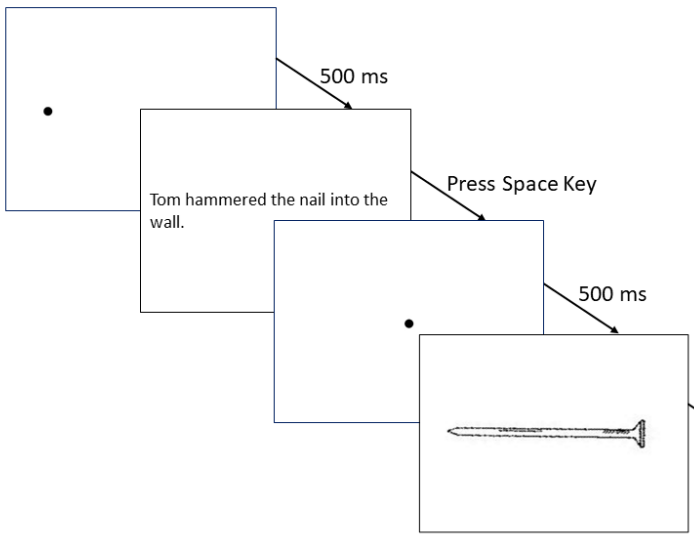
Mental simulation theories of language comprehension propose that people automatically create mental representations of objects mentioned in sentences. Mental representation is often measured with the sentence-picture verification task, wherein participants first read a sentence that implies the object property (i.e., shape and orientation). Participants then respond to an image of an object by indicating whether it was an object from the sentence or not. Previous studies have shown matching advantages for shape, but findings concerning object orientation have not been robust across languages. This registered report investigated the match advantage of object orientation across 18 languages in nearly 4,000 participants. The preregistered analysis revealed no compelling evidence for a match advantage for orientation across languages. Additionally, the match advantage was not predicted by mental rotation scores. In light of these findings, we discuss the implications for current theory and methodology surrounding mental simulation.
View full textStudy at a glance
object shape and orientation"] --> B["Verify pictured object:
from the sentence or not"] B --> C["Test match advantage for orientation
across 18 languages,
nearly 4,000 participants"] C --> D["No compelling evidence for
an orientation match advantage"] C --> E["Match advantage not predicted
by mental rotation scores"] D --> F["Implications for mental simulation
theory and methodology"] E --> F
General project
Stage 1 Registered Report
Data from our lab
Video demonstration of the procedure followed in our lab
The value of conducting a replication study during a PhD.
Related podcasts
Created using NotebookLM, with all the benefits and blind spots of human editing.
Reference
Chen, S.-C., Buchanan, E. M., Kekecs, Z., Miller, J. K., Szabelska, A., Aczel, B., Bernabeu, P., Forscher, P. S., Szuts, A., Vally, D. Z., Al-Hoorie, A. H., Helmy, M., Silva, C. S. A. da, Silva, L. O. da, Moraes, Y. L. de, Hsu, R. M. C. S., Mafra, A. L., Valentova, J. V., Varella, M. A. C., … Chartier, C. R. (2025). Investigating object orientation effects across 18 languages. Current Psychology. https://doi.org/10.1007/s12144-025-08304-x
Related references
’t Hart, B., Struiksma, M., van Boxtel, A., & van Berkum, J. J. A. (2021). Reading About Us and Them: Moral but no Minimal Group Effects on Language-Induced Emotion. Frontiers in Communication, 6. https://doi.org/10.3389/fcomm.2021.590077
Abbondanza, M., Amenta, S., Rinaldi, L., & Marelli, M. (2025). Time is -ending: Sublexical information activates the horizontal mental time line in word processing. Journal of Experimental Psychology: Learning, Memory, and Cognition, 51(1), 119–132. https://doi.org/10.1037/xlm0001331
Abdu, R., Tancredi, S., Abrahamson, D., & Balasubramaniam, R. (2023). Demonstrating mathematics learning as the emergence of eye–hand dynamic equilibrium. Educational Studies in Mathematics, 118(3), 505–528. https://doi.org/10.1007/s10649-023-10279-0
Acuña Luongo, N., & Arriaza Puebla, V. (2024). Modelos de situación espacial y procesamiento de anáforas durante la lectura en estudiantes universitarios con trastorno del espectro autista. Revista Signos. Estudios de Lingüística, 57(115), 379–401. https://doi.org/10.4151/S0718-09342024011501088
Agmon, G., Loewenstein, Y., & Grodzinsky, Y. (2022). Negative sentences exhibit a sustained effect in delayed verification tasks. Journal of Experimental Psychology: Learning, Memory, and Cognition, 48(1), 122–141. https://doi.org/10.1037/xlm0001059
Ahmedien, D. A. M. (2024). A drop of light: an interactive new media art investigation of human-technology symbiosis. Humanities and Social Sciences Communications, 11(1). https://doi.org/10.1057/s41599-024-03206-y
Ahmmad, K., Howlett, E., & Perkins, A. (2023). Into the matrix: collecting psychometric data from consumers immersed in virtual worlds. Journal of Marketing Theory and Practice, 32(3), 378–395. https://doi.org/10.1080/10696679.2023.2202861
Akcakoca, T., Yazgan-Sag, G., & Argun, Z. (2023). An alternative path of embodying geometrical concepts: Student gestures. Pedagogical Research, 8(2), em0152. https://doi.org/10.29333/pr/12786
Al-Azary, H., & Katz, A. N. (2020). Do metaphorical sharks bite? Simulation and abstraction in metaphor processing. Memory & Cognition, 49(3), 557–570. https://doi.org/10.3758/s13421-020-01109-2
Al-Beltagi, M., Saeed, N. K., Bediwy, A. S., Bediwy, E. A., & Elbeltagi, R. (2025). Unraveling functional neurological disorder in pediatric populations: A systematic review of diagnosis, treatment, and outcomes. World Journal of Clinical Pediatrics, 14(3). https://doi.org/10.5409/wjcp.v14.i3.105290
Alallah, F., Sakamoto, Y., & Irani, P. (2020). Exploring the Need and Design for Situated Video Analytics. Symposium on Spatial User Interaction, 1–11. https://doi.org/10.1145/3385959.3418458
Álamos-Gómez, J., & Tejada, J. (2020). Interrelaciones entre acción y cognición. Aportaciones de la neurociencia a la educación rítmico-musical. OPUS, 26(2), 1. https://doi.org/10.20504/OPUS2020B2606
Albuquerque, M., Dara, S., Elangaivendan, P., & Chandrasekharan, S. (2025). Designing a Sequence of Systems to Facilitate the Evolution of Embodied Learning in Teaching Rate of Change and Slope in 7th Grade. Proceedings of the International Conference on Technology 4 Education 2024, Volume 2, 230–237. https://doi.org/10.1007/978-981-95-1734-3_27
Alcaraz‐Valencia, P. A., Santana‐Mancilla, P. C., & Gaytán‐Lugo, L. S. (2025). BattleInTheSky: A Low‐Cost Gamified Expert System for Explainable Artificial Intelligence Education. Computer Applications in Engineering Education, 33(6). https://doi.org/10.1002/cae.70115
Ale, M., Sturdee, M., & Rubegni, E. (2022). A systematic survey on embodied cognition: 11 years of research in child–computer interaction. International Journal of Child-Computer Interaction, 33, 100478. https://doi.org/10.1016/j.ijcci.2022.100478
Alegiani, A., Marraffa, M., & Vistarini, T. (2023). Two open questions in the reformist agenda of the philosophy of cognitive science [JB]. Rivista internazionale di Filosofia e Psicologia, Vol 14, n. 1-2, 59–73. https://doi.org/10.4453/rifp.2023.0005
Alexander, C. (2025). What is 4E cognitive science? Phenomenology and the Cognitive Sciences. https://doi.org/10.1007/s11097-025-10055-w
Alhakamy, A., Trajkova, M., & Cafaro, F. (2021). Show Me How You Interact, I Will Tell You What You Think: Exploring the Effect of the Interaction Style on Users’ Sensemaking about Correlation and Causation in Data. Designing Interactive Systems Conference 2021, 564–575. https://doi.org/10.1145/3461778.3462083
Alhazzaa, K., & Yan, W. (2025). Bridging the gap between theory and practice: AR and VR for building thermal behavior in architectural education. Energy and Buildings, 343, 115940. https://doi.org/10.1016/j.enbuild.2025.115940
Alibali, M. W., & Hostetter, A. B. (2024). Gestures in Cognition: Actions that Bridge the Mind and the World. The Cambridge Handbook of Gesture Studies, 501–524. https://doi.org/10.1017/9781108638869.020
Allen, K. R., Smith, K. A., Bird, L.-A., Tenenbaum, J. B., Makin, T. R., & Cowie, D. (2023). Lifelong learning of cognitive styles for physical problem-solving: The effect of embodied experience. Psychonomic Bulletin & Review, 31(3), 1364–1375. https://doi.org/10.3758/s13423-023-02400-4
Almjally, A., Howland, K., & Good, J. (2020). Investigating children’s spontaneous gestures when programming using TUIs and GUIs. Proceedings of the Interaction Design and Children Conference, 36–48. https://doi.org/10.1145/3392063.3394408
Almjally, A., Howland, K., Good, J., & du Boulay, B. (2023). Investigating primary school children’s embodied expression of programming concepts. International Journal of Child-Computer Interaction, 36, 100574. https://doi.org/10.1016/j.ijcci.2023.100574
Alsharif, A. H., Salleh, N. Z. M., Baharun, R., Hashem E, A. R., Mansor, A. A., Ali, J., & Abbas, A. F. (2021). Neuroimaging techniques in advertising research: Main applications, development, and brain regions and processes. Sustainability, 13(11), 6488. https://doi.org/10.3390/su13116488
Alvarez-Vargas, D., Begolli, K. N., Choc, M., Acevedo-Farag, L. M., Bailey, D. H., Richland, L., & Bustamante, A. (2024). Fraction Ball impact on student and teacher math talk and behavior. Journal of Experimental Child Psychology, 239, 105777. https://doi.org/10.1016/j.jecp.2023.105777
Amara, S., Habacha, H., Khalfallah, S., Al-Hadabi, B., El-Ashkar, H., Nasr, M. H., & Mkaouer, B. (2025). Acute effect of unstable equilibrium on mental rotation task with object-based 3D cube vs. human in collegiate female athletes. Sport Sciences for Health, 21(4), 2751–2762. https://doi.org/10.1007/s11332-025-01478-8
Ambretti, A., Fogliata, A., & Di Palma, D. (2024). Innovation in physical education. Journal of Human Sport and Exercise, 19(3), 915–929. https://doi.org/10.55860/ng96c626
Amico, G., & Schaefer, S. (2021). Implementing Full‐Body Movements in a Verbal Memory Task: Searching for Benefits but Finding Mainly Costs. Mind, Brain, and Education, 15(2), 211–219. https://doi.org/10.1111/mbe.12284
Amico, G., & Schaefer, S. (2021). Negative Effects of Embodiment in a Visuo-Spatial Working Memory Task in Children, Young Adults, and Older Adults. Frontiers in Psychology, 12. https://doi.org/10.3389/fpsyg.2021.688174
Amin, T. G. (2025). Learning Scientific Concepts. https://doi.org/10.4324/9780429505126
Amini, B., Hosini, S. A., Pishyareh, E., & Bakhshi, E. (2025). The Effect of a Structured and Progressive Rhythmiccognitive Dual-task Exercise Program on Impulsivity in Children With ADHD. Basic and Clinical Neuroscience Journal, 15(5), 949–964. https://doi.org/10.32598/bcn.2025.7630.1
Anceresi, G., Gatti, D., Vecchi, T., Marelli, M., & Rinaldi, L. (2024). Visual experience modulates the sensitivity to the distributional history of words in natural language. Psychonomic Bulletin & Review, 32(1), 472–481. https://doi.org/10.3758/s13423-024-02557-6
Anderson, D. I. (2020). Re-Education: What Can Complementary and Alternative Approaches to Movement Education Teach Kinesiology? Kinesiology Review, 9(3), 181–189. https://doi.org/10.1123/KR.2020-0027
Andorno, C. (2023). Evolution is an arc along a timeline. Review of Cognitive Linguistics, 21(1), 9–34. https://doi.org/10.1075/rcl.00125.and
Andrade, V. D., Freire, S., Baptista, M., & Shwartz, Y. (2022). Drawing as a space for social-cognitive interaction. Education Sciences, 12(1), 45. https://doi.org/10.3390/educsci12010045
Anesa, P. (2025). Extended reality in language learning and interpreting: From solutionism to a social constructivist bricolage. Zenodo. https://doi.org/10.5281/zenodo.14524787
Angilletta, S., De Giorgio, A., & Iuliano, E. (2026). Comprender el valor percibido de la psicomotricidad relacional en la Educación Infantil: un estudio de métodos mixtos sobre las perspectivas de padres y docentes. Sportis. Scientific Journal of School Sport, Physical Education and Psychomotricity, 12(2), 1–18. https://doi.org/10.17979/sportis.2026.12.2.12735
Animal models of action control and cognitive dysfunction in Parkinson’s disease. (2022). Cognition in Parkinson’s Disease, 227–255. https://doi.org/10.1016/bs.pbr.2022.01.006
Anna M. Borghi. (2022). Embodied e grounded cognition e oltre: una rivoluzione all’inizio [JB]. Giornale italiano di psicologia, 2, 423–427. https://doi.org/10.1421/105152
Antović, M., Jovanović, V. Ž., & Popović, M. (2024). From spatial perception to referential meaning: convergent image schemas in the music of and texts about Beethoven’s piano sonatas. Frontiers in Psychology, 15. https://doi.org/10.3389/fpsyg.2024.1497557
Anufrieva, A. (2025). Cognitive-digital interaction: the state of the field, weaknesses and solutions. Acta Psychologica, 259, 105229. https://doi.org/10.1016/j.actpsy.2025.105229
Araguas, A., Blanchard, A., Derégnaucourt, S., Chopin, A., & Guellai, B. (2025). Body Knowledge and Emotion Recognition in Preschool Children: A Comparative Study of Human Versus Robot Tutors. Behavioral Sciences, 16(1), 29. https://doi.org/10.3390/bs16010029
Aranda, G., Campbell, C., Ferguson, J., & Speldewinde, C. (2022). Introducing Digital Technologies into Play-Based Learning in Early Childhood. STEM, Robotics, Mobile Apps in Early Childhood and Primary Education, 525–551. https://doi.org/10.1007/978-981-19-0568-1_22
Araneda Hinrichs, N. (2020). (New) Realist Social Cognition. Frontiers in Human Neuroscience, 14. https://doi.org/10.3389/fnhum.2020.00337
Argiris, G., Rumiati, R. I., & Crepaldi, D. (2021). No fruits without color: Cross-modal priming and EEG reveal different roles for different features across semantic categories. PLOS ONE, 16(4), e0234219. https://doi.org/10.1371/journal.pone.0234219
Arjunamahanthi, P., Kottur, H. R., Stanbury, A., Lam, J. F., Cheon, S., Asadizanjani, N., & Kang, H. (2025). Interactive Learning in Microelectronics Education: Comparing PC and Mixed Reality Approaches for Student Engagement and Visual-Spatial Memory. Proceedings of the Extended Abstracts of the CHI Conference on Human Factors in Computing Systems, 1–8. https://doi.org/10.1145/3706599.3721269
Arnold, A. J., & Winkielman, P. (2019). The Mimicry Among Us: Intra- and Inter-Personal Mechanisms of Spontaneous Mimicry. Journal of Nonverbal Behavior, 44(1), 195–212. https://doi.org/10.1007/s10919-019-00324-z
Arora, A. S., & Arora, A. (2020). The Race Between Cognitive and Artificial Intelligence. International Journal of Intelligent Information Technologies, 16(1), 1–16. https://doi.org/10.4018/IJIIT.2020010101
Arora, P., Raman, U., & König, R. (2025). Feminist Futures of Work. Routledge. https://doi.org/10.5117/9789463728386
Artemenko, C., Wortha, S. M., Dresler, T., Frey, M., Barrocas, R., Nuerk, H.-C., & Moeller, K. (2022). Finger-Based Numerical Training Increases Sensorimotor Activation for Arithmetic in Children—An fNIRS Study. Brain Sciences, 12(5), 637. https://doi.org/10.3390/brainsci12050637
Arya, V. (2026). When reality meets intelligence: Integrating ARIx attributes with spatial immersion, self-brand connection, and aesthetic experience to influence retail brand equity. Journal of Retailing and Consumer Services, 90, 104693. https://doi.org/10.1016/j.jretconser.2025.104693
Aryadoust, V. (2019). Measureable Dimensions of Visual Mental Imagery and Their Relationship With Listening Comprehension: Evidence From Forensic Arts and Latent Class Analysis. Imagination, Cognition and Personality, 39(3), 291–319. https://doi.org/10.1177/0276236619829879
Aschenbrenner, L. (2024). Aesthetic Assemblages: Relational Aesthetics of the Israeli Movement Practice Gaga. Material Religion, 20(1), 73–99. https://doi.org/10.1080/17432200.2024.2303899
Aschenbrenner, L. (2025). Studying the Materialization of Power in the Body. Implicit Religion, 26(1), 289–314. https://doi.org/10.1558/imre.25347
Ashok, S., Kim, S. S., Heidkamp, R. A., Munos, M. K., Menon, P., & Avula, R. (2021). Using cognitive interviewing to bridge the intent‐interpretation gap for nutrition coverage survey questions in India. Maternal & Child Nutrition, 18(1). https://doi.org/10.1111/mcn.13248
Au, K. B., & Lo, L. Y. (2018). March for unity: A study on an effect of synchronized actions to perceived closeness. Current Psychology, 39(3), 1012–1019. https://doi.org/10.1007/s12144-018-9820-z
Auriemma, V. (2023). Empathy. Springer International Publishing. https://doi.org/10.1007/978-3-031-38860-6
Auriemma, V. (2024). Emotion, Embodiment and the Virtual World. https://doi.org/10.4324/9781003440185
Autenrieth, D., Autenrieth, N., & Farsani, D. (2026). From metrics to meaning: large language models and the computational turn in embodied educational research. Frontiers in Language Sciences, 5. https://doi.org/10.3389/flang.2026.1753250
Aveni, K., McRae, K., Borovsky, A., Katz, B., & Roberts, A. (2025). Action and event-based lexical-semantic processing in Parkinson’s disease. Language, Cognition and Neuroscience, 41(1), 2–26. https://doi.org/10.1080/23273798.2025.2580970
Awad, S., Debatin, T., & Ziegler, A. (2021). Embodiment: I sat, I felt, I performed – Posture effects on mood and cognitive performance. Acta Psychologica, 218, 103353. https://doi.org/10.1016/j.actpsy.2021.103353
Babik, I. (2022). From hemispheric asymmetry through sensorimotor experiences to cognitive outcomes in children with cerebral palsy. Symmetry, 14(2), 345. https://doi.org/10.3390/sym14020345
Babik, I., Cunha, A. B., & Srinivasan, S. (2023). Biological and environmental factors may affect children’s executive function through motor and sensorimotor development: Preterm birth and cerebral palsy. Infant Behavior and Development, 73, 101881. https://doi.org/10.1016/j.infbeh.2023.101881
Baceviciute, S., Cordoba, A. L., Wismer, P., Jensen, T. V., Klausen, M., & Makransky, G. (2021). Investigating the value of immersive virtual reality tools for organizational training: An applied international study in the biotech industry. Journal of Computer Assisted Learning, 38(2), 470–487. https://doi.org/10.1111/jcal.12630
Badets, A. (2023). The evolutionary roots of goal-directed mechanisms: A communication account. Behavioral and Brain Sciences, 46. https://doi.org/10.1017/S0140525X22000711
Baduni, K., Khan, O. A., Modlesky, C. M., & Maitre, N. L. (2025). Early motor and cognitive development in typically developing children and those with or at high risk of cerebral palsy: A scoping review. Developmental Medicine & Child Neurology, 68(5), 623–635. https://doi.org/10.1111/dmcn.70041
Bae, S. S., Vanukuru, R., Yang, R., Gyory, P., Zhou, R., Do, E. Y.-L., & Szafir, D. A. (2023). Cultivating Visualization Literacy for Children Through Curiosity and Play. IEEE Transactions on Visualization and Computer Graphics, 29(1), 257–267. https://doi.org/10.1109/TVCG.2022.3209442
Bagher, M. M. (2020). Immersive VR and Embodied Learning: The Role of Embodied Affordances in The Long-term Retention of Semantic Knowledge. 2020 IEEE Conference on Virtual Reality and 3D User Interfaces Abstracts and Workshops (VRW), 537–538. https://doi.org/10.1109/VRW50115.2020.00120
Bagher, M. M., Sajjadi, P., Wallgrün, J. O., La Femina, P. C., & Klippel, A. (2021). Move the object or move the user: The role of interaction techniques on embodied learning in VR. Frontiers in Virtual Reality, 2. https://doi.org/10.3389/frvir.2021.695312
Bagossi, S., Swidan, O., & Arzarello, F. (2022). Timeline tool for analyzing the relationship between students-teachers-artifacts interactions and meaning-making. Journal on Mathematics Education, 13(2), 357–382. https://doi.org/10.22342/jme.v13i2.pp357-382
Bai, B., Yang, C., & Fan, J. (2021). Semantic integration of multidimensional perceptual information in L1 sentence comprehension. Language and Cognition, 14(1), 109–130. https://doi.org/10.1017/langcog.2021.24
Bai, Y., & He, W. (2022). Involvement of the sensorimotor system in less advanced L2 processing: Evidence from a semantic category decision task. Frontiers in Psychology, 13. https://doi.org/10.3389/fpsyg.2022.980967
Bailey, R. P., Hoe, T. W., Morrison, G. Z., Ali, A., & Samsudin, N. (2026). Rethinking higher education: embodied learning and pedagogical transformation. Higher Education. https://doi.org/10.1007/s10734-025-01581-2
Balakrishnan, J., Dwivedi, Y. K., Mishra, A., Malik, F. T., & Giannakis, M. (2024). The role of embodiment and ergonomics in immersive VR tours in creating memorable tourism experiences. International Journal of Contemporary Hospitality Management, 36(11), 3794–3822. https://doi.org/10.1108/IJCHM-09-2023-1425
Balasubramaniam, R., Haegens, S., Jazayeri, M., Merchant, H., Sternad, D., & Song, J.-H. (2020). Neural Encoding and Representation of Time for Sensorimotor Control and Learning. The Journal of Neuroscience, 41(5), 866–872. https://doi.org/10.1523/JNEUROSCI.1652-20.2020
Balduin-Philipps, L. S., Weiss, S., Schaller, F., & Müller, H. M. (2021). Abstract Action Language Processing in Eleven-Year-Old Children: Influence of Upper Limb Movement on Sentence Comprehension. Behavioral Sciences, 11(12), 162. https://doi.org/10.3390/bs11120162
Balkenius, C., & Johansson, B. (2022). Almost Alive: Robots and Androids. Frontiers in Human Dynamics, 4. https://doi.org/10.3389/fhumd.2022.703879
Ball, L. J., Butler, L. T., Sherman, S. M., & St Clair-Thompson, H. (2023). Cognitive Psychology in a Changing World. https://doi.org/10.4324/9781003145851
Baltruschat, S., Cándido, A., Maldonado, A., Verdejo-Lucas, C., Catena-Verdejo, E., & Catena, A. (2021). There Is More to Mindfulness Than Emotion Regulation: A Study on Brain Structural Networks. Frontiers in Psychology, 12. https://doi.org/10.3389/fpsyg.2021.659403
Bambini, V., Ranieri, G., Bischetti, L., Scalingi, B., Bertini, C., Ricci, I., Schaeken, W., & Canal, P. (2023). The costs of multimodal metaphors: comparing ERPs to figurative expressions in verbal and verbo-pictorial formats. Discourse Processes, 61(1–2), 44–68. https://doi.org/10.1080/0163853X.2023.2282895
Bampouni, E., Ahmad, A., Xi, N., Legaki, N.-Z., & Hamari, J. (2024). Effects of Immersion and Embodiment on Memory in Virtual Reality. Proceedings of the 27th International Academic Mindtrek Conference, 58–67. https://doi.org/10.1145/3681716.3681724
Banaruee, H., & Khatin-Zadeh, O. (2026). Embodied Language across Cultures. Springer Nature Switzerland. https://doi.org/10.1007/978-3-032-13848-4
Bandara, M., Viduranga, S., Rodrigo, N., & Ranasinghe, M. (2021). Architectures used in Artificial Cognitive Systems for Embodiment. 2021 5th SLAAI International Conference on Artificial Intelligence (SLAAI-ICAI), 1–6. https://doi.org/10.1109/SLAAI-ICAI54477.2021.9664660
Banks, B., & Connell, L. (2022). Multi-dimensional sensorimotor grounding of concrete and abstract categories. Philosophical Transactions of the Royal Society B, 378(1870). https://doi.org/10.1098/rstb.2021.0366
Barahona Esteban, M. N., Fernández Mateos, L. M., Urchaga Litago, J. D., & Sánchez Cabaco, A. (2025). Programa CIP para el desarrollo de las competencias vitales en estudiantes de educación secundaria y universitarios. Cauriensia. Revista Anual de Ciencias Eclesiásticas, 20, 1163–1184. https://doi.org/10.17398/2340-4256.20.1163
Barrios, L., González-Bravo, C., Álvarez-Mon, M., Buján, J., Ortega, M. Á., & de la Torre, B. (2025). The “Stela Effect” of bright and dark narcissism on educational innovation in higher education: exploratory psychometric validation. Discover Psychology, 5(1). https://doi.org/10.1007/s44202-025-00517-2
Barrocas, R., Bahnmueller, J., Roesch, S., Lachmair, M., & Moeller, K. (2023). Design and empirical evaluation of a multitouch interaction game-like app for fostering early embodied math learning. International Journal of Human-Computer Studies, 175, 103030. https://doi.org/10.1016/j.ijhcs.2023.103030
Barsalou, L. W. (2020). Challenges and Opportunities for Grounding Cognition. Journal of Cognition, 3(1). https://doi.org/10.5334/joc.116
Barsalou, L. W. (2023). Implications of grounded cognition for conceptual processing across cultures. Topics in Cognitive Science, 15(4), 648–656. https://doi.org/10.1111/tops.12661
Barton, R., & Barrett, L. (2025). Embodied cognitive evolution and the limits of convergence. Philosophical Transactions of the Royal Society B: Biological Sciences, 380(1929). https://doi.org/10.1098/rstb.2024.0255
Basso, F., & Herrmann-Pillath, C. (2024). Embodiment, Political Economy and Human Flourishing. Springer International Publishing. https://doi.org/10.1007/978-3-031-54971-7
Baths, V., Jartarkar, M., Sood, S., Lewis, A. G., Ostarek, M., & Huettig, F. (2024). Testing the involvement of low-level visual representations during spoken word processing with non-Western students and meditators practicing Sudarshan Kriya Yoga. Brain Research, 1838, 148993. https://doi.org/10.1016/j.brainres.2024.148993
Batori, A. (2026). Posthumanism, Cognition, and Cyborg Spectatorship. https://doi.org/10.4324/9781032641492
Bauer, V., Caslini, G., Mores, M., Gianotti, M., & Garzotto, F. (2026). MusicTraces: Combining music and painting to support adults with neurodevelopmental conditions and intellectual disabilities. International Journal of Human-Computer Studies, 207, 103675. https://doi.org/10.1016/j.ijhcs.2025.103675
Baxter, P., Bekkering, H., Dijkstra, T., Droop, M., van den Hurk, M., & Léoné, F. (2021). Grounding Second Language Vocabulary Instruction in Cognitive Science. Mind, Brain, and Education, 15(1), 24–34. https://doi.org/10.1111/mbe.12278
Bayro, A., Moon, H., Ghasemi, Y., Jeong, H., & Lee, J. Y. (2025). Object Manipulation in Physically Constrained Workplaces: Remote Collaboration with Extended Reality. IISE Transactions on Occupational Ergonomics and Human Factors, 13(3), 177–190. https://doi.org/10.1080/24725838.2025.2484731
Beccaluva, E. A., Riccardi, F., Bettelli, G., Moskwa, L., Di Iorio, M., Di Gioia, F. R., Pasqua, E., Arosio, F., Guasti, M. T., & Garzotto, F. (2022). Grasping the Grammar with Moovy: a Tangible User Interface to Train Linguistic Skills in Children. CHI Conference on Human Factors in Computing Systems Extended Abstracts, 1–7. https://doi.org/10.1145/3491101.3519733
Beccaluva, E., Riccardi, F., Gianotti, M., Barbieri, J., & Garzotto, F. (2022). VIC — A Tangible User Interface to train memory skills in children with Intellectual Disability. International Journal of Child-Computer Interaction, 32, 100376. https://doi.org/10.1016/j.ijcci.2021.100376
Bechtold, L., Cosper, S. H., Malyshevskaya, A., Montefinese, M., Morucci, P., Niccolai, V., Repetto, C., Zappa, A., & Shtyrov, Y. (2023). Brain Signatures of Embodied Semantics and Language: A Consensus Paper. Journal of Cognition, 6(1). https://doi.org/10.5334/JOC.237
Beck, S. D., & Weber, A. (2024). Who said it? Native and non-native listeners’ source memory for object-speaker associations. Frontiers in Language Sciences, 2. https://doi.org/10.3389/flang.2023.1296945
Becker, L., & Rech, E. (2024). Sensorial Customer Experiences in Online Touchpoints. The Impact of Digitalization on Current Marketing Strategies, 19–37. https://doi.org/10.1108/978-1-83753-686-320241002
Beckerle, P. (2022). Human-Robot Body Experience: An Artificial Intelligence Perspective. KI - Künstliche Intelligenz, 36(3–4), 267–270. https://doi.org/10.1007/s13218-022-00779-1
Bédard, P. (2025). The Ultimate Potential of Immersive Media: An Interview with Kent Podcast). States of Immersion Across Media, 498–510. https://doi.org/10.5117/9789048558766_CH25
Beier, J. P., & Rau, M. A. (2022). Embodied Learning with Physical and Virtual Manipulatives in an Intelligent Tutor for Chemistry. Artificial Intelligence in Education, 103–114. https://doi.org/10.1007/978-3-031-11644-5_9
Beier, J. P., Swart, M. I., Pazicni, S., & Nathan, M. J. (2024). Connecting Chemistry Understanding: An Integrated Framework for Concretizing Abstract Visual Representations. Proceedings of the 18th International Conference of the Learning Sciences - ICLS 2024, 242–249. https://doi.org/10.22318/icls2024.905723
Bektaş, K., Thrash, T., van Raai, M. A., Künzler, P., & Hahnloser, R. (2021). The systematic evaluation of an embodied control interface for virtual reality. PLOS ONE, 16(12), e0259977. https://doi.org/10.1371/journal.pone.0259977
Belío-Apaolaza, H. S. (2023). Propuesta metodológica para determinar el núcleo semántico de los gestos emblemáticos. Revista Española de Lingüística Aplicada/Spanish Journal of Applied Linguistics, 37(1), 200–232. https://doi.org/10.1075/resla.21035.bel
Bell, I. H., Pot-Kolder, R., Rizzo, A., Rus-Calafell, M., Cardi, V., Cella, M., Ward, T., Riches, S., Reinoso, M., Thompson, A., Alvarez-Jimenez, M., & Valmaggia, L. (2024). Advances in the use of virtual reality to treat mental health conditions. Nature Reviews Psychology, 3(8), 552–567. https://doi.org/10.1038/s44159-024-00334-9
Bellacicco, R., Capone, F., Sorrentino, C., & Di Martino, V. (2025). The Role of Active Breaks and Curriculum-Based Active Breaks in Enhancing Executive Functions and Math Performance, and in Reducing Math Anxiety in Primary School Children: A Systematic Review. Education Sciences, 15(1), 47. https://doi.org/10.3390/educsci15010047
Bembich, C., & Bologna, V. (2025). Recognising patterns of authentic inquiry-based approach to foster children’s scientific reasoning process. Frontiers in Education, 10. https://doi.org/10.3389/feduc.2025.1574267
Ben-Ami, S., Buaron, B., Yaron, O., Keane, K., Sun, V. H., Phillips, F., Friedman, J., Sinha, P., & Mukamel, R. (2024). What the visual system can learn from the non-dominant hand: The effect of graphomotor engagement on visual discrimination. Memory & Cognition, 53(1), 325–340. https://doi.org/10.3758/s13421-024-01628-2
Berent, I. (2020). The Blind Storyteller. https://doi.org/10.1093/oso/9780190061920.001.0001
Bergmann, L. T., & Wagner, J. (2020). When Push Comes to Shove—The Moral Fiction of Reason-Based Situational Control and the Embodied Nature of Judgment. Frontiers in Psychology, 11. https://doi.org/10.3389/fpsyg.2020.00203
Bergner, Y., Damast, D., Romita, A., & Smock, A. M. R. (2020). Movement Computing Education for Middle Grades. Proceedings of the 7th International Conference on Movement and Computing, 1–5. https://doi.org/10.1145/3401956.3404238
Bergner, Y., Mund, S., Chen, O., & Payne, W. (2020). Leveraging interest-driven embodied practices to build quantitative literacies: A case study using motion and audio capture from dance. Educational Technology Research and Development, 69(4), 2013–2036. https://doi.org/10.1007/s11423-020-09804-2
Berndt, E., Dudschig, C., & Kaup, B. (2018). Green as a cbemcuru: modal as well as amodal color cues can help to solve anagrams. Psychological Research, 84(2), 491–501. https://doi.org/10.1007/s00426-018-1055-y
Bernstein, K. A., van Huisstede, L., Marley, S. C., Gao, Y. (Blanche), Pierce-Rivera, M., Ippolito, E., Restrepo, M. A., Millinger, J., Brantley, K., & Gantwerker, J. (2024). Gesture like a kitten and you won’t forget your tale: Drama-based, embodied story time supports preschoolers’ narrative skills. Early Childhood Research Quarterly, 66, 178–190. https://doi.org/10.1016/j.ecresq.2023.10.004
Betti, S., Muffato, V., Conte, D., Karadeniz, C., Sartori, L., & Meneghetti, C. (2026). Environmental representation in action: gender differences and alignment effects in pointing kinematics. Journal of Environmental Psychology, 111, 103015. https://doi.org/10.1016/j.jenvp.2026.103015
Bettinsoli, M. L., Suitner, C., & Maass, A. (2021). Take a Walk on the Cultural Side: A Journey into Embodied Social Cognition. Handbook of Embodied Psychology, 423–450. https://doi.org/10.1007/978-3-030-78471-3_19
Beudaert, A. (2025). Vers une meilleure compréhension de l’expérience incarnée du handicap : une investigation qualitative auprès de consommateurs atteints de troubles olfactifs. Recherche et Applications En Marketing (French Edition), 40(2), 63–87. https://doi.org/10.1177/07673701251324511
Bhagrath, P. (2025). Creating an Anti-Racist Curriculum for Children with Special Educational Needs. https://doi.org/10.4324/9781003416081
Bianchi, I., Paradis, C., & van de Weijer, J. (2025). Perceptual structure of opposites across sensory modalities. Language and Cognition, 17. https://doi.org/10.1017/langcog.2025.10016
Bidet-Ildei, C., Beauprez, S.-A., & Badets, A. (2020). A review of literature on the link between action observation and action language: advancing a shared semantic theory. New Ideas in Psychology, 58, 100777. https://doi.org/10.1016/j.newideapsych.2019.100777
Bisson, M., Palmieri, S., & Spinò, C. (2026). Designing Meaning Across Cultures a Framework for HCI from an Interdisciplinary Perspective. HCI International 2025 – Late Breaking Papers, 7–20. https://doi.org/10.1007/978-3-032-12773-0_2
Bitu, F., Galinon-Mélénec, B., & Molina, M. (2021). Digital touchscreens as a media for creativity during adolescence. L’Année Psychologique, Vol. 121(4), 489–518. https://doi.org/10.3917/anpsy1.214.0489
Bitzenbauer, P., & Ubben, M. S. (2025). The structure of learners’ perceptions of models (not only) in quantum physics: spotlight on Fidelity of Gestalt and Functional Fidelity. EPJ Quantum Technology, 12(1). https://doi.org/10.1140/epjqt/s40507-025-00316-7
Blinova, E. N., & Shcherbakova, O. V. (2024). Readers’ Comprehension of New Text Formats. Part I. Empirical Evidence from Russian and Research Methodology Behind It. Psikhologicheskii Zhurnal, 45(4), 16–28. https://doi.org/10.31857/S0205959224040026
Bocanegra, B. R., Poletiek, F. H., & Zwaan, R. A. (2022). Language concatenates perceptual features into representations during comprehension. Journal of Memory and Language, 127, 104355. https://doi.org/10.1016/j.jml.2022.104355
Bogosian, B., Wu, Y. C., Nassa, A., Jalali, D., & Yenney, J. (2025). Demo: Balboa Park Alive!: Exploring Biodiversity through Mobile AR. Proceedings of the 23rd Annual International Conference on Mobile Systems, Applications and Services, 641–642. https://doi.org/10.1145/3711875.3734382
Bohlen, L., Shaw, R., Cerritelli, F., & Esteves, J. E. (2021). Osteopathy and Mental Health: An Embodied, Predictive, and Interoceptive Framework. Frontiers in Psychology, 12. https://doi.org/10.3389/fpsyg.2021.767005
Boieblan, M. (2024). Grounded cognition and the role of musical expertise in shaping synesthetic metaphors among a music speech community. International Journal of Language and Culture, 11(2), 180–210. https://doi.org/10.1075/ijolc.00065.boi
Bolens, G. (2021). Kinesic Humor. https://doi.org/10.1093/oso/9780190930066.001.0001
Bolens, G. (2022). Kinesic intelligence, medieval illuminated psalters, and the poetics of the psalms. Studia Neophilologica, 95(2), 257–280. https://doi.org/10.1080/00393274.2022.2051733
Bolock, A. E., Abdennadher, S., & Herbert, C. (2021). An ontology-based framework for psychological monitoring in education during the COVID-19 pandemic. Frontiers in Psychology, 12. https://doi.org/10.3389/fpsyg.2021.673586
Bonini, N., & Dorigoni, A. (2024). Green Nudging: A Behavioral Approach to Environmental Policies. Nudging Green: Behavioral Economics and Environmental Sustainability, 1–21. https://doi.org/10.1007/978-3-031-65972-0_1
Bonnet, C., Bayram, M., El Bouzaïdi Tiali, S., Lebon, F., Harquel, S., Palluel-Germain, R., & Perrone-Bertolotti, M. (2022). Kinesthetic motor-imagery training improves performance on lexical-semantic access. PLOS ONE, 17(6), e0270352. https://doi.org/10.1371/journal.pone.0270352
Bonny, J. W., Hussain, Z., Russell, M. D., Trouvé, A., & Milke, J. A. (2024). Simulated fire video collection for advancing understanding of human behavior in building fires. Frontiers in Psychology, 15. https://doi.org/10.3389/fpsyg.2024.1438020
Boonstra, K., Kool, M., Shvarts, A., & Drijvers, P. (2023). Theories and practical perspectives on fostering embodied abstraction in primary school geometry education. Frontiers in Education, 8. https://doi.org/10.3389/feduc.2023.1162681
Booth, I. (2023). Using Technology to Support My Teaching of Mathematics in a Play-Based Learning Environment. Professional Learning from Classroom-Based Inquiries, 69–83. https://doi.org/10.1007/978-981-99-5099-7_6
Bores-Calle, N. J., Escudero, A., & Bores-García, D. (2020). Teaching approaches to learn theoretical contents in physical education: A study about contour lines. International Journal of Environmental Research and Public Health, 17(22), 8599. https://doi.org/10.3390/ijerph17228599
Borghi, A. M. (2020). A future of words: Language and the challenge of abstract concepts. Journal of Cognition, 3(1). https://doi.org/10.5334/joc.134
Borghi, A. M., & Barsalou, L. (2019). Perspective in the conceptualization of categories. Psychological Research, 85(2), 697–719. https://doi.org/10.1007/s00426-019-01269-0
Borghi, A. M., De Livio, C., Gervasi, A. M., Mannella, F., Nolfi, S., & Tummolini, L. (2024). Language as a cognitive and social tool at the time of large language models. Journal of Cultural Cognitive Science, 8(3), 179–198. https://doi.org/10.1007/s41809-024-00152-8
Borghi, A. M., Shaki, S., & Fischer, M. H. (2022). Abstract concepts: external influences, internal constraints, and methodological issues. Psychological Research, 86(8), 2370–2388. https://doi.org/10.1007/s00426-022-01698-4
Borkent, M. (2023). Comics and Cognition. https://doi.org/10.1093/oso/9780197509784.001.0001
Borowiecki, O. (2025). Embodied pixels: A neuroscientific framework for cognitive research using games. Avant, 16(2). https://doi.org/10.26913/ava22503
Bortolotti, A., & Carpi, L. (2025). Playing Outdoors Amidst Objects to Foster Experiences and Attribute Meanings in Italy. Risk and Outdoor Play, 219–233. https://doi.org/10.1007/978-981-96-5455-0_13
Boutyline, A., & Soter, L. K. (2021). Cultural Schemas: What They Are, How to Find Them, and What to Do Once You’ve Caught One. American Sociological Review, 86(4), 728–758. https://doi.org/10.1177/00031224211024525
Braddock, L. (2022). ‘What it is like to be me’: from paranoia and projection to sympathy and self-knowledge. Philosophical Explorations, 26(2), 254–275. https://doi.org/10.1080/13869795.2022.2146160
Brake, J. (2026). A grounded and contextual view of social cognition in autism. Disability & Society, 1–6. https://doi.org/10.1080/09687599.2026.2634353
Brännström, K. J., Rudner, M., Carlie, J., Sahlén, B., Gulz, A., Andersson, K., & Johansson, R. (2021). Listening effort and fatigue in native and non-native primary school children. Journal of Experimental Child Psychology, 210, 105203. https://doi.org/10.1016/j.jecp.2021.105203
Bredikhin, D., Agranovich, O., Ulanov, M., Koriakina, M., Shestakova, A. N., Kadieva, D., Kopytin, G., Ermolovich, E., Bermúdez-Margaretto, B., Shtyrov, Y., Jääskeläinen, I. P., & Blagovechtchenski, E. (2023). Altered evoked responses for motor-related words in children with upper limb motor impairments. Clinical Neurophysiology, 145, 11–21. https://doi.org/10.1016/j.clinph.2022.10.010
Bremmer, M. (2020). Where’s the body? Reconsidering the concept of pedagogical content knowledge through research in music education with Dutch specialist preschool music teachers. British Journal of Music Education, 38(2), 119–130. https://doi.org/10.1017/S0265051720000285
Brezack, N., Pan, S., Chandler, J., & Woodward, A. L. (2023). Toddlers’ action learning and memory from active and observed instructions. Journal of Experimental Child Psychology, 232, 105670. https://doi.org/10.1016/j.jecp.2023.105670
Brich, I. R., Bause, I. M., Hesse, F. W., & Wesslein, A.-K. (2021). How spatial information structuring in an interactive technological environment affects decision performance under working memory load. Computers in Human Behavior, 123, 106860. https://doi.org/10.1016/j.chb.2021.106860
Briedis, M., & Navarro, M. (2024). CONCEPTUAL PROBLEMS WITH DISEMBODIED COGNITION IN LEARNING ENVIRONMENT(S) AND THE ALTERNATIVE OF EMBODIED CREATIVITY. Creativity Studies, 17(1), 244–253. https://doi.org/10.3846/cs.2024.20755
Britt, N., Román-Caballero, R., Lee, F., Raghuraman, S., & Sun, H. (2026). Hemispheric asymmetry for visual information processing in 3D space. Neuroscience & Biobehavioral Reviews, 181, 106504. https://doi.org/10.1016/j.neubiorev.2025.106504
Brock, K. L., & Hung, P.-F. (2020). The effects of digital symbol format on the naming, identification, and sentence production incorporating verbs for individuals with aphasia. Aphasiology, 35(5), 681–703. https://doi.org/10.1080/02687038.2020.1734528
Brouillet, T., Michalland, A.-H., Martin, S., & Brouillet, D. (2021). When the Action to Be Performed at the Stage of Retrieval Enacts Memory of Action Verbs. Experimental Psychology, 68(1), 18–31. https://doi.org/10.1027/1618-3169/a000507
Brown, A. J., Macpherson, M. C., & Miles, L. K. (2026). Subclinical Variation in Mental Health Shapes the Dynamics of Everyday Behaviour. Quarterly Journal of Experimental Psychology. https://doi.org/10.1177/17470218261424186
Brown, D. G., Bauer, J., Wittbrodt, L., & Mulder, S. (2024). A Cognitive Approach to Improving Binary Reverse Engineering with Immersive Virtual Reality. 2024 IEEE Working Conference on Software Visualization (VISSOFT), 116–121. https://doi.org/10.1109/VISSOFT64034.2024.00023
Brown, G. C. (2025). Why things look the way they do: we live in a Cartesian grid of reified concepts. Frontiers in Psychology, 16. https://doi.org/10.3389/fpsyg.2025.1612191
Brown, H. D., & Lee, H. (2025). Principles of Language Learning and Teaching. https://doi.org/10.4324/9781003494294
Bruera, A., Tao, Y., Anderson, A., Çokal, D., Haber, J., & Poesio, M. (2023). Modeling brain representations of words’ concreteness in context using GPT‐2 and human ratings. Cognitive Science, 47(12). https://doi.org/10.1111/cogs.13388
Bruner, E. (2023). Cognitive Archeology and the Attentional System: An Evolutionary Mismatch for the Genus Homo. Journal of Intelligence, 11(9), 183. https://doi.org/10.3390/jintelligence11090183
Bruner, E. (2024). Cognitive archaeology, and the psychological assessment of extinct minds. Journal of Comparative Neurology, 532(1). https://doi.org/10.1002/cne.25583
Bruner, E. (2025). Cognitive archeology, technological evolution, and the current agenda for extended cognition. Cognitive Neuroscience, 1–3. https://doi.org/10.1080/17588928.2025.2585993
Bruner, E., Silva-Gago, M., Fedato, A., Martín-Loeches, M., & Colom, R. (2023). Psychometrics, visuospatial abilities, and cognitive archaeology. Cognitive Archaeology, Body Cognition, and the Evolution of Visuospatial Perception, 279–304. https://doi.org/10.1016/B978-0-323-99193-3.00005-2
Brunyé, T. T., Booth, K., Hendel, D., Kerr, K. F., Shucard, H., Weaver, D. L., & Elmore, J. G. (2023). Machine learning classification of diagnostic accuracy in pathologists interpreting breast biopsies. Journal of the American Medical Informatics Association, 31(3), 552–562. https://doi.org/10.1093/jamia/ocad232
Brunyé, T. T., Okano, K., McIntyre, J., Sandone, M. K., Townsend, L. N., Lee, M. M., Smith, M., & Hughes, G. I. (2025). Inferring Mental States via Linear and Non-Linear Body Movement Dynamics: A Pilot Study. Sensors, 25(22), 6990. https://doi.org/10.3390/s25226990
Bryant, G. A., & Dale, R. (2024). Language, Communication, and Social Cognition. The Oxford Handbook of Social Cognition, Second Edition, 884–900. https://doi.org/10.1093/oxfordhb/9780197763414.013.32
Buchanan, E. M., Valentine, K. D., & Wilkowsky, A. (2022). An extension of the QWERTY effect: Not just the right hand, expertise and typeability predict valence ratings of words. Psychology of Language and Communication, 26(1), 85–101. https://doi.org/10.2478/plc-2022-0005
Buchholz, F., Uzun, Y., Riedlinger, U., Nilsson, T., & Oppermann, L. (2026). The global classroom: vision-driven XR across the time-space matrix. I-Com. https://doi.org/10.1515/icom-2026-0012
Buchner, E. L., Lenhard, W., & Richter, T. (2025). Comprehending dynamic directions: the role of perceptual simulations. Journal of Cognitive Psychology, 37(8), 807–823. https://doi.org/10.1080/20445911.2025.2546865
Buchner, E. L., Richter, T., & Lenhard, W. (2026). The Processing of Color Words in Sentence Comprehension. Quarterly Journal of Experimental Psychology. https://doi.org/10.1177/17470218261428130
Budde, K., & Weigelt, M. (2023). No effects of different perturbations on the performance in a mental body-rotation task (MBRT) with egocentric perspective transformations and object-based transformations. Human Movement Science, 92, 103156. https://doi.org/10.1016/j.humov.2023.103156
Budde, K., Jöllenbeck, T., Barela, J. A., Figueiredo, G. A., & Weigelt, M. (2021). Mental body rotation with egocentric and object-based transformations in different postures: standing vs. balancing. Brazilian Journal of Motor Behavior, 15(3), 180–194. https://doi.org/10.20338/bjmb.v15i3.250
Budelmann, F., & Sluiter, I. (Eds.). (2023). Minds on Stage. Oxford University PressOxford. https://doi.org/10.1093/oso/9780192888938.001.0001
Bühler, D. (2021). Universal, Intuitive, and Permanent Pictograms. Springer Fachmedien Wiesbaden. https://doi.org/10.1007/978-3-658-32310-3
Bülbül, M. Ş., & Aslan, M. (2026). Innovative approaches to periodic table instruction for students with visual impairments. Journal of Chemical Education, 103(3), 1206–1213. https://doi.org/10.1021/acs.jchemed.5c00018
Bursjöö, I. (2022). Multimodality in the teaching of biology: Nordic Studies in Science Education, 18(2), 243–253. https://doi.org/10.5617/nordina.8740
Buttazzoni, A., Ellard, C., Sadiora, S., & Minaker, L. (2022). Toward conceptualizing “place immersion” as a spatial neuropsychosocial phenomenon: A multidisciplinary meta-review and -synthesis. Journal of Environmental Psychology, 81, 101810. https://doi.org/10.1016/j.jenvp.2022.101810
Byrne, E. M., Jensen, H., Thomsen, B. S., & Ramchandani, P. G. (2023). Educational interventions involving physical manipulatives for improving children’s learning and development: A scoping review. Review of Education, 11(2). https://doi.org/10.1002/rev3.3400
Caballero, R., & Paradis, C. (2023). Sharing perceptual experiences through language. Journal of Intelligence, 11(7), 129. https://doi.org/10.3390/jintelligence11070129
Cafaro, F., Brady, E., Chandra, S., Patil, U., & Saxena, A. (2021). E Pluribus Unum: Using Conceptual Metaphor Theory to Explore and Support Mixed-Ability Workplaces. Proceedings of the ACM on Human-Computer Interaction, 5(CSCW2), 1–31. https://doi.org/10.1145/3479528
Cai, S., Hu, Y., He, J., & Li, K. (2025). The impact of embodied cognition on place attachment and supportive behavior toward historic buildings in heritage sites: exploring the moderating role of resident identity climate. Frontiers in Psychology, 16. https://doi.org/10.3389/fpsyg.2025.1702052
Cai, Z., Qi, B., & Fan, N. (2025). The action-sentence compatibility effect in third person action sentence comprehension. Frontiers in Psychology, 16. https://doi.org/10.3389/fpsyg.2025.1562351
Caldwell, M. P., Cheung, H., Cheung, S.-K., Li, J.-B., & Carrey Siu, T.-S. (2022). Visuospatial perspective-taking in social-emotional development: enhancing young children’s mind and emotion understanding via block building training. BMC Psychology, 10(1). https://doi.org/10.1186/s40359-022-00976-5
Camcı, H., & Büyükbayraktar, Z. Ç. (2025). Embodied cognition and the placebo effect: Implications for temporomandibular disorder therapy. AJO-DO Clinical Companion, 5(1), 1–5. https://doi.org/10.1016/j.xaor.2024.12.002
Canales, M., Castilla-Rho, J., Rojas, R., Vicuña, S., & Ball, J. (2024). Agent-based models of groundwater systems: A review of an emerging approach to simulate the interactions between groundwater and society. Environmental Modelling & Software, 175, 105980. https://doi.org/10.1016/j.envsoft.2024.105980
Cancer, A., Maietti, A., Caldana, M., & Repetto, C. (2026). First-person perspective gesture observation in virtual reality: A novel approach for anomia rehabilitation in post-stroke aphasia. Neuropsychologia, 226, 109432. https://doi.org/10.1016/j.neuropsychologia.2026.109432
Canessa, E., Chaigneau, S. E., & Moreno, S. (2021). Language processing differences between blind and sighted individuals and the abstract versus concrete concept difference. Cognitive Science, 45(10). https://doi.org/10.1111/cogs.13044
Cao, H., & Li, G. (2026). The Influence of Varying Degrees of Enactability on the Enactment Effect in Action Memory During the Encoding and Retrieval Stages: A Study with Healthy Young Adults. Behavioral Sciences, 16(3), 438. https://doi.org/10.3390/bs16030438
Cao, S., Wang, Y., Wang, H., Chen, H., Zhang, G., & Kritikos, A. (2020). A Facilitatory Effect of Perceptual Incongruity on Target-Source Matching in Pictorial Metaphors of Chinese Advertising: EEG Evidence. Advances in Cognitive Psychology, 16(1), 1–12. https://doi.org/10.5709/acp-0279-Z
Cao, X., Wang, L., Yang, X., & Liu, Y. (2024). How Do Urban Nature Parks Contribute to Psychological Restoration? The Perspective of Embodied Experience. Leisure Sciences, 1–21. https://doi.org/10.1080/01490400.2024.2370529
Capio, C. M., Mendoza, N. B., Jones, R. A., Masters, R. S. W., & Lee, K. (2024). The contributions of motor skill proficiency to cognitive and social development in early childhood. Scientific Reports, 14(1). https://doi.org/10.1038/s41598-024-79538-1
Capouskova, K., Kringelbach, M. L., & Deco, G. (2022). Modes of cognition: Evidence from metastable brain dynamics. NeuroImage, 260, 119489. https://doi.org/10.1016/j.neuroimage.2022.119489
Capuano, F., Claus, B., & Kaup, B. (2022). The experiential basis of compatibility effects in reading-by-rotating paradigms. Psychological Research, 87(1), 124–136. https://doi.org/10.1007/s00426-022-01663-1
Caputa, W., Krawczyk-Sokołowska, I., Paździor, A., & Sozanskyy, L. (2025). Digital thinking as a navigator of the progressive digitalization process in an enterprise. Technological Forecasting and Social Change, 210, 123862. https://doi.org/10.1016/j.techfore.2024.123862
Carey, M. D., Rugins, O., & Grainger, P. R. (2023). Investigating the effects of varying Accelerative Integrated Method instruction on spoken recall accuracy: a case study with junior primary learners of French. International Review of Applied Linguistics in Language Teaching, 62(4), 2065–2085. https://doi.org/10.1515/iral-2023-0001
Carota, F., Nili, H., Kriegeskorte, N., & Pulvermüller, F. (2023). Experientially-grounded and distributional semantic vectors uncover dissociable representations of conceptual categories. Language, Cognition and Neuroscience, 39(8), 1020–1044. https://doi.org/10.1080/23273798.2023.2232481
Carpio, R., Birt, J., & Baumann, O. (2023). Using case study analysis to develop heuristics to guide new filmmaking techniques in embodied virtual reality films. Creative Industries Journal, 18(1), 3–24. https://doi.org/10.1080/17510694.2023.2171336
Carter, G., Keller, F., & Hoffman, P. (2025). Leveraging context for perceptual prediction using word embeddings. Cognitive Science, 49(6). https://doi.org/10.1111/cogs.70072
Carter, J. A., & Rupert, R. D. (2020). Epistemic value in the subpersonal vale. Synthese, 198(10), 9243–9272. https://doi.org/10.1007/s11229-020-02631-1
Cash, P., & Maier, A. (2021). Understanding representation: Contrasting gesture and sketching in design through dual-process theory. Design Studies, 73, 100992. https://doi.org/10.1016/j.destud.2021.100992
Castaño, E., & Carrol, G. (2020). Mental simulation in the processing of literal and metaphorical motion language: An eye movement study. Metaphor and Symbol, 35(3), 153–170. https://doi.org/10.1080/10926488.2020.1794318
Castro-Alonso, J. C., Ayres, P., Zhang, S., de Koning, B. B., & Paas, F. (2024). Research avenues supporting embodied cognition in learning and instruction. Educational Psychology Review, 36(1). https://doi.org/10.1007/s10648-024-09847-4
Cayol, Z., & Nazir, T. A. (2020). Why Language Processing Recruits Modality Specific Brain Regions: It Is Not About Understanding Words, but About Modelling Situations. Journal of Cognition, 3(1). https://doi.org/10.5334/joc.124
Cayol, Z., Rotival, C., Paulignan, Y., & Nazir, T. A. (2020). “Embodied” language processing: Mental motor imagery aptitude predicts word-definition skill for high but not for low imageable words in adolescents. Brain and Cognition, 145, 105628. https://doi.org/10.1016/j.bandc.2020.105628
Cayoun, B. A., & Grabovac, A. D. (2025). Mindfulness‐integrated CBT for Well‐Being and Personal Growth. https://doi.org/10.1002/9781394215645
Cecutti, L., & Lee, S. W. S. (2023). Physical firmness increases structural alignment. Scientific Reports, 13(1). https://doi.org/10.1038/s41598-023-27933-5
Čepič, A. V. (2023). Conversations about Reading with Older Adults: Self-Knowledge and Empowerment. Storytelling, Self, Society, 19(1), 91–116. https://doi.org/10.1353/sss.2023.a947878
Cerda-Vega, E., Irarrázabal-Guerra, C., Sabja-Sepúlveda, L. S.-S., Guajardo-Sandoval, N., Roa-Chiarleoni, N., Morales-Sánchez, V., Reigal, R. E., & Pérez Romero, N. (2024). Effects of aerobic, strength, and combined exercise on cognitive functions in older adults: a systematic review. Retos, 60, 1341–1355. https://doi.org/10.47197/retos.v60.107701
Cervera Torres, S., Ruiz Fernández, S., Lachmair, M., & Gerjets, P. (2018). Coding valence in touchscreen interactions: hand dominance and lateral movement influence valence appraisals of emotional pictures. Psychological Research, 84(1), 23–31. https://doi.org/10.1007/s00426-018-0971-1
Chaker, R. (2023). Studying ergonomic gestures on interactive learning tabletop and tablets from a situated approach: a pilot taxonomic table and a case study. Journal of Computers in Education. https://doi.org/10.1007/s40692-023-00306-7
Chan, J. Y.-C., Closser, A. H., Smith, H., Lee, J.-E., Drzewiecki, K. C., & Ottmar, E. (2023). Grasping Patterns of Algebraic Understanding: Dynamic Technology Facilitates Learning, Research, and Teaching in Mathematics Education. Mathematical Teaching and Learning, 207–225. https://doi.org/10.1007/978-3-031-31848-1_12
Chandler, S. (2020). Sentence-level constructions: A demonstration in support of Ambridge (2020). First Language, 40(5–6), 569–572. https://doi.org/10.1177/0142723720905764
Chang, C. (2023). Examining the effectiveness of public service announcements in encouraging pro-health behaviors: self-referent mental simulation and empowerment as mediators. International Journal of Advertising, 43(2), 336–360. https://doi.org/10.1080/02650487.2023.2197777
Chang, Y., Chen, X., Sang, T., & Gao, Z. (2025). SWEAR: A Multimodal Dataset and Embodied Emotion Simulation System for Understanding Hyperhidrosis through Interactive Wearable Jewellery. Proceedings of the SIGGRAPH Asia 2025 Posters, 1–3. https://doi.org/10.1145/3757374.3771442
Charras, K., Mabire, J.-B., Bouaziz, N., Deschamps, P., Froget, B., de Malherbe, A., Rosa, S., & Aquino, J.-P. (2020). Dance intervention for people with dementia: Lessons learned from a small-sample crossover explorative study. The Arts in Psychotherapy, 70, 101676. https://doi.org/10.1016/j.aip.2020.101676
Chatain, J., Gashaj, V., Muttappillil, B., Sumner, R. W., & Kapur, M. (2024). Designing for Embodied Sense-making of Mathematics: Perspectives on Directed and Spontaneous Bodily Actions. Designing Interactive Systems Conference, 3318–3335. https://doi.org/10.1145/3643834.3661571
Chatzipanteli, A., & Gorozidis, G. S. (2024). Developing Young Children’s Physical Literacy Through Picturebooks. Early Childhood Education Journal, 52(7), 1681–1692. https://doi.org/10.1007/s10643-024-01652-6
Checa, D., & Bustillo, A. (2023). Virtual Reality for Learning. Virtual Reality in Behavioral Neuroscience: New Insights and Methods, 289–307. https://doi.org/10.1007/7854_2022_404
Chen, B., Zheng, W., Zhao, L., & Ding, X. (2025). Leveraging large language models to assist philosophical counseling: prospective techniques, value, and challenges. Humanities and Social Sciences Communications, 12(1). https://doi.org/10.1057/s41599-025-04657-7
Chen, D., Su, J., & Wang, R. (2024). Differences in perceptual representations in multilinguals’ first, second, and third language. Frontiers in Human Neuroscience, 18. https://doi.org/10.3389/fnhum.2024.1408411
Chen, D., Wang, R., Zhang, J., & Liu, C. (2019). Perceptual representations in L1, L2 and L3 comprehension: Delayed sentence–picture verification. Journal of Psycholinguistic Research, 49(1), 41–57. https://doi.org/10.1007/s10936-019-09670-x
Chen, J., Ban, Y., Pan, W., & Liao, Z. (2024). Optimal design of informal green spaces in cold-region settlements: an embodied cognition perspective. Journal of Asian Architecture and Building Engineering, 24(4), 2398–2410. https://doi.org/10.1080/13467581.2024.2373820
Chen, L. K., Daughrity, L., Sakowicz, M., Hamidi, F., Godwin, K., & Lipsmeyer, L. L. (2025). ABii at School: Findings from a Long-Term In-School Field Study with a Commercial Robot-Assisted Learning System. Education and Information Technologies, 31(5), 1481–1516. https://doi.org/10.1007/s10639-025-13865-2
Chen, L., van Ede, F., Jungerius, C., & Slagter, H. A. (2026). Grounding distractor inhibition in action control: Implicit distractor-location learning is viewer dependent. Cognition, 271, 106480. https://doi.org/10.1016/j.cognition.2026.106480
Chen, M. (2022). Small Leans into Big Steps: A Mixed-Reality Environment to Support Embodied, Ensembled Mathematics Learning. Interaction Design and Children, 564–568. https://doi.org/10.1145/3501712.3535294
Chen, M., Chai, C.-S., Jong, M. S.-Y., & Chao, G. C.-N. (2021). Modeling learners’ self-concept in Chinese descriptive writing based on the affordances of a virtual reality-supported environment. Education and Information Technologies, 26(5), 6013–6032. https://doi.org/10.1007/s10639-021-10582-4
Chen, M., Chai, C.-S., Jong, M. S.-Y., & Jiang, M. Y.-C. (2021). Teachers’ Conceptions of Teaching Chinese Descriptive Composition With Interactive Spherical Video-Based Virtual Reality. Frontiers in Psychology, 12. https://doi.org/10.3389/fpsyg.2021.591708
Chen, N., Sarkaar, A., Whang, J., Wonderly, J., Ye, J., & Gracanin, D. (2020). Design of a Mixed Reality Based System for Multimedia Content Presentation. 2020 IEEE Conference on Virtual Reality and 3D User Interfaces Abstracts and Workshops (VRW), 433–438. https://doi.org/10.1109/VRW50115.2020.00092
Chen, P., Chau, H., & Schroeder, S. R. (2026). People leniently interpret sentences from second-language accented and language disordered speakers: a replication and extension. Language, Cognition and Neuroscience, 41(3), 337–346. https://doi.org/10.1080/23273798.2026.2618581
Chen, S.-C., Buchanan, E. M., Kekecs, Z., Miller, J. K., Szabelska, A., Aczel, B., Bernabeu, P., Forscher, P., Szuts, A., Vally, Z., Al-Hoorie, A. H., Helmy, M., da Silva, C. S. A., da Silva, L. O., de Moraes, Y. L., Hsu, R. M. C. S., Mafra, A. L., Valentova, J. V., Varella, M. A. C., … Chartier, C. R. (2025). Investigating object orientation effects across 18 languages. Current Psychology, 44(24), 19148–19174. https://doi.org/10.1007/s12144-025-08304-x
Chen, S.-C., de Koning, B. B., & Zwaan, R. A. (2020). Does Object Size Matter With Regard to the Mental Simulation of Object Orientation? Experimental Psychology, 67(1), 56–72. https://doi.org/10.1027/1618-3169/a000468
Chen, S.-J., Chen, C.-Q., & Shan, X.-F. (2024). The Effects of an Immersive Virtual-Reality-Based 3D Modeling Approach on the Creativity and Problem-Solving Tendency of Elementary School Students. Sustainability, 16(10), 4092. https://doi.org/10.3390/su16104092
Chen, S., Liu, Y., Wang, Z. A., Colonell, J., Liu, L. D., Hou, H., Tien, N.-W., Wang, T., Harris, T., Druckmann, S., Li, N., & Svoboda, K. (2024). Brain-wide neural activity underlying memory-guided movement. Cell, 187(3), 676-691.e16. https://doi.org/10.1016/j.cell.2023.12.035
Chen, X., & Azraai, N. Z. B. (2025). Animating Embodied Memories: An Inquiry into Medium-Specificity of Animation in Greatness Code Chen, X., Liu, W., Ma, Y., & Sun, Z. (2024). How pupils of different ages perceive menus denoting metaphorical and metonymic expressions: Insights from eye-tracking. Acta Psychologica, 249, 104443. https://doi.org/10.1016/j.actpsy.2024.104443
Chen, Y., & Deng, Z. (2024). Research on the Elements of Tourist Experience Demands in Archaeological Site Parks Based on Grounded Theory. Design Studies and Intelligence Engineering. https://doi.org/10.3233/FAIA231517
Chen, Z. (2022). Collaboration among recruiters and artificial intelligence: removing human prejudices in employment. Cognition, Technology & Work, 25(1), 135–149. https://doi.org/10.1007/s10111-022-00716-0
Chen, Z., Liang, Q., Wei, Z., Chen, X., Shi, Q., Yu, Z., & Sun, T. (2023). An Overview of In Vitro Biological Neural Networks for Robot Intelligence. Cyborg and Bionic Systems, 4. https://doi.org/10.34133/cbsystems.0001
Chen, Z., Sun, T., Wei, Z., Chen, X., Shimoda, S., Fukuda, T., Huang, Q., & Shi, Q. (2022). A real-time neuro-robot system for robot state control. 2022 IEEE International Conference on Real-Time Computing and Robotics (RCAR), 124–129. https://doi.org/10.1109/RCAR54675.2022.9872184
Cheng, M., Han, D., Haq, M., & Ossmy, O. (2026). Physical cognition in altered gravity: Link between sensorimotor and cognitive adaptability. IScience, 29(2), 114343. https://doi.org/10.1016/j.isci.2025.114343
Cheng, M., Qiao, P., Ni, H., Xie, H., Mayer, R. E., & Wang, F. (2026). Adding pedagogical agents who point or trace to children’s instructional videos. Computers & Education, 249, 105618. https://doi.org/10.1016/j.compedu.2026.105618
Cherniak, C. (2020). Extending the bounded rationality framework. Routledge Handbook of Bounded Rationality, 391–397. https://doi.org/10.4324/9781315658353-27
Chesluk, B., & Youngblood, M. (2024). Systems, Complexity, and Human Experience in Design Anthropology. The Routledge Companion to Practicing Anthropology and Design, 8–20. https://doi.org/10.4324/9781003340188-3
Chettaoui, N., Atia, A., & Bouhlel, M. S. (2020). Exploring the Impact of Multimodal Adaptive Learning with Tangible Interaction on Learning Motivation. 2020 15th International Conference on Computer Engineering and Systems (ICCES), 1–6. https://doi.org/10.1109/ICCES51560.2020.9334588
Chettaoui, N., Atia, A., & Bouhlel, M. S. (2021). Exploring the impact of interaction modality on students’ learning performance. Journal of Educational Computing Research, 60(1), 4–27. https://doi.org/10.1177/07356331211027297
Chettaoui, N., Atia, A., & Bouhlel, M. S. (2022). Embodied learning via tangible user interfaces: the impact of physical interaction on learning performance. International Journal of Technology Enhanced Learning, 14(2), 180. https://doi.org/10.1504/IJTEL.2022.121820
Chettaoui, N., Atia, A., & Bouhlel, M. S. (2022). Predicting Students Performance Using Eye-Gaze Features in an Embodied Learning Environment. 2022 IEEE Global Engineering Education Conference (EDUCON), 704–711. https://doi.org/10.1109/EDUCON52537.2022.9766783
Chettaoui, N., Atia, A., & Bouhlel, Med. S. (2022). Examining the effects of embodied interaction modalities on students’ retention skills in a real classroom context. Journal of Computers in Education, 9(4), 549–569. https://doi.org/10.1007/s40692-021-00213-9
Chettaoui, N., Atia, A., Bouhlel, M. S., Elmohaiman, D. A., & Ahmed, S. (2022). Usability of Montessori tangible user interfaces to support learners’ retention skills in preschools. Personal and Ubiquitous Computing, 27(2), 481–494. https://doi.org/10.1007/s00779-022-01706-9
Chiarenza, G. A., & Bosch-Bayard, J. (2025). Utilizing movement-related potentials to monitor cognitive rehabilitation in individuals with central nervous system disorders: A review. International Journal of Psychophysiology, 208, 112485. https://doi.org/10.1016/j.ijpsycho.2024.112485
Chistova, E. V. (2021). Non-verbal Semiotics in Dance Narrative and Simultaneous Interpreting: Cognitive Intersections. Language, Music and Gesture: Informational Crossroads, 125–138. https://doi.org/10.1007/978-981-16-3742-1_10
Chkhaidze, T., & Surmanidze, L. (2019). Culture and Individual Action: Rebuilding the Broken Dialog Between Anthropology and Psychology. Human Arenas, 3(3), 421–434. https://doi.org/10.1007/s42087-019-00091-9
Cho, D., Zhong, S., Vasudevan, M. K., & Obrist, M. (2025). Mindful touch: Mid-air haptics facilitates novices’ subjective experiences of audio-guided mindfulness meditation. International Journal of Human-Computer Studies, 201, 103528. https://doi.org/10.1016/j.ijhcs.2025.103528
Cho, M., Ko, E., & Jung, H. (2024). Virtual reality luxury fashion show: how imaginary space influences brand word‑of‑mouth. International Journal of Advertising, 44(7), 1175–1194. https://doi.org/10.1080/02650487.2024.2419227
Chojnacka, M. A. (2020). Sartre and Merleau-Ponty’s Theories of Perception as Cognition in the Context of Phenomenological Thought in Cognitive Sciences. Diametros, 1–17. https://doi.org/10.33392/diam.1197
Chrabaszcz, A., Laurinavichyute, A., Ladinskaya, N., Baladzhaeva, L., Prior, A., Myachykov, A., & Dragoy, O. (2024). Writing direction influences the spatial representations of past- and future-tense forms: Evidence from eye tracking. Memory & Cognition, 53(4), 1079–1094. https://doi.org/10.3758/s13421-024-01633-5
Chrysti, K. S., Rokhmaniyah, & Chamdani, M. (2020). Enhancement of Artifact Based Activities Learning in Natural Science Through Scientific Reading Based Project (SRBP) Model for Preservice Teacher Using Design Based Research (DBR). Proceedings of the 4th International Conference on Learning Innovation and Quality Education, 1–5. https://doi.org/10.1145/3452144.3452210
Chua, Y. W., Lu, S., Anzulewicz, A., Sobota, K., Tachtatzis, C., Andonovic, I., Rowe, P., & Delafield‐Butt, J. (2021). Developmental differences in the prospective organisation of goal‐directed movement between children with autism and typically developing children: A smart tablet serious game study. Developmental Science, 25(3). https://doi.org/10.1111/desc.13195
Chuderski, A., Jastrzębski, J., & Kucwaj, H. (2020). How physical interaction with insight problems affects solution rates, hint use, and cognitive load. British Journal of Psychology, 112(1), 120–143. https://doi.org/10.1111/bjop.12442
Chun, D. M., Karimi, H., & Sañosa, D. J. (2022). Traveling by Headset. CALICO Journal, 39(2), 129–149. https://doi.org/10.1558/cj.21306
Church, R. B., Perry, M., Singer, M. A., Cook, S. W., & Alibali, M. W. (2024). Teachers’ gestures and how they matter. Topics in Cognitive Science, 17(3), 545–568. https://doi.org/10.1111/tops.12755
Chwilla, D. J. (2022). Context effects in language comprehension: The role of emotional state and attention on semantic and syntactic processing. Frontiers in Human Neuroscience, 16. https://doi.org/10.3389/fnhum.2022.1014547
Cienki, A. (2023). Speakers’ gestures and semantic analysis. Cognitive Semantics, 9(2), 167–191. https://doi.org/10.1163/23526416-bja10051
Cimier, A., Biancardi, B., Guegan, J., Segonds, F., Mantelet, F., Jean, C., Gazo, C., & Buisine, S. (2025). Multisensory objects’ role on creativity. Journal of Creativity, 35(1), 100092. https://doi.org/10.1016/j.yjoc.2024.100092
Clark, H. H., & Fischer, K. (2022). Social robots as depictions of social agents. Behavioral and Brain Sciences, 46. https://doi.org/10.1017/S0140525X22000668
Clark, K. M. (2024). Embodied Imagination: Lakoff and Johnson’s Experientialist View of Conceptual Understanding. Review of General Psychology, 28(2), 166–183. https://doi.org/10.1177/10892680231224400
Clement, J. J. (2022). Multiple Levels of Heuristic Reasoning Processes in Scientific Model Construction. Frontiers in Psychology, 13. https://doi.org/10.3389/fpsyg.2022.750713
Closser, A. H., Erickson, J. A., Smith, H., Varatharaj, A., & Botelho, A. F. (2022). Blending learning analytics and embodied design to model students’ comprehension of measurement using their actions, speech, and gestures. International Journal of Child-Computer Interaction, 32, 100391. https://doi.org/10.1016/j.ijcci.2021.100391
Coad, J., Harding, S., Hambly, H., Parker, N., Morgan, L., Marshall, J., & Roulstone, S. (2020). Perspectives of preschool children in England with speech and language needs in the development of evidence‐based activities. Child: Care, Health and Development, 46(3), 283–293. https://doi.org/10.1111/cch.12746
Cognition Philosophy Logic and Design Evaluation of Intelligent Interaction. (2023). Journal of Mechanical Engineering, 59(11), 31. https://doi.org/10.3901/JME.2023.11.031
Cohn, N., & Schilperoord, J. (2022). Reimagining Language. Cognitive Science, 46(7). https://doi.org/10.1111/cogs.13174
Colas, J. T., O’Doherty, J. P., & Grafton, S. T. (2024). Active reinforcement learning versus action bias and hysteresis: control with a mixture of experts and nonexperts. PLOS Computational Biology, 20(3), e1011950. https://doi.org/10.1371/journal.pcbi.1011950
Collaro, E., Barton, R. A., Ainge, J. A., & Easton, A. (2024). Measuring episodic memory and mental time travel: crossing the species gap. Philosophical Transactions of the Royal Society B: Biological Sciences, 379(1913). https://doi.org/10.1098/rstb.2023.0406
Colling, L. J., Szűcs, D., De Marco, D., Cipora, K., Ulrich, R., Nuerk, H.-C., Soltanlou, M., Bryce, D., Chen, S.-C., Schroeder, P. A., Henare, D. T., Chrystall, C. K., Corballis, P. M., Ansari, D., Goffin, C., Sokolowski, H. M., Hancock, P. J. B., Millen, A. E., Langton, S. R. H., … McShane, B. B. (2020). Registered Replication Report on Fischer, Castel, Dodd, and Pratt (2003). Advances in Methods and Practices in Psychological Science, 3(2), 143–162. https://doi.org/10.1177/2515245920903079
Colston, H. L., & Gibbs, R. W. (2021). Figurative language communicates directly because it precisely demonstrates what we mean. Canadian Journal of Experimental Psychology / Revue Canadienne de Psychologie Expérimentale, 75(2), 228–233. https://doi.org/10.1037/cep0000254
Colston, H. L., & Rasse, C. (2021). Embodiment Across Englishes: The Comprehension of Metaphors in Popular Song Lyrics in Canadian, Austrian, and American English. Metaphor in Language and Culture across World Englishes. https://doi.org/10.5040/9781350157569.ch-007
Colucci-Gray, L., Hancock, J., Manches, A., Mozier, S., Lakeman-Fraser, P., Newman, J., Islam, R., Sharma, N., Dodd, M., Ansine, J., Bowers, L., Rüger, S., & Siddharthan, A. (2025). ‘ To touch is to know’’’ : haptic inquiry for primary school citizen science.’ International Journal of Science Education, Part B, 15(3), 360–376. https://doi.org/10.1080/21548455.2025.2496428
Colzato, L. S., & Hommel, B. (2020). The Future of Cognitive Training. Cognitive Training, 397–410. https://doi.org/10.1007/978-3-030-39292-5_27
Comer, C., & Taggart, A. (2021). Brain, Mind, and the Narrative Imagination. https://doi.org/10.5040/9781350127838
Cona, G., Casagrande, A., Lenzoni, S., Pegoraro, E., Bozzoni, V., Bello, L., Sorarù, G., Botta, A., & Semenza, C. (2019). The Role of Motor System in Mental Rotation: New Insights from Myotonic Dystrophy Type 1. Journal of the International Neuropsychological Society, 26(5), 492–502. https://doi.org/10.1017/S1355617719001383
Conde, S., Elor, A., Mateas, M., & Kurniawan, S. (2023). Acculturative game design with Latine communities: a bridging review on acculturative stress, behavior change, and serious games. Frontiers in Education, 8. https://doi.org/10.3389/feduc.2023.1231907
Congdon, E. L., & Goldin-Meadow, S. (2021). Mechanisms of Embodied Learning Through Gestures and Actions: Lessons from Development. Handbook of Embodied Psychology, 527–546. https://doi.org/10.1007/978-3-030-78471-3_23
Conley, Q., Atkinson, R. K., Nguyen, F., & Nelson, B. C. (2020). MantarayAR: Leveraging augmented reality to teach probability and sampling. Computers & Education, 153, 103895. https://doi.org/10.1016/j.compedu.2020.103895
Conrad, D., & Libarkin, J. C. (2021). Using Conceptual Metaphor Theory within the Model of Educational Reconstruction to identify students’ alternative conceptions and improve instruction: A plate tectonics example. Journal of Geoscience Education, 70(2), 262–277. https://doi.org/10.1080/10899995.2021.1983941
Contreras Kallens, P., & Christiansen, M. H. (2024). Distributional Semantics: Meaning Through Culture and Interaction. Topics in Cognitive Science, 17(3), 739–769. https://doi.org/10.1111/tops.12771
Cook, M. L., Sheffield, S. L., Ryan, J. G., Bebeau, C. M., & Rodgers, M. (2025). Enhancing geoscience education through immersive virtual field trips: Student perspectives and implications for broadening participation. Journal of Geoscience Education, 73(4), 352–369. https://doi.org/10.1080/10899995.2025.2537995
Cooper, A. B., & Tisdell, E. J. (2020). Embodied aspects of learning to be a surgeon. Medical Teacher, 42(5), 515–522. https://doi.org/10.1080/0142159X.2019.1708289
Coppola, S., D’Anna, C., Minghelli, V., & Vastola, R. (2024). Ecological dynamics approach in physical education to promote cognitive skills development. Journal of Human Sport and Exercise, 19(3), 792–802. https://doi.org/10.55860/k7ynwe36
Coppola, S., Matrisciano, C., Minghelli, V., Pallonetto, L., & D’Anna, C. (2025). The Impact of an Ecological Dynamics-Based Physical Education Program on Creative Thinking in Primary School Children. Education Sciences, 15(12), 1591. https://doi.org/10.3390/educsci15121591
Corbett, G., & Moerman, S. (Eds.). (2024). Music and Spirituality. https://doi.org/10.11647/OBP.0403
Corcoran, A. W., Perrykkad, K., Feuerriegel, D., & Robinson, J. E. (2023). Body as first teacher: The role of rhythmic visceral dynamics in early cognitive development. Perspectives on Psychological Science, 20(1), 45–75. https://doi.org/10.1177/17456916231185343
Corrigan, M. W., Wong, J. T., Grove, D., Andersen, S., & Hughes, B. S. (2025). Enhancing elementary students conceptual understandings of scientific phenomena: The impact of STEAM‐First and STEM‐First approaches. Science Education, 109(5), 1336–1364. https://doi.org/10.1002/sce.21942
Cortes, D. H., Gregg, A., Lee, M., Pauley, L. L., & Osunbunmi, I. (2024). WIP: By Students, for Students: Development of Custom Virtual Reality Applications for Teaching and Learning in Engineering Courses. 2024 IEEE Frontiers in Education Conference (FIE), 1–4. https://doi.org/10.1109/FIE61694.2024.10893592
Cosentino, G. (2021). Exploring Multi-Sensory Interaction to Enhance Children’ Learning Experience. Interaction Design and Children, 644–647. https://doi.org/10.1145/3459990.3463397
Cosentino, G., Lee-Cultura, S., Papavlasopoulou, S., & Giannakos, M. (2023). Designing Multi Sensory Environments for Children’s Learning: An Analysis of Teachers’ and Researchers’ Perspectives. Proceedings of the 22nd Annual ACM Interaction Design and Children Conference, 388–396. https://doi.org/10.1145/3585088.3589368
Cosentino, G., Morra, D., Gelsomini, M., Matera, M., & Mores, M. (2021). COBO: A Card-Based Toolkit for Co-Designing Smart Outdoor Experiences with People with Intellectual Disability. Human-Computer Interaction – INTERACT 2021, 149–169. https://doi.org/10.1007/978-3-030-85623-6_11
Ćoso, B., & Bogunović, I. (2021). An Experimental Approach to Negations. Fluminensia, 33(2), 359–385. https://doi.org/10.31820/F.33.2.11
Costello, M. C., & Aho, K. A. (2025). The paradoxical nature of older adult embodiment. Topoi, 44(4), 1145–1157. https://doi.org/10.1007/s11245-025-10175-7
Costello, M. C., MacCormack, J. K., Paek, E. J., Jalloh, U., & Borghi, A. M. (2025). Evidence of Embodiment-based changes in older Adult Language. Psychological Research, 89(5). https://doi.org/10.1007/s00426-025-02173-6
Coucke, N., Heinrich, M. K., Cleeremans, A., & Dorigo, M. (2023). Learning from humans to build social cognition among robots. Frontiers in Robotics and AI, 10. https://doi.org/10.3389/frobt.2023.1030416
Courson, M., & Tremblay, P. (2020). Neural correlates of manual action language: Comparative review, ALE meta-analysis and ROI meta-analysis. Neuroscience & Biobehavioral Reviews, 116, 221–238. https://doi.org/10.1016/j.neubiorev.2020.06.025
Cox, A. M., Benson Marshall, M., Burnham, J. A. J., Care, L., Herrick, T., & Jones, M. (2020). Mapping the campus learning landscape. Pedagogy, Culture & Society, 30(2), 149–167. https://doi.org/10.1080/14681366.2020.1788124
Craighero, L., Granziol, U., & Sartori, L. (2023). Digital Intentions in the Fingers: I Know What You Are Doing with Your Smartphone. Brain Sciences, 13(10), 1418. https://doi.org/10.3390/brainsci13101418
Craighero, L., Straulino, E., Liso, A., Viviani, L., Conte, D., Morelli, A., Bocchi, L., & Sartori, L. (2026). The embodied digital divide: how sensorimotor experience shapes touchscreen typing performance and strategy. Experimental Brain Research, 244(3). https://doi.org/10.1007/s00221-025-07220-7
Craik, F. I. M. (2021). Remembering. https://doi.org/10.1093/oso/9780192895226.001.0001
Crandall, R., & Karadoğan, E. (2021). Designing pedagogically effective haptic systems for learning: A review. Applied Sciences, 11(14), 6245. https://doi.org/10.3390/app11146245
Crivelli, D., Allegretta, R. A., & Balconi, M. (2023). The “status quo bias” in Response to External Feedback in Decision-Makers. Adaptive Human Behavior and Physiology, 9(4), 426–441. https://doi.org/10.1007/s40750-023-00230-1
Crockett, M. J., & Messeri, L. (2026). AI Surrogates and illusions of generalizability in cognitive science. Trends in Cognitive Sciences, 30(3), 203–215. https://doi.org/10.1016/j.tics.2025.09.012
Croijmans, I., Pellegrino, R., & Janice Wang, Q. (2024). Demystifying wine expertise through the lens of imagination: Descriptions and imagery vividness across sensory modalities. Food Research International, 182, 114159. https://doi.org/10.1016/j.foodres.2024.114159
Crollen, V., Noël, M.-P., Honoré, N., Degroote, V., & Collignon, O. (2020). Investigating the respective contribution of sensory modalities and spatial disposition in numerical training. Journal of Experimental Child Psychology, 190, 104729. https://doi.org/10.1016/j.jecp.2019.104729
Cruz-Aguilar, M. A., Guevara, M. A., Hernández-González, M., Rovirosa-Hernández, M. de J., García-Orduña, F., & Gómez-Méndez, A. Z. (2025). Lateralized motor control in spider monkeys ( Ateles geoffroyi ): Evidence from visual-spatial working memory tasks. Laterality, 30(2–6), 107–135. https://doi.org/10.1080/1357650X.2025.2573521
Cummine, J., Cullum, A., Aalto, D., Sereda, T., Fleming, C., Reed, A., Ostevik, A., Cashion-Dextrase, S., Jeffery, C. C., & Hodgetts, W. E. (2021). From lollipops to lidocaine: The need for a universal print-to-speech framework. Canadian Journal of Experimental Psychology / Revue Canadienne de Psychologie Expérimentale, 75(3), 279–298. https://doi.org/10.1037/cep0000257
Cummine, J., Huynh, T. K. T., Cullum, A., Ostevik, A., & Hodgetts, W. (2021). Chew on this! Oral stereognosis predicts visual word recognition in typical adults. Current Psychology, 42(4), 3305–3318. https://doi.org/10.1007/s12144-021-01647-1
Cummings, J. J., Tsay-Vogel, M., Cahill, T. J., & Zhang, L. (2021). Effects of immersive storytelling on affective, cognitive, and associative empathy: The mediating role of presence. New Media & Society, 24(9), 2003–2026. https://doi.org/10.1177/1461444820986816
Cummins, F. (2020). On vain repetitions: The enactment of collective subjectivities through speaking in unison. Mediation and Immediacy, 165–178. https://doi.org/10.1515/9783110690347-012
Cunningham, A. C., Hall, J., Owen, M. J., & van den Bree, M. B. M. (2019). Coordination difficulties, IQ and psychopathology in children with high-risk copy number variants. Psychological Medicine, 51(2), 290–299. https://doi.org/10.1017/S0033291719003210
Cunningham, A. J., Baikousi, V., Eyre, E., Duncan, M., Crotti, M., Martins, R., & Wood, C. (2025). A movement and story-telling intervention improves language and fundamental movement skills and is feasible for delivery by teachers in the first year of school. Learning and Instruction, 97, 102110. https://doi.org/10.1016/j.learninstruc.2025.102110
Cunningham, I., Kittel, A., Mascarenhas, D., MacMahon, C., & Larkin, P. (2025). Decision Making for Sports Officials. https://doi.org/10.4324/9781032615943
Curlee, B., Newman, T., Sarkar, K., & Bahamón, J. C. (2021). Conceptualizing Embodied Pedagogical Mediation (EPM): The Plávana Project, A Choreographer’s Toolkit. Extended Abstracts of the 2021 Annual Symposium on Computer-Human Interaction in Play, 37–42. https://doi.org/10.1145/3450337.3483474
Curtis, J., Oxburgh, G., & Briggs, P. (2021). Heroes and Hooligans: The Heterogeneity of Video Game Modders. Games and Culture, 17(2), 219–243. https://doi.org/10.1177/15554120211026255
D’Aniello, A., Martinez Levy, A. C., Amatulli, C., De Angelis, M., & Pozharliev, R. (2025). Aesthetics and Sustainable Luxury Consumption. In Palgrave Advances in Luxury. Springer Nature Switzerland. https://doi.org/10.1007/978-3-031-96833-4
D’Anna, C., Basadonne, I., Aquino, G., Minghelli, V., & Limone, P. (2025). Relationships between motor skills and academic achievement: An exploratory study on Italian primary school children. Education Sciences, 15(2), 124. https://doi.org/10.3390/educsci15020124
Dale, R., & Contreras Kallens, P. A. (2022). Dissipation, integration and practical pluralism. Multidisciplinary Perspectives on Representational Pluralism in Human Cognition, 250–269. https://doi.org/10.4324/9781003189930-17
Dalléry, R., Fraisse, N., Cléret de Langavant, L., Youssov, K., Morgado, G., Massart, R., Schubert, R., Reilmann, R., Jacquemot, C., Bapst, B., Busse, M., Craufurd, D., Rosser, A., Lunven, M., & Bachoud-Lévi, A.-C. (2024). The joint memory effect: challenging the selfish stigma in Huntington’s disease? Brain Communications, 7(1). https://doi.org/10.1093/braincomms/fcae440
Dandarova-Robert, Z., Cocco, C., Dessart, G., & Brandt, P.-Y. (2023). Where Gods Dwell? Part II: Embodied Cognition Approach and Children’s Drawings of Gods. When Children Draw Gods, 171–187. https://doi.org/10.1007/978-3-030-94429-2_7
Danish, J. A., Enyedy, N., Saleh, A., & Humburg, M. (2020). Learning in embodied activity framework: a sociocultural framework for embodied cognition. International Journal of Computer-Supported Collaborative Learning, 15(1), 49–87. https://doi.org/10.1007/s11412-020-09317-3
Danışman, M., Demirdel, E., Zengin İspir, G., Katar, K. S., & Soylu, Ç. (2025). Embodied Cognition in Substance Use Disorder: Evaluation of Implicit Muscle Activity in Forearms with Surface Electromyography. Addicta: The Turkish Journal on Addictions, 12(2), 197–204. https://doi.org/10.5152/ADDICTA.2025.24136
Daprati, E., & Nico, D. (2025). Action representations and associated disorders. Encyclopedia of the Human Brain, 476–485. https://doi.org/10.1016/B978-0-12-820480-1.00083-8
Daprati, E., Balestrucci, P., & Nico, D. (2022). Do graspable objects always leave a motor signature? A study on memory traces. Experimental Brain Research, 240(12), 3193–3206. https://doi.org/10.1007/s00221-022-06487-4
Daprati, E., Marrocco, G., & Nico, D. (2025). ‘Some like it cold’. On the association between the physical and affective notion of warmth. Quarterly Journal of Experimental Psychology, 78(11), 2419–2440. https://doi.org/10.1177/17470218251329230
Darejeh, A., Mondal, M., Marcus, N., & Vassar, A. (2024). Exploring the Cognitive Load Effects of Diverse Virtual Reality Interaction Methods in Interactive Educational Platforms. 2024 IEEE International Symposium on Mixed and Augmented Reality Adjunct (ISMAR-Adjunct), 435–438. https://doi.org/10.1109/ISMAR-Adjunct64951.2024.00127
Daruwala, N. A. (2025). How multimodal narrative and visual representations of human-like service robots shape attitudes and social connection. Frontiers in Robotics and AI, 12. https://doi.org/10.3389/frobt.2025.1568146
Daughrity, L., Walkington, C., & Sherard, M. (2025). From Abstract to Tangible: Leveraging Virtual Reality for Playful Math Education. Education Sciences, 15(9), 1108. https://doi.org/10.3390/educsci15091108
David, K. P., Hao, A. J., Madrid, V. R., & Pabico, J. (2025). OHMNI: Hand-Tracked XR Circuit Prototyping with Integrated SPICE Simulation. SIGGRAPH Asia 2025 XR, 1–3. https://doi.org/10.1145/3761667.3761952
Davidson, R., & Randhawa, G. (2022). The Sign 4 Big Feelings Intervention to Improve Early Years Outcomes in Preschool Children: Outcome Evaluation. JMIR Pediatrics and Parenting, 5(2), e25086. https://doi.org/10.2196/25086
Davis, C. P., & Yee, E. (2021). Building semantic memory from embodied and distributional language experience. WIREs Cognitive Science, 12(5). https://doi.org/10.1002/wcs.1555
Davis, K., Kutsch, E., Turner, N., & Lynch, Z. (2026). From tragedy to training: Multi-dimensional leadership learning through the K2 mountain simulation. The International Journal of Management Education, 24(1), 101324. https://doi.org/10.1016/j.ijme.2025.101324
de Koning, B., Zhang, S., & Sepp, S. (2025). Integrating Human Movement in Learning: Advancements in Language Instruction, Multimedia, and Theory. Educational Psychology Review, 37(2). https://doi.org/10.1007/s10648-025-10027-1
de Melo, E. A., de Souza, A. F., Nicácio, I. L. de O., Camara, C. A., do Nascimento Júnior, E. S., de Azevedo, G. D., de Paiva Cavalcanti, J. R. L., Duque Neto, S. P., Costa, R. R. de O., & Lucena, E. E. de S. (2026). Evaluation of virtual reality versus plastinated specimens in musculoskeletal anatomy education for second year medical students. Scientific Reports, 16(1). https://doi.org/10.1038/s41598-025-34832-4
de Ruiter, J. P. (2023). Co-Speech Gesture. Language Production, 257–283. https://doi.org/10.4324/9781003145790-11
de Ruyter, K., Heller, J., Hilken, T., Chylinski, M., Keeling, D. I., & Mahr, D. (2020). Seeing with the Customer’s Eye: Exploring the Challenges and Opportunities of AR Advertising. Journal of Advertising, 49(2), 109–124. https://doi.org/10.1080/00913367.2020.1740123
de Varda, A. G., Petilli, M., & Marelli, M. (2025). A distributional model of concepts grounded in the spatial organization of objects. Journal of Memory and Language, 142, 104624. https://doi.org/10.1016/j.jml.2025.104624
de Vega, M. (2021). Revisitando la corporeidad del lenguaje narrativo. Revista Signos, 54(107), 985–1003. https://doi.org/10.4067/S0718-09342021000300985
de Vega, M., Dutriaux, L., Moreno, I. Z., García-Marco, E., Seigneuric, A., & Gyselinck, V. (2021). Crossing hands behind your back reduces recall of manual action sentences and alters brain dynamics. Cortex, 140, 51–65. https://doi.org/10.1016/j.cortex.2021.03.016
de Vries, E., Schwartz, N., & Galilée, M. (2024). Learning Magnitudes of Energy Consumption with Symbolic or Iconic Representations. Diagrammatic Representation and Inference, 335–349. https://doi.org/10.1007/978-3-031-71291-3_27
de Zubicaray, G. I., Arciuli, J., Guenther, F. H., McMahon, K. L., & Kearney, E. (2023). Non-arbitrary mappings between size and sound of English words: Form typicality effects during lexical access and memory. Quarterly Journal of Experimental Psychology, 77(5), 943–963. https://doi.org/10.1177/17470218231184940
de Zubicaray, G. I., McMahon, K. L., & Arciuli, J. (2021). A sound explanation for motor cortex engagement during action word comprehension. Journal of Cognitive Neuroscience, 33(1), 129–145. https://doi.org/10.1162/jocn_a_01640
Decker-Woodrow, L. E., Mason, C. A., Lee, J.-E., Chan, J. Y.-C., Sales, A., Liu, A., & Tu, S. (2023). The impacts of three educational technologies on algebraic understanding in the context of COVID-19. AERA Open, 9. https://doi.org/10.1177/23328584231165919
Delfin, A. B., & Wang, W. (2023). The influence of pretend ‘technologies’ on children’s cognitive development in symbolic play. International Journal of Play, 12(3), 387–402. https://doi.org/10.1080/21594937.2023.2235474
Delliponti, A. D. (2022). Motor Simulation and Ostensive-Inferential Communication. Avant, 13(1). https://doi.org/10.26913/AVA202204
Deng, W., Liu, D., & Fan, G. (2025). The impact of power posing on presentation performance and self-efficacy in higher education: An embodied cognition approach. Innovations in Education and Teaching International, 63(2), 384–401. https://doi.org/10.1080/14703297.2025.2452393
Deng, Y., Zhang, Y., Zhang, J., & Huang, S. (2025). The efficacy of mindful movement for improving cognitive functioning among children and adolescents: a systematic review and meta-analysis. Developmental Review, 78, 101229. https://doi.org/10.1016/j.dr.2025.101229
Dennis, J. L., & Margola, D. (2021). Priming the self as an agent influences causal, spatial, and temporal events: implications for animacy, cultural differences, and clinical settings. Psychological Research, 86(3), 711–722. https://doi.org/10.1007/s00426-021-01521-6
Derbali, C. (2026). Pedagogías creativas centradas en el estudiante en la educación física: una revisión sistemática y un metanálisis de resultados multidimensionales. Sportis. Scientific Journal of School Sport, Physical Education and Psychomotricity, 12(2), 1–37. https://doi.org/10.17979/sportis.2026.12.2.12602
Destéfano, M. (2021). Las representaciones conceptuales en la ciencia cognitiva. Quaderns de Filosofia, 8(1), 11–35. https://doi.org/10.7203/qfia.8.1.15786
DeStefano, P. R., Perez-Franco, R., Siebert, C., & Widenhorn, R. (2020). Pulling for better understanding of Newton’s laws. European Journal of Physics, 41(6), 065006. https://doi.org/10.1088/1361-6404/aba224
Dewaele, J.-M. (2022). 58 Research into multilingualism and emotions. Handbücher Zur Sprach- Und Kommunikationswissenschaft / Handbooks of Linguistics and Communication Science [HSK] 46/2, 1217–1237. https://doi.org/10.1515/9783110670851-026
Dhatterwal, J. S., Kaswan, K. S., & Batra, R. (2024). Nature Inspired Robotics. https://doi.org/10.1201/9781032624358
Di Nuovo, A. (2020). A Developmental Neuro-Robotics Approach for Boosting the Recognition of Handwritten Digits. 2020 International Joint Conference on Neural Networks (IJCNN), 1–8. https://doi.org/10.1109/IJCNN48605.2020.9206857
Di Plinio, S., Perrucci, M. G., Ferrara, G., Sergi, M. R., Tommasi, M., Martino, M., Saggino, A., & Ebisch, S. J. (2025). Intrinsic brain mapping of cognitive abilities: A multiple-dataset study on intelligence and its components. NeuroImage, 309, 121094. https://doi.org/10.1016/j.neuroimage.2025.121094
Di, X., & Zheng, X. (2026). How field independence/dependence and immersion tendency affect spatial ability training in VR environments: An empirical study. Education and Information Technologies. https://doi.org/10.1007/s10639-026-13935-z
Dijkstra, T., & Peeters, D. (2023). The New Psychology of Language. https://doi.org/10.4324/9781003326274
Dillmann, J., den Hartigh, R. J. R., Kurpiers, C. M., Pelzer, J., Raisch, F. K., Cox, R. F. A., & de Waard, D. (2021). Keeping the driver in the loop through semi-automated or manual lane changes in conditionally automated driving. Accident Analysis & Prevention, 162, 106397. https://doi.org/10.1016/j.aap.2021.106397
Dillmann, J., Den Hartigh, R. J. R., Kurpiers, C. M., Raisch, F. K., Kadrileev, N., Cox, R. F. A., & De Waard, D. (2023). Repeated conditionally automated driving on the road: How do drivers leave the loop over time? Accident Analysis & Prevention, 181, 106927. https://doi.org/10.1016/j.aap.2022.106927
Ding, N., Chen, W., Zhang, Z., Hu, S., Cui, G., Yao, Y., Qin, Y., Zeng, Z., Han, X., Liu, Z., Lin, Y., & Sun, M. (2023). Ten Key Problems of Pre-trained Models: An Outlook of Representation Learning. Representation Learning for Natural Language Processing, 491–521. https://doi.org/10.1007/978-981-99-1600-9_14
Ding, X., Wang, X., Yang, Z., Tang, R., & Tang, Y.-Y. (2020). Relationship Between Trait Mindfulness and Sleep Quality in College Students: A Conditional Process Model. Frontiers in Psychology, 11. https://doi.org/10.3389/fpsyg.2020.576319
Dip, J. A., & Silenzi, M. I. (2024). Empirical application of sentiment analysis and emotions in Spanish: A post-cognitivist approach. Training, Language and Culture, 8(2), 52–65. https://doi.org/10.22363/2521-442X-2024-8-2-52-65
Döbler, N. A., & Carbon, C.-C. (2024). Inferring their minds and analysing our beliefs: on the contribution of (exo)psychology to the search for extraterrestrial intelligence. International Journal of Astrobiology, 23. https://doi.org/10.1017/S1473550424000156
Doedens, W. J., & Meteyard, L. (2022). What is Functional Communication? A Theoretical Framework for Real-World Communication Applied to Aphasia Rehabilitation. Neuropsychology Review, 32(4), 937–973. https://doi.org/10.1007/s11065-021-09531-2
Dohn, N. B., & Dohn, N. B. (2024). Design Principles for Disciplinary Learning Designs with Unplugged Computational Thinking as Pedagogical Means. Proceedings of the 18th International Conference of the Learning Sciences - ICLS 2024, 2115–2116. https://doi.org/10.22318/icls2024.309157
Dolatabadi, M. (2023). Predicting English word concreteness through its multidimensional perceptual and action strength norms. Australian Journal of Applied Linguistics, 6(3), 176–187. https://doi.org/10.29140/ajal.v6n3.1003
Dolese, M. J. (2026). Art as a meaningful environment: an integrative model of aesthetic engagement and interpretation. Frontiers in Psychology, 16. https://doi.org/10.3389/fpsyg.2025.1677529
Döllinger, N., Wienrich, C., & Latoschik, M. E. (2021). Challenges and opportunities of immersive technologies for mindfulness meditation: A systematic review. Frontiers in Virtual Reality, 2. https://doi.org/10.3389/frvir.2021.644683
Döllinger, N., Wolf, E., Botsch, M., Latoschik, M. E., & Wienrich, C. (2023). Are Embodied Avatars Harmful to our Self-Experience? The Impact of Virtual Embodiment on Body Awareness. Proceedings of the 2023 CHI Conference on Human Factors in Computing Systems, 1–14. https://doi.org/10.1145/3544548.3580918
Domhoff, G. W. (2023). The relationship between dreaming and autonoetic consciousness: The neurocognitive theory of dreaming gains in explanatory power by drawing upon the multistate hierarchical model of consciousness. Dreaming, 33(1), 1–18. https://doi.org/10.1037/drm0000233
Dong, J., Li, D., Ozcan, K., Wan, D., Jiang, W., & Chen, Y. (2022). Development of CryoVR, a virtual reality training system for hands-on cryoEM operations. Acta Crystallographica Section D Structural Biology, 78(7), 903–910. https://doi.org/10.1107/S2059798322005654
Dong, J., Yu, S., Choi, K., & Jeon, M. (2025). A child-robot theater afterschool program can promote children’s conceptualization of social robots’ mental capacities and engagement in learning. Frontiers in Robotics and AI, 12. https://doi.org/10.3389/frobt.2025.1529421
Dong, R., Yin, L., Zheng, K., & Chen, K. (2026). Executive Function and Writing Performance Among Primary School Students With Writing Difficulties: The Mediating Role of Visual-Motor Integration. Journal of Learning Disabilities. https://doi.org/10.1177/00222194261417608
Dou, J., & Xue, W. (2025). Perceptual (dis)similarities between colors and emotions: An empirical investigation with the image-based visual corpus analysis approach. Acta Psychologica, 259, 105447. https://doi.org/10.1016/j.actpsy.2025.105447
Dou, J., He, T., & Chen, T. (2025). Embodied grounding of abstract concepts: an image-based comparative analysis of sensorimotor and emotional experiences in Chinese. Cognitive Processing. https://doi.org/10.1007/s10339-025-01310-8
Dou, J., Liu, M., & Chen, T. (2023). Embodiment of color metaphor: an image-based visual analysis of the Chinese color terms hēi ‘black’ and bái ‘white.’ Language and Cognition, 15(3), 574–600. https://doi.org/10.1017/langcog.2023.22
Douglas, E. P., Goetz, N., Therriault, D. J., & Berry, M. B. (2020). Characterization of Problem Types in a Statics Textbook. 2020 IEEE Frontiers in Education Conference (FIE), 1–4. https://doi.org/10.1109/FIE44824.2020.9273925
Doumanis, I., & Economou, D. (2024). Enhanced Retention of Historical Information with Empathetic Pedagogical Conversational Agents (PCAs). Digital Transformation in Higher Education. Empowering Teachers and Students for Tomorrow’s Challenges, 63–79. https://doi.org/10.1007/978-3-031-73990-3_6
Dove, G. (2023). Concepts require flexible grounding. Brain and Language, 245, 105322. https://doi.org/10.1016/j.bandl.2023.105322
Drogemuller, A., Cunningham, A., Walsh, J. A., Baumeister, J., Smith, R. T., & Thomas, B. H. (2021). Haptic and Visual Comprehension of a 2D Graph Layout Through Physicalisation. Proceedings of the 2021 CHI Conference on Human Factors in Computing Systems, 1–16. https://doi.org/10.1145/3411764.3445704
Duarte, E. F., Mendoza, Y. L. M., de Queiroz, M. J. N., & Baranauskas, M. C. C. (2022). Embodiment in interactive installations. Proceedings of the 21st Brazilian Symposium on Human Factors in Computing Systems, 1–13. https://doi.org/10.1145/3554364.3559118
Dubova, M. (2022). Building human-like communicative intelligence: A grounded perspective. Cognitive Systems Research, 72, 63–79. https://doi.org/10.1016/j.cogsys.2021.12.002
Dubova, M., & Moskvichev, A. (2025). The role of active perception and naming in sameness comparison. Attention, Perception, & Psychophysics, 87(4), 1287–1306. https://doi.org/10.3758/s13414-025-03046-1
Dudley, D., Dean, H., Cairney, J., & Van Bergen, P. (2020). Pedagogical constraints of physical literacy based on cognitive load theory. PROSPECTS, 50(1–2), 151–164. https://doi.org/10.1007/s11125-020-09496-9
Duerler, P., Brem, S., Fraga-González, G., Neef, T., Allen, M., Zeidman, P., Stämpfli, P., Vollenweider, F. X., & Preller, K. H. (2021). Psilocybin Induces Aberrant Prediction Error Processing of Tactile Mismatch Responses—A Simultaneous EEG–FMRI Study. Cerebral Cortex, 32(1), 186–196. https://doi.org/10.1093/cercor/bhab202
Duncan, R. (2021). Cognitive processing in digital audio workstation composing. Journal of General Music Education, 39(2), 7–14. https://doi.org/10.1177/10483713211034441
Dunn, T. L., Gaspar, C., McLean, D., Koehler, D. J., & Risko, E. F. (2021). Distributed metacognition: Increased bias and deficits in metacognitive sensitivity when retrieving information from the internet. Technology, Mind, and Behavior, 2(3), 234–243. https://doi.org/10.1037/tmb0000039
Dupont, W., Madden-Lombardi, C., Perrone-Bertolotti, M., Palluel-Germain, R., & Lebon, F. (2025). The role of the motor system in action imagination and comprehension. Neuroscience & Biobehavioral Reviews, 178, 106392. https://doi.org/10.1016/j.neubiorev.2025.106392
Dutriaux, L., & Gyselinck, V. (2021). The postural effect on the memory of manipulable objects. Experimental Psychology, 68(6), 333–339. https://doi.org/10.1027/1618-3169/a000537
Dutriaux, L., Clark, N. E., Papies, E. K., Scheepers, C., & Barsalou, L. W. (2023). The Situated Assessment Method (SAM2): Establishing individual differences in habitual behavior. PLOS ONE, 18(6), e0286954. https://doi.org/10.1371/journal.pone.0286954
Dutta, A. (2025). Neurocomputational mechanisms of sense of agency: Literature review for integrating predictive coding and adaptive control in human–machine interfaces. Brain Sciences, 15(4), 396. https://doi.org/10.3390/brainsci15040396
Dvoretskii, S., Gong, Z., Gupta, A., Parent, J., & Alicea, B. (2022). Braitenberg Vehicles as Developmental Neurosimulation. Artificial Life, 28(3), 369–395. https://doi.org/10.1162/artl_a_00384
Dwivedi, Y. K., Balakrishnan, J., Mishra, A., Bock, K. W. D., & Al-Busaidi, A. S. (2024). The role of embodiment, experience, and self-image expression in creating continuance intention in the metaverse. Technological Forecasting and Social Change, 203, 123402. https://doi.org/10.1016/j.techfore.2024.123402
Dziarnowska, W. (2025). Ecological Intuition: Towards Metaethical and Cognitive Foundations of Life in a Biocentric Community. Ruch Filozoficzny, 81(1), 45–66. https://doi.org/10.12775/RF.2025.004
Ebersole, C. R., Mathur, M. B., Baranski, E., Bart-Plange, D.-J., Buttrick, N. R., Chartier, C. R., Corker, K. S., Corley, M., Hartshorne, J. K., IJzerman, H., Lazarević, L. B., Rabagliati, H., Ropovik, I., Aczel, B., Aeschbach, L. F., Andrighetto, L., Arnal, J. D., Arrow, H., Babincak, P., … Nosek, B. A. (2020). Many Labs 5: Testing Pre-Data-Collection Peer Review as an Intervention to Increase Replicability. Advances in Methods and Practices in Psychological Science, 3(3), 309–331. https://doi.org/10.1177/2515245920958687
Ebrahimi, A. (Nova), & Ramaprasad, H. (2025). Interaction Design Strategies for Socio-Spatial Embodiment in Virtual World Learning. Virtual Worlds, 4(3), 30. https://doi.org/10.3390/virtualworlds4030030
Eerola, T. (2022). Future Perspectives and Challenges. Music and Mental Imagery, 281–288. https://doi.org/10.4324/9780429330070-30
Eising, M., & Karasinski, C. (2022). Developmental kindergarten classroom intervention for spatial relational terms. CoDAS, 34(6). https://doi.org/10.1590/2317-1782/20212021176
El Helbawy, M., & Clark, P. (n.d.). Revolutionizing Semiconductor Education: An Immersive Virtual Cleanroom for Enhanced Nanofabrication Training. 2025 ASEE Annual Conference & Exposition Proceedings. https://doi.org/10.18260/1-2--57145
Elise Bruen, J., & Jeon, M. (2025). Algorithms in Art and Code: How Teaching Embodied Artmaking Procedures Can Stimulate Analytical Thinking in Art Crafting and Computer Programming. Proceedings of the 2025 Conference on Creativity and Cognition, 390–397. https://doi.org/10.1145/3698061.3734412
Elkjær, E., Mikkelsen, M. B., Michalak, J., Mennin, D. S., & O’Toole, M. S. (2020). Expansive and Contractive Postures and Movement: A Systematic Review and Meta-Analysis of the Effect of Motor Displays on Affective and Behavioral Responses. Perspectives on Psychological Science, 17(1), 276–304. https://doi.org/10.1177/1745691620919358
Elkjær, E., Mikkelsen, M. B., Michalak, J., Mennin, D. S., & O’Toole, M. S. (2022). Motor alterations in depression and anxiety disorders: A systematic review and meta-analysis. Journal of Affective Disorders, 317, 373–387. https://doi.org/10.1016/j.jad.2022.08.060
Ellison, A. M., & Patel, M. V. (2022). Evaluation. Success in Mentoring Your Student Researchers, 65–73. https://doi.org/10.1007/978-3-031-06645-0_7
Ericson, J. D. (2021). Mapping the relationship between critical thinking and design thinking. Journal of the Knowledge Economy, 13(1), 406–429. https://doi.org/10.1007/s13132-021-00733-w
Eriksson, E., Baykal, G. E., & Torgersson, O. (2022). The Role of Learning Theory in Child-Computer Interaction - A Semi-Systematic Literature Review. Interaction Design and Children, 50–68. https://doi.org/10.1145/3501712.3529728
Esfandbod, A., Rokhi, Z., Meghdari, A. F., Taheri, A., Soleymani, Z., Alemi, M., & Karimi, M. (2023). Fast mapping in word-learning: A case study on the humanoid social robots’ impacts on Children’s performance. International Journal of Child-Computer Interaction, 38, 100614. https://doi.org/10.1016/j.ijcci.2023.100614
Everaert, L., Emmers, E., Stevens, R., Agten, A., & Tops, W. (2024). The body–brain connection: investigating the link between embodied cognition, well-being, and academic performances in autism - a rapid review. European Journal of Special Needs Education, 40(3), 505–521. https://doi.org/10.1080/08856257.2024.2382624
Everaert, L., Tops, W., Agten, A., Vanrie, J., & Stevens, R. (2025). Affording embodied learning in and beyond the classroom environment: A Sample Study in the Belgian Secondary School Landscape. Improving Schools, 27(2–3), 88–103. https://doi.org/10.1177/13654802251401648
Eysenck, M. W., & Brysbaert, M. (2023). Fundamentals of Cognition. https://doi.org/10.4324/9781003384694
Eysenck, M. W., & Keane, M. T. (2020). Cognitive Psychology. Psychology Press. https://doi.org/10.4324/9781351058513
Faghihi, N., & Vaid, J. (2023). Reading/writing direction as a source of directional bias in spatial cognition: Possible mechanisms and scope. Psychonomic Bulletin & Review, 30(3), 843–862. https://doi.org/10.3758/s13423-022-02239-1
Fails, J. A., Ratakonda, D. kumar, Koren, N., Elsayed-Ali, S., Bonsignore, E., & Yip, J. (2022). Pushing boundaries of co-design by going online: Lessons learned and reflections from three perspectives. International Journal of Child-Computer Interaction, 33, 100476. https://doi.org/10.1016/j.ijcci.2022.100476
Falandays, J. B., Batzloff, B. J., Spevack, S. C., & Spivey, M. J. (2018). Interactionism in language: from neural networks to bodies to dyads. Language, Cognition and Neuroscience, 35(5), 543–558. https://doi.org/10.1080/23273798.2018.1501501
Falck, M. J., & Okonski, L. (2022). Procedure for Identifying Metaphorical Scenes (pims): A Cognitive Linguistics Approach to Bridge Theory and Practice. Cognitive Semantics, 8(2), 294–322. https://doi.org/10.1163/23526416-bja10031
Falikman, M. (2021). There and back again: A (reversed) Vygotskian perspective on digital socialization. Frontiers in Psychology, 12. https://doi.org/10.3389/fpsyg.2021.501233
Fan, N., Zhu, H., & Cai, Z. (2026). The influence of aspect markers and tense on the action-sentence compatibility effect in Mandarin action sentence comprehension. PLOS One, 21(1), e0340298. https://doi.org/10.1371/journal.pone.0340298
Fang, J.-W., Chen, J., Guo, X.-G., Fu, Q.-K., Hwang, G.-J., & Tu, Y.-F. (2024). Emotional supports in robot-based self-regulated learning contexts to promote pre-service teachers’ digital learning resource development competences. Education and Information Technologies, 30(5), 6483–6509. https://doi.org/10.1007/s10639-024-13059-2
Fang, X., & Zhang, Z. (2026). Examining the Contradictions Between the Theory and Practice of Physical Literacy Assessment: Toward a New Assessment Framework. Journal of Teaching in Physical Education, 45(1), 52–65. https://doi.org/10.1123/jtpe.2023-0350
Farina, E., Borgnis, F., & Pozzo, T. (2020). Mirror neurons and their relationship with neurodegenerative disorders. Journal of Neuroscience Research, 98(6), 1070–1094. https://doi.org/10.1002/jnr.24579
Faya Ornia, G., Barranco Izquierdo, N., Calderón Quindós, T., & Quijada Diez, C. (2023). Combining subtitle creation and subtitle alignment in foreign language teaching. Instrumentalising Foreign Language Pedagogy in Translator and Interpreter Training, 97–111. https://doi.org/10.1075/btl.161.06fay
Faye, J. (2023). The Biological and Social Dimensions of Human Knowledge. Springer Nature Switzerland. https://doi.org/10.1007/978-3-031-39137-8
Feast, L., & Hoshi, K. (2022). North-south design education: Integrating Māori knowledge in design using the blend approach. DRS2022: Bilbao. https://doi.org/10.21606/drs.2022.362
Fedato, A., & Bruner, E. (2023). Handling prehistory: tools, electrophysiology, and haptics. Cognitive Archaeology, Body Cognition, and the Evolution of Visuospatial Perception, 241–262. https://doi.org/10.1016/B978-0-323-99193-3.00012-X
Fekete, I., & Kendöl-Nmar, J. (2025). Enhancing Environmental Sensitivity through Emotional Intelligence. Emotional Intelligence in the Digital Era, 199–211. https://doi.org/10.1201/9781032715377-13
Felisatti, A., & Gianelli, C. (2023). A taxonomy of methods in embodied cognition research. Experimental Methods in Embodied Cognition, 19–34. https://doi.org/10.4324/9781003290698-3
Felisatti, A., Lindemann, O., Shaki, S., & Salas, J. A. R. (2023). Interdisciplinary approaches to embodied cognition research. Experimental Methods in Embodied Cognition, 179–193. https://doi.org/10.4324/9781003290698-15
Feng, T., Zhang, F., Liang, M., Liu, J., & Wei, Y. (2024). Sport training of axial rotation affects spatial ability: Evidence from behavior and fNIRS. Heliyon, 10(23), e39340. https://doi.org/10.1016/j.heliyon.2024.e39340
Feng, T., Zhang, F., Liu, J., Liang, M., & Li, Y. (2024). Axial rotation affects the cognitive characteristics of spatial ability. Frontiers in Psychology, 15. https://doi.org/10.3389/fpsyg.2024.1396441
Ferenczi, Z. M., Hoesterey, S., & Onnasch, L. (2025). Enhancing Operator Understanding of Circular Production Facilities Through Augmented Reality: A Comparative Study. Extended Reality, 331–349. https://doi.org/10.1007/978-3-031-97763-3_26
Fernández-Méndez, L. M., Contreras, M. J., Mammarella, I. C., Feraco, T., & Meneghetti, C. (2020). Mathematical achievement: the role of spatial and motor skills in 6–8 year-old children. PeerJ, 8, e10095. https://doi.org/10.7717/peerj.10095
Fernández-Méndez, L. M., Meneghetti, C., Martínez-Molina, A., Mammarella, I., & Contreras, M. J. (2023). Visuospatial and Motor Ability Contributions in Primary School Geometry. Digital.CSIC. https://doi.org/10.20350/digitalCSIC/16046
Fernandino, L., Tong, J.-Q., Conant, L. L., Humphries, C. J., & Binder, J. R. (2022). Decoding the information structure underlying the neural representation of concepts. Proceedings of the National Academy of Sciences, 119(6). https://doi.org/10.1073/pnas.2108091119
Ferraro, F. V., Aruta, L., Ambra, F. I., Distaso, F. P., & Iavarone, M. L. (2021). PEDAGOGIC INTERVENTION FOR HEALTH: A NARRATIVE SYSTEMATIC REVIEW ON BIODANZA. Movimento, e27069. https://doi.org/10.22456/1982-8918.111547
Ferraro, F. V., de Ruggiero, F., Marino, S., & Ferraro, G. (2021). Social Bottom-Up Approaches in Post-COVID-19 Scenario: The AGOGHÈ Project. Social Sciences, 10(7), 274. https://doi.org/10.3390/socsci10070274
Ferreira, J. M. (2021). What If We Look at the Body? An Embodied Perspective of Collaborative Learning. Educational Psychology Review, 33(4), 1455–1473. https://doi.org/10.1007/s10648-021-09607-8
Ferreira, J. M., & Ineson, G. (2026). Embodied learning in teacher education: Investigating student-teachers’ experiences in engaging with embodied cognition theories. Teaching and Teacher Education, 171, 105335. https://doi.org/10.1016/j.tate.2025.105335
Ferreira, M. C., & Nora de Souza Ribeiro, P. (2021). O movimento corporal na aprendizagem de vocabulário em L2/LE em ambientes imersivos. Ilha Do Desterro A Journal of English Language, Literatures in English and Cultural Studies, 74(3). https://doi.org/10.5007/2175-8026.2021.E80715
Ferreri, L., Versace, R., Victor, C., & Plancher, G. (2022). Temporal predictions in space: Isochronous rhythms promote forward projections of the body. Frontiers in Psychology, 13. https://doi.org/10.3389/fpsyg.2022.832322
Fielding, R. (2022). Teaching The Tragedy of the Commons through an Iterative, Performance-based, Embodied Cognition Pedagogy. Journal of Geography in Higher Education, 47(3), 485–501. https://doi.org/10.1080/03098265.2022.2045577
Fini, C., Bolis, D., Moreau, Q., & Era, V. (2023). Editorial: Physical and psychological proximity in humans: From the body to the mind and vice-versa. Frontiers in Psychology, 14. https://doi.org/10.3389/fpsyg.2023.1113851
Finley, J. R. (2025). Expanded taxonomies of human memory. Frontiers in Cognition, 3. https://doi.org/10.3389/fcogn.2024.1505549
Fiorella, L. (2021). The Embodiment Principle in Multimedia Learning. The Cambridge Handbook of Multimedia Learning, 286–295. https://doi.org/10.1017/9781108894333.030
Fiorella, L., & Mayer, R. E. (2021). The Generative Activity Principle in Multimedia Learning. The Cambridge Handbook of Multimedia Learning, 339–350. https://doi.org/10.1017/9781108894333.036
Fischer, E., & Engelhardt, P. E. (2019). Lingering stereotypes: Salience bias in philosophical argument. Mind & Language, 35(4), 415–439. https://doi.org/10.1111/mila.12249
Fischer, M. H. (2024). On the embodied nature of knowledge: From neurons to numbers. Annals of the New York Academy of Sciences, 1537(1), 5–12. https://doi.org/10.1111/nyas.15182
Fischer, M. H., Felisatti, A., Kulkova, E., Mende, M. A., & Miklashevsky, A. (2021). Measuring the Mathematical Mind: Embodied Evidence from Motor Resonance, Negative Numbers, Calculation Biases, and Emotional Priming. Handbook of Embodied Psychology, 149–170. https://doi.org/10.1007/978-3-030-78471-3_7
Fischer, M. H., Glenberg, A. M., Moeller, K., & Shaki, S. (2021). Grounding (fairly) complex numerical knowledge: an educational example. Psychological Research, 86(8), 2389–2397. https://doi.org/10.1007/s00426-021-01577-4
Fischer, R., & Liepelt, R. (2019). Embodied cognition in multitasking: increased hand-specific task shielding when stimuli are presented near the hand. Psychological Research, 84(6), 1668–1682. https://doi.org/10.1007/s00426-019-01174-6
Fischer, W. (2022). Sensual Construction of Body and Biography. Suggestions to Mutually Improve Deficient but Widespread Body Concepts and Biographical Research. Qualitative Sociology Review, 18(4), 38–63. https://doi.org/10.18778/1733-8077.18.4.03
Fitzpatrick, T., & Thwaites, P. (2020). Word association research and the L2 lexicon. Language Teaching, 53(3), 237–274. https://doi.org/10.1017/S0261444820000105
Fornasiero, E. (2020). Description and analysis of evaluative constructions in Italian Sign Language (LIS). Sign Language and Linguistics, 24(1), 97–106. https://doi.org/10.1075/sll.00057.for
Foroni, F. (2022). 17 Multimodality, facial expression, and emotional language. Handbücher Zur Sprach- Und Kommunikationswissenschaft / Handbooks of Linguistics and Communication Science [HSK] 46/1, 364–384. https://doi.org/10.1515/9783110347524-017
Forys, B. J., Qi, E., Todd, R. M., & Kingstone, A. (2025). Hear it here: Built environments predict ratings and descriptions of ambiguous sounds. PLOS ONE, 20(1), e0316187. https://doi.org/10.1371/journal.pone.0316187
Fowler, S., & Leonard, S. N. (2021). Using design based research to shift perspectives: a model for sustainable professional development for the innovative use of digital tools. Professional Development in Education, 50(1), 192–204. https://doi.org/10.1080/19415257.2021.1955732
Fox, A. R., & Hollan, J. D. (2023). Visualization Psychology: Foundations for an Interdisciplinary Research Program. Visualization Psychology, 217–242. https://doi.org/10.1007/978-3-031-34738-2_9
Fram, N. R. (2023). Music in the Middle: A Culture-Cognition-Mediator Model of Musical Functionality. Perspectives on Psychological Science, 18(5), 1178–1197. https://doi.org/10.1177/17456916221144266
Francesco Iani. (2022). Embodied cognition: Una rivoluzione a metà? [JB]. Giornale italiano di psicologia, 2, 399–422. https://doi.org/10.1421/105151
Frangou, S.-M., & Körkkö, M. (2020). Model of Technology Enhanced Affective Learning. Innovative Technologies and Learning, 582–590. https://doi.org/10.1007/978-3-030-63885-6_63
Freksa, C. (2020). Beyond spatial reasoning: Challenges for ecological problem solving. Journal of Spatial Information Science, 20. https://doi.org/10.5311/JOSIS.2020.20.622
Freksa, C., Vasardani, M., & Kroll, F. (2020). Dynamic Problem Solving in Space. Spatial Cognition XII, 18–32. https://doi.org/10.1007/978-3-030-57983-8_2
Frey, M., Gashaj, V., Nuerk, H.-C., & Moeller, K. (2024). You can count on your fingers: Finger-based intervention improves first-graders’ arithmetic learning. Journal of Experimental Child Psychology, 244, 105934. https://doi.org/10.1016/j.jecp.2024.105934
Friedrich, J., Fischer, M. H., & Raab, M. (2024). Invariant representations in abstract concept grounding – the physical world in grounded cognition. Psychonomic Bulletin & Review, 31(6), 2558–2580. https://doi.org/10.3758/s13423-024-02522-3
Friedrich, J., Fischer, M. H., & Raab, M. (2025). Issues in Grounded Cognition and How to Solve Them – the Minimalist Account. Journal of Cognition, 8(1). https://doi.org/10.5334/joc.444
Friedrich, J., Grove, P., Iskra, M., Ittlinger, S., Koop, L., Raab, M., & Voigt, L. (2026). Less-is-More and Embodiment—How the Body Simplifies Cognition. Adaptive Behavior. https://doi.org/10.1177/10597123261418953
Friend, L., & Mills, K. A. (2021). Towards a typology of touch in multisensory makerspaces. Learning, Media and Technology, 46(4), 465–482. https://doi.org/10.1080/17439884.2021.1928695
Fries, J. (2025). Drama as a resource for transformative learning in sustainability education. International Journal of Sustainability in Higher Education, 26(9), 412–426. https://doi.org/10.1108/IJSHE-10-2024-0756
Frith, E., & Miller, S. E. (2024). Creativity in motion: examining the impact of meaningful movement on creative cognition. Frontiers in Cognition, 3. https://doi.org/10.3389/fcogn.2024.1386375
Frith, E., Miller, S., & Loprinzi, P. D. (2019). A Review of Experimental Research on Embodied Creativity: Revisiting the Mind–Body Connection. The Journal of Creative Behavior, 54(4), 767–798. https://doi.org/10.1002/jocb.406
Fu, R., & He, H. (2025). The influence of embodied cognition on the perception and representation of numbers: A meta-analysis. Acta Psychologica, 258, 105180. https://doi.org/10.1016/j.actpsy.2025.105180
Fu, X., Vanek, N., & Roberts, L. (2023). Matched or moved? Asymmetry in high- and low-level visual processing of motion events. Language and Cognition, 16(2), 283–306. https://doi.org/10.1017/langcog.2023.37
Fugate, J. M. B., Tonsager, M. J., & Macrine, S. L. (2025). Immersive Extended Reality (I-XR) in Medical and Nursing for Skill Competency and Knowledge Acquisition: A Systematic Review and Implications for Pedagogical Practices. Behavioral Sciences, 15(4), 468. https://doi.org/10.3390/bs15040468
Gabriel, R. (2021). The pragmatic use of metaphor in empirical psychology. History of the Human Sciences, 35(3–4), 291–316. https://doi.org/10.1177/09526951211047395
Gabriel, R. (2023). A Suspicious Science. https://doi.org/10.1093/oso/9780197513583.001.0001
Gali, O., Ercan, S. B., Atherton, G., Cross, L., Heaton, P., & Pares, N. (2025). Exploring the role of rhythmic music and embodied interaction in interpersonal synchrony and prosocial behaviors in children: The Moving Mandala mixed reality experience. International Journal of Clinical and Health Psychology, 25(4), 100622. https://doi.org/10.1016/j.ijchp.2025.100622
Gali, O., Ercan, S. B., Hepdoğan, D., Atherton, G., Cross, L., & Pares, N. (2024). DragonIce, an Initial Full-Body Mixed Reality Experience to Facilitate Interpersonal Synchrony in Children. Extended Abstracts of the CHI Conference on Human Factors in Computing Systems, 1–7. https://doi.org/10.1145/3613905.3651069
Gali, O., Tüter, G., Ercan, S. B., Delgado, Ó., Atherton, G., Cross, L., & Pares, N. (2024). Participatory Design of an Embodied Mixed Reality Experience Aimed to Assessing Individual and Collaborative Behaviors of Children. Proceedings of the ACM on Human-Computer Interaction, 8(CHI PLAY), 1–27. https://doi.org/10.1145/3677093
Galigani, M., Romeo, M., Bruno, V., Forster, B., & Garbarini, F. (2025). The somatosensory side of the affordance: How seeing an object influences touch. NeuroImage, 319, 121427. https://doi.org/10.1016/j.neuroimage.2025.121427
Gallot, M., di Rienzo, F., Binay, M., Collet, C., & Hoyek, N. (2024). Learning functional human anatomy with a new interactive three‐dimensional digital tool. Anatomical Sciences Education, 17(3), 660–673. https://doi.org/10.1002/ase.2377
Gambino, R., & Pulvirenti, G. (2021). Burke’s “sensitive” sublime rooted in brain and body versus Kant’s transcendental concept in the German Romantic discourse. PsyCh Journal, 10(2), 210–223. https://doi.org/10.1002/pchj.414
Gan, J., Shi, S., Filieri, R., & Leung, W. K. S. (2023). Short video marketing and travel intentions: The interplay between visual perspective, visual content, and narration appeal. Tourism Management, 99, 104795. https://doi.org/10.1016/j.tourman.2023.104795
Gao, C., Wang, F., & Danovitch, J. H. (2024). Can touchscreens replace teachers? Chinese children’s character learning from a touchscreen-based app, video, or face-to-face instruction. Journal of Experimental Child Psychology, 244, 105961. https://doi.org/10.1016/j.jecp.2024.105961
Garagnani, M., Kirilina, E., & Pulvermüller, F. (2021). Semantic grounding of novel spoken words in the primary visual cortex. Frontiers in Human Neuroscience, 15. https://doi.org/10.3389/fnhum.2021.581847
Garavito-Bermúdez, D., & Boonstra, W. J. (2022). Knowing through fishing: exploring the connection between fishers’ ecological knowledge and fishing styles. Journal of Environmental Planning and Management, 66(9), 1841–1860. https://doi.org/10.1080/09640568.2022.2043257
García Yanes, F. J. (2022). El punto de vista inherente como factor clave en la elección del modo en las oraciones subordinadas temporales: los casos de antes/después (de). Verba: Anuario Galego de Filoloxía, 1–32. https://doi.org/10.15304/verba.49.7217
García-Pérez, M. A. (2023). Use and misuse of corrections for multiple testing. Methods in Psychology, 8, 100120. https://doi.org/10.1016/j.metip.2023.100120
Garello, S. (2023). The visibility of speech. Pragmatics and Cognition, 30(2), 353–376. https://doi.org/10.1075/pc.00034.gar
Garello, S., Ferroni, F., Gallese, V., Cuccio, V., & Ardizzi, M. (2024). From breaking bread to breaking hearts: embodied simulation and action language comprehension. Language, Cognition and Neuroscience, 39(4), 489–500. https://doi.org/10.1080/23273798.2024.2328596
Garner, T. A. (2024). The fundamental frequency: Extending sound perception theory to extended-reality collaborative environments. Computers & Education: X Reality, 5, 100080. https://doi.org/10.1016/j.cexr.2024.100080
Garofalo, G., Marino, B. F. M., Bellelli, S., & Riggio, L. (2021). Adjectives modulate sensorimotor activation driven by nouns. Cognitive Science, 45(3). https://doi.org/10.1111/cogs.12953
Garrido Rodriguez, G., Norcliffe, E., Brown, P., Huettig, F., & Levinson, S. C. (2023). Anticipatory Processing in a Verb‐Initial Mayan Language: Eye‐Tracking Evidence During Sentence Comprehension in Tseltal. Cognitive Science, 47(1). https://doi.org/10.1111/cogs.13219
Garrido, C. O., & Albohn, D. N. (2020). Automaticity. Encyclopedia of Personality and Individual Differences, 333–336. https://doi.org/10.1007/978-3-319-24612-3_1781
Garrido, M. (2024). The Spatial Organization of Inequality. American Journal of Sociology, 129(6), 1579–1617. https://doi.org/10.1086/730069
Garzotto, F., Beccaluva, E., Gianotti, M., & Riccardi, F. (2020). Interactive Multisensory Environments for Primary School Children. Proceedings of the 2020 CHI Conference on Human Factors in Computing Systems, 1–12. https://doi.org/10.1145/3313831.3376343
Gatti, D., Günther, F., & Rinaldi, L. (2024). A body map beyond perceptual experience. Journal of Cognition, 7(1). https://doi.org/10.5334/joc.347
Gatti, D., Marelli, M., Vecchi, T., & Rinaldi, L. (2022). Spatial representations without spatial computations. Psychological Science, 33(11), 1947–1958. https://doi.org/10.1177/09567976221094863
Geisen, M., Fox, A., & Klatt, S. (2023). VR as an Innovative Learning Tool in Sports Education. Applied Sciences, 13(4), 2239. https://doi.org/10.3390/app13042239
Geisen, M., Raab, M., Jansen, P., & Klatt, S. (2024). Embodied mental rotation ability in open- and closed-skill sports: pilot study with a new virtual paradigm. Experimental Brain Research, 242(3), 653–664. https://doi.org/10.1007/s00221-023-06753-z
Gejl, A. K., Malling, A. S. B., Damsgaard, L., Veber-Nielsen, A.-M., & Wienecke, J. (2021). Motor-enriched learning for improving pre-reading and word recognition skills in preschool children aged 5–6 years – study protocol for the PLAYMORE randomized controlled trial. BMC Pediatrics, 21(1). https://doi.org/10.1186/s12887-020-02430-0
Gelepithis, P. A. M. (2024). Unification of Artificial Intelligence and Psychology. Springer Nature Switzerland. https://doi.org/10.1007/978-3-031-68319-0
Gelsomini, M., Leonardi, G., & Garzotto, F. (2020). Embodied Learning in Immersive Smart Spaces. Proceedings of the 2020 CHI Conference on Human Factors in Computing Systems, 1–14. https://doi.org/10.1145/3313831.3376667
Gelsomini, M., Spitale, M., & Garzotto, F. (2021). Phygital interfaces for people with intellectual disability: an exploratory study at a social care center. Multimedia Tools and Applications, 80(26–27), 34843–34874. https://doi.org/10.1007/s11042-021-11164-9
Geng, R., Zhang, J., Yang, R., Quan, M., Zheng, X., & Xu, Y. (2026). Limitations in cultural context: systematic biases of LLMs in Chinese sentiment analysis. Information Research an International Electronic Journal, 31(iConf), 178–192. https://doi.org/10.47989/ir31iConf64278
Gennari, S. P. (2025). Situating language in higher-order cognition. Language and Cognition, 17. https://doi.org/10.1017/langcog.2025.10021
Georgiou, Y., Ioannou, A., & Kosmas, P. (2021). Comparing a digital and a non-digital embodied learning intervention in geometry: can technology facilitate? Technology, Pedagogy and Education, 30(2), 345–363. https://doi.org/10.1080/1475939X.2021.1874501
Geraedts, C., Arents, R., & Huizinga, J. (2019). Enacting molecular genetic processes with a versatile DNA stamp kit. Journal of Biological Education, 55(4), 418–428. https://doi.org/10.1080/00219266.2019.1703785
Getzmann, S., Wascher, E., Rudinger, G., Graas, F., & Karthaus, M. (2026). Active mobility in higher age: Regular cycling is associated with maintaining car driving performance. Transportation Research Part F: Traffic Psychology and Behaviour, 118, 103544. https://doi.org/10.1016/j.trf.2026.103544
Geuss, M. N., Cooper, L., Bakdash, J., Moore, S., & Holder, E. (2020). Visualizing dynamic and uncertain battlefield information: lessons from cognitive science. Virtual, Augmented, and Mixed Reality (XR) Technology for Multi-Domain Operations, 21. https://doi.org/10.1117/12.2558509
Ghandhari, M., & Ghatreh, F. (2022). Does embodied simulation contain schematic motional imagery when it comes to action concepts? Language Sciences, 90, 101457. https://doi.org/10.1016/j.langsci.2021.101457
Ghelfi, E., Christopherson, C. D., Urry, H. L., Lenne, R. L., Legate, N., Ann Fischer, M., Wagemans, F. M. A., Wiggins, B., Barrett, T., Bornstein, M., de Haan, B., Guberman, J., Issa, N., Kim, J., Na, E., O’Brien, J., Paulk, A., Peck, T., Sashihara, M., … Sullivan, D. (2020). Reexamining the Effect of Gustatory Disgust on Moral Judgment: A Multilab Direct Replication of Eskine, Kacinik, and Prinz (2011). Advances in Methods and Practices in Psychological Science, 3(1), 3–23. https://doi.org/10.1177/2515245919881152
Gianelli, C., & Kühne, K. (2021). Location, Timing, and Magnitude of Embodied Language Processing: Methods and Results. Handbook of Embodied Psychology, 245–263. https://doi.org/10.1007/978-3-030-78471-3_11
Gianelli, C., Kühne, K., Miklashevsky, A., Jeglinski-Mende, M., Canessa, N., & Borghi, A. M. (2023). COVID-19 and the Perceived Dangerousness of Everyday Objects: A Behavioural Online Study in Italy and Germany. Collabra: Psychology, 9(1). https://doi.org/10.1525/collabra.89171
Gianelli, C., Maiocchi, C., & Canessa, N. (2021). Action Fluency in Parkinson’s Disease: A Mini-Review and Viewpoint. Frontiers in Aging Neuroscience, 13. https://doi.org/10.3389/fnagi.2021.778429
Gigerenzer, G. (2021). Embodied Heuristics. Frontiers in Psychology, 12. https://doi.org/10.3389/fpsyg.2021.711289
Gigerenzer, G. (2023). The Intelligence of Intuition. https://doi.org/10.1017/9781009304887
Gilday, K., Sirithunge, C., Iida, F., & Hughes, J. (2025). Embodied manipulation with past and future morphologies through an open parametric hand design. Science Robotics, 10(102). https://doi.org/10.1126/scirobotics.ads6437
Gillioz, C., & Zufferey, S. (2020). Introduction to Experimental Linguistics. https://doi.org/10.1002/9781119801719
Gimenez Calpe, A. (2020). The Lecture-Performance: Implementing Performative Pedagogy in Literature Class. 6th International Conference on Higher Education Advances (HEAd’20). https://doi.org/10.4995/HEAd20.2020.11186
Giorgi, I., Cangelosi, A., & Masala, G. L. (2021). Learning Actions From Natural Language Instructions Using an ON-World Embodied Cognitive Architecture. Frontiers in Neurorobotics, 15. https://doi.org/10.3389/fnbot.2021.626380
Giraldo Ospina, D. L., Suaza Restrepo, A., & Suárez de la Torre, M. (2024). Embodied simulation as a mechanism for understanding concrete and metaphorical language. Revista de Estudos Da Linguagem, 32(2), 641–666. https://doi.org/10.17851/2237-2083.32.2.641-666
Giraud, M., Javadi, A.-H., Lenatti, C., Allen, J., Tamè, L., & Nava, E. (2024). The role of the somatosensory system in the feeling of emotions: a neurostimulation study. Social Cognitive and Affective Neuroscience, 19(1). https://doi.org/10.1093/scan/nsae062
Giudici, M., Beccaluva, E., Gianotti, M., Barbieri, J., Caslini, G., & Garzotto, F. (2022). A Pilot Study on Interactive Multisensory Environments for Neuropsychological Assessment. Proceedings of the 2022 International Conference on Advanced Visual Interfaces, 1–5. https://doi.org/10.1145/3531073.3531169
Glaser, M., & te Brömmelstroet, M. (2020). Unpacking policy transfer as a situated practice: blending social, spatial, and sensory learning at a conference. Applied Mobilities, 7(2), 163–185. https://doi.org/10.1080/23800127.2020.1827559
Godard, M., Wamain, Y., Ott, L., Delepoulle, S., & Kalénine, S. (2022). How competition between action representations affects object perception during development. Journal of Cognition and Development, 23(3), 360–384. https://doi.org/10.1080/15248372.2022.2025808
Gökçen Kütüklü, T. (2025). Augmenting Spatial Learning and Problem-Solving in Game-Based Education Through Virtual Environments. European Conference on Games Based Learning, 19(1), 311–321. https://doi.org/10.34190/ecgbl.19.1.3897
Goldin‐Meadow, S. (2024). The Mind Hidden in Our Hands. Topics in Cognitive Science, 17(3), 443–468. https://doi.org/10.1111/tops.12756
Golshaie, R., & Incera, S. (2020). Grammatical aspect and mental activation of implied instruments: A mouse-tracking study in Persian. Journal of Psycholinguistic Research, 50(4), 737–755. https://doi.org/10.1007/s10936-020-09742-3
Gómez Franco, L. E., Badilla-Quintana, M. G., Walker, E., Restrepo, M. A., & Glenberg, A. M. (2025). Embodied activity enhances young children’s STEM comprehension and vocabulary acquisition. First Language, 45(5), 570–595. https://doi.org/10.1177/01427237251345858
Gong, T., Gao, X., & Jiang, T. (2023). FAB: A “Dummy’s” program for self-paced forward and backward reading. Behavior Research Methods, 55(8), 4419–4436. https://doi.org/10.3758/s13428-022-02025-w
González-Millán, S., Illera-Domínguez, V., Toro-Román, V., Fernández-Valdés, B., Morral-Yepes, M., Albesa-Albiol, L., Pérez-Chirinos Buxadé, C., & Caparrós, T. (2024). Effects of adding dual-task or sport-specific task constrains to jump-landing tests on biomechanical parameters related to injury risk factors in team sports: a systematic review. PeerJ, 12, e17720. https://doi.org/10.7717/peerj.17720
Gonzalez, A. G. C., & Mizuuchi, I. (2023). Physical Embodiment versus Novelty – which influences interactions with Embodied Conversational Agents more? 2023 32nd IEEE International Conference on Robot and Human Interactive Communication (RO-MAN), 675–682. https://doi.org/10.1109/RO-MAN57019.2023.10309561
Gordon, R., & Ramani, G. B. (2021). Integrating Embodied Cognition and Information Processing: A Combined Model of the Role of Gesture in Children’s Mathematical Environments. Frontiers in Psychology, 12. https://doi.org/10.3389/fpsyg.2021.650286
Gori, M., Volpe, G., Cappagli, G., Volta, E., & Cuturi, L. F. (2021). Embodied multisensory training for learning in primary school children. 2021 IEEE International Conference on Development and Learning (ICDL), 1–7. https://doi.org/10.1109/ICDL49984.2021.9515596
Goriachun, D., Strijkers, K., Gala, N., & Ziegler, J. C. (2025). The role of social and emotional experience in representing abstract words. Journal of Experimental Psychology: General, 154(8), 2076–2104. https://doi.org/10.1037/xge0001771
Gose, R., & Abraham, A. (2021). Looking beyond the binary: an extended paradigm for focus of attention in human motor performance. Experimental Brain Research, 239(6), 1687–1699. https://doi.org/10.1007/s00221-021-06126-4
Gougelet, R. J., Terzibas, C., & Callan, D. E. (2020). Cerebellum, basal ganglia, and cortex mediate performance of an aerial pursuit task. Frontiers in Human Neuroscience, 14. https://doi.org/10.3389/fnhum.2020.00029
Govrin, A. (2025). Beyond the black box: why algorithms cannot replace the unconscious or the psychodynamic therapist. Frontiers in Psychiatry, 16. https://doi.org/10.3389/fpsyt.2025.1614125
Grandchamp des Raux, H., Ghilardi, T., Soderberg, C., & Ossmy, O. (2024). The role of action concepts in physical reasoning: insights from late childhood. Philosophical Transactions of the Royal Society B: Biological Sciences, 379(1911). https://doi.org/10.1098/rstb.2023.0154
Grasso-Cladera, A., Costa-Cordella, S., Mattoli-Sánchez, J., Vilina, E., Santander, V., Hiltner, S. E., & Parada, F. J. (2024). Embodied hyperscanning for studying social interaction: A scoping review of simultaneous brain and body measurements. Social Neuroscience, 20(3), 163–179. https://doi.org/10.1080/17470919.2024.2409758
Gratch, J. (2023). The promise and peril of interactive embodied agents for studying non-verbal communication: a machine learning perspective. Philosophical Transactions of the Royal Society B, 378(1875). https://doi.org/10.1098/rstb.2021.0475
Gray, L. E., & Dunn, S. D. (Eds.). (2024). Humanizing Online Teaching and Learning in Higher Education. Advances in Mobile and Distance Learning. https://doi.org/10.4018/979-8-3693-0762-5
Greaves, D. A., Pinti, P., Din, S., Hickson, R., Diao, M., Lange, C., Khurana, P., Hunter, K., Tachtsidis, I., & Hamilton, A. F. de C. (2022). Exploring Theater Neuroscience: Using Wearable Functional Near-infrared Spectroscopy to Measure the Sense of Self and Interpersonal Coordination in Professional Actors. Journal of Cognitive Neuroscience, 34(12), 2215–2236. https://doi.org/10.1162/jocn_a_01912
Gregorcic, B., & Haglund, J. (2018). Conceptual Blending as an Interpretive Lens for Student Engagement with Technology: Exploring Celestial Motion on an Interactive Whiteboard. Research in Science Education, 51(2), 235–275. https://doi.org/10.1007/s11165-018-9794-8
Grethlein, J. (2021). Author and Characters: Ancient, Narratological, and Cognitive Views on a Tricky Relationship. Classical Philology, 116(2), 208–230. https://doi.org/10.1086/712921
Grethlein, J., Huitink, L., & Tagliabue, A. (2019). Introduction. Experience, Narrative, and Criticism in Ancient Greece, 1–12. https://doi.org/10.1093/oso/9780198848295.003.0001
Griffith, A. (2021). Embodied creativity in the fine and performing arts. Journal of Creativity, 31, 100010. https://doi.org/10.1016/j.yjoc.2021.100010
Grimm, J., & Richter, T. (2026). Training rational thinking: Improvements without transfer to argument evaluation. Learning and Instruction, 104, 102359. https://doi.org/10.1016/j.learninstruc.2026.102359
Grinschgl, S., Meyerhoff, H. S., & Papenmeier, F. (2020). Interface and interaction design: How mobile touch devices foster cognitive offloading. Computers in Human Behavior, 108, 106317. https://doi.org/10.1016/j.chb.2020.106317
Grinschgl, S., Meyerhoff, H. S., Schwan, S., & Papenmeier, F. (2020). From metacognitive beliefs to strategy selection: does fake performance feedback influence cognitive offloading? Psychological Research, 85(7), 2654–2666. https://doi.org/10.1007/s00426-020-01435-9
Grinschgl, S., Papenmeier, F., & Meyerhoff, H. S. (2021). Consequences of cognitive offloading: Boosting performance but diminishing memory. Quarterly Journal of Experimental Psychology, 74(9), 1477–1496. https://doi.org/10.1177/17470218211008060
Grinschgl, S., Papenmeier, F., & Meyerhoff, H. S. (2023). Mutual interplay between cognitive offloading and secondary task performance. Psychonomic Bulletin & Review, 30(6), 2250–2261. https://doi.org/10.3758/s13423-023-02312-3
Grmusa, L. G., & Oklopcic, B. (2022). Memory and Identity in Modern and Postmodern American Literature. Springer Nature Singapore. https://doi.org/10.1007/978-981-19-5025-4
Grondin, M. (n.d.). Epistemological Changes: How Structure and Function Shape Mechanical Reasoning About Torsion in Speech and Gesture. 2025 ASEE Annual Conference & Exposition Proceedings. https://doi.org/10.18260/1-2--56434
Grootswagers, T. (2020). A primer on running human behavioural experiments online. Behavior Research Methods, 52(6), 2283–2286. https://doi.org/10.3758/s13428-020-01395-3
Groth, C., & Nimkulrat, N. (2024). Introduction. Craft and Design Practice from an Embodied Perspective, 1–12. https://doi.org/10.4324/9781003328018-1
Groth, C., & Schilhab, T. (2024). Conclusions. Embodied Learning and Teaching Using the 4E Cognition Approach, 181–191. https://doi.org/10.4324/9781003341604-25
Grounding motivation for behavior change. (2022). Advances in Experimental Social Psychology, 107–189. https://doi.org/10.1016/bs.aesp.2022.04.002
Gu, P., Li, Y., Ji, H., Zhang, Y., Zhang, Y., & Luo, Y. (2025). The Role of Haptic Interaction in Embodied Extended-Reality Learning: A Three-Level Meta-Analysis. Educational Psychology Review, 37(4). https://doi.org/10.1007/s10648-025-10072-w
Gubenko, A., & Houssemand, C. (2022). Alternative object use in adults and children: Embodied cognitive bases of creativity. Frontiers in Psychology, 13. https://doi.org/10.3389/fpsyg.2022.893420
Guerineau, R., Heurley, L. P., Sabek, H., Brouillet, D., & Dru, V. (2023). The verbal instruction in favour of action effects can influence the congruity effect of grasping behaviours. Current Psychology, 43(9), 7974–7985. https://doi.org/10.1007/s12144-023-04995-2
Gugan, D. (2025). Reframing Neoliberalism as a Cognitive Regime. https://doi.org/10.4324/9781003640165
Guglietti, M. V. (2023). Redefining visual literacy in an era of visual overload: The use of reflective visual journals to expand students’ visual thinking. Journal of University Teaching and Learning Practice, 20(4). https://doi.org/10.53761/1.20.4.03
Günther, F., Nguyen, T., Chen, L., Dudschig, C., Kaup, B., & Glenberg, A. M. (2020). Immediate sensorimotor grounding of novel concepts learned from language alone. Journal of Memory and Language, 115, 104172. https://doi.org/10.1016/j.jml.2020.104172
Günther, F., Petilli, M. A., & Marelli, M. (2020). Semantic transparency is not invisibility: A computational model of perceptually-grounded conceptual combination in word processing. Journal of Memory and Language, 112, 104104. https://doi.org/10.1016/j.jml.2020.104104
Günther, F., Press, S. A., Dudschig, C., & Kaup, B. (2021). The limits of automatic sensorimotor processing during word processing: investigations with repeated linguistic experience, memory consolidation during sleep, and rich linguistic learning contexts. Psychological Research, 86(6), 1792–1803. https://doi.org/10.1007/s00426-021-01620-4
Guo, J., & Song, J.-H. (2023). Reciprocal facilitation between mental and visuomotor rotations. Scientific Reports, 13(1). https://doi.org/10.1038/s41598-022-26397-3
Guo, J., Zhang, Z., Makwana, M., Sternad, D., & Song, J.-H. (2025). Emergent motor timing enhances time perception. IScience, 28(9), 113367. https://doi.org/10.1016/j.isci.2025.113367
Guo, Y., & Li, D. (2026). Interaction Design Strategies of AI Smart Glasses for Older Workers: An Embodied Cognition Perspective and Usability Evaluation. Applied Sciences, 16(6), 2768. https://doi.org/10.3390/app16062768
Guo, Y., Zhou, Y., Ge, Y., Yu, J., Li, G., & Sato, H. (2025). New online in-air signature recognition dataset and embodied cognition inspired feature selection. Scientific Reports, 15(1). https://doi.org/10.1038/s41598-025-03917-5
Gupta, D. S., Banerjee, A., Roy, D., & Piras, F. (2020). Editorial: Temporal structure of neural processes coupling sensory, motor and cognitive functions of the brain. Frontiers in Computational Neuroscience, 14. https://doi.org/10.3389/fncom.2020.00073
Gustafsson, R. (2023). Strategy Work with Artifacts: Neurocognitive Advantages of Visual Sense-building. Cognitive Aids in Strategy, 111–134. https://doi.org/10.1108/S2397-521020230000006008
Güven AKDENİZ, D., Gürefe, N., & Arikan, A. (2020). Angle Conceptions of Students with Learning Disabilities and Hearing Impairments. Hacettepe University Journal of Education, 1–19. https://doi.org/10.16986/HUJE.2020064476
H. Messer, R., & Kennison, S. (2020). The Contributions of Singular and Plural Nouns to Sentence Processing Complexity: Evidence from Reading Time. East European Journal of Psycholinguistics, 7(1). https://doi.org/10.29038/EEJPL.2020.7.1.MES
Haas, P., Sudeck, G., Kelava, A., Cattarius, M., Meibohm, M., Schmid, J., Kistoglidou, E., & Gawrilow, C. (2022). Acute effects of a motor coordination intervention on executive functions in kindergartners: a proof-of-concept randomized controlled trial. Pilot and Feasibility Studies, 8(1). https://doi.org/10.1186/s40814-022-01125-w
Habeeb, K. M. (2025). Integrating Digital Tools with Origami Activities to Enhance Geometric Concepts and Creative Thinking in Kindergarten Education. Education Sciences, 15(7), 924. https://doi.org/10.3390/educsci15070924
Hadad, S., & Deshen, M. (2025). Adapting to crisis: assessing teacher self-efficacy, stability, and ICT support within emergency remote teaching and learning environments. Learning Environments Research, 28(3), 571–592. https://doi.org/10.1007/s10984-025-09539-y
Hadar, B., Katzir, M., Pumpian, S., Karelitz, T., & Liberman, N. (2023). Psychological proximity improves reasoning in academic aptitude tests. Npj Science of Learning, 8(1). https://doi.org/10.1038/s41539-023-00158-x
Haiman, A., Arroyo, I., & McLaren, B. M. (2025). Comparing the Effectiveness of Digital Game-Based Learning and Embodied Learning. Artificial Intelligence in Education. Posters and Late Breaking Results, Workshops and Tutorials, Industry and Innovation Tracks, Practitioners, Doctoral Consortium, Blue Sky, and WideAIED, 409–414. https://doi.org/10.1007/978-3-031-99261-2_45
Hajnal, A., Olavarria, C. X., Surber, T., Clark, J. D., & Doyon, J. K. (2018). Comparison of two psychophysical methods across visual and haptic perception of stand-on-ability. Psychological Research, 84(3), 602–610. https://doi.org/10.1007/s00426-018-1076-6
Haliburton, L., Rossmy, B., Schmidt, A., & George, C. (2023). An Exploration of Hidden Data: Identifying and Physicalizing Personal Virtual Data to Extend Co-located Communication. Proceedings of the 22nd International Conference on Mobile and Ubiquitous Multimedia, 210–224. https://doi.org/10.1145/3626705.3627788
Hamburg, S., Jimenez Rodriguez, A., Htet, A., & Di Nuovo, A. (2024). Active inference for learning and development in embodied neuromorphic agents. Entropy, 26(7), 582. https://doi.org/10.3390/e26070582
Han, M., Zheng, D., & Gu, D. (2022). Driving Mechanism for Manufacturer’s Decision of Green Innovation: From the Perspectives of Manager Cognition and Behavior Selection. Frontiers in Psychology, 13. https://doi.org/10.3389/fpsyg.2022.851180
Han, S., Han, X., Wang, X., & Qi, M. (2026). Understanding workplace deviant behavior in the coal mining: the roles of self-experience and differential susceptibility. Chinese Management Studies, 1–29. https://doi.org/10.1108/CMS-05-2025-0477
Han, Y., Yang, J., Diao, Y., Jin, R., Guo, B., & Adamu, Z. (2022). Process and Outcome-based Evaluation between Virtual Reality-driven and Traditional Construction Safety Training. Advanced Engineering Informatics, 52, 101634. https://doi.org/10.1016/j.aei.2022.101634
Hanai, J., Rosa da Silveira Cunha, N., & Luis Emmendoerfer, M. (2022). “Por um salário digno” para os juízes: a potência do discurso jurídico pela interdiscursividade. Revista Latinoamericana de Estudios Del Discurso, 22(1), 58–78. https://doi.org/10.35956/v.22.n1.2022.p.58-78
Hanham, J., Castro‐Alonso, J. C., & Chen, O. (2023). Integrating cognitive load theory with other theories, within and beyond educational psychology. British Journal of Educational Psychology, 93(S2), 239–250. https://doi.org/10.1111/bjep.12612
Hansen, F. T. (2024). Embodied knowledge integrated into robotic wire cutting of clay. Craft and Design Practice from an Embodied Perspective, 84–96. https://doi.org/10.4324/9781003328018-11
Hao, C., Russwinkel, N., Haeufle, D. F. B., & Beckerle, P. (2025). Conceptualizing the Integration of Cognitive and Physical Models to Enable Continuous Human-Robot Interaction. 2025 IEEE Conference on Cognitive and Computational Aspects of Situation Management (CogSIMA), 111–118. https://doi.org/10.1109/CogSIMA64436.2025.11079490
Hao, L., & Chen, P. (2026). When expertise recalibrates perception: skill-dependent dissociation between perceived effort and objective force in calligraphy. Frontiers in Psychology, 17. https://doi.org/10.3389/fpsyg.2026.1775281
Hardy, B. W. (2020). Embodied Cognition in Communication Science. Communication Theory, 31(4), 633–653. https://doi.org/10.1093/ct/qtaa003
Harel, A., Nador, J. D., Bonner, M. F., & Epstein, R. A. (2022). Early electrophysiological markers of navigational affordances in scenes. Journal of Cognitive Neuroscience, 34(3), 397–410. https://doi.org/10.1162/jocn_a_01810
Harper, C., Mohammed, K., & Cooper, S. (2025). A Conceptual Metaphor Analysis of Recursion in a CS1 Course. Proceedings of the 56th ACM Technical Symposium on Computer Science Education V. 1, 457–463. https://doi.org/10.1145/3641554.3701949
Harris, D. J., Wilson, M. R., Holmes, T., de Burgh, T., & Vine, S. J. (2022). Eye Movements in Sports Research and Practice: Immersive Technologies as Optimal Environments for the Study of Gaze Behavior. Eye Tracking, 207–221. https://doi.org/10.1007/978-1-0716-2391-6_12
Harris, D., Arthur, T., Wilson, M., & Vine, S. (2023). Eye tracking for affective computing in virtual reality healthcare applications. 2023 11th International Conference on Affective Computing and Intelligent Interaction Workshops and Demos (ACIIW), 1–6. https://doi.org/10.1109/ACIIW59127.2023.10388102
Harrison, J. M., & Rey Williams, V. (2023). A Guide to Curriculum Mapping. https://doi.org/10.4324/9781003439837
Hart, C. (2025). Language, Image, Gesture. https://doi.org/10.1017/9781009257572
Hartman, J., & Paradis, C. (2020). Figurative meaning in multimodal work by an autistic artist: a cognitive semantic approach. Language and Cognition, 13(1), 1–33. https://doi.org/10.1017/langcog.2020.20
Hartman, J., & Paradis, C. (2023). The language of sound: events and meaning multitasking of words. Cognitive Linguistics, 34(3–4), 445–477. https://doi.org/10.1515/cog-2022-0006
Hartmann, S. (2024). Open Corpus Linguistics – or How to overcome common problems in dealing with corpus data by adopting open research practices. Challenges in Corpus Linguistics, 89–105. https://doi.org/10.1075/scl.118.06har
Hatukai, T., Algom, D., & Fischer, M. H. (2020). Rodin has it! The role of hands in improving the selectivity of attention. Acta Psychologica, 210, 103160. https://doi.org/10.1016/j.actpsy.2020.103160
Hauf, J. E. K., Nieding, G., & Seger, B. T. (2020). The development of dynamic perceptual simulations during sentence comprehension. Cognitive Processing, 21(2), 197–208. https://doi.org/10.1007/s10339-020-00959-7
Hauptman, M., Elli, G., Pant, R., & Bedny, M. (2025). Neural specialization for ‘visual’ concepts emerges in the absence of vision. Cognition, 257, 106058. https://doi.org/10.1016/j.cognition.2024.106058
Hayashi, A., Liew, J., Aguilar, S. D., Nyanamba, J. M., & Zhao, Y. (2022). Embodied and social-emotional learning (SEL) in early childhood: Situating culturally relevant SEL in Asian, African, and North American contexts. Early Education and Development, 33(5), 746–763. https://doi.org/10.1080/10409289.2021.2024062
Hayashi, Y., Hashimoto, Y., Shimizu, D., & Okada, T. (2025). Somatic Movement/Dance course for undergraduates: Learning process and outcome. Journal of Dance Education, 26(1), 84–97. https://doi.org/10.1080/15290824.2025.2451915
Hays, K., Barrera, A., Ogbadu-Oladapo, L., Oyedare, O., Payne, J., Rashid, M., Stanley, J., Stocker, L., Lueg, C., Twidale, M., & West, R. (2022). A state of the art and scoping review of embodied information behavior in shared, co-present extended reality experiences. Electronic Imaging, 34(12), 298-1-298–19. https://doi.org/10.2352/EI.2022.34.12.ERVR-298
He, J., Gong, Y., Yin, M., Zhang, L., & Wu, X. (2025). Optimal dosage of group-based organized physical activity for enhancing social abilities in autistic children: insights from a multilevel meta-analysis. International Journal of Behavioral Nutrition and Physical Activity, 22(1). https://doi.org/10.1186/s12966-025-01787-8
Heck, D. H., & Varga, S. (2022). “The great mixing machine”: multisensory integration and brain-breath coupling in the cerebral cortex. Pflügers Archiv - European Journal of Physiology, 475(1), 5–11. https://doi.org/10.1007/s00424-022-02738-z
Hegarty, P., & Parr, A. (2023). Embodied standpoints in gender difference graphs and tables: When, where, and why are men still prioritized? Feminism & Psychology, 34(1), 26–46. https://doi.org/10.1177/09593535231181240
Hejri, S. M., Pourfannan, H., Ma, R., Rodriguez, A. J., & Di Nuovo, A. (2025). Disentangling Grasp-Object Representations in the Latent Space: Toward Brain-Like Affordances for Machines. Biomimetic and Biohybrid Systems, 415–426. https://doi.org/10.1007/978-3-032-07448-5_35
Hellström, T., Kaiser, N., & Bensch, S. (2024). A Taxonomy of Embodiment in the AI Era. Electronics, 13(22), 4441. https://doi.org/10.3390/electronics13224441
Hendery, R., & Burrell, A. (2019). Playful interfaces to the archive and the embodied experience of data. Journal of Documentation, 76(2), 484–501. https://doi.org/10.1108/JD-05-2019-0078
Hendriks, D., Verkoeijen, P., & Pecher, D. (2024). Encoding variability explains the multisensory benefit in recognition memory. Journal of Experimental Psychology: Learning, Memory, and Cognition, 50(6), 920–929. https://doi.org/10.1037/xlm0001305
Hendriks, M., Willemsen, M. C., Sartor, F., & Hoonhout, J. (2021). Respecting human autonomy in critical care clinical decision support. Frontiers in Computer Science, 3. https://doi.org/10.3389/fcomp.2021.690576
Hennig-Thurau, T., Aliman, D. N., Herting, A. M., Cziehso, G. P., Linder, M., & Kübler, R. V. (2022). Social interactions in the metaverse: Framework, initial evidence, and research roadmap. Journal of the Academy of Marketing Science, 51(4), 889–913. https://doi.org/10.1007/s11747-022-00908-0
Herman, B., Jackson, C. D., & Keefe, D. F. (2025). Touching the Ground: Evaluating the Effectiveness of Data Physicalizations for Spatial Data Analysis Tasks. IEEE Transactions on Visualization and Computer Graphics, 31(1), 875–885. https://doi.org/10.1109/TVCG.2024.3456377
Herman, L. (2025). Globalized Creative Economies: Rethinking Local Craft, Provenance, and Platform Design. Feminist Futures of Work, 53–60. https://doi.org/10.5117/9789463728386_ch03
Herman, L. M., & Hwang, A. H.-C. (2022). In the eye of the beholder: A viewer-defined conception of online visual creativity. New Media & Society, 26(5), 2721–2747. https://doi.org/10.1177/14614448221089604
Herold, F., Ludyga, S., Mavilidi, M. F., Benzing, V., Vazou, S., Tomporowski, P. D., & Pesce, C. (2025). The other side of the coin – A call to investigate the influence of reduced levels of physical activity on children’s cognition. Educational Psychology Review, 37(3). https://doi.org/10.1007/s10648-025-10031-5
Hesse, J. (2023). Machines and metaphors: Challenges for the detection, interpretation and production of metaphors by computer programs. Theoria, 89(5), 607–624. https://doi.org/10.1111/theo.12481
Heurley, L. P. (2024). The diversity of possible constitutive components in cognitive neurosciences. Cognitive Neuroscience, 15(3–4), 108–110. https://doi.org/10.1080/17588928.2024.2411317
Hillesund, T. (2023). Scholarly reading (and writing) and the power of impact factors: a study of distributed cognition and intellectual habits. Frontiers in Psychology, 14. https://doi.org/10.3389/fpsyg.2023.1165700
Hillesund, T., Schilhab, T., & Mangen, A. (2022). Text Materialities, Affordances, and the Embodied Turn in the Study of Reading. Frontiers in Psychology, 13. https://doi.org/10.3389/fpsyg.2022.827058
Ho, J. T., Preller, K. H., & Lenggenhager, B. (2020). Neuropharmacological modulation of the aberrant bodily self through psychedelics. Neuroscience & Biobehavioral Reviews, 108, 526–541. https://doi.org/10.1016/j.neubiorev.2019.12.006
Hoeben Mannaert, L. N., Dijkstra, K., & Zwaan, R. A. (2020). Is color continuously activated in mental simulations across a broader discourse context? Memory & Cognition, 49(1), 127–147. https://doi.org/10.3758/s13421-020-01078-6
Hoeben Mannaert, L. N., Dijkstra, K., & Zwaan, R. A. (2020). Object combination in mental simulations. Quarterly Journal of Experimental Psychology, 73(11), 1796–1806. https://doi.org/10.1177/1747021820933214
Hoeben Mannaert, L., & Dijkstra, K. (2019). Situation model updating in young and older adults. International Journal of Behavioral Development, 45(5), 389–396. https://doi.org/10.1177/0165025419874125
Hoffman, P., & Bair, M. (2025). How do brain regions specialised for concrete and abstract concepts align with functional brain networks? A neuroimaging meta-analysis. Neuroscience & Biobehavioral Reviews, 174, 106214. https://doi.org/10.1016/j.neubiorev.2025.106214
Hofmann, P., & Jansen, P. (2021). The relation of mental rotation and postural stability. Journal of Motor Behavior, 55(6), 580–593. https://doi.org/10.1080/00222895.2021.1899113
Hofmann, P., Jost, L., & Jansen, P. (2022). Embodied Mental Rotation – Does It Affect Postural Stability? Journal of Motor Behavior, 55(2), 202–219. https://doi.org/10.1080/00222895.2022.2151970
Hollander, J., & Olney, A. (2024). Raising the Roof: Situating Verbs in Symbolic and Embodied Language Processing. Cognitive Science, 48(4). https://doi.org/10.1111/cogs.13442
Hollett, T., Luo, S., Turcotte, N., Ramsay, C., Stubbs, C., & Zidik, Z. (2019). Moments of friction in virtual reality: How feeling histories impact experience. E-Learning and Digital Media, 17(1), 56–77. https://doi.org/10.1177/2042753019876043
Hollett, T., Peng, X., & Land, S. (2021). Learning with and beyond the body: The production of mobile architectures in a ballet variations class. Journal of the Learning Sciences, 31(1), 43–72. https://doi.org/10.1080/10508406.2021.2003801
Holm, A. (2024). The Stylistics of Embodiment. Springer Nature Switzerland. https://doi.org/10.1007/978-3-031-78230-5
Holt, D. E. (2022). 3-D Virtual Reality Takes Patient Education to the Next Level. Oncology Issues, 37(2), 14–20. https://doi.org/10.1080/10463356.2022.2029114
Holt, D. E., Carr, A. L., Roberts, S., Milgrom, S. A., Kolva, E., Kavanagh, B. D., Switzer, G. E., Eitel, C., Nelson, J., Miller, B., Shiao, J., Mueller, A. C., Karam, S. D., & Clapp, T. R. (2025). The Use of Virtual Reality for 3D Diagnostic Imaging Review Enhances Understanding and Education of Patients with Cancer. International Journal of Radiation OncologyBiologyPhysics, 122(5), 1102–1112. https://doi.org/10.1016/j.ijrobp.2025.02.038
Hommel, B. (2021). The Future of Embodiment Research: Conceptual Themes, Theoretical Tools, and Remaining Challenges. Handbook of Embodied Psychology, 597–617. https://doi.org/10.1007/978-3-030-78471-3_26
Hommel, B. (2022). Embodiment in Action. https://doi.org/10.48611/isbn.978-2-406-13546-3.p.0091
Hong, M., Zhang, X., Li, G., & Huang, Q. (2026). A Multi-Modal Knowledge-Driven Approach for Generalized Zero-shot Video Classification. International Journal of Computer Vision, 134(1). https://doi.org/10.1007/s11263-025-02584-3
Hoogerbrugge, A. J., Strauch, C., Böing, S., Nijboer, T. C. W., & Van der Stigchel, S. (2024). Just-in-Time Encoding Into Visual Working Memory Is Contingent Upon Constant Availability of External Information. Journal of Cognition, 7(1), 39. https://doi.org/10.5334/JOC.364
Hooyman, A., Wang, P., & Schaefer, S. Y. (2021). Age-related differences in functional tool-use are due to changes in movement quality and not simply motor slowing. Experimental Brain Research, 239(5), 1617–1626. https://doi.org/10.1007/s00221-021-06084-x
Horchak, O. V., & Garrido, M. V. (2020). Explicit (Not Implicit) Attitudes Mediate the Focus of Attention During Sentence Processing. Frontiers in Psychology, 11. https://doi.org/10.3389/fpsyg.2020.583814
Horchak, O. V., & Garrido, M. V. (2020). Is complex visual information implicated during language comprehension? The case of cast shadows. Cognitive Science, 44(7). https://doi.org/10.1111/cogs.12870
Horchak, O. V., & Garrido, M. V. (2021). Dropping bowling balls on tomatoes: Representations of object state-changes during sentence processing. Journal of Experimental Psychology: Learning, Memory, and Cognition, 47(5), 838–857. https://doi.org/10.1037/xlm0000980
Horchak, O. V., & Garrido, M. V. (2022). Simulating background settings during spoken and written sentence comprehension. Psychonomic Bulletin & Review, 29(4), 1426–1439. https://doi.org/10.3758/s13423-022-02061-9
Horchak, O. V., & Garrido, M. V. (2024). Language comprehenders are sensitive to multiple states of semantically similar objects. Journal of Memory and Language, 135, 104478. https://doi.org/10.1016/j.jml.2023.104478
Hoshino, Y., Nishiyama, Y., Yamamoto, T., Shinomiya, Y., Rathnayake, N., & Dang, T. L. (2024). Human-inspired similarity control system: Enhancing line-following robot perception. Applied Soft Computing, 160, 111660. https://doi.org/10.1016/j.asoc.2024.111660
Hosokawa, A., & Kitagami, S. (2024). Visuospatial perspective-taking of a protagonist during narrative comprehension: the effects of task load and individual differences in visuospatial working memory. Frontiers in Psychology, 15. https://doi.org/10.3389/fpsyg.2024.1379472
Hoven, E. van den, Mazalek, A., & Margetis, G. (2024). Tangible and Embodied Interaction. Interaction Techniques and Technologies in Human-Computer Interaction, 290–324. https://doi.org/10.1201/9781003490678-11
Hu, L., Lin, L., & Wang, M. (2025). The more your body is engaged, the better your learning will be: comparing different degrees of embodiment on learning, cognitive load, and intrinsic motivation. Educational Psychology, 45(10), 1239–1253. https://doi.org/10.1080/01443410.2025.2561031
Hu, W., Huang, R., & Li, Y. (2023). Young children’s experience in unplugged activities about computational thinking: From an embodied cognition perspective. Early Childhood Education Journal, 52(4), 769–782. https://doi.org/10.1007/s10643-023-01475-x
Hu, Y., & Zhao, H. (2026). Mental imagery effects in bilingual phrasal verb comprehension. Language and Cognition, 18. https://doi.org/10.1017/langcog.2026.10062
Huang, C.-R., Zhao, Q., Ahrens, K., Wang, Z., & Long, Y. (2025). Linguistic synesthesia and embodiment: A study based on Mandarin modality exclusivity norms. Language Sciences, 109, 101715. https://doi.org/10.1016/j.langsci.2025.101715
Huang, S., Huang, C., Sun, Y., & Lu, S. (2025). Adaptation to invisible motion impairs the understanding of verb phrases. Journal of Experimental Psychology: Human Perception and Performance, 51(3), 303–313. https://doi.org/10.1037/xhp0001304
Huang, W., Roscoe, R. D., Johnson‐Glenberg, M. C., & Craig, S. D. (2020). Motivation, engagement, and performance across multiple virtual reality sessions and levels of immersion. Journal of Computer Assisted Learning, 37(3), 745–758. https://doi.org/10.1111/jcal.12520
Huang, W., Walkington, C., & Nathan, M. J. (2023). Coordinating modalities of mathematical collaboration in shared VR environments. International Journal of Computer-Supported Collaborative Learning, 18(2), 163–201. https://doi.org/10.1007/s11412-023-09397-x
Huang, X. (Irene), & Labroo, A. A. (2019). Cueing Morality: The Effect of High-Pitched Music on Healthy Choice. Journal of Marketing, 84(6), 130–143. https://doi.org/10.1177/0022242918813577
Huang, X., Liang, H., Wang, Y., Wang, Y., Li, D., & Zhang, B. (2026). Narrative as cognitive infrastructure reduces semantic opacity in virtual industrial heritage. Npj Heritage Science, 14(1). https://doi.org/10.1038/s40494-026-02352-7
Huangfu, G., Li, L., Zhang, Z., & Sheng, C. (2021). Moral metaphorical effect of cleanliness on immoral workplace behaviors. Journal of Pacific Rim Psychology, 15. https://doi.org/10.1177/18344909211034257
Huard, A. L., Ajit Nargund, A., Aponte, A., Ondo, M., & Sra, M. (2025). SearchSense: Haptic Directional Guidance for Emergency Response. IEEE Access, 13, 162881–162902. https://doi.org/10.1109/ACCESS.2025.3610656
Huettig, F., Guerra, E., & Helo, A. (2020). Towards understanding the task dependency of embodied language processing: The influence of colour during language-vision interactions. Journal of Cognition, 3(1). https://doi.org/10.5334/joc.135
Hughes-Berheim, S. S., Cheimariou, S., Shelley-Tremblay, J. F., Doheny, M. M., & Morett, L. M. (2022). Extending Gesture’s Impact on Word Learning to Reading: A Self-Paced Reading Study. Discourse Processes, 59(8), 646–667. https://doi.org/10.1080/0163853X.2022.2132080
Hughes, B. S., Corrigan, M. W., Grove, D., Andersen, S. B., & Wong, J. T. (2022). Integrating arts with STEM and leading with STEAM to increase science learning with equity for emerging bilingual learners in the United States. International Journal of STEM Education, 9(1). https://doi.org/10.1186/s40594-022-00375-7
Hughes, D. (2022). Picturing Ecology. Springer Nature Singapore. https://doi.org/10.1007/978-981-19-2515-3
Hupp, J. M., Jungers, M. K., Porter, B. L., & Plunkett, B. A. (2020). The implied shape of an object in adults’ and children’s visual representations. Journal of Cognition and Development, 21(3), 368–382. https://doi.org/10.1080/15248372.2020.1741362
Hurter, C., Rogowitz, B., Truong, G., Andry, T., Romat, H., Gardy, L., Amini, F., & Riche, N. H. (2024). Memory Recall for Data Visualizations in Mixed Reality, Virtual Reality, 3D and 2D. IEEE Transactions on Visualization and Computer Graphics, 30(10), 6691–6706. https://doi.org/10.1109/TVCG.2023.3336588
Iachini, T., Troise, A., Rega, A. S., Silvino, A. L., Rapuano, M., & Ruotolo, F. (2025). Climate-crisis landscapes in VR: Effects on distance and time estimation. Sustainability, 17(21), 9778. https://doi.org/10.3390/su17219778
Ianì, F. (2021). Embodied cognition: So flexible as to be “disembodied”? Consciousness and Cognition, 88, 103075. https://doi.org/10.1016/j.concog.2021.103075
Ianì, F. (2024). Reification and cognitive science. Journal of Theoretical and Philosophical Psychology. https://doi.org/10.1037/teo0000296
Ianì, F., Limata, T., Bucciarelli, M., & Mazzoni, G. (2020). Children’s kinematic false memories. Journal of Cognitive Psychology, 32(5–6), 479–493. https://doi.org/10.1080/20445911.2020.1796686
Ianì, F., Limata, T., Bucciarelli, M., & Mazzoni, G. (2022). The implicit effect of action mental simulation on action evaluation. Quarterly Journal of Experimental Psychology, 76(2), 257–270. https://doi.org/10.1177/17470218221091096
Ianì, F., Limata, T., Ras, I. N., & Bucciarelli, M. (2023). Forward effects from action observation: the role of attentional focus. Psychological Research, 88(3), 773–785. https://doi.org/10.1007/s00426-023-01888-8
Ianì, F., Schaeken, W., Ras, I. N., & Bucciarelli, M. (2022). Motor imagery and engagement favour spatial reasoning. Memory & Cognition, 51(5), 1103–1114. https://doi.org/10.3758/s13421-022-01383-2
Ibanez, A., Kringelbach, M. L., & Deco, G. (2024). A synergetic turn in cognitive neuroscience of brain diseases. Trends in Cognitive Sciences, 28(4), 319–338. https://doi.org/10.1016/j.tics.2023.12.006
Ibáñez, A., Kühne, K., Miklashevsky, A., Monaco, E., Muraki, E., Ranzini, M., Speed, L. J., & Tuena, C. (2023). Ecological Meanings: A Consensus Paper on Individual Differences and Contextual Influences in Embodied Language. Journal of Cognition, 6(1). https://doi.org/10.5334/JOC.228
Ibbotson, P. (2020). What it Takes to Talk. https://doi.org/10.1515/9783110647914
Ikeda, T., & Takeda, Y. (2024). Haptic Sensations Modulate Judgment of Words that Elicit Self‐referent Memory. Japanese Psychological Research. https://doi.org/10.1111/jpr.12532
Iltis, A. (2022). Heads, Bodies, Brains, and Selves: Personal Identity and the Ethics of Whole-Body Transplantation. The Journal of Medicine and Philosophy: A Forum for Bioethics and Philosophy of Medicine, 47(2), 257–278. https://doi.org/10.1093/jmp/jhab049
Incao, S., Sciutti, A., & Gallagher, S. (2025). Robodiment, Self and Temporality:Phenomenological Insights for Cognitive Architectures in Robotics. Minds and Machines, 35(4). https://doi.org/10.1007/s11023-025-09750-z
Inoue, S., Komazaki, K., Wada, Y., & Watanabe, J. (2026). Proactive experiences of vibrotactile stimuli enhance learners’ task-specific confidence in cooking skills. Frontiers in Virtual Reality, 6. https://doi.org/10.3389/frvir.2025.1623119
Invitto, S., & Moselli, P. (2024). Exploring Embodied and Bioenergetic Approaches in Trauma Therapy: Observing Somatic Experience and Olfactory Memory. Brain Sciences, 14(4), 385. https://doi.org/10.3390/brainsci14040385
Iqbal, M., Suhail, S., Milani, F., & Halas, Y. (2024). Metaverse in financial industry: Use cases, value, and challenges. International Journal of Information Management Data Insights, 4(2), 100302. https://doi.org/10.1016/j.jjimei.2024.100302
Iriki, A., Suzuki, H., Tanaka, S., Bretas Vieira, R., & Yamazaki, Y. (2021). THE SAPIENT PARADOX AND THE GREAT JOURNEY: INSIGHTS FROM COGNITIVE PSYCHOLOGY, NEUROBIOLOGY, AND PHENOMENOLOGY. PSYCHOLOGIA, 63(2), 151–173. https://doi.org/10.2117/psysoc.2021-B017
Iriye, H., & Ehrsson, H. H. (2022). Perceptual illusion of body-ownership within an immersive realistic environment enhances memory accuracy and re-experiencing. IScience, 25(1), 103584. https://doi.org/10.1016/j.isci.2021.103584
Isaka, S. (2023). Developmental Autonomous Behavior: An Ethological Perspective to Understanding Machines. IEEE Access, 11, 17375–17423. https://doi.org/10.1109/ACCESS.2023.3246840
Isenman, L. (2020). What is feeling, and what is its role in intuition? Handbook of Intuition Research as Practice. https://doi.org/10.4337/9781788979757.00016
Ishikawa, A. (2023). A review of effects of visual environmental factors on interpersonal cognition and behavior: Focusing on brightness, color, and depth. JAPAN ARCHITECTURAL REVIEW, 6(1). https://doi.org/10.1002/2475-8876.12343
Ismail, O. F., & Alkhayat, A. (2025). Immersive Classic Literature with VR: A Study of Emotional and Thematic Engagement Through Embodied Cognition. 2025 Eighth International Women in Data Science Conference at Prince Sultan University (WiDS PSU), 285–289. https://doi.org/10.1109/WiDS-PSU64963.2025.00062
Israel, L., Konieczny, L., & Ferstl, E. C. (2022). Cognitive and Affective Aspects of Verbal Humor: A Visual-World Eye-Tracking Study. Frontiers in Communication, 6. https://doi.org/10.3389/fcomm.2021.758173
Jabbari, Y., Kenney, D. M., von Mohrenschildt, M., & Shedden, J. M. (2022). Testing landmark-specific effects on route navigation in an ecologically valid setting: a simulated driving study. Cognitive Research: Principles and Implications, 7(1). https://doi.org/10.1186/s41235-022-00374-w
Jacobs, J. B., Smith-Spark, J. H., & Newton, E. J. (2024). The Roles of Rule Type and Word Term in the Deductive Reasoning of Adults with and without Dyslexia. Behavioral Sciences, 14(8), 635. https://doi.org/10.3390/bs14080635
Jäggi, T., Sato, S., Gillioz, C., & Gygax, P. M. (2020). An Interdisciplinary Approach to Understanding the Psychological Impact of Different Grammaticalizations of the Future. Journal of Cognition, 3(1). https://doi.org/10.5334/joc.100
Jäggi, T., Sato, S., Gillioz, C., & Gygax, P. M. (2022). Is the future near or far depending on the verb tense markers used? An experimental investigation into the effects of the grammaticalization of the future. PLOS ONE, 17(1), e0262778. https://doi.org/10.1371/journal.pone.0262778
Jain, A., Horowitz, A. H., Schoeller, F., Leigh, S., Maes, P., & Sra, M. (2020). Designing interactions beyond conscious control. Proceedings of the ACM on Interactive, Mobile, Wearable and Ubiquitous Technologies, 4(3), 1–23. https://doi.org/10.1145/3411829
Jain, A., Schoeller, F., Zhang, E., & Maes, P. (2022). Frisson: Leveraging Metasomatic Interactions for Generating Aesthetic Chills. Proceedings of the 2022 International Conference on Multimodal Interaction, 148–158. https://doi.org/10.1145/3536221.3556626
Jain, R. P., Drogemuller, A., Satriadi, K. A., Smith, R., & Cunningham, A. (2025). Strollytelling: Coupling Animation with Physical Locomotion to Explore Immersive Data Stories. Proceedings of the 2025 CHI Conference on Human Factors in Computing Systems, 1–17. https://doi.org/10.1145/3706598.3713132
Jalali, Y., Bürer, M. J., Petringa, N., & Zufferey, J. D. (2023). What Role Do Tangibles Play in Fostering Design Thinking Skills? An Exploratory Study. 2023 IEEE Frontiers in Education Conference (FIE), 1–9. https://doi.org/10.1109/FIE58773.2023.10343272
Jamalian, N., Gillies, M., Leymarie, F. F., & Pan, X. (2022). The Effects of Hand Tracking on User Performance: an experimental study of an object selection based memory game. 2022 IEEE International Symposium on Mixed and Augmented Reality (ISMAR), 768–776. https://doi.org/10.1109/ISMAR55827.2022.00095
Jang, Y. H., Im, S. H., Kang, Y., & Baek, J. S. (2022). Relational Agents for the Homeless with Tuberculosis Experience: Providing Social Support Through Human–agent Relationships. ACM Transactions on Interactive Intelligent Systems, 12(2), 1–22. https://doi.org/10.1145/3488056
Jarrette-Kenny, M. (2022). The Disembodied Self and the Future of Psychotherapy. Social Work in the Age of Disconnection, 110–137. https://doi.org/10.4324/9781003270225-6
Javaheri, H., Lehmann, J., Altmeyer, K., Müller, L. M., Brünken, R., & Lukowicz, P. (2022). Design of Augmented Reality based Environment to Promote Spatial Imagination for Mathematics Education in Elementary School. Proceedings of the 2022 ACM International Joint Conference on Pervasive and Ubiquitous Computing, 274–277. https://doi.org/10.1145/3544793.3560380
Jeppsson, F., Kersting, M., Haglund, J., & Danielsson, K. (2025). Dual Lenses on Science Classroom Interaction. Science & Education, 34(5), 2845–2869. https://doi.org/10.1007/s11191-025-00630-7
Jeria, P. D., & Muñoz, M. (2023). Expressions of Subjectivity. Identity and History in Non-Anglophone Comics, 239–258. https://doi.org/10.4324/9781003386841-17
Ji, X., Malliet, S., & Muravevskaia, E. (2025). Exploring Empathy through the Design of an Embodied Installation Game. International Journal on Stereo & Immersive Media, Vol. 9 No. 1 (2025): International Journal on Stereo & Immersive Media. https://doi.org/10.60543/ijsim.v9i1.9381
Jia, W., Li, H., Jiang, M., & Wu, L. (2023). Melting the psychological boundary: How interactive and sensory affordance influence users’ adoption of digital heritage service. Sustainability, 15(5), 4117. https://doi.org/10.3390/su15054117
Jia, X., & Song, X. (2022). The enhancing effect of tracking gesture on visuo-spatial learning. Acta Psychologica Sinica, 54(9), 1009. https://doi.org/10.3724/SP.J.1041.2022.01009
Jia, Y., Ouyang, J., & Guo, Q. (2021). When rich pictorial information backfires: The interactive effects of pictures and psychological distance on evaluations of tourism products. Tourism Management, 85, 104315. https://doi.org/10.1016/j.tourman.2021.104315
Jiang, M., & Henley, T. (2021). Perceiving power: A study of spatial relations as perceptual symbols. Current Psychology, 42(5), 3559–3566. https://doi.org/10.1007/s12144-021-01713-8
Jiang, S., & Wong, G. K. W. (2021). Exploring age and gender differences of computational thinkers in primary school: A developmental perspective. Journal of Computer Assisted Learning, 38(1), 60–75. https://doi.org/10.1111/jcal.12591
Jiang, S., Tatar, C., Huang, X., Sung, S. H., & Xie, C. (2021). Augmented Reality in Science Laboratories: Investigating High School Students’ Navigation Patterns and Their Effects on Learning Performance. Journal of Educational Computing Research, 60(3), 777–803. https://doi.org/10.1177/07356331211038764
Jiao, Z., Niu, Y., Zhang, Z., Wu, Y., Su, Y., Zhu, Y., Liu, H., & Zhu, S.-C. (2025). Integration of Robot and Scene Kinematics for Sequential Mobile Manipulation Planning. IEEE Transactions on Robotics, 41, 5679–5699. https://doi.org/10.1109/TRO.2025.3605261
Jin, H., Zhou, G., & Li, X. (2024). The influence of sentence focus on mental simulation: A possible cause of ACE instability. Memory & Cognition, 52(6), 1368–1386. https://doi.org/10.3758/s13421-024-01549-0
Jin, J., & Liu, S. (2024). The influences of narrative perspective shift and scene detail on narrative semantic processing. Language and Cognition, 16(4), 1366–1394. https://doi.org/10.1017/langcog.2024.9
Jin, J., & Zhao, T. (2026). A systematic review and meta-analyses on the psychological effects and mechanisms of the second-person pronoun “you.” Acta Psychologica, 262, 106104. https://doi.org/10.1016/j.actpsy.2025.106104
Jin, S., Fan, M., & Kadir, A. (2021). Immersive Spring Morning in the Han Palace: Learning Traditional Chinese Art Via Virtual Reality and Multi-Touch Tabletop. International Journal of Human–Computer Interaction, 38(3), 213–226. https://doi.org/10.1080/10447318.2021.1930389
Jin, Z., Li, X., Yin, J., Yang, J., Min, B., He, W., Zhang, G., & Luo, J. (2025). Longitudinal association between physical activity and creative self-efficacy in adolescents: Mediating role of psychological resilience. Thinking Skills and Creativity, 58, 101904. https://doi.org/10.1016/j.tsc.2025.101904
Johannessen, C. M., Longcamp, M., Stuart, S. A. J., Thibault, P. J., & Baber, C. (2021). The look of writing in reading. Graphetic empathy in making and perceiving graphic traces. Language Sciences, 84, 101363. https://doi.org/10.1016/j.langsci.2021.101363
Johansen, M. W. (2024). Cognitive artifacts in the history of mathematics. Mastering the History of Pure and Applied Mathematics, 153–168. https://doi.org/10.1515/9783110769968-008
Johnson-Glenberg, M. C., Ly, V., Su, M., Zavala, R. N., Bartolomeo, H., & Kalina, E. (2020). Embodied Agentic STEM Education: Effects of 3D VR Compared to 2D PC. 2020 6th International Conference of the Immersive Learning Research Network (ILRN), 24–30. https://doi.org/10.23919/iLRN47897.2020.9155155
Johnson-Glenberg, M. C., Yu, C. S. P., Liu, F., Amador, C., Bao, Y., Yu, S., & LiKamWa, R. (2023). Embodied mixed reality with passive haptics in STEM education: randomized control study with chemistry titration. Frontiers in Virtual Reality, 4. https://doi.org/10.3389/frvir.2023.1047833
Johnson‐Glenberg, M. C., Bartolomea, H., & Kalina, E. (2021). Platform is not destiny: Embodied learning effects comparing 2D desktop to 3D virtual reality STEM experiences. Journal of Computer Assisted Learning, 37(5), 1263–1284. https://doi.org/10.1111/jcal.12567
Johnson, B. P., Dayan, E., Censor, N., & Cohen, L. G. (2021). Crowdsourcing in cognitive and systems neuroscience. The Neuroscientist, 28(5), 425–437. https://doi.org/10.1177/10738584211017018
Johnson, E., Bae, S. S., & Do, E. Y.-L. (2023). Supporting Data Visualization Literacy through Embodied Interactions. Creativity and Cognition, 346–348. https://doi.org/10.1145/3591196.3596607
Johnson, J. G., Sharkey, T., Butarbutar, I. C., Xiong, D., Huang, R., Sy, L., & Weibel, N. (2023). UnMapped: Leveraging Experts’ Situated Experiences to Ease Remote Guidance in Collaborative Mixed Reality. Proceedings of the 2023 CHI Conference on Human Factors in Computing Systems, 1–20. https://doi.org/10.1145/3544548.3581444
Jones Young, N. C., & Anazodo, K. S. (2023). The Visibility of Invisibility: Exploring Criminal History Appearance and Implications to Careers. The Emerald Handbook of Appearance in the Workplace, 287–300. https://doi.org/10.1108/978-1-80071-174-720230017
Jones, A. C. T., & Haga, M. R. (2025). You Understand, So I Understand: How a “Community of Knowledge” Shapes Trust and Credibility in Expert Testimony Evidence. Behavioral Sciences, 15(8), 1071. https://doi.org/10.3390/bs15081071
Jones, C. R., Bergen, B., & Trott, S. (2024). Do Multimodal Large Language Models and Humans Ground Language Similarly? Computational Linguistics, 50(4), 1415–1440. https://doi.org/10.1162/coli_a_00531
Jones, M., & Schoonen, T. (2024). Embodied simulation and knowledge of possibilities. Philosophical Psychology, 39(2), 522–546. https://doi.org/10.1080/09515089.2024.2417990
Jones, T. R. L. (2026). The Teacher’s Guide to Learning by Doing. https://doi.org/10.4324/9781003727637
Jongbloed, J., Chaker, R., & Lavoué, E. (2024). Immersive procedural training in virtual reality: A systematic literature review. Computers & Education, 221, 105124. https://doi.org/10.1016/j.compedu.2024.105124
Jurčević, J. (2024). Leksikalna sinestezija v metaforičnih kolokacijah. Journal for Foreign Languages, 16(1), 63–82. https://doi.org/10.4312/vestnik.16.63-82
Kagan, A., & Lassiter, C. (2026). An Introduction to Embodied Mind. https://doi.org/10.4324/9781003356622
Kalaganis, F. P., Georgiadis, K., Oikonomou, V. P., Laskaris, N. A., Nikolopoulos, S., & Kompatsiaris, I. (2021). Unlocking the Subconscious Consumer Bias: A Survey on the Past, Present, and Future of Hybrid EEG Schemes in Neuromarketing. Frontiers in Neuroergonomics, 2. https://doi.org/10.3389/fnrgo.2021.672982
Kallia, M., & Cutts, Q. (2022). Conceptual development in early-years computing education: a grounded cognition and action based conceptual framework. Computer Science Education, 33(4), 485–511. https://doi.org/10.1080/08993408.2022.2140527
Kamaniuk, Anna. P., & Vartanov, A. V. (2026). Psychophysiological Mechanisms of Perception and Internal Pronunciation of Action Words. Biologically Inspired Cognitive Architectures 2025, 335–349. https://doi.org/10.1007/978-3-032-13977-1_25
Kang, S., Aguilar, J. J., & Kim, S. (2026). An Integrated Pedagogical Approach to Enhance Hispanic Elementary Students’ STEM Learning and Motivation. Journal of Latinos and Education, 1–16. https://doi.org/10.1080/15348431.2026.2636125
Kang, S., Lu, M., Black, J. B., & Kim, S. (2022). Mindful movements matter: differentiating active body movements in underprivileged students’ learning of physics concepts. Research in Science & Technological Education, 42(2), 412–430. https://doi.org/10.1080/02635143.2022.2093344
Kang, X., & Ge, H. (2022). Tracking object-state representations during real-time language comprehension by native and non-native speakers of English. Frontiers in Psychology, 13. https://doi.org/10.3389/fpsyg.2022.819243
Kang, X., Eerland, A., Joergensen, G. H., Zwaan, R. A., & Altmann, G. T. M. (2019). The influence of state change on object representations in language comprehension. Memory & Cognition, 48(3), 390–399. https://doi.org/10.3758/s13421-019-00977-7
Kang, X., Joergensen, G. H., & Altmann, G. T. M. (2020). The activation of object-state representations during online language comprehension. Acta Psychologica, 210, 103162. https://doi.org/10.1016/j.actpsy.2020.103162
Karaca, N. H., Uzun, H., Göle, M. O., & Aydoğuş, R. (2024). Examining the relationship between teachers’ attitudes toward risky play and children’s motor creativity skills. Thinking Skills and Creativity, 53, 101534. https://doi.org/10.1016/j.tsc.2024.101534
Karatzoglou, O. (2023). Empedocles’ epistemology and embodied cognition. Ancient Philosophy Today, 5(1), 1–28. https://doi.org/10.3366/anph.2023.0084
Kaschak, M. P., & Madden, J. (2021). Embodiment in the Lab: Theory, Measurement, and Reproducibility. Handbook of Embodied Psychology, 619–635. https://doi.org/10.1007/978-3-030-78471-3_27
Kass, S. (2024). Technology and interspecies musical practice. Biosemiotics, 17(2), 565–585. https://doi.org/10.1007/s12304-024-09584-9
Kaup, B., Ulrich, R., Bausenhart, K. M., Bryce, D., Butz, M. V., Dignath, D., Dudschig, C., Franz, V. H., Friedrich, C., Gawrilow, C., Heller, J., Huff, M., Hütter, M., Janczyk, M., Leuthold, H., Mallot, H., Nürk, H.-C., Ramscar, M., Said, N., … Wong, H. Y. (2023). Modal and amodal cognition: an overarching principle in various domains of psychology. Psychological Research, 88(2), 307–337. https://doi.org/10.1007/s00426-023-01878-w
Kaur, D. P., Singh, N. P., & Banerjee, B. (2022). A review of platforms for simulating embodied agents in 3D virtual environments. Artificial Intelligence Review, 56(4), 3711–3753. https://doi.org/10.1007/s10462-022-10253-x
Kazandjian, N., Harandian, K., Dufour, M.-M., Chichinina, E. A., Desmurget, M., & Pagani, L. S. (2025). Tracing the Cognitive–Motor Connection: Prospective-Longitudinal Associations Between Early Parent–Toddler Literacy Activities and Subsequent Gross Motor Skills at School Entry. Children, 12(11), 1431. https://doi.org/10.3390/children12111431
Kearney, B. E., Terpou, B. A., Densmore, M., Shaw, S. B., Théberge, J., Jetly, R., McKinnon, M. C., & Lanius, R. A. (2023). How the body remembers: Examining the default mode and sensorimotor networks during moral injury autobiographical memory retrieval in PTSD. NeuroImage: Clinical, 38, 103426. https://doi.org/10.1016/j.nicl.2023.103426
Keen, S. (2022). Empathy and Reading. https://doi.org/10.4324/9781003264071
Kelly, S. D., & Ngo Tran, Q. (2023). Exploring the Emotional Functions of Co‐Speech Hand Gesture in Language and Communication. Topics in Cognitive Science, 17(3), 586–608. https://doi.org/10.1111/tops.12657
Kemmerer, D. (2022). Grounded Cognition Entails Linguistic Relativity: A Neglected Implication of a Major Semantic Theory. Topics in Cognitive Science, 15(4), 615–647. https://doi.org/10.1111/tops.12628
Keric, V., & Sebanz, N. (2021). Task construal influences estimations of the environment. Frontiers in Human Neuroscience, 15. https://doi.org/10.3389/fnhum.2021.625193
Kersting, M., Haglund, J., & Steier, R. (2021). A Growing Body of Knowledge. Science & Education, 30(5), 1183–1210. https://doi.org/10.1007/s11191-021-00232-z
Keshava, A., Nezami, F. N., Neumann, H., Izdebski, K., Schüler, T., & König, P. (2024). Just-in-time: Gaze guidance in natural behavior. PLOS Computational Biology, 20(10), e1012529. https://doi.org/10.1371/journal.pcbi.1012529
Keshmirshekan, M. H. (2026). Acoustic ecologies in ESP: rethinking professional language learning through soundscapes. Asian-Pacific Journal of Second and Foreign Language Education, 11(1). https://doi.org/10.1186/s40862-025-00385-2
Khan, G., & Feroz, A. K. (2024). “Use” as a Conscious Thought: Towards a Theory of “Use” in Autonomous Things. Australasian Journal of Information Systems, 28. https://doi.org/10.3127/ajis.v28.4611
Khan, H., Dray, R., & Pourzanjani, P. (2024). Neonate Simulators: Creatively Engaging Social Work Students in Understanding Risks of Alcohol Use during Pregnancy. The British Journal of Social Work, 54(6), 2736–2755. https://doi.org/10.1093/bjsw/bcae054
Khan, J., Tao, M., & Abbass, A. (2025). Digital doppelgänger: navigating consumer brand engagement in the metaverse. Journal of Research in Interactive Marketing, 19(8), 1184–1202. https://doi.org/10.1108/JRIM-07-2024-0344
Kharlamov, N. (2023). Space. Creativity — A New Vocabulary, 229–239. https://doi.org/10.1007/978-3-031-41907-2_21
Khatin-Zadeh, O. (2023). Embodied Metaphor Processing: A Study of the Priming Impact of Congruent and Opposite Gestural Representations of Metaphor Schema on Metaphor Comprehension. Metaphor and Symbol, 38(1), 70–80. https://doi.org/10.1080/10926488.2022.2122830
Khatin-Zadeh, O., Eskandari, Z., Cervera-Torres, S., Ruiz Fernández, S., Farzi, R., & Marmolejo-Ramos, F. (2021). The strong versions of embodied cognition: Three challenges faced. Psychology & Neuroscience, 14(1), 16–33. https://doi.org/10.1037/pne0000252
Khatin-Zadeh, O., Eskandari, Z., Yazdani-Fazlabadi, B., & Marmolejo-Ramos, F. (2022). Four functions of gesture in promoting thought processes. Psychological Studies, 67(4), 411–418. https://doi.org/10.1007/s12646-022-00680-9
Khatin-Zadeh, O., Farsani, D., & Breda, A. (2023). How can transforming representation of mathematical entities help us employ more cognitive resources? Frontiers in Psychology, 14. https://doi.org/10.3389/fpsyg.2023.1091678
Khatin-Zadeh, O., Farsani, D., Hu, J., & Marmolejo-Ramos, F. (2023). The role of perceptual and action effector strength of graphs and bases of mathematical metaphors in the metaphorical processing of mathematical concepts. Frontiers in Psychology, 14. https://doi.org/10.3389/fpsyg.2023.1178095
Khatin-Zadeh, O., Hu, J., & Farsani, D. (2024). Motor strength as a feature of concepts and visual representations. Frontiers in Psychology, 15. https://doi.org/10.3389/fpsyg.2024.1164836
Khatin-Zadeh, O., Hu, J., Eskandari, Z., Banaruee, H., Yanjiao, Z., Farsani, D., & He, J. (2023). Embodiment and gestural realization of ergative verbs. Psychological Research, 88(3), 762–772. https://doi.org/10.1007/s00426-023-01887-9
Khatin-Zadeh, O., Marmolejo-Ramos, F., & Trenholm, S. (2022). The role of motion-based metaphors in enhancing mathematical thought: a perspective from embodiment theories of cognition. Journal of Cognitive Enhancement, 6(4), 455–462. https://doi.org/10.1007/s41465-022-00247-6
Khatin‐Zadeh, O., & Yazdani‐Fazlabadi, B. (2023). Two mechanisms for understanding mathematical concepts in terms of fictive motions. Mind, Brain, and Education, 17(2), 86–92. https://doi.org/10.1111/mbe.12358
Kholodniak, O. (2025). The Role of Augmented Reality in English Language Teaching: Technical Innovations and Application. Indian Journal of Information Sources and Services, 15(3), 212–220. https://doi.org/10.51983/ijiss-2025.IJISS.15.3.24
Khvatov, I. A. (2025). Body Size Awareness and Modular Self-Representation in Reedfish (Erpetoichthys calabaricus): Near-Field Passability Judgments. Animals, 15(22), 3231. https://doi.org/10.3390/ani15223231
Killeen, P. R., Tillery, S. H., & Cabrera, F. (2024). Agency. The Journal of General Psychology, 152(3), 526–576. https://doi.org/10.1080/00221309.2024.2433277
Kim, H. N., & Ugboya, I. (2025). Reduced Loneliness in People With Visual Impairments Using Interconnected Smart Technologies. Journal of Visual Impairment & Blindness, 120(1), 46–63. https://doi.org/10.1177/0145482X251396972
Kim, M.-K., Müller, H. M., & Weiss, S. (2021). What you “mean” is not what I “mean”: Categorization of verbs by Germans and Koreans using the semantic differential. Lingua, 252, 103012. https://doi.org/10.1016/j.lingua.2020.103012
Kim, N. (2023). Reformulating Crafts in Art Education Curriculum. Art Education, 76(1), 44–49. https://doi.org/10.1080/00043125.2022.2131203
Kim, S. J., & Bacos, C. A. (2020). Wearable stories for children: embodied learning through pretend and physical play. Interactive Learning Environments, 31(1), 129–141. https://doi.org/10.1080/10494820.2020.1764979
Kim, S. S., Pino, Z., & Mathew, A. (2025). The Impact of Virtual Transition Spaces on Learning Engagement and Memory Retention. Immersive Learning Research Network, 343–358. https://doi.org/10.1007/978-3-031-98080-0_21
Kim, S., Pino, Z., & Mathew, A. (2025). Enhancing Memory Retention through the Strategic Timing of VR Transitions. Proceedings of the Extended Abstracts of the CHI Conference on Human Factors in Computing Systems, 1–6. https://doi.org/10.1145/3706599.3720190
Kim, T. (2021). How Mobility Technologies Change Our Lived Experiences: A Phenomenological Approach to the Sense of Agency in the Autonomous Vehicle. Kritike: An Online Journal of Philosophy, 14(3), 23–47. https://doi.org/10.25138/14.3.A2
Kim, T., Planey, J., & Lindgren, R. (2023). Theory-Driven Design in Metaverse Virtual Reality Learning Environments: Two Illustrative Cases. IEEE Transactions on Learning Technologies, 16(6), 1141–1153. https://doi.org/10.1109/TLT.2023.3307211
Kim, Y., & Tscholl, M. (2021). Young children’s embodied interactions with a social robot. Educational Technology Research and Development, 69(4), 2059–2081. https://doi.org/10.1007/s11423-021-09978-3
Kim, Y., Park, J., Choi, H., Loeser, M., Ryu, H., & Seo, K. (2024). Decoding Behavior: Utilizing Virtual Reality Digital Marker and Machine Learning for Early Detection of Mild Cognitive Impairment. Extended Abstracts of the CHI Conference on Human Factors in Computing Systems, 1–8. https://doi.org/10.1145/3613905.3650731
King, H., Brock, R., Healy, L., Glackin, M., & Xanthoudaki, M. (2025). Science learning as a rich, complementary interplay between symbolic, embodied, and emotional aspects of learning. International Journal of Science Education, Part B, 15(4), 597–611. https://doi.org/10.1080/21548455.2025.2453952
King, J. L., & Parada, F. J. (2021). Using mobile brain/body imaging to advance research in arts, health, and related therapeutics. European Journal of Neuroscience, 54(12), 8364–8380. https://doi.org/10.1111/ejn.15313
Kirsch, W., & Kunde, W. (2022). On the role of interoception in body and object perception: A multisensory-integration account. Perspectives on Psychological Science, 18(2), 321–339. https://doi.org/10.1177/17456916221096138
Kislinger, L. (2020). Photographs beyond concepts: Access to actions and sensations. Review of General Psychology, 25(1), 44–59. https://doi.org/10.1177/1089268020969113
Klein, R. M. (2022). Thinking about attention: Successive approximations to a productive taxonomy. Cognition, 225, 105137. https://doi.org/10.1016/j.cognition.2022.105137
Klein, R. M. (2025). Thinking about attention. Attention and Cognition, 5–26. https://doi.org/10.4324/9781003360896-2
Kleinsorge, T. (2021). Cognitive capacity, representation, and instruction. Frontiers in Psychology, 12. https://doi.org/10.3389/fpsyg.2021.701687
Klippel, A. (2020). From spatial to platial - the role and future of immersive technologies in the spatial sciences. Journal of Spatial Information Science, 21. https://doi.org/10.5311/JOSIS.2020.21.722
Klippel, A., Sajjadi, P., Zhao, J., Wallgrün, J. O., Huang, J., & Bagher, M. M. (2021). EMBODIED DIGITAL TWINS FOR ENVIRONMENTAL APPLICATIONS. ISPRS Annals of the Photogrammetry, Remote Sensing and Spatial Information Sciences, V-4–2021, 193–200. https://doi.org/10.5194/isprs-annals-V-4-2021-193-2021
Kljajevic, V. (2021). Self in Virtual Reality. Consensual Illusion: The Mind in Virtual Reality, 33–55. https://doi.org/10.1007/978-3-662-63742-5_2
Klomberg, B., Schilhab, T., & Burke, M. (2022). Picturing Fiction through Embodied Cognition. https://doi.org/10.4324/9781003225300
Klotzbier, T. J., & Schott, N. (2025). Scaffolding theory of maturation, cognition, motor performance, and motor skill acquisition: a revised and comprehensive framework for understanding motor–cognitive interactions across the lifespan. Frontiers in Human Neuroscience, 19. https://doi.org/10.3389/fnhum.2025.1631958
Klug, M., Gherman, D. E., Krol, L. R., & Zander, T. O. (2025). Passive brain–computer interfaces: tracking mental states for neuroadaptive technology. Neural Interfaces, 161–176. https://doi.org/10.1016/B978-0-443-24824-5.00010-7
Knoeferle, P. (2021). Grounding language processing: The added value of specifying Linguistic/Compositional representations and processes. Journal of Cognition, 4(1). https://doi.org/10.5334/joc.155
Knoeferle, P. (2025). Modeling effects of comprehenders’ world knowledge on sentence processing. Language and Knowledge, 155–194. https://doi.org/10.1016/bs.plm.2025.07.001
Koçak, O. M., Kayıpmaz, S., Kutlutürk Üney, P., & Hacıyev, C. (2022). Obsessive-Compulsive Disorder from Embodied Cognition Perspective. Archives of Neuropsychiatry. https://doi.org/10.29399/npa.28151
Kock, C. (2024). A Rhetoric of Aesthetic Power. In Rhetoric, Politics and Society. Springer Nature Switzerland. https://doi.org/10.1007/978-3-031-68970-3
Kocur, M., Jackermeier, L., Schwind, V., & Henze, N. (2023). The Effects of Avatar and Environment on Thermal Perception and Skin Temperature in Virtual Reality. Proceedings of the 2023 CHI Conference on Human Factors in Computing Systems, 1–15. https://doi.org/10.1145/3544548.3580668
Kocur, M., Mayer, M., Karber, A., Witte, M., Henze, N., & Bogon, J. (2023). The Absence of Athletic Avatars’ Effects on Physiological and Perceptual Responses while Cycling in Virtual Reality. Proceedings of the 22nd International Conference on Mobile and Ubiquitous Multimedia, 366–376. https://doi.org/10.1145/3626705.3627769
Kodama, K., Shimizu, D., Dale, R., & Sekine, K. (2021). An approach to aligning categorical and continuous time series for studying the dynamics of complex human behavior. Frontiers in Psychology, 12. https://doi.org/10.3389/fpsyg.2021.614431
Koester, D. (2023). The (cognitive) future of motor control and learning. Frontiers in Sports and Active Living, 5. https://doi.org/10.3389/fspor.2023.1181808
Kogan, B., Birba, A., Díaz Rivera, M., González Santibáñez, C., & García, A. M. (2025). Dynamics of language grounding: on the time course, durability, adaptability, and vulnerability of embodied effects. Frontiers in Psychology, 16. https://doi.org/10.3389/fpsyg.2025.1637855
Kokkonen, T., & Schalk, L. (2020). One Instructional Sequence Fits all? A Conceptual Analysis of the Applicability of Concreteness Fading in Mathematics, Physics, Chemistry, and Biology Education. Educational Psychology Review, 33(3), 797–821. https://doi.org/10.1007/s10648-020-09581-7
Kolovou, M. (2022). In Search of Assessment Shifts in Embodied Learning Science Research: a Review. Journal of Science Education and Technology, 31(2), 246–257. https://doi.org/10.1007/s10956-021-09952-x
Kompa, N. A. (2019). Language and embodiment—Or the cognitive benefits of abstract representations. Mind & Language, 36(1), 27–47. https://doi.org/10.1111/mila.12266
Kompara Lukančič, M. (2021). Language learning with physical activity: The case of learning Italian in tourism. Training, Language and Culture, 5(3), 10–28. https://doi.org/10.22363/2521-442X-2021-5-3-10-28
Konderak, P. (2021). Towards an integration of two aspects of semiosis – A cognitive semiotic perspective. Sign Systems Studies, 49(1–2), 132–165. https://doi.org/10.12697/SSS.2021.49.1-2.06
König, S. U., Keshava, A., Clay, V., Rittershofer, K., Kuske, N., & König, P. (2021). Embodied Spatial Knowledge Acquisition in Immersive Virtual Reality: Comparison to Map Exploration. Frontiers in Virtual Reality, 2. https://doi.org/10.3389/frvir.2021.625548
Konstantinidou, E. (2023). Creative dance studies in elementary schools: a systematic search and a narrative review. Research in Dance Education, 26(4), 388–422. https://doi.org/10.1080/14647893.2023.2177266
Kopcha, T. “TJ,” & Ocak, C. (2024). Embodied Learning in the Schools. https://doi.org/10.4324/9781003385875
Kopcha, T. J., & Ocak, C. (2023). Children’s computational thinking as the development of a possibility space. Computers and Education Open, 5, 100156. https://doi.org/10.1016/j.caeo.2023.100156
Kopcha, T. J., Ocak, C., & Qian, Y. (2020). Analyzing children’s computational thinking through embodied interaction with technology: a multimodal perspective. Educational Technology Research and Development, 69(4), 1987–2012. https://doi.org/10.1007/s11423-020-09832-y
Kopera, M., Maurage, P., Suszek, H., Kobyliński, P., Rydzewska, M., Zaorska, J., Trucco, E. M., Zawiślak, I., Caban, W., & Jakubczyk, A. (2026). How identification with one’s own body is related to emotional processes in individuals with alcohol use disorder. Journal of Psychiatric Research, 192, 69–78. https://doi.org/10.1016/j.jpsychires.2025.10.047
Korbach, A., Ginns, P., Brünken, R., & Park, B. (2019). Should learners use their hands for learning? Results from an eye‐tracking study. Journal of Computer Assisted Learning, 36(1), 102–113. https://doi.org/10.1111/jcal.12396
Korhonen, T., Lindqvist, T., Laine, J., & Hakkarainen, K. (2022). Training Hard Skills in Virtual Reality: Developing a Theoretical Framework for AI-Based Immersive Learning. AI in Learning: Designing the Future, 195–213. https://doi.org/10.1007/978-3-031-09687-7_12
Körner, A., Castillo, M., Drijvers, L., Fischer, M. H., Günther, F., Marelli, M., Platonova, O., Rinaldi, L., Shaki, S., Trujillo, J. P., Tsaregorodtseva, O., & Glenberg, A. M. (2023). Embodied Processing at Six Linguistic Granularity Levels: A Consensus Paper. Journal of Cognition, 6(1). https://doi.org/10.5334/JOC.231
Korosidou, E., & Bratitsis, T. (2020). Gamifying Early Foreign Language Learning. Internet of Things, Infrastructures and Mobile Applications, 726–737. https://doi.org/10.1007/978-3-030-49932-7_68
Koshelev, A. D. (2022). On the functional definition of concepts and linguistic meanings: the embodied/grounded approach. Slovo.Ru: Baltic Accent, 13(3), 45–67. https://doi.org/10.5922/2225-5346-2022-3-3
Kosmas, P., & Zaphiris, P. (2019). Words in action: investigating students’ language acquisition and emotional performance through embodied learning. Innovation in Language Learning and Teaching, 14(4), 317–332. https://doi.org/10.1080/17501229.2019.1607355
Kosmas, P., & Zaphiris, P. (2023). Improving students’ learning performance through Technology-Enhanced Embodied Learning: A four-year investigation in classrooms. Education and Information Technologies, 28(9), 11051–11074. https://doi.org/10.1007/s10639-022-11466-x
Krason, A., Varley, R., & Vigliocco, G. (2025). Understanding discourse in face-to-face settings: The impact of multimodal cues and listening conditions. Journal of Experimental Psychology: Learning, Memory, and Cognition, 51(5), 837–854. https://doi.org/10.1037/xlm0001399
Krause, D., Richert, B., & Weigelt, M. (2021). Neurophysiology of embodied mental rotation: Event‐related potentials in a mental rotation task with human bodies as compared to alphanumeric stimuli. European Journal of Neuroscience, 54(4), 5384–5403. https://doi.org/10.1111/ejn.15383
Kreilinger, I. L., Moeller, K., & Pixner, S. (2021). Mental simulation and its influence on finger-based numerical representations. Trends in Neuroscience and Education, 25, 100167. https://doi.org/10.1016/j.tine.2021.100167
Kreiner, H., & Eviatar, Z. (2024). The sound of thought: Form matters–The prosody of inner speech. Physics of Life Reviews, 51, 231–242. https://doi.org/10.1016/j.plrev.2024.10.006
Krishnaswamy, N., & Pustejovsky, J. (2022). Affordance embeddings for situated language understanding. Frontiers in Artificial Intelligence, 5. https://doi.org/10.3389/frai.2022.774752
Kriss, K., Eastwood, D., Najafi, H., Oh, J.-E., Chan, Y. K., & Sharp, P. (2025). Embodied Mark Making: Reframing motion capture and drawing as disruptive and collaborative pedagogy. SIGGRAPH Asia 2025 Educator’s Forum, 1–8. https://doi.org/10.1145/3757372.3771853
Kronsted, C., Kugele, S., Neemeh, Z. A., Ryan, K. J., & Franklin, S. (2022). Embodied Intelligence: Smooth Coping in the Learning Intelligent Decision Agent Cognitive Architecture. Frontiers in Psychology, 13. https://doi.org/10.3389/fpsyg.2022.846931
Krüger, B., Hettwer, M., Zabicki, A., de Haas, B., Munzert, J., & Zentgraf, K. (2020). Practice modality of motor sequences impacts the neural signature of motor imagery. Scientific Reports, 10(1). https://doi.org/10.1038/s41598-020-76214-y
Kruger, J. M., & Bodemer, D. (2020). Different Types of Interaction with Augmented Reality Learning Material. 2020 6th International Conference of the Immersive Learning Research Network (ILRN), 78–85. https://doi.org/10.23919/iLRN47897.2020.9155148
Krumholz, B. (2023). Why Do Actors Train? Bloomsbury Publishing Plc. https://doi.org/10.5040/9781350236998
Kryszajtys, D. T., Rudzinski, K., Chan Carusone, S., Guta, A., King, K., & Strike, C. (2021). Do Mock-Ups, Presentations of Evidence, and Q&As Help Participants Voice their Opinions During Focus Groups and Interviews About Supervised Injection Services? International Journal of Qualitative Methods, 20. https://doi.org/10.1177/16094069211033439
Kuang, Y., Wang, Q., & Jiang, J. (2023). Analysis and Conclusion: Children’s Safety Education Games Based on VR. Computer Science and Education, 585–596. https://doi.org/10.1007/978-981-99-2446-2_53
Kubanek, J., Snyder, L. H., & Abrams, R. A. (2025). Sensorimotor faculties bias choice behavior. Frontiers in Psychology, 16. https://doi.org/10.3389/fpsyg.2025.1432996
Kucirkova, N. I. (2024). Fostering children’s agency in their learning futures: Exploring the synergy of generative AI and sensory learning. First Monday. https://doi.org/10.5210/fm.v29i3.13266
Kucirkova, N. I., & Speed, L. J. (2023). Children’s multisensory experiences in museums: how olfaction interacts with color. Frontiers in Education, 8. https://doi.org/10.3389/feduc.2023.1242708
Küçükuncular, A. (2026). Robots and AI are not one moral category: why the distinction matters for ethical and conscious systems. Frontiers in Robotics and AI, 13. https://doi.org/10.3389/frobt.2026.1776097
Kugele, S., & Franklin, S. (2021). Learning in LIDA. Cognitive Systems Research, 66, 176–200. https://doi.org/10.1016/j.cogsys.2020.11.001
Kühnapfel, C., Fingerhut, J., Brinkmann, H., Ganster, V., Tanaka, T., Specker, E., Mikuni, J., Güldenpfennig, F., Gartus, A., Rosenberg, R., & Pelowski, M. (2023). How Do We Move in Front of Art? How Does This Relate to Art Experience? Linking Movement, Eye Tracking, Emotion, and Evaluations in a Gallery-Like Setting. Empirical Studies of the Arts, 42(1), 86–146. https://doi.org/10.1177/02762374231160000
Kumar, D. (2022). Unconscious Branding. Promoting Consumer Engagement Through Emotional Branding and Sensory Marketing, 99–112. https://doi.org/10.4018/978-1-6684-5897-6.ch009
Kumcu, A., & Thompson, R. L. (2018). Less imageable words lead to more looks to blank locations during memory retrieval. Psychological Research, 84(3), 667–684. https://doi.org/10.1007/s00426-018-1084-6
Kumcu, A., & Thompson, R. L. (2021). Remembering spatial words: Sensorimotor simulation affects verbal recognition memory. Quarterly Journal of Experimental Psychology, 75(9), 1694–1710. https://doi.org/10.1177/17470218211059011
Kwon, K., Jeon, M., Zhou, C., Kim, K., & Brush, T. A. (2022). Embodied learning for computational thinking in early primary education. Journal of Research on Technology in Education, 56(4), 410–430. https://doi.org/10.1080/15391523.2022.2158146
Kwon, K., Kim, K., Zhou, C., & Jeon, M. (2025). Embodied learning experiences of early elementary students in computational thinking education. Technology, Knowledge and Learning, 31(1), 547–567. https://doi.org/10.1007/s10758-025-09826-w
Labat, H., Boisson, A., Brunel, L., Ecalle, J., Versace, R., & Magnan, A. (2020). Multisensory letter integration and implicit learning of reading with 5-year-old children. European Review of Applied Psychology, 70(1), 100477. https://doi.org/10.1016/j.erap.2019.100477
Ladeira, W. J., Dalmoro, M., de Oliveira Santini, F., Ruffatto, J., & Zanoni, R. (2021). More bodily motor action, less visual attention: How supermarket stimuli and consumer-related factors influence gaze behavior. Journal of Retailing and Consumer Services, 59, 102403. https://doi.org/10.1016/j.jretconser.2020.102403
Laeng, B., & Mathôt, S. (2024). Methodological Aspects of Pupillometry. Modern Pupillometry, 375–400. https://doi.org/10.1007/978-3-031-54896-3_13
LaFleur, J. (2025). Building thinking classrooms in literacy: Collaborative semantic gradients for grades 2–7 content reading. The Reading Teacher, 79(4). https://doi.org/10.1002/trtr.70030
Lai, C.-J. (2024). Examining the impact of multimodal task design on English oral communicative competence in fourth-grade content-language integrated social studies: A quasi-experimental study. Asian-Pacific Journal of Second and Foreign Language Education, 9(1). https://doi.org/10.1186/s40862-024-00289-7
Lai, P. K. (2026). Enhancing learning of nanoscale phenomena: the role of agent-based models and embodied reasoning. Instructional Science, 54(1). https://doi.org/10.1007/s11251-025-09776-x
Lakhzoum, D., Izaute, M., & Ferrand, L. (2020). Semantic similarity and associated abstractness norms for 630 French word pairs. Behavior Research Methods, 53(3), 1166–1178. https://doi.org/10.3758/s13428-020-01488-z
Lakhzoum, D., Izaute, M., & Ferrand, L. (2023). Word-association norms for 1,100 French words with varying levels of concreteness. Quarterly Journal of Experimental Psychology, 76(12), 2794–2803. https://doi.org/10.1177/17470218231154454
Lambert, K. J. M., Chen, Y. Y., Donoff, C., Elke, J., Madan, C. R., & Singhal, A. (2023). Handedness effects on imagery of dominant‐ versus non‐dominant‐hand movements: An electroencephalographic investigation. European Journal of Neuroscience, 58(5), 3286–3298. https://doi.org/10.1111/ejn.16096
Lames, M. (2023). Performance Analysis in Game Sports: Concepts and Methods. Springer International Publishing. https://doi.org/10.1007/978-3-031-07250-5
Lan, Y.-J., Grant, S., & Chang, H.-Y. (2025). Improving procedural skills for autistic adults in a 3D virtual world through embodied hands-on learning. Interactive Learning Environments, 33(8), 4820–4844. https://doi.org/10.1080/10494820.2025.2471911
Lander, N. J., Contardo Ayala, A. M., Mazzoli, E., Lai, S. K., Orr, J., & Salmon, J. (2024). Beyond “Brain Breaks”: A New Model for Integrating Classroom-Based Active Breaks. Journal of Physical Education, Recreation & Dance, 95(4), 22–30. https://doi.org/10.1080/07303084.2024.2308253
Lange-Küttner, C. (2024). Visual and Motor Cognition in Infants and Children. https://doi.org/10.4324/9780429270604
Langer, C., & Ay, N. (2021). How morphological computation shapes integrated information in embodied agents. Frontiers in Psychology, 12. https://doi.org/10.3389/fpsyg.2021.716433
Lassiter, C., & Vukov, J. (2021). In search of an ontology for 4E theories: from new mechanism to causal powers realism. Synthese, 199(3–4), 9785–9808. https://doi.org/10.1007/s11229-021-03225-1
Lauer, L., Altmeyer, K., Malone, S., Barz, M., Brünken, R., Sonntag, D., & Peschel, M. (2021). Investigating the Usability of a Head-Mounted Display Augmented Reality Device in Elementary School Children. Sensors, 21(19), 6623. https://doi.org/10.3390/s21196623
Laurence, S., & Margolis, E. (2024). The Building Blocks of Thought. Oxford University PressOxford. https://doi.org/10.1093/9780191925375.001.0001
Lauro, J., Papadakis, Z., & Williams, N. (2026). Attentional processing in athletes and non-athletes. Sport Sciences for Health, 22(1). https://doi.org/10.1007/s11332-026-01679-9
Le, T.-L., Chong, H., & Kim, S.-A. (2025). A physical-digital integration framework for environmental simulation through deep learning: Wind flow implementation. Building and Environment, 276, 112869. https://doi.org/10.1016/j.buildenv.2025.112869
Lebert, A., & Vilarroya, Ó. (2024). The links between experiential learning and 4E cognition. Annals of the New York Academy of Sciences, 1541(1), 37–52. https://doi.org/10.1111/nyas.15238
Leblanc, H. (2025). La main à l’épée comme l’esprit au verbe : l’apprentissage du savoir incarné à partir des livres de combat de la fin du Moyen Âge. Encounters in Theory and History of Education, 26, 220–246. https://doi.org/10.24908/encounters.v26i0.19262
Lee-Cultura, S., & Giannakos, M. (2020). Embodied interaction and spatial skills: A systematic review of empirical studies. Interacting with Computers, 32(4), 331–366. https://doi.org/10.1093/iwcomp/iwaa023
Lee-Cultura, S., Sharma, K., & Giannakos, M. (2022). Children’s play and problem-solving in motion-based learning technologies using a multi-modal mixed methods approach. International Journal of Child-Computer Interaction, 31, 100355. https://doi.org/10.1016/j.ijcci.2021.100355
Lee-Cultura, S., Sharma, K., Cosentino, G., Papavlasopoulou, S., & Giannakos, M. (2021). Children’s Play and Problem Solving in Motion-Based Educational Games: Synergies between Human Annotations and Multi-Modal Data. Interaction Design and Children, 408–420. https://doi.org/10.1145/3459990.3460702
Lee, B. K., & Seo, Y. (2025). The leverage points framework enhanced by an unconscious perspective. Sustainability Science, 21(2), 565–579. https://doi.org/10.1007/s11625-025-01754-z
Lee, D., Nam, D., & Choi, S. (2025). Augmenting outdated museum exhibits with embodied and tangible interactions for prolonged use and learning enhancement. International Journal of Human-Computer Studies, 198, 103470. https://doi.org/10.1016/j.ijhcs.2025.103470
Lee, D., Nam, D., Yoon, J., Yoon, D., Jeong, S., Kim, K., & Choi, S. (2024). A Comparative Study of Physical and Haptic Exhibits in an Informal Learning Environment. IEEE Transactions on Haptics, 17(4), 557–566. https://doi.org/10.1109/TOH.2024.3368429
Lee, J. M. (2025). Embodied Learning in Architecture: A Design Studio Model Utilizing Extended Reality. Buildings, 15(13), 2158. https://doi.org/10.3390/buildings15132158
Lee, J. S. K., & David, E. M. (2021). Examining the indirect effects of embodied learning on adaptability: The mediating roles of challenge stressors and psychological capital. Personnel Psychology, 75(3), 707–737. https://doi.org/10.1111/peps.12482
Lee, S. W. S., & Schwarz, N. (2020). Grounded procedures: A proximate mechanism for the psychology of cleansing and other physical actions. Behavioral and Brain Sciences, 44. https://doi.org/10.1017/S0140525X20000308
Lee, S.-M., Wang, X., Park, I., & Lestiono, R. (2024). It feels so real! Situated authentic language learning in immersive virtual reality. Education and Information Technologies, 29(18), 24023–24045. https://doi.org/10.1007/s10639-024-12807-8
Lee, S., Kim, D., Jeong, Y., & Ryu, J. (2024). Exploring Embodied Learning and XR Technologies in Online Education. Humanizing Online Teaching and Learning in Higher Education, 263–286. https://doi.org/10.4018/979-8-3693-0762-5.ch013
Lee, V. R. (2023). Common “place” observations about embodiment and CSCL. International Journal of Computer-Supported Collaborative Learning, 18(2), 153–162. https://doi.org/10.1007/s11412-023-09402-3
Legg, C. (2021). Discursive habits: a representationalist re-reading of teleosemiotics. Synthese, 199(5–6), 14751–14768. https://doi.org/10.1007/s11229-021-03442-8
Legg, C., & Reynolds, J. (2022). Habits of Mind. European Journal of Pragmatism and American Philosophy, XIV(2). https://doi.org/10.4000/ejpap.2994
Lehrman, A. L. (2025). Embodied Learning Through Immersive Virtual Reality: Theoretical Perspectives for Art and Design Education. Behavioral Sciences, 15(7), 917. https://doi.org/10.3390/bs15070917
Leighton, V. (2020). Envisaging Teacher Spatial Competency Through the Lenses of Situated Cognition and Personal Imagination to Reposition It as a Professional Classroom Practice Skill. Teacher Transition into Innovative Learning Environments, 249–275. https://doi.org/10.1007/978-981-15-7497-9_21
Leinonen, T., Brinck, J., Vartiainen, H., & Sawhney, N. (2021). Augmented reality sandboxes: children’s play and storytelling with mirror worlds. Digital Creativity, 32(1), 38–55. https://doi.org/10.1080/14626268.2020.1868535
Leng, J., Gao, B., Ma, H., & Hu, P. (2024). The influence of model position, attractiveness, and consumer body image on consumer attitudes in fashion advertising. Current Psychology, 43(48), 37070–37085. https://doi.org/10.1007/s12144-024-07143-6
Leng, X., Zhu, W., Mayer, R. E., & Wang, F. (2024). The viewing perspective effect in learning from instructional videos: A replication and neuroimaging extension. Learning and Instruction, 94, 102004. https://doi.org/10.1016/j.learninstruc.2024.102004
Lenhart, J., & Richter, T. (2025). Does reading a single short story of literary fiction improve social-cognitive skills? Testing the priming hypothesis. Psychology of Aesthetics, Creativity, and the Arts, 19(1), 165–179. https://doi.org/10.1037/aca0000533
Lenkei, R., Faragó, T., Zsilák, B., & Pongrácz, P. (2021). Dogs (Canis familiaris) recognize their own body as a physical obstacle. Scientific Reports, 11(1). https://doi.org/10.1038/s41598-021-82309-x
Lenoir, J., & Badets, A. (2023). Effect of egocentric and allocentric reference frames on spatial-numerical associations. Quarterly Journal of Experimental Psychology, 77(10), 1967–1977. https://doi.org/10.1177/17470218231216269
Lenoir, J., & Badets, A. (2025). Effect of spatial training on space-number mapping: a situated cognition account. Psychological Research, 89(1). https://doi.org/10.1007/s00426-025-02078-4
León, J. A., Martínez‐Huertas, J. Á., Moreno, J. D., & Martín, L. A. (2023). Strong versus weak embodiment: Spatial iconicity in physical, abstract, and social semantic categories. Scandinavian Journal of Psychology, 64(5), 574–581. https://doi.org/10.1111/sjop.12909
Lepa, S. (2020). Interdisciplinary Research on Modes of Listening to Music and Sound. How We Use the Media, 115–131. https://doi.org/10.1007/978-3-030-41313-2_6
Letmathe, P., & Noll, E. (2024). Analysis of email management strategies and their effects on email management performance. Omega, 124, 103002. https://doi.org/10.1016/j.omega.2023.103002
Leung, A. Y., Logvinenko, T., & Schmalz, X. (2025). Dyslexia Research and Replicability: Should We Be Worried? Mind, Brain, and Education, 20(1). https://doi.org/10.1111/mbe.70031
Levy, R. S., & Kelly, S. D. (2020). Emotion matters. Gesture, 19(1), 41–71. https://doi.org/10.1075/gest.19029.lev
Lhuillier, S., Dutriaux, L., Nicolas, S., & Gyselinck, V. (2024). Manipulating objects during learning shrinks the global scale of spatial representations in memory: a virtual reality study. Scientific Reports, 14(1). https://doi.org/10.1038/s41598-024-53239-1
Li, B. Z., Nye, M., & Andreas, J. (2023). Language Modeling with Latent Situations. Findings of the Association for Computational Linguistics: ACL 2023, 12556–12571. https://doi.org/10.18653/v1/2023.findings-acl.795
Li, G., Luo, H., Hou, S., & Zhu, M. (2021). Comparison of Direct and Vicarious VR Learning Experience: A Perspective from Accessibility and Equity. 2021 7th International Conference of the Immersive Learning Research Network (ILRN), 1–5. https://doi.org/10.23919/iLRN52045.2021.9459413
Li, G., Teng, G., Zhang, W., Song, T., Li, Y., Wang, Z., & Chen, A. (2025). Comparative effects of different physical exercises on cognitive function and intervention adherence in older adults with cognitive impairment: A systematic review and network meta-analysis. Clinical Psychology Review, 120, 102604. https://doi.org/10.1016/j.cpr.2025.102604
Li, G., Zhang, C., Xu, D., & Wang, L. (2024). How emotions catalyse learning through study tours: Evidence from Panda Ambassador. Journal of Hospitality and Tourism Management, 60, 322–333. https://doi.org/10.1016/j.jhtm.2024.08.006
Li, H. (2021). Living in turbulent times. Review of Cognitive Linguistics, 19(2), 548–562. https://doi.org/10.1075/rcl.00094.li
Li, H. (2021). Philosophy in the flesh: How philosophical view of embodiment motivates public compliance with health recommendations during the COVID-19 crisis. Personality and Individual Differences, 181, 111059. https://doi.org/10.1016/j.paid.2021.111059
Li, H. (2024). To Be a Tough Guy: Social-Categorical Thinking about Gender in a Chinese Primitive Patriarchal Tribe. Archives of Sexual Behavior, 54(1), 75–84. https://doi.org/10.1007/s10508-024-03029-7
Li, J., Zhou, F., & Wu, Q. (2026). A Novel Expert-Assisted Anomaly-Aware Embodied Learning Framework for UAV Active Target Tracking. IEEE Transactions on Mobile Computing, 1–21. https://doi.org/10.1109/TMC.2026.3666656
Li, L., Wang, W., Li, W., Chen, Y., Mao, Y., Li, Y., & Qiu, J. (2025). The relationship between the APOE genotypes and memory performance of young adults and its neural basis. Scientific Reports, 15(1). https://doi.org/10.1038/s41598-025-08958-4
Li, N., Du, J., González, V. A., & Chen, J. (2022). Methodology for Extended Reality–Enabled Experimental Research in Construction Engineering and Management. Journal of Construction Engineering and Management, 148(10). https://doi.org/10.1061/(ASCE)CO.1943-7862.0002367
Li, N., Li, Y., Yu, G., & Li, W. (2026). Embodied cognition perspective: conceptual foundations, theoretical framework and enhancement strategies for teachers’ field learning power. Journal of Education for Teaching, 1–10. https://doi.org/10.1080/02607476.2026.2631174
Li, Q., Joo, S. J., Yeatman, J. D., & Reinecke, K. (2020). Controlling for Participants’ Viewing Distance in Large-Scale, Psychophysical Online Experiments Using a Virtual Chinrest. Scientific Reports, 10(1). https://doi.org/10.1038/s41598-019-57204-1
Li, S., Wang, T., Zheng, J., & Lajoie, S. P. (2025). A complex dynamical system approach to student engagement. Learning and Instruction, 98, 102120. https://doi.org/10.1016/j.learninstruc.2025.102120
Li, W. (2025). A Comparative Study of Multidisciplinary Education Models in Science, Technology, and Arts: Global Perspectives and Practices. Human-Computer Interaction, 364–377. https://doi.org/10.1007/978-3-031-93838-2_23
Li, W., Gao, Y., Liu, G., Hao, R., Zhang, M., & Li, X. (2024). Shifting the Paradigm: A Fresh Look at Physical Activity Frequency and Its Impact on Mental Health, Life Satisfaction, and Self-Rated Health in Adolescents. International Journal of Mental Health Promotion, 26(2), 83–92. https://doi.org/10.32604/ijmhp.2023.042014
Li, W., Wang, F., Mayer, R. E., & Liu, T. (2021). Animated pedagogical agents enhance learning outcomes and brain activity during learning. Journal of Computer Assisted Learning, 38(3), 621–637. https://doi.org/10.1111/jcal.12634
Li, X., Jia, L., Wei, S., Chen, J., Xia, Y., Wang, Q., & Jin, H. (2024). Motor features of abstract verbs determine their representations in the motor system: An fMRI and EMG study. Acta Psychologica Sinica, 56(12), 1718. https://doi.org/10.3724/SP.J.1041.2024.01718
Li, X., Luo, D., Wang, C., Xia, Y., & Jin, H. (2022). Motor features of abstract verbs determine their representations in the motor system. Frontiers in Psychology, 13. https://doi.org/10.3389/fpsyg.2022.957426
Li, X., Luo, J., Ai, D., Zhou, X., Zhao, M., & Xiang, H. (2025). A DBVRL Approach: Developing Computational Thinking in Immersive Environments. 2025 International Conference on Distance Education and Learning (ICDEL), 271–275. https://doi.org/10.1109/ICDEL65868.2025.11193626
Li, X., Luo, J., Ai, D., Zhou, X., Zhao, M., & Xiang, H. (2025). Using Design-Based Learning Approach Integrated with Immerse Virtual Reality to Enhance Computational Thinking. 2025 7th International Conference on Computer Science and Technologies in Education (CSTE), 25–29. https://doi.org/10.1109/CSTE64638.2025.11092099
Li, Y. X., Peng, B., Hsu, Y.-Y., & Huang, C.-R. (2024). EmbodiedBERT: Cognitively Informed Metaphor Detection Incorporating Sensorimotor Information. Findings of the Association for Computational Linguistics: EMNLP 2024, 16868–16876. https://doi.org/10.18653/v1/2024.findings-emnlp.982
Li, Y., & Feng, T. (2021). The Effect of Judgement Bias on Cue Utilization for Shot Prediction in Basketball Athletes. Brain Sciences, 11(8), 1058. https://doi.org/10.3390/brainsci11081058
Li, Y., Liang, M., Preissing, J., Bachl, N., Dutoit, M. M., Weber, T., Mayer, S., & Hussmann, H. (2022). A Meta-Analysis of Tangible Learning Studies from the TEI Conference. Sixteenth International Conference on Tangible, Embedded, and Embodied Interaction, 1–17. https://doi.org/10.1145/3490149.3501313
Li, Z., Gao, H., Cui, X., Wang, P., & Zhang, D. (2025). Navigating Task Delegation in Human-Automation Teams: The Role of Task Difficulty and Cognitive Aids. Proceedings of the 57th Hawaii International Conference on System Sciences. https://doi.org/10.24251/hicss.2025.077
Liang, H., Wang, Y., & Huang, X. (2025). Leveraging Intelligent NPCs in Virtual Reality: The impact of background knowledge on understanding and experiencing urban environmental design. Proceedings of the 30th Conference on Computer Aided Architectural Design Research in Asia (CAADRIA) [Volume 4], 4, 511–520. https://doi.org/10.52842/conf.caadria.2025.4.511
Liang, J.-C., & Hwang, G.-J. (2023). A robot-based digital storytelling approach to enhancing EFL learners’ multimodal storytelling ability and narrative engagement. Computers & Education, 201, 104827. https://doi.org/10.1016/j.compedu.2023.104827
Liang, K., Ma, X., Zhang, J., Zhang, B., Xin, F., Yuan, Q., Zhang, D., Chen, R., & Tang, Y. (2022). A Pilot Movement Integrity with Intelligent Play Program (MIIP): Effects on Math Performance and Enjoyment for Preschoolers in China. Child & Youth Care Forum, 52(3), 703–719. https://doi.org/10.1007/s10566-022-09707-8
Liao, M., & Wu, J.-F. (2022). A bibliometric analysis of embodied cognition based on CNKI from 2005 to 2021. International Journal of Modern Education and Computer Science, 14(5), 34–43. https://doi.org/10.5815/ijmecs.2022.05.04
Liew, J., Erbeli, F., Nyanamba, J. M., & Li, D. (2020). Pathways to Reading Competence: Emotional Self-regulation, Literacy Contexts, and Embodied Learning Processes. Reading Psychology, 41(7), 633–659. https://doi.org/10.1080/02702711.2020.1783145
Lim, L. (2023). Visual Mapping and Guiding Framework for the Educational Success of Twice-Exceptional Learners. Strategies and Considerations for Educating the Academically Gifted, 255–277. https://doi.org/10.4018/978-1-6684-6677-3.ch014
Lin, Y., & Matsumi, N. (2021). Visuospatial working memory and the construction of a spatial situation model in listening comprehension: An examination using a spatial tapping task. Cognitive Processing, 23(1), 41–54. https://doi.org/10.1007/s10339-021-01063-0
Lin, Y., Suh, A., & Wagner, C. (2026). Increasing immersive virtual reality platform loyalty: The role of embodiment. Information & Management, 63(1), 104255. https://doi.org/10.1016/j.im.2025.104255
Lin, Y., Suh, A., & Wagner, C. (2026). Restorative VR technology: The role of embodied interactivity and environmental embeddedness in mental well-being. Journal of Environmental Psychology, 111, 103003. https://doi.org/10.1016/j.jenvp.2026.103003
Lindgren, R., & DeLiema, D. (2022). Viewpoint, embodiment, and roles in STEM learning technologies. Educational Technology Research and Development, 70(3), 1009–1034. https://doi.org/10.1007/s11423-022-10101-3
Lindgren, R., Morphew, J. W., Kang, J., Planey, J., & Mestre, J. P. (2022). Learning and transfer effects of embodied simulations targeting crosscutting concepts in science. Journal of Educational Psychology, 114(3), 462–481. https://doi.org/10.1037/edu0000697
Ling, Y., Gao, B., Jiang, B., Zhu, S., & Jiang, Y. (2024). Self-control and bed procrastination as mediators between mindfulness and sleep quality among college students during the COVID-19 pandemic. Scientific Reports, 14(1). https://doi.org/10.1038/s41598-024-68591-5
Lisle, L., Davidson, K., Gitre, E. J. K., North, C., & Bowman, D. A. (2021). Sensemaking Strategies with Immersive Space to Think. 2021 IEEE Virtual Reality and 3D User Interfaces (VR), 529–537. https://doi.org/10.1109/VR50410.2021.00077
Littlemore, J. (2023). Applying Cognitive Linguistics to Second Language Learning and Teaching. Springer Nature Switzerland. https://doi.org/10.1007/978-3-031-39796-7
Litts, B. K., Lewis, W. E., & Mortensen, C. K. (2019). Engaging youth in computational thinking practices through designing place-based mobile games about local issues. Interactive Learning Environments, 28(3), 302–315. https://doi.org/10.1080/10494820.2019.1674883
Liu, C., Sheng, A., & Choi, S. (2026). By hand or device? The “observation effect” of employees’ notetaking mode on consumer service evaluations. Tourism Management, 112, 105270. https://doi.org/10.1016/j.tourman.2025.105270
Liu, C., Zhang, Y., & Liang, X. (2026). Infant Motor Competence Predicts Executive Functions in Preschoolers: The Role of Sleep. Behavioral Sciences, 16(2), 288. https://doi.org/10.3390/bs16020288
Liu, D., Wang, L., & Han, Y. (2024). Mental simulation of colour properties during language comprehension: influence of context and comprehension stages. Cognitive Processing, 25(4), 587–600. https://doi.org/10.1007/s10339-024-01201-4
Liu, H. (2024). Mathematical Modeling of Embodied Cognition and Personalized Learning in Interactive Virtual Reality: A Nonlinear Systems Approach. Applied Mathematics and Nonlinear Sciences, 9(1). https://doi.org/10.2478/amns-2024-2630
Liu, H.-T., Yang, S.-H., Ren, J.-J., Wang, J.-H., Zhuang, Y.-Y., & Chen, G.-D. (2025). Integrating Physical Object Manipulation, Sensory-Motor Feedback, and AI-Driven Multimodal Assessment in Situated Extended Reality: Enhancing Reflection and Skill Acquisition. 2025 IEEE International Conference on Advanced Learning Technologies (ICALT), 319–323. https://doi.org/10.1109/ICALT64023.2025.00099
Liu, M. (2022). Mental Imagery and Poetry. The Journal of Aesthetics and Art Criticism, 81(1), 24–34. https://doi.org/10.1093/jaac/kpac052
Liu, M. (2022). Mental Imagery and Polysemy Processing. Journal of Consciousness Studies, 29(5), 176–189. https://doi.org/10.53765/20512201.29.5.176
Liu, M. (2023). Mental simulation and language comprehension: The case of copredication. Mind & Language, 39(1), 2–21. https://doi.org/10.1111/mila.12459
Liu, S., & Takeuchi, M. A. (2022). Embodied mathematical pedagogy to liberate racialized and multilingual bodies. Educational Studies in Mathematics, 112(2), 267–287. https://doi.org/10.1007/s10649-022-10185-x
Liu, T., Gomez, G., & Shipman, F. M. (2025). Investigating Children’s Multimodal Enactment in Digitally Augmented Tabletop Storytelling. International Journal of Child-Computer Interaction, 46, 100770. https://doi.org/10.1016/j.ijcci.2025.100770
Liu, X., & Wu, J. (2025). Investigating the role of spatial perception in literal and metaphorical language comprehension. NeuroImage, 323, 121592. https://doi.org/10.1016/j.neuroimage.2025.121592
Liu, X., Qin, H., Zhang, H., Weng, X., Lin, S., Ge, F., & Wang, R. (2025). Exploring the psychological impacts of water-based outdoor physical activities on university students: a qualitative interview study. Scientific Reports, 15(1). https://doi.org/10.1038/s41598-025-04894-5
Liu, Y. (Alison), Jiang, Z. (Jack), & Choi, B. C. F. (2023). Pushing Yourself Harder: The Effects of Mobile Touch Modes on Users’ Self-Regulation. Information Systems Research, 34(3), 996–1016. https://doi.org/10.1287/ISRE.2022.1155
Liu, Y., & Minamikawa, K. (2024). From sensory experience to revisit intentions: An embodied cognition perspective on replica tourism. Sustainability, 16(18), 8030. https://doi.org/10.3390/su16188030
Liu, Y., Sang, T., Shu, W., Qiu, Q., & Hu, Y. (2025). Confiding to AI: Impacts of ICE Framework-Based Body Movements of VR Chatbots on User Self-Disclosure and Experience. International Journal of Human–Computer Interaction, 42(6), 4519–4554. https://doi.org/10.1080/10447318.2025.2540060
Liu, Y., Shi, Y., Zhou, J., & Dong, E. (2020). “Tourism+ Yoga”Development Strategy Study from Perspective of Embodied Cognition. 2020 6th International Conference on Information Management (ICIM), 78–82. https://doi.org/10.1109/ICIM49319.2020.244674
Liu, Z., Zuo, H., Zhao, Y., & Lu, Y. (2025). The effect of embodied learning on students’ learning performance: A meta-analysis. Frontiers in Psychology, 16. https://doi.org/10.3389/fpsyg.2025.1658797
Logan, T., & Chaffin, R. (2020). Movement is part of the meaning of music notation: A musical Stroop effect for trombonists. Psychology of Music, 49(4), 828–840. https://doi.org/10.1177/0305735619900921
Long, M., Chia, K., & Kaschak, M. P. (2021). Pointing to the Future of Language Research. Journal of Cognition, 4(1). https://doi.org/10.5334/JOC.162
Long, P. A., & Wang, X. T. (2021). Embodied loss and the psychophysiological effects of pain examined with traditional and new behavioral measures. Illness, Crisis & Loss, 30(4), 729–740. https://doi.org/10.1177/10541373211020667
Looney, B. (2025). Maker Pedagogy. https://doi.org/10.1108/978-1-83608-204-0
Lopez, L., Xiong, Z., Chau, K., Umbelino, G., Wu, Z., & Wang, A. (2025). datAR: A Situated Learning Approach for Data Literacy Through Everyday Objects. Proceedings of the 30th ACM Conference on Innovation and Technology in Computer Science Education V. 1, 152–158. https://doi.org/10.1145/3724363.3729047
Lorusso, M. L., Pigazzini, L., Zampini, L., Burigo, M., Caccia, M., Milani, A., & Molteni, M. (2025). The role of the visual versus verbal modality in learning novel verbs. Children, 12(6), 722. https://doi.org/10.3390/children12060722
Loureiro, S. M. C. (2023). Artificial Intelligence and Extended Reality in Luxury Fashion Retail: Analysis and Reflection. Augmented Reality and Artificial Intelligence, 323–348. https://doi.org/10.1007/978-3-031-27166-3_18
Low, S. C., Vouloutsi, V., & Verschure, P. F. M. J. (2021). Complementary interactions between classical and top-down driven inhibitory mechanisms of attention. Cognitive Systems Research, 67, 66–72. https://doi.org/10.1016/j.cogsys.2020.12.003
Lu Li, Huangfu, G., & Ma, R. (2025). Moral regulating role of environmental cleanliness: Evidences from both practices and field experiments. Environment and Social Psychology, 10(9). https://doi.org/10.59429/esp.v10i9.4045
Lu, F., & Zhao, Q. (2026). Towards cobodied/symbodied AI: concept and eight scientific and technical problems. Science China Information Sciences, 69(1). https://doi.org/10.1007/s11432-025-4589-x
Lu, M., & Hu, Z. (2025). Leveraging Multimodal Information for Web Front-End Development Instruction: Analyzing Effects on Cognitive Behavior, Interaction, and Persistent Learning. Information, 16(9), 734. https://doi.org/10.3390/info16090734
Lu, T., Zhu, Q., Ma, T., Kam-Kwai, W., Xie, A., Endert, A., & Yang, Y. (2025). Ego vs. Exo and Active vs. Passive: Investigating the Individual and Combined Effects of Viewpoint and Navigation on Spatial Immersion and Understanding in Immersive Storytelling. Proceedings of the 2025 CHI Conference on Human Factors in Computing Systems, 1–19. https://doi.org/10.1145/3706598.3713849
Lu, X., & Yang, J. (2025). Second language embodiment of action verbs: the impact of bilingual experience as a multidimensional spectrum. Bilingualism: Language and Cognition, 28(4), 1117–1133. https://doi.org/10.1017/S1366728924000981
Lubashevsky, I., & Plavinska, N. (2021). The Phenomenological Self in Physics of the Human Mind. Physics of the Human Temporality, 611–633. https://doi.org/10.1007/978-3-030-82612-3_7
Lui, A. L. C., Not, C., & Wong, G. K. W. (2023). Theory-Based Learning Design with Immersive Virtual Reality in Science Education: a Systematic Review. Journal of Science Education and Technology, 32(3), 390–432. https://doi.org/10.1007/s10956-023-10035-2
Łukowska, M., Kałwak, W., Osiński, D., Janik, J., & Wierzchoń, M. (2022). How to teach a blind person to hear colours? Multi-method training for a colour-to-sound sensory substitution device – design and evaluation. International Journal of Human-Computer Studies, 168, 102925. https://doi.org/10.1016/j.ijhcs.2022.102925
Luo, W., Zhang, S., & Geng, H. (2022). Embodied processing during social interactions: From a perspective of self-other shared representation. Chinese Science Bulletin, 67(35), 4236–4250. https://doi.org/10.1360/TB-2022-0746
Luo, Y., Yu, J., Liang, M., Wan, Y., Zhu, K., & Santosa, S. S. (2024). Emotion Embodied: Unveiling the Expressive Potential of Single-Hand Gestures. Proceedings of the CHI Conference on Human Factors in Computing Systems, 1–17. https://doi.org/10.1145/3613904.3642255
Luongo, N. A., & Arriaza, V. (2025). Interaction Between Word Processing and Low‐Level Visual Representation in Autistic College Students. Mind, Brain, and Education, 19(2), 50–60. https://doi.org/10.1111/mbe.70002
Luria, E., Rothgangel, M., & Gross, Z. (2025). Unveiling the power of educational media: enhancing immersion and affective engagement in holocaust education through virtual reality. Educational Media International, 62(3), 380–404. https://doi.org/10.1080/09523987.2025.2490914
Lux, V., Non, A. L., Pexman, P. M., Stadler, W., Weber, L. A. E., & Krüger, M. (2021). A Developmental Framework for Embodiment Research: The Next Step Toward Integrating Concepts and Methods. Frontiers in Systems Neuroscience, 15. https://doi.org/10.3389/fnsys.2021.672740
Lv, X., Lu, R., Xu, S., Sun, J., & Yang, Y. (2022). Exploring visual embodiment effect in dark tourism: The influence of visual darkness on dark experience. Tourism Management, 89, 104438. https://doi.org/10.1016/j.tourman.2021.104438
Lyberg-Åhlander, V., Holsanova, J., & Johansson, R. (2024). Influence of Narrative Specificity and Voice Quality When Listening to Audio Descriptions: Journal of Audiovisual Translation, 7(2). https://doi.org/10.47476/jat.v7i2.2024.314
Lynch, T., Matthews, N. L., Gilbert, M., Jones, S., & Freiberger, N. (2022). Explicating how skill determines the qualities of user-avatar bonds. Frontiers in Psychology, 13. https://doi.org/10.3389/fpsyg.2022.713678
Lynott, D., Connell, L., Brysbaert, M., Brand, J., & Carney, J. (2019). The Lancaster Sensorimotor Norms: multidimensional measures of perceptual and action strength for 40,000 English words. Behavior Research Methods, 52(3), 1271–1291. https://doi.org/10.3758/s13428-019-01316-z
Lyu, C., & Deng, S. (2024). Effectiveness of embodied learning on learning performance: A meta-analysis based on the cognitive load theory perspective. Learning and Individual Differences, 116, 102564. https://doi.org/10.1016/j.lindif.2024.102564
Lyu, Q., Chen, W., Liu, S., John Gerard Heng, K. H., Su, J., & Wang, Y. (2025). Hands-on consensus building: Leveraging deep learning models to unveil hand gestures in consensus-building discourses. Cognition and Instruction, 43(1–2), 33–68. https://doi.org/10.1080/07370008.2024.2448797
Lyu, Q., Chen, W., Yeo, A., Heng, K. H. J. G., Wang, Y., & Su, J. (2024). How bodily engagement support design in groups: an exploratory study of hand gesture patterns in higher and lower-performing groups in design tasks. International Journal of Technology and Design Education, 35(4), 1663–1691. https://doi.org/10.1007/s10798-024-09956-9
M. Bagher, M., Sajjadi, P., Wallgrün, J. O., LaFemina, P., & Klippel, A. (2022). Virtual reality for geospatial education: immersive technologies enhance sense of embodiment. Cartography and Geographic Information Science, 50(3), 233–248. https://doi.org/10.1080/15230406.2022.2122569
Ma, C., & Wu, C. (2025). Effects of a combined intervention of music-based movement, neuromodulation-synchronized cognitive training, and emotion regulation on cognitive function in community-dwelling older adults: A randomized controlled trial. Archives of Gerontology and Geriatrics, 139, 106000. https://doi.org/10.1016/j.archger.2025.106000
Ma, H. L., Dawson, M. R. W., Prinsen, R. S., & Hayward, D. A. (2022). Embodying cognitive ethology. Theory & Psychology, 33(1), 42–58. https://doi.org/10.1177/09593543221126165
Ma, R., & Zhang, B. (2025). Understanding the impact of digital cue on consumer e-WOM for plant-based food: A situational experiment to explore the roles of sensory experience and social influence. Journal of Retailing and Consumer Services, 87, 104370. https://doi.org/10.1016/j.jretconser.2025.104370
Ma, Y., Zhao, W., Zhang, X., & Gao, Z. (2023). Embodied Cognition Guides Virtual-Real Interaction Design to Help Yicheng Flower Drum Intangible Cultural Heritage Dissemination. 2023 Asia Conference on Cognitive Engineering and Intelligent Interaction (CEII), 1–7. https://doi.org/10.1109/CEII60565.2023.00009
Maastricht, L. van, Hoetjes, M., & Heijden, L. van der. (2022). Learning L2 Prosody using Gestures: The Role of Individual Differences related to Musicality. Speech Prosody 2022, 718–722. https://doi.org/10.21437/SpeechProsody.2022-146
Macedo, M. N., Yerro, M., Vivas, J., Castillo, M., Meliande, M., de León, A., Fojo, A., & Aguirre, R. (2023). Contrasting the semantic typology biases of Deaf and hearing nonsigners in their conceptualization of time and space. Applied Psycholinguistics, 44(6), 1090–1123. https://doi.org/10.1017/S0142716423000413
Macedonia, M. (2025). Your body as a tool to learn second language vocabulary. Behavioral Sciences, 15(8), 997. https://doi.org/10.3390/bs15080997
Machery, E. (2023). The significance of supramodality for embodied cognition: a commentary on Calzavarini (2024). Language, Cognition and Neuroscience, 39(7), 847–849. https://doi.org/10.1080/23273798.2023.2247500
Mackin Roberts, E. (2024). The Cave of Laughlessness, sensory deprivation, and cognitive depletion at Eleusis. Bulletin of the Institute of Classical Studies, 67(1), 64–74. https://doi.org/10.1093/bics/qbae010
Macpherson, M. C., Marie, D., Schön, S., & Miles, L. K. (2019). Evaluating the interplay between subclinical levels of mental health symptoms and coordination dynamics. British Journal of Psychology, 111(4), 782–804. https://doi.org/10.1111/bjop.12426
MacRae, S., & Matheson, H. E. (2025). Juggling with rubber hands, leaping with rubber feet: Sensorimotor reuse during verb comprehension. Brain and Language, 271, 105639. https://doi.org/10.1016/j.bandl.2025.105639
MacRae, S., Duffels, B., Duchesne, A., Siakaluk, P. D., & Matheson, H. E. (2022). God in body and space: Investigating the sensorimotor grounding of abstract concepts. Frontiers in Psychology, 13. https://doi.org/10.3389/fpsyg.2022.972193
Macrine, S. L., & Fugate, J. M. B. (2021). Translating embodied cognition for embodied learning in the classroom. Frontiers in Education, 6. https://doi.org/10.3389/feduc.2021.712626
Madden-Lombardi, C., & Dupont, W. (2023). Experimental methods to study distributed comprehension of action language. The Routledge Handbook of Experimental Linguistics, 173–184. https://doi.org/10.4324/9781003392972-13
Madden, J., Pandita, S., Schuldt, J. P., Kim, B., S. Won, A., & Holmes, N. G. (2020). Ready student one: Exploring the predictors of student learning in virtual reality. PLOS ONE, 15(3), e0229788. https://doi.org/10.1371/journal.pone.0229788
Madupu, T., & Coëgnarts, M. (2025). Embodied Metaphors in Film Sound: The Case of Aural Dynamics. International Journal of Film and Media Arts, Vol. 10 No. 2 (2025): Cinematic Minds Behind the Screens. https://doi.org/10.24140/ijfma.v10i2.9708
Maggio, M. G., Piazzitta, D., Andaloro, A., Latella, D., Sciarrone, F., Casella, C., Naro, A., Manuli, A., & Calabrò, R. S. (2022). Embodied cognition in neurodegenerative disorders: What do we know so far? A narrative review focusing on the mirror neuron system and clinical applications. Journal of Clinical Neuroscience, 98, 66–72. https://doi.org/10.1016/j.jocn.2022.01.028
Mahecha Arango, V. J., Ovais, M., Youssef, Y., Das, S., Van Koningsbruggen, R., & Hornecker, E. (2024). ‘A Fair Game?’: Using Narrative Sensification and Embodied Metaphors for Awareness. Proceedings of the Eighteenth International Conference on Tangible, Embedded, and Embodied Interaction, 1–12. https://doi.org/10.1145/3623509.3633375
Maimon-Mor, R. O., Schone, H. R., Moran, R., Brugger, P., & Makin, T. R. (2020). Motor control drives visual bodily judgements. Cognition, 196, 104120. https://doi.org/10.1016/j.cognition.2019.104120
Mak, M., & Willems, R. M. (2021). Mental Simulation during Literary Reading. Handbook of Empirical Literary Studies, 63–84. https://doi.org/10.1515/9783110645958-004
Makransky, G., & Petersen, G. B. (2021). The Cognitive Affective Model of Immersive Learning (CAMIL): a Theoretical Research-Based Model of Learning in Immersive Virtual Reality. Educational Psychology Review, 33(3), 937–958. https://doi.org/10.1007/s10648-020-09586-2
Makransky, G., & Petersen, G. B. (2023). The Theory of Immersive Collaborative Learning (TICOL). Educational Psychology Review, 35(4). https://doi.org/10.1007/s10648-023-09822-5
Makransky, G., Andreasen, N. K., Baceviciute, S., & Mayer, R. E. (2021). Immersive virtual reality increases liking but not learning with a science simulation and generative learning strategies promote learning in immersive virtual reality. Journal of Educational Psychology, 113(4), 719–735. https://doi.org/10.1037/edu0000473
Malaei, F. (2024). Evolutionary Cognitive Enhancement: Stimulating Whole-Body Problem-Solving Capacities. Journal of Cognitive Enhancement, 9(2), 137–155. https://doi.org/10.1007/s41465-024-00308-y
Male, A. G., & Gouldthorp, B. (2020). Hemispheric differences in perceptual integration during language comprehension: An ERP study. Neuropsychologia, 139, 107353. https://doi.org/10.1016/j.neuropsychologia.2020.107353
Male, A. G., & Gouldthorp, B. (2020). Perceptual elaboration paradigm (PEP): A new approach for investigating mental representations of language. MethodsX, 7, 100925. https://doi.org/10.1016/j.mex.2020.100925
Male, A. G., Smith, C. A., & Gouldthorp, B. (2021). An ERP study of hemispheric differences in perceptual representations of language reveals meaning attribution in the right hemisphere and constituents of the N400-effect. Brain and Language, 219, 104963. https://doi.org/10.1016/j.bandl.2021.104963
Malighetti, C., Schnitzer, C. K., YorkWilliams, S. L., Bernardelli, L., Runfola, C. D., Riva, G., & Safer, D. L. (2023). A Pilot Multisensory Approach for Emotional Eating: Pivoting from Virtual Reality to a 2-D Telemedicine Intervention during the COVID-19 Pandemic. Journal of Clinical Medicine, 12(23), 7402. https://doi.org/10.3390/jcm12237402
Malinverni, L., Schaper, M.-M., & Valero, C. (2020). Relating to materials in digital fabrication: Transform materials to transform yourself. International Journal of Child-Computer Interaction, 23–24, 100166. https://doi.org/10.1016/j.ijcci.2020.100166
Mamus, E., Speed, L. J., Rissman, L., Majid, A., & Özyürek, A. (2023). Lack of visual experience affects multimodal language production: Evidence from congenitally blind and sighted people. Cognitive Science, 47(1). https://doi.org/10.1111/cogs.13228
Manches, A., & Ainsworth, S. (2022). Learning About Viruses: Representing Covid-19. Frontiers in Education, 6. https://doi.org/10.3389/feduc.2021.736744
Manches, A., McKenna, P. E., Rajendran, G., & Robertson, J. (2020). Identifying embodied metaphors for computing education. Computers in Human Behavior, 105, 105859. https://doi.org/10.1016/j.chb.2018.12.037
Manches, A., Nygren, M., Price, S., & Revueltas Roux, A. (2025). Challenges of translational education research: Teachers’ interpretations of embodied learning. Cogent Education, 12(1). https://doi.org/10.1080/2331186X.2025.2490443
Manchini, N. (2020). cuerpo, presencia y distancia en la enseñanza de la filosofía. exploración educativa durante el distanciamiento social. Childhood & Philosophy, 16(36), 01–25. https://doi.org/10.12957/CHILDPHILO.2020.50438
Marichal, S., Rosales, A., González Perilli, F., Pires, A. C., & Blat, J. (2022). Auditory and haptic feedback to train basic mathematical skills of children with visual impairments. Behaviour & Information Technology, 42(8), 1081–1109. https://doi.org/10.1080/0144929X.2022.2060860
Markostamou, I., & Coventry, K. R. (2022). Naming spatial relations across the adult lifespan: At the crossroads of language and perception. Neuropsychology, 36(3), 216–230. https://doi.org/10.1037/neu0000789
Marrero, H., Yagual, S. N., Díaz, J. M., Gámez, E., Lemus, A., Urrutia, M., Nuez, A., & Beltrán, D. (2023). Embodied representation of approach and avoidance attitudes by language: Pro is forward, against is backward. Adaptive Behavior, 31(3), 281–288. https://doi.org/10.1177/10597123231157787
Martarelli, C. S., Dubach, J., Schelleis, N., Cacchione, T., & Tempelmann, S. (2024). Virtual reality in primary science education: improving knowledge of the water cycle. Educational Technology Research and Development, 73(2), 999–1024. https://doi.org/10.1007/s11423-024-10431-4
Martikainen, J., & Sakki, I. (2023). Sensory experiences and social representation – Embodied multimodality of common‐sense thinking. Journal for the Theory of Social Behaviour, 53(4), 488–505. https://doi.org/10.1111/jtsb.12380
Martín, A., Trench, M., & Minervino, R. A. (2020). The Sensory-Motor Grounding of the TIME IS SPACE Conceptual Metaphor. Avances En Psicología Latinoamericana, 38(1), 1–17. https://doi.org/10.12804/revistas.urosario.edu.co/apl/a.6081
Martínez Manrique, F. (2024). The Amodality of Language. Forum Philosophicum, 29(2), 277–292. https://doi.org/10.35765/forphil.2024.2902.03
Martínez-Cano, F.-J., & Chock, T. M. (2026). Understanding Virtual Environments. The Art and Science of Virtual Content Creation, 29–44. https://doi.org/10.1201/9781003673538-2
Martínez-Huertas, J. Á., Jorge-Botana, G., Luzón, J. M., & Olmos, R. (2020). Redundancy, isomorphism, and propagative mechanisms between emotional and amodal representations of words: A computational study. Memory & Cognition, 49(2), 219–234. https://doi.org/10.3758/s13421-020-01086-6
Martínez-Monés, A., Villagrá-Sobrino, S., Fernández Faundez, E. M., & Jiménez Ruiz, M. (2020). Teachers’ Adoption of Embodied Learning Digital Games with an Inclusive Education Approach: Lessons Learnt from the INTELed Project in Spain. Learning and Collaboration Technologies. Human and Technology Ecosystems, 241–253. https://doi.org/10.1007/978-3-030-50506-6_18
Martínez‐Huertas, J. Á., Jorge‐Botana, G., & Olmos, R. (2021). Emotional Valence Precedes Semantic Maturation of Words: A Longitudinal Computational Study of Early Verbal Emotional Anchoring. Cognitive Science, 45(7). https://doi.org/10.1111/cogs.13026
Maselli, A., Iodice, P., Cisek, P., & Pezzulo, G. (2025). Embodied decision making in athletes and other animals. Psychology of Sport and Exercise, 80, 102915. https://doi.org/10.1016/j.psychsport.2025.102915
Mastrogiorgio, A., & Mastrogiorgio, M. (2020). The Role of Affordance Landscapes in Exaptive Innovations. Understanding Innovation Through Exaptation, 85–92. https://doi.org/10.1007/978-3-030-45784-6_7
Mastrogiorgio, A., & Palumbo, R. (2025). Superintelligence, heuristics and embodied threats. Mind & Society, 24(1), 109–123. https://doi.org/10.1007/s11299-025-00317-0
Mastrogiorgio, A., Felin, T., Kauffman, S., & Mastrogiorgio, M. (2022). More Thumbs Than Rules: Is Rationality an Exaptation? Frontiers in Psychology, 13. https://doi.org/10.3389/fpsyg.2022.805743
Mastrogiorgio, A., Petracca, E., & Palumbo, R. (2021). Extended Cognition and The Innovation Process. New Developments in Evolutionary Innovation, 144–168. https://doi.org/10.1093/oso/9780198837091.003.0008
Mateescu, M., Pimmer, C., Zahn, C., Klinkhammer, D., & Reiterer, H. (2019). Collaboration on large interactive displays: a systematic review. Human–Computer Interaction, 36(3), 243–277. https://doi.org/10.1080/07370024.2019.1697697
Mateos, R., Ruiz, I. C., & Horcajo, J. (2024). Increasing Anaerobic Power in Cycling By Implementing Embodied Self-Talk. The Sport Psychologist, 38(3), 207–216. https://doi.org/10.1123/tsp.2023-0154
Mathayas, N., Brown, D. E., & Lindgren, R. (2021). “I got to see, and I got to be a part of it”: How cued gesturing facilitates middle‐school students’ explanatory modeling of thermal conduction. Journal of Research in Science Teaching, 58(10), 1557–1589. https://doi.org/10.1002/tea.21718
Mathew, R. S., Daniel, A. Y., & Jolly, S. (2025). Three‐Dimensional Pen—A New Teaching Learning Method for Teaching Masticatory Muscle Anatomy. Journal of Dental Education, 90(3), 412–419. https://doi.org/10.1002/jdd.13965
Matthews, S., Nicholas, M., Paatsch, L., Kervin, L., & Wyeth, P. (2025). Social and curious: Lessons in designing digital manipulatives for young children. International Journal of Child-Computer Interaction, 44, 100725. https://doi.org/10.1016/j.ijcci.2025.100725
Mavilidi, M. F., Ouwehand, K., Schmidt, M., Pesce, C., Tomporowski, P. D., Okely, A., & Paas, F. (2021). Embodiment as a pedagogical tool to enhance learning. The Body, Embodiment, and Education, 183–203. https://doi.org/10.4324/9781003142010-10
Mavilidi, M. F., Paas, F., Zou, L., Lubans, D. R., Mokhtari, L., Schmidt, M., Alonso, J. C. C., Ng, R., & Bennett, S. (2026). Effects of videos with whole-body movements on young children’s geography learning. Npj Science of Learning, 11(1). https://doi.org/10.1038/s41539-026-00408-8
Mavilidi, M. F., Pesce, C., Benzing, V., Schmidt, M., Paas, F., Okely, A. D., & Vazou, S. (2022). Meta-analysis of movement-based interventions to aid academic and behavioral outcomes: A taxonomy of relevance and integration. Educational Research Review, 37, 100478. https://doi.org/10.1016/j.edurev.2022.100478
May, J. M., Barth-Cohen, L. A., Gerton, J. M., De Grandi, C., & Adams, A. L. (2022). Student sensemaking about inconsistencies in a reform-based introductory physics lab. Physical Review Physics Education Research, 18(2). https://doi.org/10.1103/PhysRevPhysEducRes.18.020134
Mayer, R. E., Fiorella, L., & Stull, A. (2020). Five ways to increase the effectiveness of instructional video. Educational Technology Research and Development, 68(3), 837–852. https://doi.org/10.1007/s11423-020-09749-6
McDevitt, A. L., Patel, M. V., & Ellison, A. M. (2020). Lessons and recommendations from three decades as an NSF REU site: A call for systems‐based assessment. Ecology and Evolution, 10(6), 2710–2738. https://doi.org/10.1002/ece3.6136
McGonigal, A. (2020). Semiology and Epileptic Networks. Neurosurgery Clinics of North America, 31(3), 373–385. https://doi.org/10.1016/j.nec.2020.03.003
McKenna, M., Cervone, D., Roy, A., & Burkett, C. (2021). Personality coherence in acts and texts: Searching for coherence within and beyond trait categories. European Journal of Personality, 36(3), 347–370. https://doi.org/10.1177/08902070211022131
McKern, N., Dargue, N., Sweller, N., Sekine, K., & Austin, E. (2021). Lending a hand to storytelling: Gesture’s effects on narrative comprehension moderated by task difficulty and cognitive ability. Quarterly Journal of Experimental Psychology, 74(10), 1791–1805. https://doi.org/10.1177/17470218211024913
McKinney, T. L., Euler, M. J., & Butner, J. E. (2019). It’s about time: The role of temporal variability in improving assessment of executive functioning. The Clinical Neuropsychologist, 34(4), 619–642. https://doi.org/10.1080/13854046.2019.1704434
McShane, B. B., Böckenholt, U., & Hansen, K. T. (2022). Variation and Covariation in Large-Scale Replication Projects: An Evaluation of Replicability. Journal of the American Statistical Association, 117(540), 1605–1621. https://doi.org/10.1080/01621459.2022.2054816
McVeigh, R. (2020). The Body in Mind: Mead’s Embodied Cognition. Symbolic Interaction, 43(3), 493–513. https://doi.org/10.1002/symb.476
McVeigh, R. (2023). The Cognitive Foundations of Classical Sociological Theory. https://doi.org/10.4324/9781003345930
Mejia-Puig, L., & Chandrasekera, T. (2022). The virtual body in a design exercise: a conceptual framework for embodied cognition. International Journal of Technology and Design Education, 33(5), 1861–1882. https://doi.org/10.1007/s10798-022-09793-8
Mejia-Puig, L., & Chandrasekera, T. (2023). The Presentation of Self in Virtual Reality: A Cognitive Load Study. Journal of Interior Design, 48(1), 29–46. https://doi.org/10.1111/joid.12234
Mendzheritskaya, J., Hansen, M., & Breitenbach, S. (2024). The effects of virtual reality learning activities on student teachers’ emotional and behavioral response tendences to challenging classroom situations. 10th International Conference on Higher Education Advances (HEAd’24). https://doi.org/10.4995/HEAd24.2024.17291
Menéndez Granda, M., Iannotti, G. R., Darqué, A., & Ptak, R. (2022). Does mental rotation emulate motor processes? An electrophysiological study of objects and body parts. Frontiers in Human Neuroscience, 16. https://doi.org/10.3389/fnhum.2022.983137
Meng, C., & Luck, G. (2024). Voluntary musical imagery in music practice: contextual meaning, neuroscientific mechanisms and practical applications. Frontiers in Psychology, 15. https://doi.org/10.3389/fpsyg.2024.1452179
Merkebu, J., Battistone, M., McMains, K., McOwen, K., Witkop, C., Konopasky, A., Torre, D., Holmboe, E., & Durning, S. J. (2020). Situativity: a family of social cognitive theories for understanding clinical reasoning and diagnostic error. Diagnosis, 7(3), 169–176. https://doi.org/10.1515/dx-2019-0100
Mertan, A., & Cheney, N. (2024). No-brainer: Morphological Computation Driven Adaptive Behavior in Soft Robots. From Animals to Animats 17, 81–92. https://doi.org/10.1007/978-3-031-71533-4_6
Messi, A.-P., & Pylkkanen, L. (2025). Tracking Neural Correlates of Contextualized Meanings with Representational Similarity Analysis. The Journal of Neuroscience, 45(19), e0409242025. https://doi.org/10.1523/JNEUROSCI.0409-24.2025
Meurer, C. F. (2022). COULD SIGN-BASED SEMANTICS AND EMBODIED SEMANTICS BENEFIT ONE ANOTHER? Manuscrito, 45(1), 123–144. https://doi.org/10.1590/0100-6045.2022.V45N1.CM
Miceli, A., Wauthia, E., Kandana Arachchige, K., Lefebvre, L., Ris, L., & Simoes Loureiro, I. (2023). Perceptual strength influences lexical decision in Alzheimer’s disease. Journal of Neurolinguistics, 68, 101144. https://doi.org/10.1016/j.jneuroling.2023.101144
Miceli, A., Wauthia, E., Lefebvre, L., Ris, L., & Simoes Loureiro, I. (2021). Perceptual and interoceptive strength norms for 270 French words. Frontiers in Psychology, 12. https://doi.org/10.3389/fpsyg.2021.667271
Miceli, A., Wauthia, E., Lefebvre, L., Vallet, G. T., Ris, L., & Loureiro, I. S. (2022). Differences related to aging in sensorimotor knowledge: Investigation of perceptual strength and body object interaction. Archives of Gerontology and Geriatrics, 102, 104715. https://doi.org/10.1016/j.archger.2022.104715
Michelini, M., & Sualdin, I. (2025). Theatrical Activities on Magnetic Phenomena for Scientific Learning in Primary School. Advancing Physics Education, 99–111. https://doi.org/10.1007/978-3-031-94207-5_6
Michirev, A., Musculus, L., & Raab, M. (2021). A developmental embodied choice perspective explains the development of numerical choices. Frontiers in Psychology, 12. https://doi.org/10.3389/fpsyg.2021.694750
Mierowsky, R., Marcus, N., & Ayres, P. (2019). Using mimicking gestures to improve observational learning from instructional videos. Educational Psychology, 40(5), 550–569. https://doi.org/10.1080/01443410.2019.1650896
Miers, J. (2025). Visual Metaphor and Drawn Narratives. In Palgrave Studies in Comics and Graphic Novels. Springer Nature Switzerland. https://doi.org/10.1007/978-3-031-95800-7
Mikkelsen, M. B., & O’Toole, M. S. (2023). A review of bodily dysfunction in depression: Empirical findings, theoretical perspectives, and implications for treatment. Journal of Psychotherapy Integration, 33(3), 321–339. https://doi.org/10.1037/int0000302
Mikkelsen, M. B., Elkjær, E., Mennin, D. S., Michalak, J., & O’Toole, M. S. (2025). The Power of Posing: Do Body Display Instructions Have an Impact on Behavior in Daily Life? Brain and Behavior, 15(6). https://doi.org/10.1002/brb3.70643
Mikkelsen, M. B., Tramm, G., Michalak, J., Mennin, D. S., Elkjær, E., & O’Toole, M. S. (2024). Bodies in action: Do contractive and expansive postures facilitate adaptive behavior? Scandinavian Journal of Psychology, 65(5), 966–979. https://doi.org/10.1111/sjop.13046
Milkowski, M. (2025). The interface mind. Philosophical Psychology, 1–14. https://doi.org/10.1080/09515089.2025.2535452
Miłkowski, M., & Nowakowski, P. (2019). Representational unification in cognitive science: Is embodied cognition a unifying perspective? Synthese, 199(S1), 67–88. https://doi.org/10.1007/s11229-019-02445-w
Mille, J., Brambati, S. M., Izaute, M., & Vallet, G. T. (2021). Low-Resolution Neurocognitive Aging and Cognition: An Embodied Perspective. Frontiers in Systems Neuroscience, 15. https://doi.org/10.3389/fnsys.2021.687393
Mills, K. A., & Exley, B. (2023). Sensory literacies: the full sensorium in literacy learning. International Encyclopedia of Education(Fourth Edition), 480–486. https://doi.org/10.1016/B978-0-12-818630-5.07023-8
Mills, K. A., Scholes, L., & Brown, A. (2022). Virtual Reality and Embodiment in Multimodal Meaning Making. Written Communication, 39(3), 335–369. https://doi.org/10.1177/07410883221083517
Mills, K. A., Unsworth, L., & Scholes, L. (2022). Literacy for Digital Futures. https://doi.org/10.4324/9781003137368
Milošević, J., & Risku, H. (2024). Interpreting and embodied cognition. The Routledge Handbook of Interpreting and Cognition, 324–340. https://doi.org/10.4324/9780429297533-24
Milshtein, D., Hochman, S., & Henik, A. (2020). Do you feel like me or not? This is the question: manipulation of emotional imagery modulates affective priming. Consciousness and Cognition, 85, 103026. https://doi.org/10.1016/j.concog.2020.103026
Minati, G. (2020). Complex Cognitive Systems and Their Unconscious. Related Inspired Conjectures for Artificial Intelligence. Future Internet, 12(12), 213. https://doi.org/10.3390/fi12120213
Minet, A., Wentzel, D., Raff, S., & Garbas, J. (2024). Design thinking in physical and virtual environments: Conceptual foundations, qualitative analysis, and practical implications. Technological Forecasting and Social Change, 207, 123596. https://doi.org/10.1016/j.techfore.2024.123596
Miozzo, M., Villabol, M., Navarrete, E., & Peressotti, F. (2020). Hands show where things are: The close similarity between sign and natural space. Cognition, 196, 104106. https://doi.org/10.1016/j.cognition.2019.104106
Misersky, J., Slivac, K., Hagoort, P., & Flecken, M. (2021). The state of the onion: Grammatical aspect modulates object representation during event comprehension. Cognition, 214, 104744. https://doi.org/10.1016/j.cognition.2021.104744
Miura, A., & Seki, H. (2022). Dynamic touch for embodying teacher’s verbal instruction: Implications from classical ballet. Frontiers in Psychology, 13. https://doi.org/10.3389/fpsyg.2022.1067658
Mohd Zahid, M. F. A., Abdul Rahman, M. K., Salehuddin, A. K. B., Musa, S. F., & Yanti Heriyawati. (2025). Embodied Cognition in ‘1st appeal’: Integrating Spoken Word, Sound, And Movement as Choreographic Tools. Harmonia: Journal of Arts Research and Education, 25(1), 227–252. https://doi.org/10.15294/harmonia.v25i1.22120
Mokhtar, T., & Manganelli, J. (2026). Coexistence and Coevolution of Humans and Intelligent, Adaptive Environments. https://doi.org/10.1201/9781003441953
Moll, I. (2022). Computers in the classroom: What informs what we teach the teachers? Innovations in Online Teaching and Learning: Case Studies of Teacher Educators from South Africa during the COVID-19 Era, 3–27. https://doi.org/10.4102/aosis.2022.BK376.01
Möller, T. J., Georgie, Y. K., Schillaci, G., Voss, M., Hafner, V. V., & Kaltwasser, L. (2021). Computational models of the “active self” and its disturbances in schizophrenia. Consciousness and Cognition, 93, 103155. https://doi.org/10.1016/j.concog.2021.103155
Mon-Williams, R., Li, G., Long, R., Du, W., & Lucas, C. G. (2025). Embodied large language models enable robots to complete complex tasks in unpredictable environments. Nature Machine Intelligence, 7(4), 592–601. https://doi.org/10.1038/s42256-025-01005-x
Mondal, P. (2024). Bridging the Chasm Between Cognitive Representations and Formal Structures of Linguistic Meanings. Cognitive Science, 48(5). https://doi.org/10.1111/cogs.13456
Monte, M. T. D. (2025). Memory in the signifying body. An insight into lexicon from different sign languages. Lexis, Words about #1. https://doi.org/10.4000/13wne
Montero-Melis, G., van Paridon, J., Ostarek, M., & Bylund, E. (2022). No evidence for embodiment: The motor system is not needed to keep action verbs in working memory. Cortex, 150, 108–125. https://doi.org/10.1016/j.cortex.2022.02.006
Moore, S., Speelman, C. P., & McGann, M. (2023). Pervasiveness of effects in sample-based experimental psychology: A Re-examination of replication data from nine famous psychology experiments. New Ideas in Psychology, 68, 100978. https://doi.org/10.1016/j.newideapsych.2022.100978
Moran, A., & Toner, J. (2025). A Critical Introduction to Sport Psychology. https://doi.org/10.4324/9781003177685
Morasso, P., & Mohan, V. (2021). The body schema: neural simulation for covert and overt actions of embodied cognitive agents. Current Opinion in Physiology, 19, 219–225. https://doi.org/10.1016/j.cophys.2020.11.009
Morey, R. D., Kaschak, M. P., Díez-Álamo, A. M., Glenberg, A. M., Zwaan, R. A., Lakens, D., Ibáñez, A., García, A., Gianelli, C., Jones, J. L., Madden, J., Alifano, F., Bergen, B., Bloxsom, N. G., Bub, D. N., Cai, Z. G., Chartier, C. R., Chatterjee, A., Conwell, E., … Ziv-Crispel, N. (2021). A pre-registered, multi-lab non-replication of the action-sentence compatibility effect (ACE). Psychonomic Bulletin & Review, 29(2), 613–626. https://doi.org/10.3758/s13423-021-01927-8
Morfidi, E., & Iatraki, G. (2025). Improving Reading Ability Using Augmented Reality. Education Sciences, 15(10), 1280. https://doi.org/10.3390/educsci15101280
Morra, D., Caslini, G., Mores, M., Garzotto, F., & Matera, M. (2024). MakeNodes: Opening connected-IoT making to people with intellectual disability. International Journal of Human-Computer Studies, 190, 103325. https://doi.org/10.1016/j.ijhcs.2024.103325
Mougenot, D., & Matheson, H. (2024). Theoretical strategies for an embodied cognitive neuroscience: Mechanistic explanations of brain-body-environment systems. Cognitive Neuroscience, 15(3–4), 85–97. https://doi.org/10.1080/17588928.2024.2349546
Moumdjian, L., Six, J., Veldkamp, R., Geys, J., Van Der Linden, C., Goetschalckx, M., Van Nieuwenhoven, J., Bosmans, I., Leman, M., & Feys, P. (2022). Embodied learning in multiple sclerosis using melodic, sound, and visual feedback: a potential rehabilitation approach. Annals of the New York Academy of Sciences, 1513(1), 153–169. https://doi.org/10.1111/nyas.14777
Mousavi, S., & Sunder, S. (2022). Emergence and embodiment in economic modeling. Frontiers in Psychology, 13. https://doi.org/10.3389/fpsyg.2022.814844
Moy, A. (2021). An Arts Therapeutic Approach to Maternal Holding. https://doi.org/10.4324/9781003104094
Mugford, G. (2025). Critical Foreign Language Teaching. https://doi.org/10.4324/9781003613787
Müller, M., Kammer, D., & Franke, I. (2024). Kickstarting Application Development for Elastic Displays with Do-it-yourself Hardware Assembly Instructions. Proceedings of the 2024 International Conference on Advanced Visual Interfaces, 1–5. https://doi.org/10.1145/3656650.3656678
Muraki, E. J., & Pexman, P. M. (2021). Simulating semantics: Are individual differences in motor imagery related to sensorimotor effects in language processing? Journal of Experimental Psychology: Learning, Memory, and Cognition, 47(12), 1939–1957. https://doi.org/10.1037/xlm0001039
Muraki, E. J., & Pexman, P. M. (2025). Simulation in the ‘Blind’ mind: Examining unconscious mental imagery in aphantasia. Neuropsychologia, 217, 109218. https://doi.org/10.1016/j.neuropsychologia.2025.109218
Muraki, E. J., Dahm, S. F., & Pexman, P. M. (2023). Meaning in hand: Investigating shared mechanisms of motor imagery and sensorimotor simulation in language processing. Cognition, 240, 105589. https://doi.org/10.1016/j.cognition.2023.105589
Muraki, E. J., Pexman, P. M., & Binney, R. J. (2025). Mapping Contributions of the Anterior Temporal Semantic Hub to the Processing of Abstract and Concrete Verbs. Human Brain Mapping, 46(6). https://doi.org/10.1002/hbm.70210
Muraki, E. J., Speed, L. J., & Pexman, P. M. (2023). Insights into embodied cognition and mental imagery from aphantasia. Nature Reviews Psychology, 2(10), 591–605. https://doi.org/10.1038/s44159-023-00221-9
Murcia, K., Lowe, G., Mavilidi, M., Cross, E., De Kok, M., & Peng, W. (2024). From conception to fruition: Co-designing a digital exhibit incorporating embodied cognition to encourage young children’s computational thinking in a Science Discovery Centre. The Australian Educational Researcher, 52(3), 1751–1772. https://doi.org/10.1007/s13384-024-00785-2
Murgiano, M., Motamedi, Y., & Vigliocco, G. (2021). Situating Language in the Real-World: Authors’ Reply to Commentaries. Journal of Cognition, 4(1). https://doi.org/10.5334/JOC.181
Murphy, D., & Skarbez, R. (2022). What Do We Mean When We Say “Presence”? PRESENCE: Virtual and Augmented Reality, 171–190. https://doi.org/10.1162/pres_a_00360
Musálek, M., Malambo, C., Chrudimský, J., Kokštejn, J., Bačáková, R., & Vokounová, Š. (2024). Strength-agility and fine motor are differently associated with non-verbal intelligence in dependency to sex and age in school children: Structural equation modelling multigroup approach. Acta Psychologica, 251, 104546. https://doi.org/10.1016/j.actpsy.2024.104546
Musculus, L., Ruggeri, A., & Raab, M. (2021). Movement matters! Understanding the developmental trajectory of embodied planning. Frontiers in Psychology, 12. https://doi.org/10.3389/fpsyg.2021.633100
Musculus, L., Tünte, M. R., Raab, M., & Kayhan, E. (2021). An Embodied Cognition Perspective on the Role of Interoception in the Development of the Minimal Self. Frontiers in Psychology, 12. https://doi.org/10.3389/fpsyg.2021.716950
Müsseler, J., von Salm-Hoogstraeten, S., & Böffel, C. (2022). Perspective Taking and Avatar-Self Merging. Frontiers in Psychology, 13. https://doi.org/10.3389/fpsyg.2022.714464
Muto, H., Gondo, Y., Inagaki, H., Masui, Y., Nakagawa, T., Ogawa, M., Onoguchi, W., Ishioka, Y., Numata, K., & Yasumoto, S. (2023). Human-body analogy improves mental rotation performance in people aged 86 to 97 years. Collabra: Psychology, 9(1). https://doi.org/10.1525/collabra.74785
Muto, H., Nakai, R., Taniguchi, M., Yagi, M., Fukumoto, Y., Okada, S., Okada, S., & Kobayashi, M. (2025). Reduced human-body advantage in mental rotation among patients with knee osteoarthritis. Experimental Brain Research, 243(11). https://doi.org/10.1007/s00221-025-07179-5
Muto, H., Suzuki, M., & Sekiyama, K. (2022). Advanced aging effects on implicit motor imagery and its links to motor performance: An investigation via mental rotation of letters, hands, and feet. Frontiers in Aging Neuroscience, 14. https://doi.org/10.3389/fnagi.2022.1025667
Na, H., & Sung, H. (2025). Learn math through motion: a technology-enhanced embodied approach with augmented reality for geometry learning in K-12 classrooms. Interactive Learning Environments, 33(6), 3744–3757. https://doi.org/10.1080/10494820.2025.2450663
Nagarhalli, A. D. (2021). Executive Function Deficits Among ADHD Students in Classroom Learning. New Developments in Diagnosing, Assessing, and Treating ADHD, 211–219. https://doi.org/10.4018/978-1-7998-5495-1.ch013
Napoli, D. J. (2022). Stimuli for initiation: a comparison of dance and (sign) language. Journal of Cultural Cognitive Science, 6(3), 287–303. https://doi.org/10.1007/s41809-022-00095-y
Naranjo Sánchez, B. (2022). Musical stairways to creativity heavens: a chain-reaction theory about the benefits of background music in literary translation. Onomázein Revista de Lingüística Filología y Traducción, 57, 120–141. https://doi.org/10.7764/onomazein.57.07
Naro, A., Maggio, M. G., Latella, D., La Rosa, G., Sciarrone, F., Manuli, A., & Calabrò, R. S. (2021). Does embodied cognition allow a better management of neurological diseases? A review on the link between cognitive language processing and motor function. Applied Neuropsychology: Adult, 29(6), 1646–1657. https://doi.org/10.1080/23279095.2021.1890595
Nathan, M. J. (2021). Foundations of Embodied Learning. https://doi.org/10.4324/9780429329098
Nathan, M. J. (2023). Disembodied AI and the limits to machine understanding of students’ embodied interactions. Frontiers in Artificial Intelligence, 6. https://doi.org/10.3389/frai.2023.1148227
Nathan, M. J., Schenck, K. E., Vinsonhaler, R., Michaelis, J. E., Swart, M. I., & Walkington, C. (2021). Embodied geometric reasoning: Dynamic gestures during intuition, insight, and proof. Journal of Educational Psychology, 113(5), 929–948. https://doi.org/10.1037/edu0000638
Naya-Varela, M., Faina, A., & Duro, R. J. (2021). Morphological Development in Robotic Learning: A Survey. IEEE Transactions on Cognitive and Developmental Systems, 13(4), 750–768. https://doi.org/10.1109/TCDS.2021.3052548
Nee, C. (2024). The impact of emotion on offender decision-making: advancing our understanding through virtual re-enactment. Psychology, Crime & Law, 31(5), 574–593. https://doi.org/10.1080/1068316X.2024.2305205
Negru, T. (2021). Self, Agency and Autonomy in Dynamical Living Systems. Synthesis Philosophica, 36(1), 191–215. https://doi.org/10.21464/SP36112
Nemadziva, B., Cole, C., & Sexton, S. (2025). Using Science Communication Strategies to Close the Resource Gap in Under-Resourced Schools: a Design-Based Study Focusing on Rural Schools in South Africa. Research in Science Education, 55(6), 1643–1663. https://doi.org/10.1007/s11165-025-10243-3
Neri, L., Noguez, J., Escobar-Castillejos, D., Robledo-Rella, V., García-Castelán, R. M. G., Gonzalez-Nucamendi, A., Magana, A. J., & Benes, B. (2024). Enhancing Buoyant force learning through a visuo-haptic environment: a case study. Frontiers in Robotics and AI, 11. https://doi.org/10.3389/frobt.2024.1276027
Neroni, M. A., Oti, A., & Crilly, N. (2021). Virtual Reality design-build-test games with physics simulation: opportunities for researching design cognition. International Journal of Design Creativity and Innovation, 9(3), 139–173. https://doi.org/10.1080/21650349.2021.1929500
Netto, V. M. (2020). Da forma urbana à cidade como informação. Urbe. Revista Brasileira de Gestão Urbana, 12. https://doi.org/10.1590/2175-3369.012.e20190242
Neupärtl, N., Tatai, F., & Rothkopf, C. A. (2021). Naturalistic embodied interactions elicit intuitive physical behaviour in accordance with Newtonian physics. Cognitive Neuropsychology, 38(7–8), 440–454. https://doi.org/10.1080/02643294.2021.2008890
New Developments in Diagnosing, Assessing, and Treating ADHD. (2021). In R. T. Gopalan (Ed.), Advances in Medical Diagnosis, Treatment, and Care. IGI Global. https://doi.org/10.4018/978-1-7998-5495-1
Ng, O.-L., & Yeung, W.-L. (2025). Making tens with four hands: Touchscreen-based classroom activity for early number learning. Digital Experiences in Mathematics Education, 11(2), 333–346. https://doi.org/10.1007/s40751-025-00171-2
Nguyen, H. V., Van Nguyen, A., & Dinh, H. L. H. (2023). COVID-19 uncertainties to impulsive buying behavior: the roles of mindfulness and afterlife belief. Current Psychology, 42(34), 30535–30547. https://doi.org/10.1007/s12144-023-05185-w
Nguyen, L. D., Preece, C., & Vom Lehn, D. (2023). Reframing art online through collective meaning-making. Journal of Marketing Management, 39(17–18), 1710–1737. https://doi.org/10.1080/0267257X.2023.2274486
Nguyen, P. H., Avula, R., Neupane, S., Akseer, N., & Heidkamp, R. (2024). Identifying measures for coverage of nutrition‐sensitive social protection programs: Learnings from India. Maternal & Child Nutrition, 20(4). https://doi.org/10.1111/mcn.13661
Niazi, S. K. (2026). Beyond mimicry: a framework for evaluating genuine intelligence in artificial systems. Frontiers in Artificial Intelligence, 8. https://doi.org/10.3389/frai.2025.1686752
Nico, D., M. Borghi, A., Tummolini, L., & Daprati, E. (2023). Abstract concepts and simulated competition. Psychological Research, 88(1), 238–256. https://doi.org/10.1007/s00426-023-01843-7
Niemi, L., Stenholm, P., Hakala, H., & Kantola, J. (2022). Immanent sensemaking by entrepreneurs and the interpretation of consumer context. International Small Business Journal: Researching Entrepreneurship, 40(8), 966–990. https://doi.org/10.1177/02662426211061531
Niikuni, K., & Sato, M. (2026). Pupillometric evidence for perceptual simulation in language comprehension: Sensory and emotional meanings of Japanese adjectives. Perception. https://doi.org/10.1177/03010066251410899
Niikuni, K., Sato, M., & Muramoto, T. (2021). Individual differences in sense of agency and perspective adoption in comprehending Japanese null-subject sentences. The Japanese Journal of Psychology, 92(2), 89–99. https://doi.org/10.4992/jjpsy.92.19045
Niksirat, K. S., Silpasuwanchai, C., Wang, C., & Ren, X. (2026). Synergizing Human Capacities and Technology with Attention Regulation Framework. Human-Engaged Computing, 193–209. https://doi.org/10.1201/9781003486831-11
Nimkulrat, N. (2024). Traces of craft experience in artefacts. Craft and Design Practice from an Embodied Perspective, 141–154. https://doi.org/10.4324/9781003328018-17
Ning, W., Davis, F. D., & Riedl, R. (2021). Musical consumption, self-control and smartphone addiction: a dual-systems theory perspective and evidence from a survey study. Internet Research, 32(3), 657–679. https://doi.org/10.1108/INTR-07-2020-0365
Nishide, T., Zhao, H., & De Deyne, S. (2025). Cross-linguistic L1–L2 dis/similarity effect on mental imagery in incremental motion event processing. Bilingualism: Language and Cognition, 1–17. https://doi.org/10.1017/S1366728925100801
Nizamani, M. M., Qureshi, S., Tarashkar, M., Zhang, H.-L., Zhou, Q., & Lai, Z. (2025). Ethical AI: Human-centered approaches for adaptive and sustainable urban planning and policy. Land Use Policy, 157, 107650. https://doi.org/10.1016/j.landusepol.2025.107650
Nogueira, J. C. de A., Gomes, A. S., Filho, A. S. de C., & Moreira, F. (2023). RETRACTED: Effectiveness of embodied evaluation of mobile applications: A qualitative study. Heliyon, 9(6), e17043. https://doi.org/10.1016/j.heliyon.2023.e17043
Nolfi, K. (2020). Epistemically flawless false beliefs. Synthese, 198(12), 11291–11309. https://doi.org/10.1007/s11229-020-02787-w
Norman, T., & Peleg, O. (2021). The reduced embodiment of a second language. Bilingualism: Language and Cognition, 25(3), 406–416. https://doi.org/10.1017/S1366728921001115
Norman, T., & Peleg, O. (2023). Visual simulations in the two cerebral hemispheres: A bilingual perspective. Brain and Language, 242, 105291. https://doi.org/10.1016/j.bandl.2023.105291
Nostadt, N., Abbink, D. A., Christ, O., & Beckerle, P. (2020). Embodiment, presence, and their intersections. ACM Transactions on Human-Robot Interaction, 9(4), 1–19. https://doi.org/10.1145/3389210
Nourbakhsh, S., Rehman, U. S. A., Carbonneau, H., & Archambault, P. S. (2024). Development and Validation of Virtual Reality Scenarios to Improve Disability Awareness among Museum Employees. Disabilities, 4(3), 525–538. https://doi.org/10.3390/disabilities4030033
Nourkova, V. V., & Sulim, O. S. (2023). Evocation of the self: self-defining mental photographs. Etnograficheskoe Obozrenie, 6, 61–76. https://doi.org/10.31857/S0869541523060052
Novak, M., & Schwan, S. (2020). Does Touching Real Objects Affect Learning? Educational Psychology Review, 33(2), 637–665. https://doi.org/10.1007/s10648-020-09551-z
Ntoumanis, I., Agranovich, O., Shestakova, A. N., Blagovechtchenski, E., Koriakina, M., Kadieva, D., Kopytin, G., & Jääskeläinen, I. P. (2022). Altered cerebral processing of videos in children with motor dysfunction suggests broad embodiment of perceptual cognitive functions. Journal of Personalized Medicine, 12(11), 1841. https://doi.org/10.3390/jpm12111841
Nuel, I., Fayant, M.-P., Morgado, N., Subra, B., & Alexopoulos, T. (2022). The (Virtual) Reality of Social Approach-Avoidance Behaviours: Operationalisation Development and Construct Validity Testing. Collabra: Psychology, 8(1). https://doi.org/10.1525/collabra.34197
Nutz, M., Kunz, K., & Tsarava, K. (2024). Development and Empirical Assessment of an Intervention on the Internet’s Structure and Functioning for Third and Fourth Graders. 2024 IEEE Global Engineering Education Conference (EDUCON), 01–10. https://doi.org/10.1109/EDUCON60312.2024.10578725
O’Shea, H., & Redmond, S. J. (2021). A review of the neurobiomechanical processes underlying secure gripping in object manipulation. Neuroscience & Biobehavioral Reviews, 123, 286–300. https://doi.org/10.1016/j.neubiorev.2021.01.007
Ocak, C., Kopcha, T. J., Hodges, C. B., Sadik, O., & Ozogul, G. (2025). How Artificial Intelligence Will Reshape Education: Conversations with the Educational Technology Community. TechTrends, 70(2), 330–345. https://doi.org/10.1007/s11528-025-01149-y
Oden Choi, J., Hammer, J., Royal, J., & Forlizzi, J. (2020). Moving for the Movement. Proceedings of the 2020 ACM Designing Interactive Systems Conference, 75–86. https://doi.org/10.1145/3357236.3395435
Oje, A. V., Hunsu, N. J., & May, D. (2023). Virtual reality assisted engineering education: A multimedia learning perspective. Computers & Education: X Reality, 3, 100033. https://doi.org/10.1016/j.cexr.2023.100033
Ojell, H., Palohuhta, M., & Ferreira, J. M. (2023). A Qualitative Microanalysis of the Immediate Behavioural Effects of Mindfulness Practices on Students’ Self-Regulation and Attention. Trends in Psychology, 31(4), 641–664. https://doi.org/10.1007/s43076-023-00263-1
Okada, M., Kuroki, Y., & Tada, M. (2020). Multimodal Analytics to Understand Self-Regulation Process of Cognitive and Behavioral Strategies in Real-World Learning. IEICE Transactions on Information and Systems, E103.D(5), 1039–1054. https://doi.org/10.1587/transinf.2018EDP7364
Oker, A. (2022). Embodied social cognition investigated with virtual agents: The infinite loop between social brain and virtual reality. Frontiers in Virtual Reality, 3. https://doi.org/10.3389/frvir.2022.962129
Oki, M., Akizuki, S., Bourreau, B., Takahashi, I., Aoki, Y., Yamamoto, J., & Suzuki, K. (2022). Supporting collective physical activities by interactive floor projection in a special-needs school setting. International Journal of Child-Computer Interaction, 32, 100392. https://doi.org/10.1016/j.ijcci.2021.100392
Oki, M., Matsuzaki, S., Ishitobi, R., Usami, T., & Suzuki, K. (2025). Supporting wayfinding behavior in shuttle run activities by floor projected pacemakers in a special-needs school gymnasium. International Journal of Child-Computer Interaction, 45, 100748. https://doi.org/10.1016/j.ijcci.2025.100748
Oldenburg, N., Dhar, R., & Søgaard, A. (2026). Realist and Pluralist Conceptions of Intelligence and Their Implications on AI Research. Proceedings of the AAAI Conference on Artificial Intelligence, 40(44), 37791–37801. https://doi.org/10.1609/aaai.v40i44.41115
Oldrati, V., Ferrari, E., Butti, N., Gagliardi, C., Romaniello, R., Borgatti, R., Peruzzo, D., & Urgesi, C. (2025). Visuo-spatial functions mediate the association between cortical thickness of fronto-parietal areas and social processing abilities in congenital atypical development. NeuroImage, 321, 121512. https://doi.org/10.1016/j.neuroimage.2025.121512
Oľhová, S., Lášticová, B., Kundrát, J., & Kanovský, M. (2022). Using fiction to improve intergroup attitudes: Testing indirect contact interventions in a school context. Social Psychology of Education, 26(1), 81–105. https://doi.org/10.1007/s11218-022-09708-4
Oliemat, A., Al-Zboon, E., & Al-Dababneh, K. (2020). The importance of and barriers to using a reading pictures strategy in the kindergarten curriculum: Jordanian teachers’ perspectives. International Journal of Early Years Education, 30(4), 650–660. https://doi.org/10.1080/09669760.2020.1779670
Ollivier, F., Noël, Y., Legrand, A., & Bonneton-Botté, N. (2019). A teacher-implemented intervention program to promote finger use in numerical tasks. European Journal of Psychology of Education, 35(3), 589–606. https://doi.org/10.1007/s10212-019-00441-9
Olsen, J. K., Guneysu Ozgur, A., Sharma, K., & Johal, W. (2022). Leveraging eye tracking to understand children’s attention during game-based, tangible robotics activities. International Journal of Child-Computer Interaction, 31, 100447. https://doi.org/10.1016/j.ijcci.2021.100447
Öncel, P., Mills, C., Creer, S. D., & Allen, L. K. (2025). Not all minds think alike: Examining the impact of time and task on visual and verbal thought. Psychology of Consciousness: Theory, Research, and Practice, 12(4), 463–478. https://doi.org/10.1037/cns0000406
Ongstad, S. (2023). The challenge of positioning space and time in systemic studies of animal utterances as both embodied and external contexts. Linguistic Frontiers, 6(3), 1–17. https://doi.org/10.2478/lf-2023-0026
Onishi, S., Tobita, K., & Makioka, S. (2022). Hand constraint reduces brain activity and affects the speed of verbal responses on semantic tasks. Scientific Reports, 12(1). https://doi.org/10.1038/s41598-022-17702-1
Orlandi, A., & Candidi, M. (2025). Toward a neuroaesthetics of interactions: Insights from dance on the aesthetics of individual and interacting bodies. IScience, 28(5), 112365. https://doi.org/10.1016/j.isci.2025.112365
Ortega, G., & Ostarek, M. (2021). Evidence for visual simulation during sign language processing. Journal of Experimental Psychology: General, 150(10), 2158–2166. https://doi.org/10.1037/xge0001041
Osina, M. A., Needham, A. W., & Saylor, M. M. (2020). Twelve-Month-Old Infants Respond to Speech About Absent Inaccessible Objects. Child Development, 91(4), 1353–1363. https://doi.org/10.1111/cdev.13328
Osiurak, F., Griffon, P., Gaujoux, V., Reynaud, E., & Navarro, J. (2021). The Toolman effect: Preexisting non-tool-use experience improves subsequent tool-use performance. Acta Psychologica, 220, 103389. https://doi.org/10.1016/j.actpsy.2021.103389
Ostarek, M., & Bottini, R. (2021). Towards strong inference in research on embodiment – Possibilities and limitations of causal paradigms. Journal of Cognition, 4(1). https://doi.org/10.5334/joc.139
Otten, M., van den Heuvel-Panhuizen, M., Veldhuis, M., Boom, J., & Heinze, A. (2020). Are Physical Experiences with the Balance Model Beneficial for Students’ Algebraic Reasoning? An Evaluation of two Learning Environments for Linear Equations. Education Sciences, 10(6), 163. https://doi.org/10.3390/educsci10060163
Ou, L., Andrade, A., Alberto, R., van Helden, G., & Bakker, A. (2020). Using a cluster-based regime-switching dynamic model to understand embodied mathematical learning. Proceedings of the Tenth International Conference on Learning Analytics & Knowledge, 496–501. https://doi.org/10.1145/3375462.3375513
Oviatt, S., Lin, J., & Sriramulu, A. (2021). I Know What You Know: What Hand Movements Reveal about Domain Expertise. ACM Transactions on Interactive Intelligent Systems, 11(1), 1–26. https://doi.org/10.1145/3423049
Ozakin, A. S., Xi, X., Li, P., & Prieto, P. (2022). Thanks or Tanks: Training with Tactile Cues Improves Learners’ Accuracy of English Interdental Consonants in an Oral Reading Task. Language Learning and Development, 19(4), 404–419. https://doi.org/10.1080/15475441.2022.2107522
Ozcelik, E. (2020). Implications of Cognitive Theories for Optimizing Higher Education Learning. Optimizing Higher Education Learning Through Activities and Assessments, 38–58. https://doi.org/10.4018/978-1-7998-4036-7.ch003
Pacholik-Żuromska, A. (2021). How Proprioception Gives Rise to Self-Others-Knowledge. Frontiers in Psychology, 12. https://doi.org/10.3389/fpsyg.2021.575945
Pacholik-Żuromska, A. (2025). The relevance of Kazimierz Twardowski’s theory of presentation for the representational theory of mind. Analiza i Egzystencja, 70, 45–72. https://doi.org/10.18276/aie.2025.70-02
Pacini, A. M., & Barnard, P. J. (2021). Exocentric coding of the mapping between valence and regions of space: Implications for embodied cognition. Acta Psychologica, 214, 103264. https://doi.org/10.1016/j.actpsy.2021.103264
Padhi, D. R., & Katoch, S. (2021). How Real is Virtual reality—An Immersion, Interaction and Embodiedness Study. Design for Tomorrow—Volume 2, 805–817. https://doi.org/10.1007/978-981-16-0119-4_65
Paek, S., & Hoffman, D. L. (2023). Designing Interactive Virtual Manipulatives: The Case of Puzzle Blocks. Learning, Design, and Technology, 2699–2725. https://doi.org/10.1007/978-3-319-17461-7_188
Paek, S., Hoffman, D. L., & Black, J. B. (2021). Shaping the sensory experience in digital environments: modality, congruency, and learning. Interactive Learning Environments, 31(9), 5665–5681. https://doi.org/10.1080/10494820.2021.2016860
Pagni, B. A., Walsh, M. J. M., Foldes, E., Sebren, A., Dixon, M. V., Guerithault, N., & Braden, B. B. (2020). The neural correlates of mindfulness‐induced depression reduction in adults with autism spectrum disorder: A pilot study. Journal of Neuroscience Research, 98(6), 1150–1161. https://doi.org/10.1002/jnr.24600
Palagi, E., Celeghin, A., Tamietto, M., Winkielman, P., & Norscia, I. (2020). The neuroethology of spontaneous mimicry and emotional contagion in human and non-human animals. Neuroscience & Biobehavioral Reviews, 111, 149–165. https://doi.org/10.1016/j.neubiorev.2020.01.020
Panagiotidou, M.-E. (2022). The Poetics of Ekphrasis. Springer International Publishing. https://doi.org/10.1007/978-3-031-11313-0
Pande, P. (2020). Learning and expertise with scientific external representations: an embodied and extended cognition model. Phenomenology and the Cognitive Sciences, 20(3), 463–482. https://doi.org/10.1007/s11097-020-09686-y
Pandey, V., Tripathi, V., Mishra, R., & Yadav, P. (2026). The Power of Imagination in Addressing the Need for Touch Among Online Shoppers in India. Journal of Global Marketing, 1–18. https://doi.org/10.1080/08911762.2026.2620726
Paoletti, D., Ragni, B., Rosati, N., Cinque, M., Casertano, D., Berenguer, C., & De Stasio, S. (2025). Development of the NEST program: Nature Education for Sustainable Teaching: a training course to foster knowledge, self-efficacy, and willingness to teach outdoors. Frontiers in Education, 10. https://doi.org/10.3389/feduc.2025.1711671
Papadopoulou, A. (2024). Affective Matter: designing human-material interactions to enhance health and wellbeing. Design Science, 10. https://doi.org/10.1017/dsj.2024.40
Parada, F. J., Grasso‐Cladera, A., Rossi, A., Soto‐Icaza, P., Arenas‐Pérez, M., & Errázuriz, M. C. (2024). Applied human neuroscience: Fostering and designing inclusive environments with the 3E‐Cognition perspective. European Journal of Neuroscience, 60(3), 4148–4168. https://doi.org/10.1111/ejn.16463
Paraman, P., Chee Hoo, W., SPR, C. R., & Dong, Y. (2026). The Illusion of Heft: Using Low-Cost Pseudo-Haptics to Increase Purchase Intent and Perceived Value in Virtual Retail. International Journal of Human–Computer Interaction, 1–22. https://doi.org/10.1080/10447318.2026.2640455
Parisi, A., Bellinzona, F., Di Lernia, D., Repetto, C., De Gaspari, S., Brizzi, G., Riva, G., & Tuena, C. (2022). Efficacy of Multisensory Technology in Post-Stroke Cognitive Rehabilitation: A Systematic Review. Journal of Clinical Medicine, 11(21), 6324. https://doi.org/10.3390/jcm11216324
Park, J., Feigenson, N. R., & Cheng, N. (2024). Effects of Verbal Framing of Video and Attitudes Toward Police on Mock Jurors’ Judgements of Body‐Worn Camera Video. Applied Cognitive Psychology, 38(6). https://doi.org/10.1002/acp.70007
Park, Y., Krukar, J., Brösamle, M., Gero, J., & Hölscher, C. (2026). Interpreting architectural drawings: The role of gaze and gestures in cognitive offloading. Applied Cognitive Psychology, 40(1). https://doi.org/10.1002/acp.70127
Parmar, D., Lin, L., DSouza, N., Jörg, S., Leonard, A. E., Daily, S. B., & Babu, S. V. (2023). How Immersion and Self-Avatars in VR Affect Learning Programming and Computational Thinking in Middle School Education. IEEE Transactions on Visualization and Computer Graphics, 29(8), 3698–3713. https://doi.org/10.1109/TVCG.2022.3169426
Parrill, F. (2023). Using cognitive science to teach cognitive science: Embodied teaching and learning in the cognitive science classroom. Scholarship of Teaching and Learning in Psychology, 9(1), 63–79. https://doi.org/10.1037/stl0000196
Pathak, A., Chang, J. S. K., Resch, G., Doucette, A., Yeboah, G., Welsh, T. N., Nitsche, M., & Mazalek, A. (2020). Thinking through the box: Evaluating a 3D game to engage penetrative thinking. Frontiers in Virtual Reality, 1. https://doi.org/10.3389/frvir.2020.569674
Patson, N. D. (2021). How quantifiers influence the conceptual representation of plurals. Memory & Cognition, 49(4), 803–814. https://doi.org/10.3758/s13421-020-01121-6
Patterson, A. (2021). Predicting second language listening functor comprehension probability with usage-based and embodiment approaches. International Journal of Bilingualism, 25(3), 772–788. https://doi.org/10.1177/13670069211000851
Paul Suggate, S. (2023). Visual Motor Skills and General Cognitive Ability. Routledge International Handbook of Visual-Motor Skills, Handwriting, and Spelling, 9–22. https://doi.org/10.4324/9781003284048-3
Pavlou, Y., Zacharia, Z. C., & Papaevripidou, M. (2024). Comparing the impact of physical and virtual manipulatives in different science domains among preschoolers. Science Education, 108(4), 1162–1190. https://doi.org/10.1002/sce.21869
Pazicni, S., & Popova, M. (2025). Making the Case for Inorganic Chemistry Education Research: Insights from Symmetry. Comments on Inorganic Chemistry, 46(2), 130–148. https://doi.org/10.1080/02603594.2025.2523259
Pearce, Z. R., & Miller, S. E. (2025). Embodied cognition perspectives within early executive function development. Frontiers in Cognition, 4. https://doi.org/10.3389/fcogn.2025.1361748
Pecher, D., Wolters, F., & Zeelenberg, R. (2021). The Role of Motor Action in Long-Term Memory for Objects. Handbook of Embodied Psychology, 291–309. https://doi.org/10.1007/978-3-030-78471-3_13
Pękowska, R. (2022). Embodied Cognition and the Limits of Digital Museum Experience. Museum International, 74(1–2), 134–143. https://doi.org/10.1080/13500775.2022.2157571
Pektaş, Ş. T. (2021). A scientometric analysis and review of spatial cognition studies within the framework of neuroscience and architecture. Architectural Science Review, 64(4), 374–382. https://doi.org/10.1080/00038628.2021.1910480
Peleg, A., & Levy, S. T. (2026). Repairing Toys as Engineering Learning: Tool Use, Problem-Solving, and Emotions in Early Childhood. Early Childhood Education Journal. https://doi.org/10.1007/s10643-026-02130-x
Peña-Casanova, J., Sánchez-Benavides, G., & Sigg-Alonso, J. (2024). Updating functional brain units: Insights far beyond Luria. Cortex, 174, 19–69. https://doi.org/10.1016/j.cortex.2024.02.004
Peng, S., Peng, B., & Li, X. (2021). Product innovation design and its method: From the perspective of embodiment cognition. E3S Web of Conferences, 236, 04057. https://doi.org/10.1051/e3sconf/202123604057
Peng, Y., Cowan, K., & Lo Ribeiro, J. (2024). Into the virtual worlds: conceptualizing the consumer‐avatar journey in virtual environments. Psychology & Marketing, 42(2), 374–394. https://doi.org/10.1002/mar.22129
Peng, Z., & Hou, J. (2023). A contrastive study of discoursal emotions between China’s and American newspapers from the perspective of Socio-emotional Theory: The case of the reports on Hong Kong National Security Law. Discourse & Communication, 17(4), 441–461. https://doi.org/10.1177/17504813231158526
Pennington, D. L., Reavis, J. V., Cano, M. T., Walker, E., & Batki, S. L. (2022). The Impact of Exercise and Virtual Reality Executive Function Training on Cognition Among Heavy Drinking Veterans With Traumatic Brain Injury: A Pilot Feasibility Study. Frontiers in Behavioral Neuroscience, 16. https://doi.org/10.3389/fnbeh.2022.802711
Peper, A. (2022). A general theory of consciousness II: The language problem. Communicative & Integrative Biology, 15(1), 182–189. https://doi.org/10.1080/19420889.2022.2101194
Pepping, J., Scholte, S., van Wijland, M., de Meij, M., Wallner, G., & Bernhaupt, R. (2020). Motiis: Fostering Parents’ Awareness of their Adolescents Emotional Experiences during Gaming. Proceedings of the 11th Nordic Conference on Human-Computer Interaction: Shaping Experiences, Shaping Society, 1–11. https://doi.org/10.1145/3419249.3420173
Pérez Sobrino, P., Littlemore, J., & Ford, S. (2021). Unpacking Creativity. https://doi.org/10.1017/9781108562409
Perrin, D. B., & Jastrzębski, A. K. (2025). Spirituality, Being-Human, and Artificial Intelligence. Spiritus: A Journal of Christian Spirituality, 25(2), 322–344. https://doi.org/10.1353/scs.2025.a972516
Pesce, C., & Tocci, N. (2024). Creativity and consciousness in motion: The roundtrip of “mindful” and “mindless” processes in embodied creativity. The Neurophysiology of Silence (C): Creativity, Aesthetic Experience and Time, 123–151. https://doi.org/10.1016/bs.pbr.2024.05.006
Pescuma, V. N., Serova, D., Lukassek, J., Sauermann, A., Schäfer, R., Adli, A., Bildhauer, F., Egg, M., Hülk, K., Ito, A., Jannedy, S., Kordoni, V., Kuehnast, M., Kutscher, S., Lange, R., Lehmann, N., Liu, M., Lütke, B., Maquate, K., … Knoeferle, P. (2023). Situating language register across the ages, languages, modalities, and cultural aspects: Evidence from complementary methods. Frontiers in Psychology, 13. https://doi.org/10.3389/fpsyg.2022.964658
Petchey, S., Treagust, D., & Niebert, K. (2023). Improving University Life Science Instruction with Analogies: Insights from a Course for Graduate Teaching Assistants. CBE—Life Sciences Education, 22(2). https://doi.org/10.1187/cbe.22-07-0142
Petersen, G. B., Petkakis, G., & Makransky, G. (2022). A study of how immersion and interactivity drive VR learning. Computers & Education, 179, 104429. https://doi.org/10.1016/j.compedu.2021.104429
Petilli, M. A., Günther, F., & Marelli, M. (2022). The Flickr frequency norms: What 17 years of images tagged online tell us about lexical processing. Behavior Research Methods, 56(1), 126–147. https://doi.org/10.3758/s13428-022-02031-y
Petilli, M. A., Günther, F., Vergallito, A., Ciapparelli, M., & Marelli, M. (2021). Data-driven computational models reveal perceptual simulation in word processing. Journal of Memory and Language, 117, 104194. https://doi.org/10.1016/j.jml.2020.104194
Petracca, E. (2020). Neuroeconomics beyond the brain: some externalist notions of choice. Journal of Economic Methodology, 27(4), 275–291. https://doi.org/10.1080/1350178X.2020.1789690
Petracca, E. (2020). Two and a half systems: The sensory-motor system in dual-process judgment and decision-making. Journal of Neuroscience, Psychology, and Economics, 13(1), 1–18. https://doi.org/10.1037/npe0000113
Pexman, P. M. (2020). How does meaning come to mind? Four broad principles of semantic processing. Canadian Journal of Experimental Psychology / Revue Canadienne de Psychologie Expérimentale, 74(4), 275–283. https://doi.org/10.1037/cep0000235
Pfeifer, P., Hilken, T., Heller, J., Alimamy, S., & Di Palma, R. (2023). More than meets the eye: In-store retail experiences with augmented reality smart glasses. Computers in Human Behavior, 146, 107816. https://doi.org/10.1016/j.chb.2023.107816
Pflieger, L. C. J., Hartmann, C., & Bannert, M. (2024). Enhancing knowledge construction in emerging technologies: the role of imagination training in immersive virtual reality environments. Discover Education, 3(1). https://doi.org/10.1007/s44217-024-00154-2
Piccardi, L., Guariglia, P., Nori, R., & Palmiero, M. (2020). The Role of Emotional Landmarks in Embodied and Not-Embodied Tasks. Brain Sciences, 10(2), 58. https://doi.org/10.3390/brainsci10020058
Pickering, M. J., & Garrod, S. (2021). Understanding Dialogue. https://doi.org/10.1017/9781108610728
Piecychna, B. (2023). Towards Translational (Neuro)Hermeneutics of Landscape: Theoretical and Methodologial Considerations on Translational Analysis. Studies in Logic, Grammar and Rhetoric, 68(1), 183–197. https://doi.org/10.2478/slgr-2023-0009
Pieschacon, J. M., Smith, R. T., Cunningham, A., O’Callaghan, E., & Harvie, D. (2025). Spatial Visualisations for Physiotherapy Training Using Volumetric Capture and Virtual Reality. Journal of Computer Assisted Learning, 41(6). https://doi.org/10.1111/jcal.70152
Pini, S., & Deans, C. (2021). Expanding Empathic and Perceptive Awareness: The experience of attunement in Contact Improvisation and Body Weather. Performance Research, 26(3), 106–113. https://doi.org/10.1080/13528165.2021.1983293
Pires Pereira, Í. S., Gil, M., & Sylla, C. M. (2023). Meeting the Challenges of Designing Multimodal Texts to Promote Multiliteracies Pedagogy. Comunicação e Sociedade, 43, e023008. https://doi.org/10.17231/COMSOC.43(2023).4481
Pishghadam, R., & Naji Meidani, E. (2023). 108 Emotion in second and foreign language education. Handbücher Zur Sprach- Und Kommunikationswissenschaft / Handbooks of Linguistics and Communication Science [HSK] 46/3, 2218–2236. https://doi.org/10.1515/9783110795486-044
Piskunowicz, M., & Skopowska, A. (2025). Visuospatial abilities and cardiorespiratory fitness in amateur sport climbers: a cross-sectional study with healthy controls. The Journal of Sports Medicine and Physical Fitness, 65(7). https://doi.org/10.23736/S0022-4707.25.16651-6
Planchart, R., Dunning, M., Peterson, M., Delgado, C., & B. Chen, K. (2024). Isolating and Addressing Theoretically-Grounded Limitations from the Rapid Translation of Interaction Design across Media Platforms. DRS2024: Boston. https://doi.org/10.21606/drs.2024.1187
Planey, J., Rajarathinam, R. J., Mercier, E., & Lindgren, R. (2023). Gesture-mediated collaboration with augmented reality headsets in a problem-based astronomy task. International Journal of Computer-Supported Collaborative Learning, 18(2), 259–289. https://doi.org/10.1007/s11412-023-09398-w
Planey, J., Trencevski, D., & Kelle, S. (2025). Lowering the Barriers for Designing Immersive Learning Environments: ImmersityXR Framework. Immersive Learning Research Network, 307–324. https://doi.org/10.1007/978-3-031-98080-0_19
Plechatá, A., Vandeweerdt, C., Atchapero, M., Luong, T., Holz, C., Betsch, C., Dietermann, B., Schultka, Y., Böhm, R., & Makransky, G. (2023). Experiencing herd immunity in virtual reality increases COVID-19 vaccination intention: Evidence from a large-scale field intervention study. Computers in Human Behavior, 139, 107533. https://doi.org/10.1016/j.chb.2022.107533
Plummer, J. (2023). How Planetariums Offer Diverse Opportunities to Engage a Broad Audience in Stem. Amplifying Informal Science Learning, 57–66. https://doi.org/10.4324/9781003145387-7
Plummer, J. D., Lewis, H. K., Cho, K., Gil, M., Ricketts, A., Nolan, K., & Ruffner, M. B. (2026). Preschool-age children’s use of spatial sensemaking in science and engineering. Discover Education, 5(1). https://doi.org/10.1007/s44217-026-01129-1
Plummer, J. D., Udomprasert, P., Vaishampayan, A., Sunbury, S., Cho, K., Houghton, H., Johnson, E., Wright, E., Sadler, P. M., & Goodman, A. (2022). Learning to think spatially through curricula that embed spatial training. Journal of Research in Science Teaching, 59(7), 1134–1168. https://doi.org/10.1002/tea.21754
Polverini, G., Melin, J., Önerud, E., & Gregorcic, B. (2025). Performance of ChatGPT on tasks involving physics visual representations: The case of the brief electricity and magnetism assessment. Physical Review Physics Education Research, 21(1). https://doi.org/10.1103/PhysRevPhysEducRes.21.010154
Ponsi, G., Era, V., Fini, C., & Falcinelli, I. (2021). It’s a matter of (executive) load: Separation as a load-dependent resetting procedure. Behavioral and Brain Sciences, 44. https://doi.org/10.1017/S0140525X20000485
Pordel, M. (2024). Toward an Embodied Theory of Understanding Literary Text. Folia Linguistica et Litteraria. https://doi.org/10.31902/fll.46.2023.9
Postan, E. (2022). Embodied Narratives. https://doi.org/10.1017/9781108652599
Poushneh, A. (2021). Impact of auditory sense on trust and brand affect through auditory social interaction and control. Journal of Retailing and Consumer Services, 58, 102281. https://doi.org/10.1016/j.jretconser.2020.102281
Pradeep, A. K., Acharya, A., Chakravarty, R., & Dev, R. (2024). neuroAI. https://doi.org/10.1002/9781394310371
Prince‐Llewellyn, H., & McCarthy, P. (2024). Walking and talking for well‐being: Exploring the effectiveness of walk and talk therapy. Counselling and Psychotherapy Research, 25(2). https://doi.org/10.1002/capr.12847
Prins, J., Gaikhorst, L., & Hovinga, D. (2025). Nature as a Co-Teacher in Early Childhood Language Education. Early Childhood Education Journal, 54(2), 661–674. https://doi.org/10.1007/s10643-025-01854-6
Privas-Bréauté, V. (2022). Mise en scène du corps dématérialisé de l’apprenant en langues : La réalité virtuelle comme dispositif enactif prometteur. Recherche et Pratiques Pédagogiques En Langues de Spécialité - Cahiers de l’APLIUT, Vol. 41 N°1. https://doi.org/10.4000/APLIUT.9830
Proctor, R. W., & Chong, I. (2021). Experiencing Embodied Cognition from the Outside. Handbook of Embodied Psychology, 573–595. https://doi.org/10.1007/978-3-030-78471-3_25
Prystauka, Y., Wing, E., & Altmann, G. T. M. (2024). Investigating the interplay between morphosyntax and event comprehension from the perspective of intersecting object histories. Journal of Experimental Psychology: Learning, Memory, and Cognition, 50(6), 985–1012. https://doi.org/10.1037/xlm0001307
Ptak, R., Doganci, N., & Bourgeois, A. (2021). From Action to Cognition: Neural Reuse, Network Theory and the Emergence of Higher Cognitive Functions. Brain Sciences, 11(12), 1652. https://doi.org/10.3390/brainsci11121652
Pushparaj, P., Kushwaha, B. P., & Prashar, S. (2025). A systematic literature review of virtual influencers in marketing using bibliometric analysis. International Review on Public and Nonprofit Marketing, 22(3), 631–662. https://doi.org/10.1007/s12208-025-00441-0
Pustejovsky, J., & Krishnaswamy, N. (2021). The Role of Embodiment and Simulation in Evaluating HCI: Theory and Framework. Digital Human Modeling and Applications in Health, Safety, Ergonomics and Risk Management. Human Body, Motion and Behavior, 288–303. https://doi.org/10.1007/978-3-030-77817-0_21
Qi, B., Zhang, M., Zhu, X., Jiang, Y., & Xiang, X. (2023). Effects of Haptic interaction on learning performance and satisfaction with 3D collections. Education and Information Technologies, 29(7), 7793–7811. https://doi.org/10.1007/s10639-023-11921-3
Qin, B., & van Heugten, M. (2025). Verbs drive real-time object state representation during language processing in children under 3 years of age. Language Learning and Development, 22(2), 101–120. https://doi.org/10.1080/15475441.2025.2480063
Qin, Y. (2024). Spice up the moment: The influence of spicy taste on people’s metaphorical perspectives on time. Perception, 53(4), 240–262. https://doi.org/10.1177/03010066241229269
Qin, Y. (2025). Bitter Monday and sweet Friday — The bidirectional relationship between taste and time. Cognitive Linguistic Studies, 12(1), 130–158. https://doi.org/10.1075/cogls.22015.qin
Qiu, L., Li, X., & Bavik, A. (2025). Exploring the Tongzhi Holiday Experience with Zaltman’s Metaphor Elicitation Technique: An Embodied Social Representational Perspective. Journal of Travel Research, 65(4), 1015–1038. https://doi.org/10.1177/00472875251331528
Qiu, M., Jin, X., & Scott, N. (2021). Sensescapes and attention restoration in nature-based tourism: Evidence from China and Australia. Tourism Management Perspectives, 39, 100855. https://doi.org/10.1016/j.tmp.2021.100855
Qiuxia, C., Dongchen, J., & Xiaoting, H. (2024). Exploring Senior Tourists’ Technological Experiences: Based on Embodied Cognitive Theory. International Journal of Tourism Research, 26(5). https://doi.org/10.1002/jtr.2750
Quandt, L. C., & Willis, A. S. (2021). Earlier and more robust sensorimotor discrimination of ASL signs in deaf signers during imitation. Language, Cognition and Neuroscience, 36(10), 1281–1297. https://doi.org/10.1080/23273798.2021.1925712
Quettier, T., Moro, E., Tsuchiya, N., & Sessa, P. (2023). When mind and body align: examining the role of cross-modal congruency in conscious representations of happy facial expressions. Cognition and Emotion, 38(2), 267–275. https://doi.org/10.1080/02699931.2023.2285823
Racat, M., Ricard, A., & Mauer, R. (2023). Effectuation and causation models: an integrative theoretical framework. Small Business Economics, 62(3), 879–893. https://doi.org/10.1007/s11187-023-00787-x
Radvansky, G. A. (2021). Human Memory. Routledge. https://doi.org/10.4324/9780429287039
Raia, R. (2023). An analysis of conceptual ambiguities in the debate on the format of concepts. Phenomenology and the Cognitive Sciences, 25(2), 245–270. https://doi.org/10.1007/s11097-023-09938-7
Ramachandran, V. S., Chunharas, C., & Marcus, Z. (2019). Constructing calendars in the brain. Neurocase, 26(1), 7–17. https://doi.org/10.1080/13554794.2019.1694040
Ramirez, E. J., Jennett, S., Tan, J., Campbell, S., & Gupta, R. (2023). XR embodiment and the changing nature of sexual harassment. Societies, 13(2), 36. https://doi.org/10.3390/soc13020036
Ranaweera, A. T. (2021). When consumers touch: a conceptual model of consumer haptic perception. Spanish Journal of Marketing - ESIC, 26(1), 23–43. https://doi.org/10.1108/SJME-08-2021-0152
Ranaweera, A. T., Martin, B. A. S., & Jin, H. S. (2020). What you touch, touches you: The influence of haptic attributes on consumer product impressions. Psychology & Marketing, 38(1), 183–195. https://doi.org/10.1002/mar.21433
Rankanen, M., Leinikka, M., Groth, C., Seitamaa-Hakkarainen, P., Mäkelä, M., & Huotilainen, M. (2022). Physiological measurements and emotional experiences of drawing and clay forming. The Arts in Psychotherapy, 79, 101899. https://doi.org/10.1016/j.aip.2022.101899
Rao, N., Zhang, L., Chu, S. L., Jurczyk, K., Candelora, C., Su, S., & Kozlin, C. (2020). Investigating the Necessity of Meaningful Context Anchoring in AR Smart Glasses Interaction for Everyday Learning. 2020 IEEE Conference on Virtual Reality and 3D User Interfaces Abstracts and Workshops (VRW), 427–432. https://doi.org/10.1109/VRW50115.2020.00091
Raphals, L. (2022). Neuroscientific and Cognitive Perspectives on the Zhuangzi. Dao Companion to the Philosophy of the Zhuangzi, 683–702. https://doi.org/10.1007/978-3-030-92331-0_29
Rasse, C., & Gibbs, R. W. (2021). Metaphorical thinking in our literary experiences of J.D. Salinger’s “The Catcher in the Rye.” Journal of Literary Semantics, 50(1), 3–23. https://doi.org/10.1515/jls-2021-2027
Rasse, T., Gyselinck, V., & Guegan, J. (2023). Encountering an emotional landmark on the route for a better spatial memory: What matters, valence or arousal? Journal of Environmental Psychology, 91, 102145. https://doi.org/10.1016/j.jenvp.2023.102145
Ratcliffe, J., & Tokarchuk, L. (2020). Evidence for embodied cognition in immersive virtual environments using a second language learning environment. 2020 IEEE Conference on Games (CoG), 471–478. https://doi.org/10.1109/CoG47356.2020.9231752
Ratcliffe, J., & Tokarchuk, L. (2020). Presence, Embodied Interaction and Motivation. Proceedings of the 28th ACM International Conference on Multimedia, 3661–3668. https://doi.org/10.1145/3394171.3413520
Ratner, H. H., & Foley, M. A. (2020). The role of goals and outcomes in young children’s memory for actions. Cognitive Processing, 21(3), 411–425. https://doi.org/10.1007/s10339-020-00979-3
Rau, M. A. (2020). Comparing Multiple Theories about Learning with Physical and Virtual Representations: Conflicting or Complementary Effects? Educational Psychology Review, 32(2), 297–325. https://doi.org/10.1007/s10648-020-09517-1
Rau, M. A., & Herder, T. (2021). Under which conditions are physical versus virtual representations effective? Contrasting conceptual and embodied mechanisms of learning. Journal of Educational Psychology, 113(8), 1565–1586. https://doi.org/10.1037/edu0000689
Rautray, P., Mathew, D. J., Eisenbart, B., & Kuys, J. (2022). Understanding Working Scenarios of Urban Air Mobility. Proceedings of the Design Society, 2, 563–572. https://doi.org/10.1017/pds.2022.58
Raykowski, W. (2024). From sensations to contrast, opposition and numbers. Forum for Linguistic Studies, 6(4), 231–253. https://doi.org/10.30564/fls.v6i4.6780
Reed, C. L., & Hartley, A. A. (2021). Embodied Attention: Integrating the Body and Senses to Act in the World. Handbook of Embodied Psychology, 265–290. https://doi.org/10.1007/978-3-030-78471-3_12
Reed, S. K. (2020). Cognitive Skills You Need for the 21st Century. https://doi.org/10.1093/oso/9780197529003.001.0001
Reggente, N. (2023). VR for Cognition and Memory. Virtual Reality in Behavioral Neuroscience: New Insights and Methods, 189–232. https://doi.org/10.1007/7854_2023_425
Reggin, L. D., Gómez Franco, L. E., Horchak, O. V., Labrecque, D., Lana, N., Rio, L., & Vigliocco, G. (2023). Consensus paper: Situated and embodied language acquisition. Journal of Cognition, 6(1). https://doi.org/10.5334/joc.308
Rehrig, G., Barker, M., Peacock, C. E., Hayes, T. R., Henderson, J. M., & Ferreira, F. (2022). Look at what I can do: Object affordances guide visual attention while speakers describe potential actions. Attention, Perception, & Psychophysics, 84(5), 1583–1610. https://doi.org/10.3758/s13414-022-02467-6
Rehrig, G., Peacock, C. E., Hayes, T. R., Henderson, J. M., & Ferreira, F. (2020). Where the action could be: Speakers look at graspable objects and meaningful scene regions when describing potential actions. Journal of Experimental Psychology: Learning, Memory, and Cognition, 46(9), 1659–1681. https://doi.org/10.1037/xlm0000837
Reichle, E. D. (2021). Computational Models of Reading. https://doi.org/10.1093/oso/9780195370669.001.0001
Reilly, J., Shain, C., Borghesani, V., Kuhnke, P., Vigliocco, G., Peelle, J. E., Mahon, B. Z., Buxbaum, L. J., Majid, A., Brysbaert, M., Borghi, A. M., De Deyne, S., Dove, G., Papeo, L., Pexman, P. M., Poeppel, D., Lupyan, G., Boggio, P., Hickok, G., … Vinson, D. (2024). What we mean when we say semantic: Toward a multidisciplinary semantic glossary. Psychonomic Bulletin & Review, 32(1), 243–280. https://doi.org/10.3758/s13423-024-02556-7
Reinhold, F., Hoch, S., Werner, B., Richter-Gebert, J., & Reiss, K. (2020). Learning fractions with and without educational technology: What matters for high-achieving and low-achieving students? Learning and Instruction, 65, 101264. https://doi.org/10.1016/j.learninstruc.2019.101264
Reinhold, F., Hofer, S. I., Hoch, S., Werner, B., Richter-Gebert, J., & Reiss, K. (2020). Digital support principles for sustained mathematics learning in disadvantaged students. PLOS ONE, 15(10), e0240609. https://doi.org/10.1371/journal.pone.0240609
Reinhold, F., Strohmaier, A., Finger-Collazos, Z., & Reiss, K. (2021). Considering Teachers’ Beliefs, Motivation, and Emotions Regarding Teaching Mathematics With Digital Tools: The Effect of an In-Service Teacher Training. Frontiers in Education, 6. https://doi.org/10.3389/feduc.2021.723869
Reitsamer, B. F., Streicher, M. C., & Teichmann, K. (2019). Sensorimotor experiences in servicescapes predict attitude formation through memory dynamics: A longitudinal study. Psychology & Marketing, 37(3), 479–487. https://doi.org/10.1002/mar.21314
Remic, B. (2021). Environment as a Resource, not a Constraint. Journal of Contextual Economics – Schmollers Jahrbuch, 141(1–2), 85–107. https://doi.org/10.3790/schm.141.1-2.85
Ren, W., Li, Y., & Wang, H. (2021). Metaphorical representation modulates the weight-embodiment effect: Evidence from behavioral- and event-related-potential-based experiments. Journal of Neurolinguistics, 60, 101022. https://doi.org/10.1016/j.jneuroling.2021.101022
Ren, Y. (2025). Gesture and cognitive load in simultaneous interpreting: A pilot study. Parallèles, 37(1), 47–65. https://doi.org/10.17462/para.2025.01.04
Ren, Y., Tian, X., Li, Z., Li, X., Zhao, B., Wang, Z., & Peng, C. (2026). Mapping the knowledge landscape of body image research: A bibliometric and visualized study. Body Image, 56, 102039. https://doi.org/10.1016/j.bodyim.2026.102039
Repetto, C., & Scerrati, E. (2026). Embodied and situated language processing: Comprehension. Psychology of Learning and Motivation. https://doi.org/10.1016/bs.plm.2026.02.006
Repetto, C., & Riva, G. (2023). The neuroscience of body memory: Recent findings and conceptual advances. EXCLI Journal; 22:Doc191; ISSN 1611-2156. https://doi.org/10.17179/excli2023-5877
Repetto, C., Mathias, B., Weichselbaum, O., & Macedonia, M. (2021). Visual recognition of words learned with gestures induces motor resonance in the forearm muscles. Scientific Reports, 11(1). https://doi.org/10.1038/s41598-021-96792-9
Repetto, C., Rodella, C., Conca, F., Santi, G. C., & Catricalà, E. (2022). The Italian Sensorimotor Norms: Perception and action strength measures for 959 words. Behavior Research Methods, 55(8), 4035–4047. https://doi.org/10.3758/s13428-022-02004-1
Repetto, C., Scerrati, E., Amighetti, G., & Cancer, A. (2026). Linking action and language for anomia rehabilitation: validation of videos to improve actions and objects naming. Aphasiology, 1–21. https://doi.org/10.1080/02687038.2026.2627314
Reva, N. (2025). Un viaje hacia un nuevo problema del mal encarnado. Análisis Filosófico, 45(2), 419–446. https://doi.org/10.36446/af.e1163
Riaz, M., Erdem, Ç., & Jensenius, A. R. (2026). Inverse and indirect mappings in embodied AI systems in everyday environments. Frontiers in Computer Science, 7. https://doi.org/10.3389/fcomp.2025.1603769
Richter, M., Lins, J., & Schöner, G. (2021). A Neural Dynamic Model of the Perceptual Grounding of Spatial and Movement Relations. Cognitive Science, 45(10). https://doi.org/10.1111/cogs.13045
Ricketts, A., & Korb, M. (2025). Moving Beyond “Hands-On” Instruction: Preservice Elementary Teachers Focusing on Sensemaking. Journal of Science Teacher Education, 37(3), 368–391. https://doi.org/10.1080/1046560X.2025.2553359
Rinaldi, L. S., & Gallese, V. (2026). How the mouth became symbolic. Trends in Cognitive Sciences. https://doi.org/10.1016/j.tics.2026.02.011
Ritchie, L. D. (2022). Feeling, Thinking, and Talking. https://doi.org/10.1017/9781108979566
Ritchie, L. D., & Zhao, X. (2020). To “Face the Powder” or “Powder the Face”? Contemporary Metaphor Theory and the Art of Chinese to English Translation. Metaphor and Symbol, 35(2), 122–135. https://doi.org/10.1080/10926488.2020.1769269
Roberts, B. R. T., & Trossman, R. (2024). Face processing in ADHD: A review of the N170 event-related potential. Canadian Journal of Experimental Psychology / Revue Canadienne de Psychologie Expérimentale, 78(1), 36–49. https://doi.org/10.1037/cep0000321
Roberts, H., Tyson-Carr, J., Giesbrecht, T., & Stancak, A. (2022). Possibilities and pitfalls for the co-registration of mobile EEG and eye-tracking in the study of economic decision-making in naturalistic settings. Current Research in Neuroadaptive Technology, 177–199. https://doi.org/10.1016/B978-0-12-821413-8.00015-4
Robin, F., & De Bont, L. (2022). Mental images and false memories: the classical cognitive approach vs. embodied cognition. Current Psychology, 42(36), 31930–31943. https://doi.org/10.1007/s12144-022-04210-8
Robinson, M. D., & Thomas, L. E. (2021). Introduction to Embodied Psychology: Thinking, Feeling, and Acting. Handbook of Embodied Psychology, 1–19. https://doi.org/10.1007/978-3-030-78471-3_1
Robutti, O., Sabena, C., Krause, C., Soldano, C., & Arzarello, F. (2022). Gestures in Mathematics Thinking and Learning. Handbook of Cognitive Mathematics, 685–726. https://doi.org/10.1007/978-3-031-03945-4_8
Rockliffe, A. (2025). Reclaiming Relevance: Positioning Design and Technology at the Heart of a Whole-School Creativity Framework. Design and Technology Education: An International Journal, 30(2), 26–48. https://doi.org/10.24377/DTEIJ.article3366
Rodak, L. (2020). Judicial Objectivity:. https://doi.org/10.3726/978-3-653-04679-3
Rodger, A., Barsalou, L. W., & Papies, E. K. (2024). Habitualness, reward and external constraints: Exploring the underlying influences of daily water intake using the Situated Assessment Method 2. Applied Psychology: Health and Well-Being, 16(4), 2458–2483. https://doi.org/10.1111/aphw.12598
Rodriguez, L. A., Gegenheimer, K., & Springer, M. G. (2023). An Examination of Tenure and Teacher Perceptions of Evaluation: Evidence from Tennessee. Journal of Education Human Resources, 41(2), 251–292. https://doi.org/10.3138/jehr-2021-0050
Roelke, T., Schwartzstein, R. M., Houston, T., & Holt, D. (2022). Innovations in Integrating Smoking Cessation and the Shared Decision-Making Discussion into Lung Cancer Screening. Lung Cancer Screening, 85–103. https://doi.org/10.1007/978-3-031-10662-0_5
Roessler, M., Schneckenberg, D., & Velamuri, V. K. (2022). Situated Entrepreneurial Cognition in Corporate Incubators and Accelerators: The Business Model as a Boundary Object. IEEE Transactions on Engineering Management, 69(4), 1696–1711. https://doi.org/10.1109/TEM.2019.2955505
Rohe, T., & Zeise, M. L. (2020). Inputs, Outputs, and Multisensory Processing. Neuroscience for Psychologists, 153–192. https://doi.org/10.1007/978-3-030-47645-8_6
Rolán, K., Sánchez-Borges, I., Kogan, B., García-Marco, E., Álvarez, C. J., de Vega, M., & García, A. M. (2023). The embodied typist: Bimanual actions are modulated by words’ implied motility and number of evoked limbs. PLOS ONE, 18(8), e0289926. https://doi.org/10.1371/journal.pone.0289926
Rollinde, E., Decamp, N., & Derniaux, C. (2021). Should frames of reference be enacted in astronomy instruction? Physical Review Physics Education Research, 17(1). https://doi.org/10.1103/PhysRevPhysEducRes.17.013105
Rookwood, J. (2025). Football, Development and Peace. https://doi.org/10.4324/9781003663584
Rorot, W. (2022). Counting with Cilia: The Role of Morphological Computation in Basal Cognition Research. Entropy, 24(11), 1581. https://doi.org/10.3390/e24111581
Rose, D., Ott, L., Guérin, S. M. R., Annett, L. E., Lovatt, P., & Delevoye-Turrell, Y. N. (2021). A general procedure to measure the pacing of body movements timed to music and metronome in younger and older adults. Scientific Reports, 11(1). https://doi.org/10.1038/s41598-021-82283-4
Rosenbaum, L. F. (2023). Move with whom? A framework for analyzing collaboration within embodied learning activities. Learning Environments Research, 27(2), 353–372. https://doi.org/10.1007/s10984-023-09483-9
Rosenbaum, L. F. (2024). Spotlighting spectatorship: elevating observation-based learning in the design and evaluation of body-scale learning environments. Educational Technology Research and Development, 72(4), 2133–2157. https://doi.org/10.1007/s11423-024-10373-x
Rosenbaum, L., Reimer, P., Palatnik, A., & Abrahamson, D. (2023). Beyond Computers: Broadening the Educational Spaces of Constructionist Design. FabLearn / Constructionism 2023 Full and Short Research Papers, 1–3. https://doi.org/10.1145/3615430.3615431
Rosenblum, S., & Cohen Elimelech, O. (2024). Daily Functional Characteristics and Health Among Older Adults During COVID-19: A Structural Equation Modeling Approach. INQUIRY: The Journal of Health Care Organization, Provision, and Financing, 61. https://doi.org/10.1177/00469580241233430
Rost, M. (2024). Teaching and Researching Listening. https://doi.org/10.4324/9781003390794
Rost, M., & Brown, S. (2022). Second language listening. Handbook of Practical Second Language Teaching and Learning, 238–255. https://doi.org/10.4324/9781003106609-20
Rouleau, N. (2022). Embodied 3D Neural Tissue Cultures for Cognitive Research. Brain and Cognitive Intelligence Control in Robotics, 81–101. https://doi.org/10.1201/9781003050315-5
Roy Choudhury, R., Mishra, A. N., & Sengupta, P. (2025). Beyond the Hype of Immersive Games: Insights from AR Gaming Apps Reviews. International Journal of Human–Computer Interaction, 1–18. https://doi.org/10.1080/10447318.2025.2565401
Ruimi, L., Amir, I., Hadash, Y., Goldstein, P., Dar, O., & Bernstein, A. (2022). Meta-awareness and control of internal attention: a simulated thoughts paradigm investigation. Mindfulness, 14(1), 6–18. https://doi.org/10.1007/s12671-022-02027-x
Ruiz de Mendoza Ibáñez, F. J. (2020). Understanding figures of speech: Dependency relations and organizational patterns. Language & Communication, 71, 16–38. https://doi.org/10.1016/j.langcom.2019.12.002
Ruiz-Hermosa, A., Sánchez-Oliva, D., & Sánchez-López, M. (2024). Active Classrooms in School Curricula and Active Breaks. Promotion of Physical Activity and Health in the School Setting, 233–250. https://doi.org/10.1007/978-3-031-65595-1_10
Rupert, R. D. (2021). Cognitive Systems, Predictive Processing, and the Self. Review of Philosophy and Psychology, 13(4), 947–972. https://doi.org/10.1007/s13164-021-00577-y
Rus-Calafell, M., Ward, T., Zhang, X. C., Edwards, C. J., Garety, P., & Craig, T. (2020). The Role of Sense of Voice Presence and Anxiety Reduction in AVATAR Therapy. Journal of Clinical Medicine, 9(9), 2748. https://doi.org/10.3390/jcm9092748
Ruusunen, N., Hallikainen, H., & Laukkanen, T. (2023). Does imagination compensate for the need for touch in 360-virtual shopping? International Journal of Information Management, 70, 102622. https://doi.org/10.1016/j.ijinfomgt.2023.102622
Ryfe, D. M. (2022). How journalists internalize news practices and why it matters. Journalism, 24(5), 921–937. https://doi.org/10.1177/14648849221074420
Saccone, E. J., Thomas, N. A., & Nicholls, M. E. R. (2021). One-handed motor activity does not interfere with naming lateralized pictures of tools. Journal of Experimental Psychology: Human Perception and Performance, 47(4), 529–544. https://doi.org/10.1037/xhp0000863
Şahin, İ., Çalışkan, G., & Yaşarsoy, E. (2025). Exploring cultural heritage in virtual Seoul: the avatar-guided and solo metaverse tour experiences in Bukchon Hanok Village. Journal of Hospitality and Tourism Technology, 17(3), 822–864. https://doi.org/10.1108/JHTT-01-2025-0025
Salas-Herrera, J. L., Urrutia Martínez, M., Melipillan Araneda, R., & Veliz De Vos, M. (2021). Comprensión de oraciones de esfuerzo en jóvenes y adultos mayores desde una perspectiva corpórea. Universitas Psychologica, 19, 1–14. https://doi.org/10.11144/JAVERIANA.UPSY19.COEJ
Sanabria, A. A., Restrepo, M. A., Walker, E., & Glenberg, A. (2022). A reading comprehension intervention for dual language learners with weak language and reading skills. Journal of Speech, Language, and Hearing Research, 65(2), 738–759. https://doi.org/10.1044/2021_jslhr-21-00266
Sanabria, A., Restrepo, M. A., Peter, B., Valentin, A., & Glenberg, A. (2023). Relationships Among Motor, First, and Second Language Skills Among Bilingual Children With Language Disorders. Journal of Speech, Language, and Hearing Research, 66(9), 3536–3549. https://doi.org/10.1044/2023_JSLHR-23-00043
Sanches de Oliveira, G. (2022). The strong program in embodied cognitive science. Phenomenology and the Cognitive Sciences, 22(4), 841–865. https://doi.org/10.1007/s11097-022-09806-w
Sandini, G., Sciutti, A., & Morasso, P. (2025). Mutual human-robot understanding for a robot-enhanced society: the crucial development of shared embodied cognition. Frontiers in Artificial Intelligence, 8. https://doi.org/10.3389/frai.2025.1608014
Santin, M., van Hout, A., & Flecken, M. (2021). Event endings in memory and language. Language, Cognition and Neuroscience, 36(5), 625–648. https://doi.org/10.1080/23273798.2020.1868542
Santoianni, F., & Ciasullo, A. (2022). Milestones of Bioeducational Approach in Mind, Brain, and Education Research. Integrated Education and Learning, 297–318. https://doi.org/10.1007/978-3-031-15963-3_17
Santoso, M., Petersen, G. B., Bailenson, J. N., & Fauville, G. (2026). Underwater virtual reality and situated cognition: Comparing ground, docked, and floating conditions for ocean connectedness and psychological wellbeing. Journal of Environmental Psychology, 110, 102950. https://doi.org/10.1016/j.jenvp.2026.102950
Saracini, C., Olivetti Belardinelli, M., Hoepfner, A., & Basso, D. (2020). Differences in Distance Estimations in Real and Virtual 3D Environments. Proceedings of the 2nd International and Interdisciplinary Conference on Image and Imagination, 881–896. https://doi.org/10.1007/978-3-030-41018-6_72
Sarkar, P., Kadam, K., & Pillai, J. S. (2020). Learners’ approaches, motivation and patterns of problem-solving on lines and angles in geometry using augmented reality. Smart Learning Environments, 7(1). https://doi.org/10.1186/s40561-020-00124-9
Sasser, J. A., McConnell, D. S., & Smither, J. A. (2024). Investigation of relationships between embodiment perceptions and perceived social presence in human–robot interactions. International Journal of Social Robotics, 16(8), 1735–1750. https://doi.org/10.1007/s12369-024-01138-w
Sato, M., Niikuni, K., Schafer, A. J., & Koizumi, M. (2020). Agentive versus non-agentive motions immediately influence event apprehension and description: an eye-tracking study in a VOS language. Journal of East Asian Linguistics, 29(2), 211–236. https://doi.org/10.1007/s10831-020-09205-9
Savojardo, V. (2023). Ähnlichkeitsurteile und Exemplare. Distinctio, 2(2), 111–132. https://doi.org/10.56550/d.2.2.5
Sayis, B., Ramirez, R., & Pares, N. (2021). Mixed reality or LEGO game play? Fostering social interaction in children with Autism. Virtual Reality, 26(2), 771–787. https://doi.org/10.1007/s10055-021-00580-9
Scavarelli, A., Arya, A., & Teather, R. J. (2020). Virtual reality and augmented reality in social learning spaces: a literature review. Virtual Reality, 25(1), 257–277. https://doi.org/10.1007/s10055-020-00444-8
Scerrati, E., Iani, C., & Rubichi, S. (2021). Does the Activation of Motor Information Affect Semantic Processing? Concepts in Action, 153–166. https://doi.org/10.1007/978-3-030-69823-2_7
Schaefer, M., Liedtke, C., & Enge, S. (2025). Roles of administration route, expectation, and belief in placebos in a randomized controlled trial with open-label placebos. Scientific Reports, 15(1). https://doi.org/10.1038/s41598-025-27622-5
Schaefer, S. (2025). Embodied counting: Touching objects reduces errors in counting under cognitive load. Journal of Cognitive Enhancement, 9(2), 206–213. https://doi.org/10.1007/s41465-025-00321-9
Schaper, M.-M., & Pares, N. (2021). Co-design Techniques for and with Children based on Physical Theatre Practice to promote Embodied Awareness. ACM Transactions on Computer-Human Interaction, 28(4), 1–42. https://doi.org/10.1145/3450446
Scheibel, M., & Indefrey, P. (2023). Top-down enhanced object recognition in blocking and priming paradigms. Journal of Experimental Psychology: Human Perception and Performance, 49(3), 327–354. https://doi.org/10.1037/xhp0001094
Schenck, K. E., Kim, D., Xia, F., Swart, M. I., Walkington, C., & Nathan, M. J. (2024). Exploring an Interactive Technology for Supporting Embodied Geometric Reasoning. Proceedings of the 18th International Conference of the Learning Sciences - ICLS 2024, 131–138. https://doi.org/10.22318/icls2024.108008
Schilhab, T. (2021). Nature Experiences in Science Education in School: Review Featuring Learning Gains, Investments, and Costs in View of Embodied Cognition. Frontiers in Education, 6. https://doi.org/10.3389/feduc.2021.739408
Schilhab, T., & Groth, C. (2024). Introduction to the anthology. Embodied Learning and Teaching Using the 4E Cognition Approach, 3–12. https://doi.org/10.4324/9781003341604-2
Schilhab, T., Balling, G., & Esbensen, G. L. (2024). Exploring reading aloud events through embodied learning. Embodied Learning and Teaching Using the 4E Cognition Approach, 25–33. https://doi.org/10.4324/9781003341604-5
Schmidt-Kassow, M., & Kaiser, J. (2023). The brain in motion–cognitive effects of simultaneous motor activity. Frontiers in Integrative Neuroscience, 17. https://doi.org/10.3389/fnint.2023.1127310
Schmidt, V., König, S. U., Dilawar, R., Sánchez Pacheco, T., & König, P. (2023). Improved spatial knowledge acquisition through sensory augmentation. Brain Sciences, 13(5), 720. https://doi.org/10.3390/brainsci13050720
Schneider, S., Krieglstein, F., Beege, M., & Rey, G. D. (2022). The impact of video lecturers’ nonverbal communication on learning – An experiment on gestures and facial expressions of pedagogical agents. Computers & Education, 176, 104350. https://doi.org/10.1016/j.compedu.2021.104350
Schönborn, K., & Besançon, L. (2024). What Can Educational Science Offer Visualization? A Reflective Essay. 2024 IEEE VIS Workshop on Visualization Education, Literacy, and Activities (EduVIS), 30–37. https://doi.org/10.1109/EduVIS63909.2024.00009
Schreiber, K., Wunderlich, T. C., Pehle, C., Petrovici, M. A., Schemmel, J., & Meier, K. (2020). Closed-loop experiments on the BrainScaleS-2 architecture. Proceedings of the Neuro-Inspired Computational Elements Workshop, 1–3. https://doi.org/10.1145/3381755.3381776
Schubert, E. (2023). Unexpected Aspects of Expectancy in Music. Psihologijske Teme, 32(1), 35–55. https://doi.org/10.31820/pt.32.1.3
Schüler, A., & Frick, P. (2024). Do passive cross-modal validation processes occur when processing multimedia materials? Learning and Instruction, 93, 101956. https://doi.org/10.1016/j.learninstruc.2024.101956
Schupp, F. (2020). Elements of Purchasing in Nature. The Nature of Purchasing, 1–76. https://doi.org/10.1007/978-3-030-43502-8_1
Schütt, E., Dudschig, C., Bergen, B. K., & Kaup, B. (2022). Sentence-based mental simulations: Evidence from behavioral experiments using garden-path sentences. Memory & Cognition, 51(4), 952–965. https://doi.org/10.3758/s13421-022-01367-2
Schütz, C., Güldenpenning, I., Koester, D., & Schack, T. (2020). Social cues can impact complex behavior unconsciously. Scientific Reports, 10(1). https://doi.org/10.1038/s41598-020-77646-2
Scifo, L., Fulantelli, G., & Vivas, A. J. (2025). The Effects of Applying Different Constraints on Children’s Four Main Competencies. Physical Education in Early Childhood, 468–492. https://doi.org/10.4324/9781003615675-33
Scorgie, D., Feng, Z., Paes, D., Parisi, F., Yiu, T. W., & Lovreglio, R. (2024). Virtual reality for safety training: A systematic literature review and meta-analysis. Safety Science, 171, 106372. https://doi.org/10.1016/j.ssci.2023.106372
Scott, H. L. (2022). Singing the English. https://doi.org/10.4324/9780367815431
Sebastiani, R., Cuccaro, A., Gentilozzi, C., & Pellegrini, S. (2026). Inclusion as Embodiment: Towards an Integrated Paradigm Between Embodied Education, Inclusive Pedagogy and Artificial Intelligence. Artificial Intelligence with and for Learning Sciences. Past, Present, and Future Horizons, 156–171. https://doi.org/10.1007/978-3-032-17604-2_15
Secco, M., Gianotti, M., Colombo, A., & Garzotto, F. (2023). Multisensory Climbing in the Magic Room. Human-Computer Interaction – INTERACT 2023, 533–538. https://doi.org/10.1007/978-3-031-42293-5_68
Seger, B. T., Hauf, J. E. K., & Nieding, G. (2020). Perceptual Simulation of Vertical Object Movement during Comprehension of Auditory and Audiovisual Text in Children and Adults. Discourse Processes, 57(5–6), 460–472. https://doi.org/10.1080/0163853X.2020.1755801
Seger, B. T., Wannagat, W., & Nieding, G. (2021). Children’s surface, textbase, and situation model representations of written and illustrated written narrative text. Reading and Writing, 34(6), 1415–1440. https://doi.org/10.1007/s11145-020-10118-1
Seifi, H., Chun, M., Gallacher, C., Schneider, O., & MacLean, K. E. (2020). How Do Novice Hapticians Design? A Case Study in Creating Haptic Learning Environments. IEEE Transactions on Haptics, 13(4), 791–805. https://doi.org/10.1109/TOH.2020.2968903
Sękowski, K., & Rorot, W. (2021). Intuition-Driven Navigation of the Hard Problem of Consciousness. Review of Philosophy and Psychology, 13(1), 239–255. https://doi.org/10.1007/s13164-021-00533-w
Selvakumaran, R. V., Adnan, M., Zhang, W., John, B., & Subramanian, R. (2025). Beyond the BATAK Lightboard: A Posture-Adaptive, Physiology-Aware VR Game for Inclusive Cognitive-Motor Assessment. Proceedings of the 37th Australian Conference on Human-Computer Interaction, 740–748. https://doi.org/10.1145/3764687.3769924
Senkbeil, K. (2020). Idioms in intercultural communication. International Journal of Language and Culture, 7(1), 38–62. https://doi.org/10.1075/ijolc.00026.sen
Şenol, F. B., & Karaca, N. H. (2023). Investigation of the effect of music education programme on preschoolers’ motor creativity skills. Education 3-13, 53(2), 252–265. https://doi.org/10.1080/03004279.2023.2172356
Serim, B., Spapé, M., & Jacucci, G. (2023). Revisiting embodiment for brain–computer interfaces. Human–Computer Interaction, 39(5–6), 417–443. https://doi.org/10.1080/07370024.2023.2170801
Sermarini, J., Michlowitz, R. A., LaViola, J. J., Walters, L. C., Azevedo, R., & Kider, J. T. (2023). Investigating the Impact of Augmented Reality and BIM on Retrofitting Training for Non-Experts. IEEE Transactions on Visualization and Computer Graphics, 29(11), 4655–4665. https://doi.org/10.1109/TVCG.2023.3320223
Šetić Beg, M. (2021). Uloga utjelovljenja u razumijevanju pojmova. Psihologijske Teme, 30(2), 371–395. https://doi.org/10.31820/PT.30.2.12
Šetić Beg, M., Čičko, J., & Domijan, D. (2019). Symbol grounding of number words in the subitization range. Psychological Research, 85(2), 720–733. https://doi.org/10.1007/s00426-019-01265-4
Seuchter, T. (2020). Action-Related Representations. https://doi.org/10.1515/9783110663792
Seyll, L., & Content, A. (2020). The impact of graphomotor demands on letter-like shapes recognition: A comparison between hampered and normal handwriting. Human Movement Science, 72, 102662. https://doi.org/10.1016/j.humov.2020.102662
Seyll, L., & Content, A. (2022). Letter-Like Shape Recognition in Preschool Children: Does Graphomotor Knowledge Contribute? Frontiers in Psychology, 12. https://doi.org/10.3389/fpsyg.2021.726454
Seyll, L., Salamin, A.-L., & Content, A. (2022). Attentional engagement in letter-like shape learning. Journal of Experimental Psychology: General, 151(8), 1762–1771. https://doi.org/10.1037/xge0001160
Seyll, L., Wyckmans, F., & Content, A. (2020). The impact of graphic motor programs and detailed visual analysis on letter-like shape recognition. Cognition, 205, 104443. https://doi.org/10.1016/j.cognition.2020.104443
Sezgin, H. S., Ada, T., & Akın, A. (2026). Analyzing characteristics of spatial scaling strategies, spatial skills, mathematical literacy, and orienteering performance: A one-year program regarding orienteering activities with seventh-grade students. Thinking Skills and Creativity, 61, 102202. https://doi.org/10.1016/j.tsc.2026.102202
Shabitha, M. P. (2025). Integrating Metaemotion and Metathinking in Social Cognition. Thinking Skills in Higher Education, 71–83. https://doi.org/10.1007/978-981-96-5600-4_6
Shaby, N., & Vedder‐Weiss, D. (2021). Embodied interactions in a science museum. Science Education, 105(5), 938–960. https://doi.org/10.1002/sce.21666
Shanneik, Y., & Deseke, N. (2026). Embodied Virtual Reality: Redistributing Narrative Power in Contexts of War and Displacement. International Journal of Qualitative Methods, 25. https://doi.org/10.1177/16094069261430198
Shao, H., & Di, M. (2024). Research on the Design of Peking Opera Performance Culture Education Based on Embodied Cognition Theory and Convolutional Neural Network. Proceedings of the 2nd International Conference on Educational Knowledge and Informatization, 95–103. https://doi.org/10.1145/3691720.3691737
Sharkey, T., Twomey, R., Eguchi, A., Sweet, M., & Wu, Y. (2022). Need Finding for an Embodied Coding Platform: Educators’ Practices and Perspectives. Proceedings of the 14th International Conference on Computer Supported Education, 216–227. https://doi.org/10.5220/0011000200003182
Sharma, C. K., & Zafar, S. (2024). The impact of auditory integration on motor functional disorder in children with attention deficit hyperactive disorder (ADHD). Romanian Journal of Neurology, 23(3), 340–347. https://doi.org/10.37897/RJN.2024.3.18
Sharna, S., Sharma, S., Doyle, P., Marcelo, L., & Kumar, D. (2021). Teaching and learning probability using games: A systematic review of research from 2010-2020. Waikato Journal of Education, 26(2). https://doi.org/10.15663/wje.v26i2.881
Shen, G., Wang, R., Yang, M., & Xie, J. (2022). Chinese children with congenital and acquired blindness represent concrete concepts in vertical space through tactile perception. International Journal of Environmental Research and Public Health, 19(17), 11055. https://doi.org/10.3390/ijerph191711055
Sheng, L., Zhang, Y., & Lyu, X. (2025). The Impact of Multimodal Design in Virtual Reality on Mindfulness Experiences. 2025 IEEE/ACIS 29th International Conference on Software Engineering, Artificial Intelligence, Networking and Parallel/Distributed Computing (SNPD), 175–180. https://doi.org/10.1109/SNPD65828.2025.11254004
Sheshadri, S., Zhao, S., Chen, Y., & Fjeld, M. (2020). Learn with Haptics: Improving Vocabulary Recall with Free-form Digital Annotation on Touchscreen Mobiles. Proceedings of the 2020 CHI Conference on Human Factors in Computing Systems, 1–13. https://doi.org/10.1145/3313831.3376272
Shi, C.-Y., Xue, X.-J., Li, Z.-F., Huang, X.-Y., Su, R., Wang, N.-N., Zhu, J.-G., Li, H., Ma, H.-L., Liu, M., & Zhang, D.-L. (2025). Efficient Sleep, Enhanced Attention: Exploring the Interplay With RBC-Inflammation Mechanisms in Hypoxic High-Altitude Areas. Nature and Science of Sleep, Volume 17, 763–778. https://doi.org/10.2147/NSS.S498996
Shi, L., Dong, L., Zhao, W., & Tan, D. (2023). Improving middle school students’ geometry problem solving ability through hands-on experience: An fNIRS study. Frontiers in Psychology, 14. https://doi.org/10.3389/fpsyg.2023.1126047
Shi, R., Xie, J., Yang, M., & Wang, R. (2022). The influence of language and context on sensorimotor simulation of concrete concepts. Acta Psychologica Sinica, 54(6), 583–594. https://doi.org/10.3724/SP.J.1041.2022.00583
Shiang, R.-F., Chern, C.-L., & Chen, H.-C. (2024). Embodied cognition and L2 sentence comprehension: an eye-tracking study of motor representations. Frontiers in Human Neuroscience, 18. https://doi.org/10.3389/fnhum.2024.1410242
Shiau, W.-L., Shi, P., & Yuan, Y. (2021). A Meta-Analysis of Emotion and Cognition in Information System. International Journal of Enterprise Information Systems, 17(1), 125–143. https://doi.org/10.4018/IJEIS.2021010107
Shimoda, S., Jamone, L., Ognibene, D., Nagai, T., Sciutti, A., Costa-Garcia, A., Oseki, Y., & Taniguchi, T. (2021). What is the role of the next generation of cognitive robotics? Advanced Robotics, 36(1–2), 3–16. https://doi.org/10.1080/01691864.2021.2011780
Shimojo, M. (2024). Salience of Information in Japanese. https://doi.org/10.1017/9781009421805
Shin, Y., Lee, H. J., Kim, K., Im, Y., & Cho, Y. (2026). A phase-sensitive multimodal learning analysis of high- and low-performing teams: the dynamics of mutual engagement. International Journal of Computer-Supported Collaborative Learning. https://doi.org/10.1007/s11412-026-09466-x
Shizha, E. (2025). Fostering Cultural and Cognitive Justice Through Inclusive Learning. Harnessing Indigenous Epistemologies for Sustainable Progress, 385–406. https://doi.org/10.4018/979-8-3693-8447-3.ch018
Shoshani, A. (2024). The Impact of Touch Screen Tablet Caring Games on Empathic Concern and Compassion in Young Children. International Journal of Human–Computer Interaction, 41(1), 51–68. https://doi.org/10.1080/10447318.2023.2295683
Shu, C., Han, J., Liu, F., Shareghi, E., & Collier, N. (2023). POSQA: Probe the World Models of LLMs with Size Comparisons. Findings of the Association for Computational Linguistics: EMNLP 2023, 7518–7531. https://doi.org/10.18653/v1/2023.findings-emnlp.504
Sidji, M., Smith, W., & Rogerson, M. J. (2024). Human-AI Collaboration in Cooperative Games: A Study of Playing Codenames with an LLM Assistant. Proceedings of the ACM on Human-Computer Interaction, 8(CHI PLAY), 1–25. https://doi.org/10.1145/3677081
Silenzi, M. I. (2025). Sobre toma de decisiones y procesos de relevancia: la función epistemológica de saliencia/relevancia de las emociones en agentes económicos. Revista Latinoamericana de Filosofía, 51(1), 77–105. https://doi.org/10.36446/rlf439
Silva Luna, D., & Bering, J. M. (2020). The construction of awe in science communication. Public Understanding of Science, 30(1), 2–15. https://doi.org/10.1177/0963662520963256
Silvis, D., Clarke‐Midura, J., Lee, V. R., & Shumway, J. (2025). Feeling a goodness of fit: Children establishing corporeal comfort in STEM learning. Science Education, 110(1), 247–262. https://doi.org/10.1002/sce.21968
Simmons, J., Bremner, P., Mitchell, T. J., Bown, A., & McIntosh, V. (2024). The ballad of the bots: sonification using cognitive metaphor to support immersed teleoperation of robot teams. Frontiers in Virtual Reality, 5. https://doi.org/10.3389/frvir.2024.1404865
Singh, A., Wrede, B., Richter, B., Groß, A., & Rohlfing, K. J. (2025). Manners Matter: Action History Guides Attention and Repair Choices During Interaction. 2025 IEEE International Conference on Development and Learning (ICDL), 1–8. https://doi.org/10.1109/ICDL63968.2025.11204385
Singh, M., Bangay, S., & Sajjanhar, A. (2025). Augmented Reality Enhanced Analytics for Education. Journal of Learning Analytics, 12(3), 126–155. https://doi.org/10.18608/jla.2025.8447
Sinha, M., Bhandari, A., Priya, S. S., & Kabiraj, S. (Eds.). (2024). Improving Service Quality and Customer Engagement With Marketing Intelligence. Advances in Marketing, Customer Relationship Management, and E-Services. https://doi.org/10.4018/979-8-3693-6813-8
Sixtus, E., Krause, F., Lindemann, O., & Fischer, M. H. (2023). A sensorimotor perspective on numerical cognition. Trends in Cognitive Sciences, 27(4), 367–378. https://doi.org/10.1016/j.tics.2023.01.002
Skipper, J. I. (2022). A voice without a mouth no more: The neurobiology of language and consciousness. Neuroscience & Biobehavioral Reviews, 140, 104772. https://doi.org/10.1016/j.neubiorev.2022.104772
Skjælaaen, G. R., Bygdås, A. L., & Hagen, A. L. (2018). Visual Inquiry: Exploring Embodied Organizational Practices by Collaborative Film-Elicitation. Journal of Management Inquiry, 29(1), 59–75. https://doi.org/10.1177/1056492618778138
Skulmowski, A. (2024). Learning by doing or doing without learning? The potentials and challenges of activity-based learning. Educational Psychology Review, 36(1). https://doi.org/10.1007/s10648-024-09869-y
Skulmowski, A., & Xu, K. M. (2021). Understanding cognitive load in digital and online learning: a new perspective on extraneous cognitive load. Educational Psychology Review, 34(1), 171–196. https://doi.org/10.1007/s10648-021-09624-7
Slivac, K., Hagoort, P., & Flecken, M. (2025). Cognitive and neural mechanisms of linguistic influence on perception. Psychological Review, 132(2), 364–379. https://doi.org/10.1037/rev0000546
Slonimska, A., Özyürek, A., & Capirci, O. (2020). The role of iconicity and simultaneity for efficient communication: The case of Italian Sign Language (LIS). Cognition, 200, 104246. https://doi.org/10.1016/j.cognition.2020.104246
Smirnova, A. A., Cheplakova, M. A., & Kubenko, K. N. (2025). Some Hooded crows (Corvus cornix) understand how a loose string works. Scientific Reports, 15(1). https://doi.org/10.1038/s41598-025-99778-z
Smit, D. (2020). Augmenting Embodied Sensemaking using VR-Enabled New and Unusual perspectives. Proceedings of the Fourteenth International Conference on Tangible, Embedded, and Embodied Interaction, 917–923. https://doi.org/10.1145/3374920.3374962
Smith, C. (2023). Embodied learning in a virtual mathematics classroom: an example lesson. International Journal of Mathematical Education in Science and Technology, 55(4), 1084–1095. https://doi.org/10.1080/0020739X.2023.2197906
Smith, C., & Tissenbaum, M. (2025). REACH: Extending reality for distributed collaborative making. Computers & Education: X Reality, 7, 100111. https://doi.org/10.1016/j.cexr.2025.100111
Smithner, N. (2025). Embodied Learning in Educational Theatre. https://doi.org/10.4324/9781003128106
So, C. (2019). Embodied design: Design inspiration and mood improvement depend on perceived stimulus sources and predict satisfaction with an immersion experience. International Journal of Design Creativity and Innovation, 8(2), 70–87. https://doi.org/10.1080/21650349.2019.1638835
Sobol, M., Blachnio, A., & Pasternak, K. (2023). Time in a Virtual World: Facebook Intrusion, Time Perspective, and Contents of Facebook Narratives. Sage Open, 13(3). https://doi.org/10.1177/21582440231184860
Sohail, A., & Khattak, S. N. (2025). Touch deprivation in female adolescents: implications for semantic processing and cognition. Frontiers in Psychology, 15. https://doi.org/10.3389/fpsyg.2024.1504060
Solana, P., & Santiago, J. (2022). Does the involvement of motor cortex in embodied language comprehension stand on solid ground? A p-curve analysis and test for excess significance of the TMS and tDCS evidence. Neuroscience & Biobehavioral Reviews, 141, 104834. https://doi.org/10.1016/j.neubiorev.2022.104834
Solana, P., & Santiago, J. (2023). Worse than expected: A z-curve reanalysis of motor cortex stimulation studies of embodied language comprehension. Digital.CSIC. https://doi.org/10.20350/digitalCSIC/15661
Solana, P., Escámez, O., Casasanto, D., Chica, A. B., & Santiago, J. (2024). No support for a causal role of primary motor cortex in construing meaning from language: An rTMS study. Neuropsychologia, 196, 108832. https://doi.org/10.1016/j.neuropsychologia.2024.108832
Son, H. (2025). The impact of movement-integrated instruction on physical literacy development in elementary students. Education Sciences, 15(5), 545. https://doi.org/10.3390/educsci15050545
Song, D., & Lee, J. G. (2025). AI engineering in the Metaverse for human learning and performance. Human-Centered Metaverse, 75–87. https://doi.org/10.1016/B978-0-443-21996-2.00006-1
Song, H., Zeng, W., Chen, J. M., & Hsu, M. K. (2024). Exploring the attitudes and behavioral intentions of marathon racers: a cross-national inquiry. Asia Pacific Journal of Tourism Research, 29(5), 577–591. https://doi.org/10.1080/10941665.2023.2289402
Soni, N., Darrow, A., Luc, A., Gleaves, S., Schuman, C., Neff, H., Chang, P., Kirkland, B., Alexandre, J., Morales, A., Stofer, K. A., & Anthony, L. (2021). Affording embodied cognition through touchscreen and above-the-surface gestures during collaborative tabletop science learning. International Journal of Computer-Supported Collaborative Learning, 16(1), 105–144. https://doi.org/10.1007/s11412-021-09341-x
Sonnenfeld, N. A., Daniliv, V., & Jentsch, F. G. (2025). Procedures Training in VR and The Role of Episodic Memory: Literature Review and Synthesis. Virtual, Augmented and Mixed Reality, 233–251. https://doi.org/10.1007/978-3-031-93715-6_15
Soto, D., Sheikh, U. A., Mei, N., & Santana, R. (2020). Decoding and encoding models reveal the role of mental simulation in the brain representation of meaning. Royal Society Open Science, 7(5), 192043. https://doi.org/10.1098/rsos.192043
Soto, H., & Armbruster, A. (2025). Painting the In-Betweenness and Squishing Circles: Learning Linear Algebra. PRIMUS, 35(8), 900–919. https://doi.org/10.1080/10511970.2025.2588754
Soto, H., & Oehrtman, M. (2022). Undergraduates’ exploration of contour integration: What is Accumulated? The Journal of Mathematical Behavior, 66, 100963. https://doi.org/10.1016/j.jmathb.2022.100963
Southgate, E. (2020). Conceptualising Embodiment through Virtual Reality for Education. 2020 6th International Conference of the Immersive Learning Research Network (ILRN), 38–45. https://doi.org/10.23919/iLRN47897.2020.9155121
Southgate, E. (2020). Virtual Reality in Curriculum and Pedagogy. Routledge. https://doi.org/10.4324/9780429291982
Soyupak, İ., & Soyupak, O. (2025). Collaborating for Çatalhöyük: co-designing an AR-enhanced illustrated E-book to explore cultural heritage. CoDesign, 1–29. https://doi.org/10.1080/15710882.2025.2581798
Spapé, M. M., Harjunen, V. J., & Ravaja, N. (2021). Time to imagine moving: Simulated motor activity affects time perception. Psychonomic Bulletin & Review, 29(3), 819–827. https://doi.org/10.3758/s13423-021-02028-2
Sparaci, L., & Gallagher, S. (2024). Chapter 15 Continuity through Change: How Gestures Inform Current Debates on the Ontogeny of Embodied Narrative. Gestures, 251–272. https://doi.org/10.1515/9783110785845-016
Speed, L. J., & Brybaert, M. (2021). Dutch sensory modality norms. Behavior Research Methods, 54(3), 1306–1318. https://doi.org/10.3758/s13428-021-01656-9
Speed, L. J., & Majid, A. (2019). Grounding language in the neglected senses of touch, taste, and smell. Cognitive Neuropsychology, 37(5–6), 363–392. https://doi.org/10.1080/02643294.2019.1623188
Speed, L. J., Eekhof, L. S., & Mak, M. (2024). The role of visual imagery in story reading: Evidence from aphantasia. Consciousness and Cognition, 118, 103645. https://doi.org/10.1016/j.concog.2024.103645
Speed, L. J., Geraerds, E. M. E., & McRae, K. (2025). Dissociating voluntary mental imagery and mental simulation: Evidence from aphantasia. Memory & Cognition, 53(8), 2674–2685. https://doi.org/10.3758/s13421-025-01731-y
Speed, L. J., Iravani, B., Lundström, J. N., & Majid, A. (2022). Losing the sense of smell does not disrupt processing of odor words. Brain and Language, 235, 105200. https://doi.org/10.1016/j.bandl.2022.105200
Speight Vaugh, M., & De Beer, J. (2020). Contextualising science and mathematics teacher professional development in rural areas. Perspectives in Education, 38(2), 213–226. https://doi.org/10.18820/2519593X/pie.v38.i2.14
Spence, C. (2022). Proprioceptive art: How should it be defined, and why has it become so popular? I-Perception, 13(5). https://doi.org/10.1177/20416695221120522
Spence, C. (2022). What is the link between personality and food behavior? Current Research in Food Science, 5, 19–27. https://doi.org/10.1016/j.crfs.2021.12.001
Spence, C. (2022). From the fairground sensorium to the digitalization of bodily entertainment: commercializing multisensory entertainments involving the bodily senses. The Senses and Society, 17(2), 153–169. https://doi.org/10.1080/17458927.2022.2066434
Spence, C. (2023). Encouraging (Nudging) People to Increase Their Fluid Intake. Nutrients, 15(12), 2702. https://doi.org/10.3390/nu15122702
Spivey, M. J. (2022). Language happens. Dynamism in Metaphor and Beyond, 341–356. https://doi.org/10.1075/milcc.9.18spi
Spychala, N., Debener, S., Bongartz, E., Müller, H. H. O., Thorne, J. D., Philipsen, A., & Braun, N. (2020). Exploring Self-Paced Embodiable Neurofeedback for Post-stroke Motor Rehabilitation. Frontiers in Human Neuroscience, 13. https://doi.org/10.3389/fnhum.2019.00461
Sra, M. (2023). Enhancing the Sense of Presence in Virtual Reality. IEEE Computer Graphics and Applications, 43(4), 90–96. https://doi.org/10.1109/MCG.2023.3252182
Srdanović, P., Skala, T., & Maričević, M. (2025). Neurocognitive Foundations of Memory Retention in AR and VR Cultural Heritage Experiences. Electronics, 14(15), 2920. https://doi.org/10.3390/electronics14152920
Srivastava, A., & Srivastava, S. (2024). Decoding the Landscape of Customer Engagement. Improving Service Quality and Customer Engagement With Marketing Intelligence, 211–227. https://doi.org/10.4018/979-8-3693-6813-8.ch009
Srivastava, A., Vaidya, V., Murthy, S., & Dasgupta, C. (2024).
Staffin, R. (2024). Implicit Rapport: Some Introductory Comments. International Journal of Clinical and Experimental Hypnosis, 72(2), 202–217. https://doi.org/10.1080/00207144.2024.2329089
Staffin, R. (2026). Hypnotically Informed Psychotherapy: Erickson and Beyond. International Journal of Clinical and Experimental Hypnosis, 74(1), 121–146. https://doi.org/10.1080/00207144.2025.2611038
Stalheim, O. R., & Somby, H. M. (2024). An embodied perspective on an augmented reality game in school: pupil’s bodily experience toward learning. Smart Learning Environments, 11(1). https://doi.org/10.1186/s40561-024-00308-7
Stefaniak, J. E. (2023). Lessons From the Barre. The Multi-Disciplinary Instructional Designer, 159–177. https://doi.org/10.4324/9781003268413-10
Stefaniak, J., Tawfik, A., & Sentz, J. (2022). Supporting Dynamic Instructional Design Decisions Within a Bounded Rationality. TechTrends, 67(2), 231–244. https://doi.org/10.1007/s11528-022-00792-z
Stewart, A. E., & Bolton, M. J. (2023). Digital Weather Information in an Embodied World. Informatics, 10(1), 13. https://doi.org/10.3390/informatics10010013
Stien, N., Andersen, V., Engelsrud, G. H., Solstad, T. E. J., & Saeterbakken, A. H. (2022). The effects of technological and traditional feedback on back squat performance in untrained women. BMC Sports Science, Medicine and Rehabilitation, 14(1). https://doi.org/10.1186/s13102-022-00556-5
Stigberg, H., Stigberg, S., & Maugesten, M. (2024). Introducing teacher students to digital fabrication to support children’s mathematical learning. International Journal of Child-Computer Interaction, 40, 100643. https://doi.org/10.1016/j.ijcci.2024.100643
Stockner, M., Mazzoni, G., Perrin, D., & Ianì, F. (2025). The same label, different processes: What lies behind the term “mental simulation” in the embodied cognition literature? Brain and Cognition, 188, 106335. https://doi.org/10.1016/j.bandc.2025.106335
Stodden, D., Lakes, K. D., Côté, J., Aadland, E., Brian, A., Draper, C. E., Ekkekakis, P., Fumagalli, G., Laukkanen, A., Mavilidi, M. F., Mazzoli, E., Neville, R. D., Niemistö, D., Rudd, J., Sääkslahti, A., Schmidt, M., Tomporowski, P. D., Tortella, P., Vazou, S., & Pesce, C. (2021). Exploration: an overarching focus for holistic development. Brazilian Journal of Motor Behavior, 15(5), 301–320. https://doi.org/10.20338/bjmb.v15i5.254
Stoltz, D. S. (2024). Imaginative labor and embodied cognition: Economic sociology as a cognitive science. Current Sociology, 73(2), 170–191. https://doi.org/10.1177/00113921241272779
Straulino, E., Scarpazza, C., Miolla, A., Spoto, A., Betti, S., & Sartori, L. (2025). The portrait of Dorian Gray: spontaneous expression of happiness is an invariant kinematic marker. Frontiers in Psychology, 16. https://doi.org/10.3389/fpsyg.2025.1546418
Ströbel, L., Koch, I., Salge, T.-O., & Antons, D. (2023). To stay, remain or leave: how verbal concepts as response options in political referendums such as the Brexit polls might bias voting outcomes. Humanities and Social Sciences Communications, 10(1). https://doi.org/10.1057/s41599-023-02422-2
Styrkowiec, P. P., Jurczyk, A., & Łepek, B. (2019). Do not turn your head when estimating the distance: influence of head rotation on distance judgement. Cognitive Processing, 21(1), 55–64. https://doi.org/10.1007/s10339-019-00944-9
Su, C., Peng, Y., Huang, S., & Chen, Y. (2020). A Metaphor Comprehension Method Based on Culture-Related Hierarchical Semantic Model. Neural Processing Letters, 51(3), 2807–2826. https://doi.org/10.1007/s11063-020-10227-6
Su, J., & Ye, H. (2020). Exploring ideas of embodied psychology in Chinese Mythology. Acta Psychologica Sinica, 52(3), 386–398. https://doi.org/10.3724/SP.J.1041.2020.00386
Su, Z., Tan, T. G., Chen, L., Su, H., & Alfayad, S. (2026). Toward Smart VR Education in Media Production: Integrating AI into Human-Centered and Interactive Learning Systems. Biomimetics, 11(1), 34. https://doi.org/10.3390/biomimetics11010034
Suggate, S. P., Karle, V. L., Kipfelsberger, T., & Stoeger, H. (2025). Keep the hands in mind: A meta-analysis of correlations between fine motor skills and reading, writing, mathematics, and cognitive development in children and adolescents. Educational Research Review, 49, 100748. https://doi.org/10.1016/j.edurev.2025.100748
Suh, A. (2024). How virtual reality influences collaboration performance: a team-level analysis. Information Technology & People, 39(1), 124–156. https://doi.org/10.1108/ITP-10-2023-1040
Sulla, F., Fantinelli, S., Lella, C., Esposito, C., & Di Fuccio, R. (2025). Exploratory Study of the Effects of Digital Storytelling Using Tangible User Interfaces on Acquired Knowledge About a Story in a Group of Primary School Children. Psychology, Learning, Technology, 168–182. https://doi.org/10.1007/978-3-031-81706-9_12
Sun, H., & Liu, D. (2021). Horizontal Spatial Metaphor Representation of Social Status in Chinese Culture. Frontiers in Psychology, 12. https://doi.org/10.3389/fpsyg.2021.658161
Sun, J., Wang, Y., Hu, Z., Liu, Y., & Sun, Y. (2024). Cognitive offloading bias in primary and secondary school students and its relationship with metacognitive monitoring. British Journal of Developmental Psychology, 43(3), 645–659. https://doi.org/10.1111/bjdp.12540
Sun, Y., Li, T., Liu, F., Liu, X., & Zhen, R. (2025). The effectiveness of virtual reality (VR)-based anti-school bullying interventions: a systematic review and meta-analysis. Interactive Learning Environments, 1–21. https://doi.org/10.1080/10494820.2025.2553116
Suri, G., Slater, L. R., Ziaee, A., & Nguyen, M. (2024). Do large language models show decision heuristics similar to humans? A case study using GPT-3.5. Journal of Experimental Psychology: General, 153(4), 1066–1075. https://doi.org/10.1037/xge0001547
Sushchin, M. (2025). On the idea of complexes of theories in the cognitive sciences. Synthese, 206(2). https://doi.org/10.1007/s11229-025-05172-7
Suzuki, H. (2025). Event conceptualization in news coverage of pro-life protests: A multimodal analysis of language and image. Discourse & Society. https://doi.org/10.1177/09579265251387152
Sweller, N., Shinooka-Phelan, A., & Austin, E. (2020). The effects of observing and producing gestures on Japanese word learning. Acta Psychologica, 207, 103079. https://doi.org/10.1016/j.actpsy.2020.103079
Swidan, O., Fried, M. N., Schacht, F., Soldano, C., & Jaber, O. (2024). Augmented Reality-Rich Environment: Designing for Mathematics Education. Handbook of Digital Resources in Mathematics Education, 519–546. https://doi.org/10.1007/978-3-031-45667-1_19
Tabatabaee Farani, S., Pishghadam, R., & Khodaverdi, A. (2023). Sensory Emotion in Words: Evidence From an Event-related Potential (ERP) Study in Light of the Emotioncy Model. Basic and Clinical Neuroscience Journal, 14(6), 773–786. https://doi.org/10.32598/BCN.2021.1870.1
Tacikowski, P., & Ehrsson, H. H. (2025). Bodily disownership is associated with self-concept fragmentation. IScience, 28(7), 112805. https://doi.org/10.1016/j.isci.2025.112805
Takac, M., Collett, J., Conduit, R., & De Foe, A. (2021). Addressing virtual reality misclassification: A hardware‐based qualification matrix for virtual reality technology. Clinical Psychology & Psychotherapy, 28(3), 538–556. https://doi.org/10.1002/cpp.2624
Tal-Or, N., & Razpurker-Apfeld, I. (2021). Embodied Cognition and Media Engagement: When the Loneliness of the Protagonist Makes the Reader Sense Coldness (and Vice Versa). Human Communication Research, 47(4), 444–476. https://doi.org/10.1093/hcr/hqab010
Tal‐Or, N., & Razpurker‐Apfeld, I. (2020). When the physical coldness in the viewer’s environment leads to identification with a suffering protagonist. International Journal of Psychology, 56(3), 394–406. https://doi.org/10.1002/ijop.12722
Tan, L. (2020). A Methodology for Designing Meaningful Interactions in Public Space. Advances in Industrial Design, 920–926. https://doi.org/10.1007/978-3-030-51194-4_119
Tan, L. (2020). Embodied Meaning Making: An Approach to Analyzing and Designing Ambient Media. The Eighth International Workshop of Chinese CHI, 1–9. https://doi.org/10.1145/3403676.3403677
Tancredi, S., Abdu, R., Abrahamson, D., & Balasubramaniam, R. (2021). Modeling nonlinear dynamics of fluency development in an embodied-design mathematics learning environment with Recurrence Quantification Analysis. International Journal of Child-Computer Interaction, 29, 100297. https://doi.org/10.1016/j.ijcci.2021.100297
Tang, R., Song, Q., & Matsumi, N. (2025). The impact of vividness of visual imagery on the construction of multi-dimensional situation models by second language learners. Cognitive Processing, 27(1), 45–58. https://doi.org/10.1007/s10339-025-01304-6
Tang, Z., Tian, L., Xin, W., Wang, Q., Rus, D., & Laschi, C. (2026). A general soft robotic controller inspired by neuronal structural and plastic synapses that adapts to diverse arms, tasks, and perturbations. Science Advances, 12(2). https://doi.org/10.1126/sciadv.aea3712
Tao, Y. E., & Hu, B. A. (2025). Towards Spatial Introspection and Experiential Prospection: A Speculative Design Inquiry in Extended Reality. 2025 IEEE Conference on Virtual Reality and 3D User Interfaces Abstracts and Workshops (VRW), 1161–1165. https://doi.org/10.1109/VRW66409.2025.00229
Tavassoli, S., Montoya, M., & Ishihara, K. (2023). Beyond boundaries: The present and future of 4E cognitive science in interdisciplinary academia, industry, and everyday life. Adaptive Behavior, 31(3), 289–295. https://doi.org/10.1177/10597123231166420
Tedjosaputro, M., Csikvari, G., & Wilson, C. (2025). Embodied Creativity in Physical Model Making in the Age of Artificial Intelligence. Proceedings of the 58ᵗʰ International Conference of the Architectural Science Association. https://doi.org/10.65388/KHKJ7650
Teichert, T., Wörfel, P., & Ackermann, C.-L. (2020). Casual snacking as an automatic process: a grounded cognition framework. British Food Journal, 123(5), 1705–1721. https://doi.org/10.1108/BFJ-07-2020-0645
Tenbrink, T. (2020). Cognitive Discourse Analysis. https://doi.org/10.1017/9781108525176
Tenenberg, J. (2024). Narratives of Qualitative Research. https://doi.org/10.4324/9781032672984
Teresa Limata, Monica Bucciarelli, Susanna Schmidt, Carla Tinti, & Francesco Iani. (2021). Il ruolo del corpo durante il recupero di tracce mnestiche: quando la postura non aiuta il ricordo [JB]. Sistemi intelligenti, 2, 305–317. https://doi.org/10.1422/98351
Terhalle, A. L. (2022). Metonymy in Frames. https://doi.org/10.1515/9783110755459
Ternblad, E.-M., Ruiz, M. M., & Holmer, S. (2025). Virtual Versus Physical Number Line Training for 6-Year-Olds: Similar Learning Outcomes, Different Pathways. Education Sciences, 15(10), 1350. https://doi.org/10.3390/educsci15101350
Teskey, M., Svendsen, K., Bub, D. N., & Masson, M. E. J. (2025). On the nature of action–sentence compatibility effects. Journal of Experimental Psychology: Learning, Memory, and Cognition, 51(1), 133–151. https://doi.org/10.1037/xlm0001327
The interplay of modal and amodal processes in language comprehension at the word level and beyond. (2025). Language and Knowledge, 97–154. https://doi.org/10.1016/bs.plm.2025.08.001
Theiner, G. (2021). The Extended Mind: A Chapter in the History of Transhumanism. The Mind-Technology Problem, 275–321. https://doi.org/10.1007/978-3-030-72644-7_13
Therriault, D. J., Douglas, E. P., Buten, E., Bates, E. A., Berry, M. B., & Waisome, J. A. M. (2025). Are there problems with academic problems? Examining problem types in two statics engineering textbooks. European Journal of Engineering Education, 50(4), 764–779. https://doi.org/10.1080/03043797.2025.2459241
Thompson, J. A. F., Sheahan, H., Dumbalska, T., Sandbrink, J. D., Piazza, M., & Summerfield, C. (2024). Zero-shot counting with a dual-stream neural network model. Neuron, 112(24), 4147-4158.e5. https://doi.org/10.1016/j.neuron.2024.10.008
Thompson, M. R., Mendoza, J. I., Luck, G., & Vuoskoski, J. K. (2023). Relationships between audio and movement features, and perceived emotions in musical performance. Music & Science, 6. https://doi.org/10.1177/20592043231177871
Thorvald, P., Fast Berglund, Å., & Romero, D. (2021). The Cognitive Operator 4.0. Advances in Manufacturing Technology XXXIV. https://doi.org/10.3233/ATDE210003
Thorvald, P., Lindblom, J., & Kolbeinsson, A. (2019). Embodied Interactions in Cognitive Manufacturing. Advances in Neuroergonomics and Cognitive Engineering, 419–426. https://doi.org/10.1007/978-3-030-20473-0_41
Tian, L., Chen, H., Heikkinen, P. P., Liu, W., & Parviainen, T. (2023). Spatiotemporal dynamics of activation in motor and language areas suggest a compensatory role of the motor cortex in second language processing. Neurobiology of Language, 4(1), 178–197. https://doi.org/10.1162/nol_a_00093
Tian, L., Chen, H., Zhao, W., Wu, J., Zhang, Q., De, A., Leppänen, P., Cong, F., & Parviainen, T. (2020). The role of motor system in action-related language comprehension in L1 and L2: An fMRI study. Brain and Language, 201, 104714. https://doi.org/10.1016/j.bandl.2019.104714
Tiba, A. (2020). Embodied Hot Cognitive Vulnerability to Emotional Disorders. Springer International Publishing. https://doi.org/10.1007/978-3-030-53989-4
Tina Iachini. (2023). Rappresentazioni, simulazioni embodied e meccanismi cognitivi semplici: quale etichetta per le piante? [JB]. Giornale italiano di psicologia, 2, 399–404. https://doi.org/10.1421/107799
Tofilski, M., & Stawski, F. (2021). Podmiot ucieleśniony w zaprojektowanym środowisku. Analiza wykorzystania koncepcji afordancji w architekturze. Argument: Biannual Philosophical Journal, 11(1). https://doi.org/10.24917/20841043.11.1.3
Tonna, M., Lucarini, V., Borrelli, D. F., Parmigiani, S., & Marchesi, C. (2022). Disembodiment and language in schizophrenia: An integrated psychopathological and evolutionary perspective. Schizophrenia Bulletin, 49(1), 161–171. https://doi.org/10.1093/schbul/sbac146
Topić, V., Šetić Beg, M., & Domijan, D. (2021). Interakcija između predznaka i pariteta pri obradi jednoznamenkastih brojeva. Psihologijske Teme, 30(2), 327–349. https://doi.org/10.31820/PT.30.2.10
Topouzeli, F., Konstantinidou, E., Evaggelinou, C., Barkoukis, V., & Fotiadou, E. (2024). A movement‐integration approach for the comprehension of punctuation marks in students with dyslexia. Journal of Research in Special Educational Needs, 25(1), 175–193. https://doi.org/10.1111/1471-3802.12718
Torre, D., Durning, S. J., Rencic, J., Lang, V., Holmboe, E., & Daniel, M. (2020). Widening the lens on teaching and assessing clinical reasoning: from “in the head” to “out in the world.” Diagnosis, 7(3), 181–190. https://doi.org/10.1515/dx-2019-0098
Torres-Martínez, S. (2022). The role of semiotics in the unification of langue and parole: anAgentive Cognitive Construction Grammarapproach to English modals. Semiotica, 2022(244), 195–225. https://doi.org/10.1515/sem-2018-0046
Torres-Torres, Y.-D., Roman-Gonzalez, M., & Perez-Gonzalez, J.-C. (2020). Unplugged Teaching Activities to Promote Computational Thinking Skills in Primary and Adults From a Gender Perspective. IEEE Revista Iberoamericana de Tecnologias Del Aprendizaje, 15(3), 225–232. https://doi.org/10.1109/RITA.2020.3008338
Touel, S., Marfisi-Schottman, I., & George, S. (2020). Analysis of Mixed Reality Tools for Learning Math in Primary and Secondary School. Games and Learning Alliance, 112–121. https://doi.org/10.1007/978-3-030-63464-3_11
Tourunen, A., Nyman-Salonen, P., Muotka, J., Penttonen, M., Seikkula, J., & Kykyri, V.-L. (2022). Associations between sympathetic nervous system synchrony, movement synchrony, and speech in couple therapy. Frontiers in Psychology, 13. https://doi.org/10.3389/fpsyg.2022.818356
Toussaint, L., Bidet-Ildei, C., Scotto, C., & Badets, A. (2023). Effects of short-term hand immobilization on anticipatory mechanism for tool use. Psychological Research, 87(8), 2407–2418. https://doi.org/10.1007/s00426-023-01824-w
Trasmundi, S. B., Kokkola, L., Schilhab, T., & Mangen, A. (2021). A distributed perspective on reading: implications for education. Language Sciences, 84, 101367. https://doi.org/10.1016/j.langsci.2021.101367
Trimble, M., Hesdorffer, D., & Letellier, R. (2024). The neural basis of our responses to reading novels: On being moved, the motion in emotion. Journal of Consciousness Studies, 31(1), 204–226. https://doi.org/10.53765/20512201.31.1.204
Trivic, Z. (2023). Older adults’ multi-sensory experience: an eye-tracking study of high-density residential neighbourhoods in Singapore. Journal of Urbanism: International Research on Placemaking and Urban Sustainability, 19(1), 21–60. https://doi.org/10.1080/17549175.2023.2229808
Trouvé, M., Dommes, A., Lhuillier, S., Dang, N., & Gyselinck, V. (2025). Embodied Cognition and Street‐Crossing in Real and Simulated Ageing. Applied Cognitive Psychology, 39(1). https://doi.org/10.1002/acp.70020
Truman, A., & Kutas, M. (2024). Flexible Conceptual Representations. Cognitive Science, 48(6). https://doi.org/10.1111/cogs.13475
Trybulec, M., & Iłowiecka-Tańska, I. (2024). Are Interactive Exhibits at a Science Center Cognitive Artifacts? Foundations of Science, 30(3), 651–675. https://doi.org/10.1007/s10699-024-09959-8
Tsaregorodtseva, O., & Kaup, B. (2024). Experiential traces first: Does holding a location in visuospatial working memory affect the processing of space-associated words? Memory & Cognition, 52(4), 965–983. https://doi.org/10.3758/s13421-023-01512-5
Tsaregorodtseva, O., Frazier, L., Stolterfoht, B., & Kaup, B. (2023). Do linguistic stimuli activate experiential colour traces related to the entities they refer to and, if so, under what circumstances? Quarterly Journal of Experimental Psychology, 77(4), 694–715. https://doi.org/10.1177/17470218231200489
Tscholl, M., Morphew, J., & Lindgren, R. (2021). Inferences on enacted understanding: using immersive technologies to assess intuitive physical science knowledge. Information and Learning Sciences, 122(7/8), 503–524. https://doi.org/10.1108/ILS-12-2020-0260
Tu, X., Danish, J., Humburg, M., Zhou, M., Mathayas, N., Enyedy, N., & Jen, T. (2023). Understanding young children’s science learning through embodied communication within an MR environment. International Journal of Computer-Supported Collaborative Learning, 18(2), 231–258. https://doi.org/10.1007/s11412-023-09395-z
Tuena, C., Di Lernia, D., Riva, G., Repetto, C., & Serino, S. (2025). Egocentric and allocentric memory recall strategies moderate transfer action sentence recognition. Language and Cognition, 17. https://doi.org/10.1017/langcog.2025.17
Tuena, C., Di Lernia, D., Riva, G., Serino, S., & Repetto, C. (2023). Phonological similarity between words is represented in declarative memory as spatial distance. Psychological Research, 87(8), 2499–2510. https://doi.org/10.1007/s00426-023-01830-y
Tuena, C., Di Lernia, D., Rodella, C., Bellinzona, F., Riva, G., Costello, M. C., & Repetto, C. (2023). The interaction between motor simulation and spatial perspective-taking in action language: a cross-cultural study. Memory & Cognition, 51(8), 1870–1880. https://doi.org/10.3758/s13421-023-01427-1
Tufton, L. R., & Jowett, S. (2021). The elusive “feel”: Exploring the quality of the rider–horse relationship. Anthrozoös, 34(2), 233–250. https://doi.org/10.1080/08927936.2021.1885145
Tufton, L. R., Kentzer, N., & Kingsley, B. E. (2023). The Human–Horse Relationship: Human Direct and Meta Perceptions of Its Importance for Performance and Welfare in Equestrian Sport. Anthrozoös, 36(5), 771–788. https://doi.org/10.1080/08927936.2023.2214418
Turo, S., Collin, F., & Brouillet, D. (2020). The importance of the body-specificity in the evaluation of visuospatial working memory. Aging, Neuropsychology, and Cognition, 28(4), 559–569. https://doi.org/10.1080/13825585.2020.1799925
Uchida, T., Lair, N., Ishiguro, H., & Dominey, P. F. (2024). Dissociable neural mechanisms for human inference processing predicted by static and contextual language models. Neurobiology of Language, 5(1), 248–263. https://doi.org/10.1162/nol_a_00090
Uhl, J. C., Regal, G., Koesten, L., Oppermann, M., Murtinger, M., & Tscheligi, M. (2025). Embodied Measurement: Tangible Interactions to Enhance the Validity of Self-Report Measures. Proceedings of the 2025 CHI Conference on Human Factors in Computing Systems, 1–16. https://doi.org/10.1145/3706598.3714055
Uithol, S., Görgen, K., Pischedda, D., Toni, I., & Haynes, J.-D. (2023). The effect of context and reason on the neural correlates of intentions. Heliyon, 9(6), e17231. https://doi.org/10.1016/j.heliyon.2023.e17231
Uittenhove, K., Jeanneret, S., & Vergauwe, E. (2023). From Lab-Testing to Web-Testing in Cognitive Research: Who You Test is More Important than how You Test. Journal of Cognition, 6(1). https://doi.org/10.5334/joc.259
Unluer, E., & Celebi Oncu, E. (2026). Books and Movement: The Practices of Preschool Teachers Regarding the Integration of Reading Activities with Movement/Knjige u pokretu: odgojiteljska praksa u aktivnosti integracije čitanja i pokreta. Croatian Journal of Education - Hrvatski Časopis Za Odgoj i Obrazovanje, 27(3). https://doi.org/10.15516/cje.v27i3.6433
Ureña, N., Fernández, N., Cárdenas, D., Madinabeitia, I., & Alarcón, F. (2020). Acute Effect of Cognitive Compromise during Physical Exercise on Self-Regulation in Early Childhood Education. International Journal of Environmental Research and Public Health, 17(24), 9325. https://doi.org/10.3390/ijerph17249325
Vaeßen, J., & Strasen, S. (2021). A cognitive and cultural reader response theory of character construction. Style and Reader Response, 81–98. https://doi.org/10.1075/lal.36.05vae
Val Danilov, I. (2022). Smartphone in Detecting Developmental Disability in Infancy: A Theoretical Approach to Shared Intentionality for Assessment Tool of Cognitive Decline and e-Learning. Intelligent Computing, 305–315. https://doi.org/10.1007/978-3-031-10467-1_19
Valente, D., Palama, A., & Gentaz, E. (2021). Exploring 3D miniatures with action simulations by finger gestures: Study of a new embodied design for blind and sighted children. PLOS ONE, 16(2), e0245472. https://doi.org/10.1371/journal.pone.0245472
Valentini, N. (2021). The Subtle Interplay Between Disgust and Morality: Miasma as a Case Study. The Dark Side: Philosophical Reflections on the “Negative Emotions,” 9–25. https://doi.org/10.1007/978-3-030-55123-0_2
Valls-Ratés, Ï., Niebuhr, O., & Prieto, P. (2023). Encouraging participant embodiment during VR-assisted public speaking training improves persuasiveness and charisma and reduces anxiety in secondary school students. Frontiers in Virtual Reality, 4. https://doi.org/10.3389/frvir.2023.1074062
Valverde-Esteve, T., Salvador-García, C., & Ruiz-Madrid, M. N. (2023). Teaching Physical Education Through English. Handbook of Research on Training Teachers for Bilingual Education in Primary Schools, 237–257. https://doi.org/10.4018/978-1-6684-6179-2.ch011
van Berkum, J. J. A., Struiksma, M., & ’t Hart, B. (2023). Using Facial EMG to Track Emotion During Language Comprehension: Past, Present, and Future. Language Electrified, 687–729. https://doi.org/10.1007/978-1-0716-3263-5_22
Van Boening, A. M., & Riggs, E. M. (2019). Geologic gestures: A new classification for embodied cognition in geology. Journal of Geoscience Education, 68(1), 49–64. https://doi.org/10.1080/10899995.2019.1624250
Van Cappellen, P., Ladd, K. L., Cassidy, S., Edwards, M. E., & Fredrickson, B. L. (2022). Bodily feedback: expansive and upward posture facilitates the experience of positive affect. Cognition and Emotion, 36(7), 1327–1342. https://doi.org/10.1080/02699931.2022.2106945
van den Hoek Ostende, M. M., Gawrilow, C., Kaup, B., & Svaldi, J. (2026). Less distracted, more restrained: Attentional differences on the rapid serial visual presentation task in restrained eaters to food words and pictures. Appetite, 217, 108356. https://doi.org/10.1016/j.appet.2025.108356
van der Burg, N. C., Hagenaars, M. A., de Jongh, A., & van Minnen, A. (2025). The role of tonic immobility during re-experiencing trauma in PTSD treatment. Journal of Anxiety Disorders, 115, 103059. https://doi.org/10.1016/j.janxdis.2025.103059
van der Schoot, M., & de Koning, B. B. (2026). The role of spatial dimensionality in arithmetic word problem solving. Contemporary Educational Psychology, 84, 102446. https://doi.org/10.1016/j.cedpsych.2026.102446
Van der sluis, I., Matoušková, G., Niemeier, H., Popp, S., & Carstens, J. (2022). The clarity and correctness of visualized thrust actions: a description and insights from users and experts. Visual Communication, 24(1), 196–221. https://doi.org/10.1177/14703572221135240
Van Der Veer, G., Kamphorst, E., Cantell, M., Minnaert, A., & Houwen, S. (2020). Task-Specific and Latent Relationships Between Motor Skills and Executive Functions in Preschool Children. Frontiers in Psychology, 11. https://doi.org/10.3389/fpsyg.2020.02208
van der Wel, R. P. R. D. (2023). Rich behavior, parsimony, and parameters: Comment on “Beyond simple laboratory studies: Developing sophisticated models to study rich behavior” by Maselli, Gordon, Eluchans, Lancia, Thiery, Moretti, Cisek, and Pezzulo. Physics of Life Reviews, 47, 184–185. https://doi.org/10.1016/j.plrev.2023.10.019
van der Wel, R. P. R. D., Becchio, C., Curioni, A., & Wolf, T. (2021). Understanding joint action: Current theoretical and empirical approaches. Acta Psychologica, 215, 103285. https://doi.org/10.1016/j.actpsy.2021.103285
van der Westhuizen, D., Page, T., Solms, M., & van Honk, J. (2020). The Territory of my Body: Testosterone Prevents Limb Cooling in the Rubber Hand Illusion. Multisensory Research, 33(2), 161–187. https://doi.org/10.1163/22134808-20191361
van Rooteselaar, N., Beke, C., & Gonzalez, C. L. R. (2020). Dual-task performance of speech and motor skill: verb generation facilitates grasping behaviour. Experimental Brain Research, 238(2), 453–463. https://doi.org/10.1007/s00221-020-05725-x
van Zuijlen, S. J. A., Singh, S., Gunawan, K., Pecher, D., & Zeelenberg, R. (2024). Automatic mental simulation in native and non-native speakers. Memory & Cognition, 52(5), 1152–1163. https://doi.org/10.3758/s13421-024-01533-8
Vander Missen, M. R., Giovanetti, A. K., Fisher, J. S., Awe, E., Ram, B. M., Rapadas, C. C., Shannon, C. T., Stallman, J. K., & Haeffel, G. J. (2025). The Effects of Repeated Finger Flexion Movements on Self‐Reported Affect and Reward System Activation Are Weak and Inconsistent. Journal of Clinical Psychology, 81(11), 1095–1102. https://doi.org/10.1002/jclp.70017
Vanek, N., Matić Škorić, A., Košutar, S., Matějka, Š., & Stone, K. (2024). Mental simulation of the factual and the illusory in negation processing: evidence from anticipatory eye movements on a blank screen. Scientific Reports, 14(1). https://doi.org/10.1038/s41598-024-53353-0
Vasylets, O., & Marín, J. (2022). Pen-and-paper versus computer-mediated writing modality as a new dimension of task complexity. Languages, 7(3), 195. https://doi.org/10.3390/languages7030195
Vazou, S., Klesel, B., Lakes, K. D., & Smiley, A. (2020). Rhythmic Physical Activity Intervention: Exploring Feasibility and Effectiveness in Improving Motor and Executive Function Skills in Children. Frontiers in Psychology, 11. https://doi.org/10.3389/fpsyg.2020.556249
Versace, R., Bailloud, N., Magnan, A., & Ecalle, J. (2021). The impact of embodied simulation in vocabulary learning. The Mental Lexicon, 16(1), 2–22. https://doi.org/10.1075/ml.20011.ver
Vesper, C., & Sevdalis, V. (2020). Informing, coordinating, and performing: A perspective on functions of sensorimotor communication. Frontiers in Human Neuroscience, 14. https://doi.org/10.3389/fnhum.2020.00168
Viale, R. (2025). Behavioral city. Frontiers in Built Environment, 10. https://doi.org/10.3389/fbuil.2024.1501853
Viale, R., Gallagher, S., & Gallese, V. (2023). Bounded rationality, enactive problem solving, and the neuroscience of social interaction. Frontiers in Psychology, 14. https://doi.org/10.3389/fpsyg.2023.1152866
Vicario, C. M., Caruso, V., Craparo, G., & Felmingham, K. (2019). Time is overestimated in obesity: A cohort study. Journal of Health Psychology, 26(6), 771–785. https://doi.org/10.1177/1359105319842937
Vieillard, S., & Msika, C. (2021). Les modifications du fonctionnement cognitif et émotionnel avec l’avancée en âge au prisme d’une approche incarnée. L’Année Psychologique, Vol. 121(1), 71–99. https://doi.org/10.3917/ANPSY1.211.0071
Villani, C., De Muynck, G., Borghi, A. M., Lugli, L., & Winter, B. (2025). Open hands, large numbers: manual gestures influence random number generation. Psychological Research, 89(2). https://doi.org/10.1007/s00426-025-02085-5
Villanueva, A., Liu, Z., Kitaguchi, Y., Zhu, Z., Peppler, K., Redick, T., & Ramani, K. (2021). Towards modeling of human skilling for electrical circuitry using augmented reality applications. International Journal of Educational Technology in Higher Education, 18(1). https://doi.org/10.1186/s41239-021-00268-9
Villatte, J., Taconnat, L., Bidet-Ildei, C., & Toussaint, L. (2022). The role of implicit motor simulation on action verb memory. Psychological Research, 87(2), 441–451. https://doi.org/10.1007/s00426-022-01671-1
Visani, E., Rossi Sebastiano, D., Garofalo, G., Duran, D., Tangorra, M., Mezzadri, M., & Buccino, G. (2025). Processing L2 action verbs shares the same mechanisms for processing L1 items: evidence from a combined behavioral and MEG study. Frontiers in Psychology, 16. https://doi.org/10.3389/fpsyg.2025.1585897
Vitale, F., & de Vega, M. (2023). Disturbing the activity of the primary motor cortex by means of transcranial magnetic stimulation affects long term memory of sentences referred to manipulable objects. Frontiers in Psychology, 14. https://doi.org/10.3389/fpsyg.2023.1175217
Viviani, L., Liso, A., & Craighero, L. (2025). Mobile Typing as a Window into Sensorimotor and Cognitive Function. Brain Sciences, 15(10), 1084. https://doi.org/10.3390/brainsci15101084
Vladimirova, V. E., Korshunova, I. S., & Rezanova, Z. I. (2023). RuTurkPsychLing database as a specialized lexicographic source: Norms for evaluating psychophysiological and emotional experience. Voprosy Leksikografii, 29, 87–105. https://doi.org/10.17223/22274200/29/5
Vladimirova, V. E., Rezanova, Z. I., & Korshunova, I. S. (2022). Ethno-linguistic contact as reflected in language cognition: Does bilingualism affect subjective assessments of perceptual semantics?. Rusin, 70*, 214–231. https://doi.org/10.17223/18572685/70/12
Vogt, A., Ganter, I., Kaup, B., & Abdel Rahman, R. (2025). Expressing experiences: Sensorimotor activations and interoceptive sensibility influence which words we choose when speaking. Acta Psychologica, 260, 105498. https://doi.org/10.1016/j.actpsy.2025.105498
Vogt, A., Kaup, B., & Abdel Rahman, R. (2022). Experience-driven meaning affects lexical choices during language production. Quarterly Journal of Experimental Psychology, 76(7), 1561–1584. https://doi.org/10.1177/17470218221125425
Vohra, S., & Childs, P. (2025). Making Creative Thinking Visible: Learner and Teacher Experiences of Boundary Objects as Epistemic Tools in Adolescent Classrooms. Education Sciences, 16(1), 13. https://doi.org/10.3390/educsci16010013
Voigt, L., & Frenkel, M. O. (2023). How Officers Perform and Grow under Stress: Police Training in Virtual Reality. Police Conflict Management, Volume II, 187–211. https://doi.org/10.1007/978-3-031-41100-7_9
Voigt, L., Friedrich, J., Grove, P., Heinrich, N., Ittlinger, S., Iskra, M., Koop, L., Michirev, A., Sparascio, S., & Raab, M. (2023). Advancing judgment and decision-making research in sport psychology by using the body as an informant in embodied choices. Asian Journal of Sport and Exercise Psychology, 3(1), 47–56. https://doi.org/10.1016/j.ajsep.2022.09.006
Volonté, P. (2021). Fat Fashion. Bloomsbury Publishing Plc. https://doi.org/10.5040/9781350126947
von Beesten, S., & Bresges, A. (2022). Effectiveness of road safety prevention in schools. Frontiers in Psychology, 13. https://doi.org/10.3389/fpsyg.2022.1046403
von Beesten, S., Bresges, A., & Lubert, D. (2024). Effectiveness of educational interventions in minimizing reactance in traffic accident prevention. Frontiers in Education, 8. https://doi.org/10.3389/feduc.2023.1276380
von Sobbe, L., Ulrich, R., Gangloff, L., Scheifele, E., & Maienborn, C. (2021). Is rushing always faster than strolling? A reaction time study on the processing of sentences containing manner of motion verbs. Acta Psychologica, 221, 103428. https://doi.org/10.1016/j.actpsy.2021.103428
Vossgerau, G. (2009). Mental Representation and Self-Consciousness. https://doi.org/10.30965/9783969750872
Vossoughi, S., Marin, A., & Bang, M. (2023). Toward Just and Sustainable Futures: Human Learning and Relationality Within Socio-Ecological Systems. Review of Research in Education, 47(1), 218–273. https://doi.org/10.3102/0091732X231223505
Voyer, D., Saint-Aubin, J., Altman, K., & Doyle, R. A. (2020). Sex differences in tests of mental rotation: Direct manipulation of strategies with eye-tracking. Journal of Experimental Psychology: Human Perception and Performance, 46(9), 871–889. https://doi.org/10.1037/xhp0000752
Vriens, T., Vassena, E., Pezzulo, G., Baldassarre, G., & Silvetti, M. (2025). Meta-Reinforcement Learning reconciles surprise, value, and control in the anterior cingulate cortex. PLOS Computational Biology, 21(4), e1013025. https://doi.org/10.1371/journal.pcbi.1013025
Vuori, K. (2025). Maritime History in a Pocket: Intimate Heritage Encounters in a Homeless Environment. Public Archaeology, 24(1), 1–26. https://doi.org/10.1080/14655187.2025.2545642
Waddington, E. E., Allison, D. J., Calabrese, E. M., Pekos, C., Lee, A., Walsh, J. J., & Heisz, J. J. (2024). Orienteering combines vigorous-intensity exercise with navigation to improve human cognition and increase brain-derived neurotrophic factor. PLOS ONE, 19(5), e0303785. https://doi.org/10.1371/journal.pone.0303785
Wagener, A. E. (2023). The Embodied Cognition Theory of Dreaming: A proposal for how dreams prepare individuals for waking life. International Journal of Dream Research, Vol 16, No 1 (April 2023). https://doi.org/10.11588/ijodr.2023.1.90586
Wakefield, E. M., & Goldin-Meadow, S. (2021). How gesture helps learning. The Body, Embodiment, and Education, 118–135. https://doi.org/10.4324/9781003142010-7
Wald, I. Y., Maimon, A., Snir, A., Goral, O., Radosher, A., Ozdemir, G., & Amedi, A. (2025). Enriched Embodiment Environments for Healthcare Spaces: Exploration through the Design of a Cancer Treatment Facility. Proceedings of the Extended Abstracts of the CHI Conference on Human Factors in Computing Systems, 1–9. https://doi.org/10.1145/3706599.3719733
Walkington, C., Nathan, M. J., Huang, W., Hunnicutt, J., & Washington, J. (2023). Multimodal analysis of interaction data from embodied education technologies. Educational Technology Research and Development, 72(5), 2565–2584. https://doi.org/10.1007/s11423-023-10254-9
Walkington, C., Nathan, M. J., Hunnicutt, J., Washington, J., & Zhou, M. (2024). New kinds of embodied interactions that arise in augmented reality dynamic geometry software. The Journal of Mathematical Behavior, 75, 101175. https://doi.org/10.1016/j.jmathb.2024.101175
Walkington, C., Nathan, M. J., Wang, M., & Schenck, K. (2022). The effect of cognitive relevance of directed actions on mathematical reasoning. Cognitive Science, 46(9). https://doi.org/10.1111/cogs.13180
Walkington, C., Sherard, M., Daughrity, L., Pande, P., Beauchamp, T., & Cuevas, A. (2025). The affordances and constraints of mathematics tutoring in immersive, collaborative, and dynamic virtual reality environments. Virtual Reality, 29(2). https://doi.org/10.1007/s10055-025-01122-3
Wallace, R. (2025). Mathematical Essays on Embodied Cognition. In Studies in Applied Philosophy, Epistemology and Rational Ethics. Springer Nature Switzerland. https://doi.org/10.1007/978-3-031-83709-8
Wallace, R., & Fricchione, G. (2024). Stress-induced failure of embodied cognition: A general model. BioSystems, 239, 105193. https://doi.org/10.1016/j.biosystems.2024.105193
Wallon, R. C., & Lindgren, R. (2023). Considerations for the Design of Gesture-Augmented Learning Environments. Learning, Design, and Technology, 861–881. https://doi.org/10.1007/978-3-319-17461-7_75
Walsh, E., & Oakley, D. A. (2022). Editing reality in the brain. Neuroscience of Consciousness, 2022(1). https://doi.org/10.1093/nc/niac009
Walsh, Y., Magana, A., Will, H., Yuksel, T., Bryan, L., Berger, E., & Benes, B. (2021). A learner‐centered approach for designing visuohaptic simulations for conceptual understanding of truss structures. Computer Applications in Engineering Education, 29(6), 1567–1588. https://doi.org/10.1002/cae.22410
Wan, M., Su, Q., Ahrens, K., & Huang, C.-R. (2023). Perceptional and actional enrichment for metaphor detection with sensorimotor norms. Natural Language Engineering, 30(6), 1181–1209. https://doi.org/10.1017/S135132492300044X
Wang, B., Tang, K., & Zhu, P. (2024). Enhancing Emotion-Cause Pair Extraction in Conversations via Center Event Detection and Reasoning. Findings of the Association for Computational Linguistics: EMNLP 2024, 10773–10783. https://doi.org/10.18653/v1/2024.findings-emnlp.632
Wang, F., Li, W., & Zhao, T. (2021). Multimedia Learning with Animated Pedagogical Agents. The Cambridge Handbook of Multimedia Learning, 450–460. https://doi.org/10.1017/9781108894333.047
Wang, H., Li, L., Yan, X., & de Vega, M. (2021). Interfering Embodiment Effects on Chinese “Transfer Verbs.” Psicológica Journal, 42(2), 120–141. https://doi.org/10.2478/psicolj-2021-0007
Wang, H., Li, W., Gu, B., Fu, Y., Chang, X., & Liu, W. (2024). Mental Simulation of Implied Orientation Information in Chinese Sentences. Emerging Technologies for Education, 188–203. https://doi.org/10.1007/978-981-97-4243-1_15
Wang, H., Zang, A., Liu, M., Cao, S., Wang, Y., & Du, J. (2025). Embodiment effect on the comprehension of manual action language in L2: an EEG study. Journal of Cognitive Psychology, 38(1), 35–53. https://doi.org/10.1080/20445911.2025.2565312
Wang, H., Zhang, S., Li, X., & Gu, B. (2024). The embodied effect in the comprehension of Chinese action-verb metaphors. Journal of Psycholinguistic Research, 53(4). https://doi.org/10.1007/s10936-024-10094-5
Wang, J.-H., Liyanawatta, M., Lee, C.-Y., Huang, Y.-L., Yang, S.-H., & Chen, G.-D. (2023). Embodied Learning Through Drama-Based Situatedness Using Immersive Technology in the Classroom. 2023 IEEE International Conference on Advanced Learning Technologies (ICALT), 274–276. https://doi.org/10.1109/ICALT58122.2023.00086
Wang, J., Gao, Y., & Cui, Y. (2023). Classroom gesture instruction on second language learners’ academic presentations: Evidence from Chinese intermediate English learners. Journal of English for Academic Purposes, 66, 101304. https://doi.org/10.1016/j.jeap.2023.101304
Wang, J., Li, J., Song, Q., Ping, X., Zhang, D., Hu, Q., & Gao, S. (2021). A Study on Serious Game Practice to Improve Children’s Global Competence. HCI in Games: Serious and Immersive Games, 84–102. https://doi.org/10.1007/978-3-030-77414-1_8
Wang, J., Wang, C., Xiao, T., & Zhang, X. (2025). Enhancing English language learning through moral dilemmas: A comparative study of GPT and human-written stories. Language Teaching Research. https://doi.org/10.1177/13621688251391412
Wang, L., Chen, Y., & Yue, Y. (2021). Is motor activity the key to the observation-inflation effect? The role of action simulation. Memory & Cognition, 50(5), 1048–1060. https://doi.org/10.3758/s13421-021-01259-x
Wang, L., Liu, L., Mou, Y., & Ding, Z. (2026). Unlocking gamification on travel and tourism platform user engagement: a dual-mediation Model from China. Asia Pacific Business Review, 1–25. https://doi.org/10.1080/13602381.2026.2645063
Wang, L., Zhang, Q., & Sun, D. (2024). Exploring the Impact of An Augmented Reality-Integrated Mathematics Curriculum on Students’ Spatial Skills in Elementary School. International Journal of Science and Mathematics Education, 23(2), 387–414. https://doi.org/10.1007/s10763-024-10473-3
Wang, M., & Zhao, H. (2024). Are schematic diagrams valid visual representations of concepts? Evidence from mental imagery in online processing of English prepositions. Language and Cognition, 16(4), 1564–1587. https://doi.org/10.1017/langcog.2024.18
Wang, M., & Zhao, H. (2024). Perceptual representations in L1 and L2 spatial and abstract language processing: applying an innovative sentence-diagram verification paradigm. Frontiers in Human Neuroscience, 18. https://doi.org/10.3389/fnhum.2024.1425576
Wang, M., Tokimoto, S., Song, G., Ueno, T., Koizumi, M., & Kiyama, S. (2022). Different neural responses for unfinished sentence as a conventional indirect refusal between native and non-native speakers: An event-related potential study. Frontiers in Psychology, 13. https://doi.org/10.3389/fpsyg.2022.806023
Wang, P., Zhou, Y., Dai, G., Li, Z., Zhao, X., Lu, J., Yao, C., & Ying, F. (2024). Exploring Perceptions of Children’s Learning Stress for Stress Management. Intelligent Computing, 51–65. https://doi.org/10.1007/978-3-031-62281-6_4
Wang, S., Liu, Y., Mei, X., & Li, J. (2025). Gamified digital therapy for reducing perioperative anxiety in children: Exploring multi-sensory interactive experience. Entertainment Computing, 54, 100962. https://doi.org/10.1016/j.entcom.2025.100962
Wang, W., Limke, A., Bobbadi, M., Isvik, A., Cateté, V., Barnes, T., & Price, T. W. (2024). Idea Builder: Motivating Idea Generation and Planning for Open-Ended Programming Projects through Storyboarding. Proceedings of the 55th ACM Technical Symposium on Computer Science Education V. 1, 1402–1408. https://doi.org/10.1145/3626252.3630872
Wang, W., Yi, Y., Li, J., Sun, G., & Zhang, M. (2022). Lighting up the dark: How the scarcity of childhood resources leads to preferences for bright stimuli. Journal of Business Research, 139, 1155–1164. https://doi.org/10.1016/j.jbusres.2021.10.058
Wang, X., & Hsu, Y. (2020). The Influence of Human-Computer Sagittal Interaction in Peripersonal Space on Affective Valence Appraisals. Human Interface and the Management of Information. Interacting with Information, 278–288. https://doi.org/10.1007/978-3-030-50017-7_20
Wang, X., Fu, J., Luo, S., Zhao, K., & Duan, Q. (2026). XR-based cultural heritage information spaces: Towards a new paradigm of information encoding and decoding guided by embodied cognition. Information Processing & Management, 63(2), 104445. https://doi.org/10.1016/j.ipm.2025.104445
Wang, X., Wang, X., Lei, J., & Chao, M. C. (2021). The clothes that make you eat healthy: The impact of clothes style on food choice. Journal of Business Research, 132, 787–799. https://doi.org/10.1016/j.jbusres.2020.10.063
Wang, X., Wang, Z., Liu, J., Zhao, W., & Tang, J. (2025). EYE-TRACKING TARGET DOMAIN-BASED COGNITIVE PSYCHOLOGY RESEARCH FOR SIGHT INTERPRETATION. Journal of Mechanics in Medicine and Biology, 25(02). https://doi.org/10.1142/S021951942540024X
Wang, Y., & Zheng, M. (2025). Effects of emotional valence, training experience, and audiovisual dual modality on emotion in dance. Empirical Studies of the Arts, 44(1), 371–398. https://doi.org/10.1177/02762374251320531
Wang, Y., Liu, L., Zhang, Y., Wei, C., Xin, T., He, Q., Hou, X., & Liu, Y. (2021). The Neural Processing of Vocal Emotion After Hearing Reconstruction in Prelingual Deaf Children: A Functional Near-Infrared Spectroscopy Brain Imaging Study. Frontiers in Neuroscience, 15. https://doi.org/10.3389/fnins.2021.705741
Wang, Z., Ding, N., Ye, H., & Lin, L. (2026). From Social Media Addiction to Appearance Anxiety During Early Adolescence: the Roles of Self-Rumination and Gender in a Two-Wave Longitudinal Study. Applied Research in Quality of Life. https://doi.org/10.1007/s11482-026-10588-5
Wang, Z., Tang, J., Zhou, L., & Goh, B. K. (2024). Tourists’ embodied metaphors in lifestyle cultural space. Journal of Hospitality & Tourism Research, 49(4), 705–718. https://doi.org/10.1177/10963480241237089
Warburton, E. C., & Crum, D. (2025). Thinking behind the doing of dance: A review of cognitive dance studies. Psychology of Aesthetics, Creativity, and the Arts. https://doi.org/10.1037/aca0000823
Warburton, M., Brookes, J., Hasan, M., Leonetti, M., Dogar, M., Wang, H., Cohn, A. G., Mushtaq, F., & Mon-Williams, M. (2024). Getting stuck in a rut as an emergent feature of a dynamic decision-making system. Royal Society Open Science, 11(4). https://doi.org/10.1098/rsos.231550
Ward, E., Brownsett, S. L. E., McMahon, K. L., Hartwigsen, G., Mascelloni, M., & de Zubicaray, G. I. (2022). Online transcranial magnetic stimulation reveals differential effects of transitivity in left inferior parietal cortex but not premotor cortex during action naming. Neuropsychologia, 174, 108339. https://doi.org/10.1016/j.neuropsychologia.2022.108339
Warner, L. C., Seitamaa-Hakkarainen, P., & Hakkarainen, K. (2021). Quiltmakers’ meaning-making in Aotearoa New Zealand: Social interactions, embodied experiences and material mediation. Craft Research, 12(1), 51–78. https://doi.org/10.1386/crre_00040_1
Way, J., & Ginns, P. (2024). Embodied Learning in Early Mathematics Education: Translating Research into Principles to Inform Teaching. Education Sciences, 14(7), 696. https://doi.org/10.3390/educsci14070696
Weber, R. (2024). The Other Reviewer: RoboReviewer. Journal of the Association for Information Systems, 25(1), 85–97. https://doi.org/10.17705/1jais.00866
Weber, S., Mast, F. W., & Weibel, D. (2019). Body size illusions influence perceived size of objects: a validation of previous research in virtual reality. Virtual Reality, 24(3), 385–397. https://doi.org/10.1007/s10055-019-00402-z
Wei, H., Bos, R., & Drijvers, P. (2023). An Embodied Approach to Abstract Functional Thinking Using Digital Technology: A Systematic Literature Review. International Journal for Technology in Mathematics Education, 30(2), 75–94. https://doi.org/10.1564/tme_v30.2.2
Wei, H., Bos, R., & Drijvers, P. (2025). A digital-embodied design for functional thinking in the classroom. Mathematical Thinking and Learning, 1–31. https://doi.org/10.1080/10986065.2025.2493375
Wei, Y., Yang, W., Oppenheim, G., & Thierry, G. (2025). The abstract concept of perceived power is embodied to a lesser extent in the second language. Bilingualism: Language and Cognition, 1–11. https://doi.org/10.1017/S1366728925100588
Weis, P. P., & Wiese, E. (2020). Investing in brain-based memory leads to decreased use of technology-based memory. Journal of Experimental Psychology: Applied, 26(3), 465–479. https://doi.org/10.1037/xap0000259
Wen, H., & Leung, X. Y. (2021). Virtual wine tours and wine tasting: The influence of offline and online embodiment integration on wine purchase decisions. Tourism Management, 83, 104250. https://doi.org/10.1016/j.tourman.2020.104250
Wen, Y., & Laporte, S. (2025). Experiential Narratives in Marketing: A Comparison of Generative AI and Human Content. Journal of Public Policy & Marketing, 44(3), 392–410. https://doi.org/10.1177/07439156241297973
Wenskovitch, J., & North, C. (2021). An Examination of Grouping and Spatial Organization Tasks for High-Dimensional Data Exploration. IEEE Transactions on Visualization and Computer Graphics, 27(2), 1742–1752. https://doi.org/10.1109/TVCG.2020.3028890
Wenzl, P., & Schultheis, H. (2020). Spatial Representation in Sequential Action Organization of Weakly Constrained Everyday Activities. Spatial Cognition XII, 59–75. https://doi.org/10.1007/978-3-030-57983-8_5
Wenzl, P., & Schultheis, H. (2024). Action Selection in Everyday Activities: The Opportunistic Planning Model. Cognitive Science, 48(4). https://doi.org/10.1111/cogs.13444
Werner, C., & Lüdtke, J. (2021). Empathy’s role in different levels of understanding literature: Empirical and philosophical perspectives. The Journal of Aesthetics and Art Criticism, 79(2), 239–244. https://doi.org/10.1093/jaac/kpab019
Wetzel, S., Bertel, S., Montag, M., & Zander, S. (2019). Spatial task solving on tablets: analysing mental and physical rotation processes of 12–13-year olds. Educational Technology Research and Development, 68(1), 363–381. https://doi.org/10.1007/s11423-019-09699-8
Wharne, S. (2021). Empathy in phenomenological research: Employing Edith Stein’s account of empathy as a practical and ethical guide. Methods in Psychology, 5, 100053. https://doi.org/10.1016/j.metip.2021.100053
Whitmarsh, T. (2025). Coming Up for Air: Immersion, Authorship, and the “Augustine Paradox.” Classical Philology, 120(4), 511–530. https://doi.org/10.1086/737714
Wicke, P. (2023). LMs stand their Ground: Investigating the Effect of Embodiment in Figurative Language Interpretation by Language Models. Findings of the Association for Computational Linguistics: ACL 2023, 4899–4913. https://doi.org/10.18653/v1/2023.findings-acl.302
Wijekoon, A., Ranaweera, A., & Martin, B. A. S. (2025). Upcycling: a systematic review and research agenda. Journal of Management History. https://doi.org/10.1108/JMH-08-2024-0123
Williams, P., Kelly, M. A., Rowett, D., & Gwilt, I. (2025). Charting the landscape of presence in virtual reality research: a bibliometric review. Frontiers in Virtual Reality, 6. https://doi.org/10.3389/frvir.2025.1691240
Williams, R. M., Alikhademi, K., Munyaka, I. N. S., & Gilbert, J. E. (2022). MetaCogs: Mitigating Executive Dysfunction via Agent-based Modeling for Metacognitive Strategy Development. ACM Transactions on Accessible Computing, 15(3), 1–32. https://doi.org/10.1145/3514254
Wingfield, C., & Connell, L. (2022). Understanding the role of linguistic distributional knowledge in cognition. Language, Cognition and Neuroscience, 37(10), 1220–1270. https://doi.org/10.1080/23273798.2022.2069278
Winkielman, P., Davis, J. D., & Coulson, S. (2023). Moving thoughts: emotion concepts from the perspective of context dependent embodied simulation. Language, Cognition and Neuroscience, 38(10), 1531–1553. https://doi.org/10.1080/23273798.2023.2236731
Winter, A. L., & Granqvist, P. (2023). Where the Spirit Meets the Bone: Embodied Religiospiritual Cognition from an Attachment Viewpoint. Religions, 14(4), 511. https://doi.org/10.3390/rel14040511
Winter, A., Dudschig, C., Miller, J., Ulrich, R., & Kaup, B. (2022). The action-sentence compatibility effect (ACE): Meta-analysis of a benchmark finding for embodiment. Acta Psychologica, 230, 103712. https://doi.org/10.1016/j.actpsy.2022.103712
Winter, B. (2022). Abstract concepts and emotion: cross-linguistic evidence and arguments against affective embodiment. Philosophical Transactions of the Royal Society B, 378(1870). https://doi.org/10.1098/rstb.2021.0368
Winter, B., & Perek, F. (2023). Cognitive linguistics. The Routledge Handbook of Applied Linguistics, 309–321. https://doi.org/10.4324/9781003082644-26
Winter, B., & Yoshimi, J. (2020). Metaphor and the Philosophical Implications of Embodied Mathematics. Frontiers in Psychology, 11. https://doi.org/10.3389/fpsyg.2020.569487
Wong, I. A., Huang, G. I., & Li, Z. C. (2022). Axiology of tourism shopping: A cross-level investigation of value-in-the-experience (VALEX). Journal of Hospitality & Tourism Research, 48(3), 549–563. https://doi.org/10.1177/10963480221108907
Wu, Q., Li, J., Zhou, F., Ji, J., Wang, H., Liang, H., & Ma, K.-K. (2025). Cognitive embodied learning for anomaly active target tracking. Communications Engineering, 4(1). https://doi.org/10.1038/s44172-025-00556-6
Wu, S.-L., Huang, L., & Polley, C. (2024). Cognitive Linguistics and Second Language Acquisition of Chinese. https://doi.org/10.1017/9781009186711
Wu, S., Li, Z., & Liu, D. (2026). Second Language Acquisition of Contextual Emotion and Its Effects on Novel Word Learning From Reading Across Contexts. Language Learning. https://doi.org/10.1111/lang.70025
Wu, Y. C., Müller, H. M., & Coulson, S. (2022). Visuospatial Working Memory and Understanding Co-Speech Iconic Gestures: Do Gestures Help to Paint a Mental Picture? Discourse Processes, 59(4), 275–297. https://doi.org/10.1080/0163853X.2022.2028087
Wu, Y., & Tan, H. (2026). A Psychology-Informed Model for Gait-Emotion Prediction with A Novel Human-Computer Collaborative Modeling Method. International Journal of Human–Computer Interaction, 1–21. https://doi.org/10.1080/10447318.2026.2638545
Wu, Y., Cao, X., Nielsen, M., Mao, Y., & Wang, F. (2024). Dragging but not tapping promotes preschoolers’ numerical estimating with touchscreens. Journal of Experimental Child Psychology, 246, 105989. https://doi.org/10.1016/j.jecp.2024.105989
Wurm, L. H. (2022). 27 Studying emotion effects in language. Handbücher Zur Sprach- Und Kommunikationswissenschaft / Handbooks of Linguistics and Communication Science [HSK] 46/1, 570–586. https://doi.org/10.1515/9783110347524-027
Xi, X., & Li, P. (2026). A review of the effectiveness of hand gestures in second language phonetic training. Languages, 11(3), 43. https://doi.org/10.3390/languages11030043
Xi, X., Li, P., & Prieto, P. (2024). Improving second language vowel production with hand gestures encoding visible articulation: Evidence from picture‐naming and paragraph‐reading tasks. Language Learning, 74(4), 884–916. https://doi.org/10.1111/lang.12647
Xia, F., Nathan, M. J., Schenck, K. E., & Swart, M. I. (2025). Action predictions facilitate embodied geometric reasoning. Cognitive Science, 49(3). https://doi.org/10.1111/cogs.70055
Xiang, M. (2023). Fictive questions in the Zhuangzi. Figurative Thought and Language. https://doi.org/10.1075/ftl.18
Xiao, Y., Liu, S., Zhu, Y., Shi, X., & Wang, R. (2025). The effect of L2 proficiency on L1 and L2 embodied effects in a bilingual context. Language and Cognition, 18. https://doi.org/10.1017/langcog.2025.10046
Xiao, Y., Miao, K., & Jiang, C. (2021). Mapping Directional Mid-Air Unistroke Gestures to Interaction Commands: A User Elicitation and Evaluation Study. Symmetry, 13(10), 1926. https://doi.org/10.3390/sym13101926
Xie, H., & Zhou, Z. (2023). Finger versus pencil: An eye tracking study of learning by drawing on touchscreens. Journal of Computer Assisted Learning, 40(1), 49–64. https://doi.org/10.1111/jcal.12863
Xie, H., Ginns, P., Liu, X., Sun, S., Wang, F., & Chen, C. (2026). Pointing-tracing effect in computer-based multimedia learning: A potential explanation from the perspective of text-picture integration. Learning and Instruction, 104, 102372. https://doi.org/10.1016/j.learninstruc.2026.102372
Xie, H., Yang, X., Yang, C., Li, S., Song, Y., & Zhou, Z. (2024). Investigating the Effect of Drawing Medium on Learning. Applied Cognitive Psychology, 38(5). https://doi.org/10.1002/acp.4249
Xie, L., Xu, C., Gao, R., & Yan, W. (2026). Effects of Doodling Style, Boredom, and Sensation Seeking on Recall Tasks. Scandinavian Journal of Psychology. https://doi.org/10.1111/sjop.70074
Xing, G. Y., Cady, A. G., & Wang, X. C. (2025). Playful computational thinking learning in and beyond early childhood classrooms: Insights from collaborative action research of two teacher-researchers. Education Sciences, 15(7), 840. https://doi.org/10.3390/educsci15070840
Xiong, W., Wang, J., & Li, J. (2025). Small means immoral? The impact of spatial size metaphor on moral judgment. PLOS One, 20(5), e0324991. https://doi.org/10.1371/journal.pone.0324991
Xiong, X., Wong, I. A., & Yang, F. X. (2025). Bodily feelings as information: the embodied cognition perspective on robotic services. European Journal of Marketing, 59(3), 782–819. https://doi.org/10.1108/EJM-06-2023-0457
Xu, F., Xiang, P., & Huang, L. (2020). Bridging Ecological Rationality, Embodied Emotion, and Neuroeconomics: Insights From the Somatic Marker Hypothesis. Frontiers in Psychology, 11. https://doi.org/10.3389/fpsyg.2020.01028
Xu, J., Jin, J., & Liu, C. (2024). Vicarious Acquisition of Learned Helplessness During the COVID-19 Campus Epidemics in China: Interactions Between Embodied and Mediated Experiences. Health Communication, 40(9), 1770–1781. https://doi.org/10.1080/10410236.2024.2421613
Xu, K., Chen, Y., Li, J., Liao, T., & Chan-Olmsted, S. (2025). Tracked but not trapped: Negotiating body tracking technologies for embodiment and privacy protection in VR. Computers in Human Behavior, 170, 108706. https://doi.org/10.1016/j.chb.2025.108706
Xu, Q., Zhang, S., Li, J., Wu, B., Qiu, H., & Qilimuge. (2021). The Post-verbal Effect of Negators in Mongolian Contradictory Negations Provides Support for the Fusion Model. Frontiers in Psychology, 12. https://doi.org/10.3389/fpsyg.2021.603075
Xu, S., Feng, X., Li, Y., & Liu, J. (2025). Object space is embodied. British Journal of Psychology, 116(4), 987–1008. https://doi.org/10.1111/bjop.12800
Xu, S., Liu, Z., & Yu, S. (2026). Effects of Olfactory Cues and Marker Type on Students’ Learning and Cognitive Performance in an AR-Based Science Lesson. International Journal of Human–Computer Interaction, 1–17. https://doi.org/10.1080/10447318.2026.2631668
Xu, T., Liu, M., & Wang, X. (2022). How humor is experienced: An embodied metaphor account. Current Psychology, 42(20), 16674–16686. https://doi.org/10.1007/s12144-022-02918-1
Xu, X., Jia, C., Chen, K., & Chen, L. (2025). Unveiling the neural mechanisms of supernatural fiction comprehension using fNIRS. Npj Science of Learning, 10(1). https://doi.org/10.1038/s41539-025-00327-0
Xu, X., Kang, J., & Yan, L. (2021). Understanding embodied immersion in technology‐enabled embodied learning environments. Journal of Computer Assisted Learning, 38(1), 103–119. https://doi.org/10.1111/jcal.12594
Xu, Y., Gao, S., Hu, X., & Wu, Y. (2026). The interactive influence mechanism of visual and olfactory stimuli on college students’ preferences for campus green spaces. Frontiers in Psychology, 17. https://doi.org/10.3389/fpsyg.2026.1737827
Xu, Z., & Liu, D. (2020). A comparison of embodied methods to improve Chinese children’s reading comprehension: observed and participant performed manipulations. Journal of Research in Reading, 43(4), 556–576. https://doi.org/10.1111/1467-9817.12329
Xu, Z., & Liu, D. (2022). Body–object interaction effect in word recognition and its relationship with screen time in Chinese children. Reading and Writing, 37(4), 841–868. https://doi.org/10.1007/s11145-021-10238-2
Xu, Z., & Liu, D. (2022). Perceptual simulation in language comprehension and Chinese character reading among third-grade Hong Kong children. Educational Psychology, 42(5), 587–606. https://doi.org/10.1080/01443410.2022.2031891
Xu, Z., Antonenko, P., Dawson, K. M., Koh, D. H., & Wusylko, C. (2026). How do gestural interactions support visuospatial cognition in STEM learning? British Journal of Educational Technology. https://doi.org/10.1111/bjet.70053
Xu, Z., Liu, D., & Joshi, R. M. (2020). The influence of sensory-motor components of handwriting on Chinese character learning in second- and fourth-grade Chinese children. Journal of Educational Psychology, 112(7), 1353–1366. https://doi.org/10.1037/edu0000443
Xu, Z., Yang, T., Chen, Y., Chen, Y., & Nan, J. (2025). Determinants of Adopting Wearable Devices for Non-Immersive Virtual Reality Upper Limb Training Systems: An Interaction Experience Perspective. International Journal of Human–Computer Interaction, 42(7), 5216–5245. https://doi.org/10.1080/10447318.2025.2544003
Xue, J., Xie, D., Lu, X., Niu, Z., & Marmolejo-Ramos, F. (2024). The different effects of a sensorimotor grounding on AoA between bilingual concepts. Frontiers in Human Neuroscience, 18. https://doi.org/10.3389/fnhum.2024.1387674
Xue, X.-J., Su, R., Li, Z.-F., Bu, X.-O., Dang, P., Yu, S.-F., Wang, Z.-X., Chen, D.-M., Zeng, T.-A., Liu, M., Ma, H.-L., & Zhang, D.-L. (2021). Oxygen Metabolism-induced Stress Response Underlies Heart–brain Interaction Governing Human Consciousness-breaking and Attention. Neuroscience Bulletin, 38(2), 166–180. https://doi.org/10.1007/s12264-021-00761-1
Yan, C., Lin, Q., Song, X., & He, J. (2025). A Study on the Effectiveness of Situated Cognition for Near and Far Transfer in Educational Games. 2025 IEEE/IEIE International Conference on Consumer Electronics-Asia (ICCE-Asia), 1–6. https://doi.org/10.1109/ICCE-Asia67487.2025.11263673
Yan, L., Gasevic, D., Echeverria, V., Jin, Y., Zhao, L., & Martinez-Maldonado, R. (2025). From Complexity to Parsimony: Integrating Latent Class Analysis to Uncover Multimodal Learning Patterns in Collaborative Learning. Proceedings of the 15th International Learning Analytics and Knowledge Conference, 70–81. https://doi.org/10.1145/3706468.3706476
Yan, L., Gašević, D., Echeverria, V., Zhao, L., Jin, Y., Li, X., & Martinez-Maldonado, R. (2025). In Sync or Out of Sync? Understanding Stress and Learning Performance in Collaborative Healthcare Simulations through Physiological Synchrony and Arousal. International Journal of Artificial Intelligence in Education, 35(4), 2421–2452. https://doi.org/10.1007/s40593-025-00475-9
Yan, L., Martinez-Maldonado, R., Swiecki, Z., Zhao, L., Li, X., & Gašević, D. (2025). Dissecting the temporal dynamics of embodied collaborative learning using multimodal learning analytics. Journal of Educational Psychology, 117(1), 106–133. https://doi.org/10.1037/edu0000905
Yan, Z., Zhou, Y., Wang, C., Luan, F., Li, X., Jiang, Y., & He, B. (2026). Developing the robotic space-force boundary of physical interaction perception in an infant way. Neurocomputing, 663, 132014. https://doi.org/10.1016/j.neucom.2025.132014
Yang, B., Wu, N., Tong, Z., & Sun, Y. (2022). Narrative-based environmental education improves environmental awareness and environmental attitudes in children aged 6–8. International Journal of Environmental Research and Public Health, 19(11), 6483. https://doi.org/10.3390/ijerph19116483
Yang, F., Shi, H., & Xiong, W. (2026). Does Extroversion Mean Being Outside? The Connection Between Introverted and Extroverted Personality Concepts and Container Metaphors. Metaphor and Symbol, 41(2), 212–226. https://doi.org/10.1080/10926488.2025.2603213
Yang, H., Chan, Y.-A., Yu, B., Hung, Y.-P., Markopoulos, P., & Liang, R.-H. (2025). MindFlow: Breathing-Integrated Progressive Muscle Relaxation with a Full-Body Self-Avatar in Virtual Reality. Proceedings of the 2025 ACM Designing Interactive Systems Conference, 1658–1673. https://doi.org/10.1145/3715336.3735713
Yang, J., Zhu, F., Guo, P., & Pi, Z. (2019). Instructors’ gestures enhance their teaching experience and performance while recording video lectures. Journal of Computer Assisted Learning, 36(2), 189–198. https://doi.org/10.1111/jcal.12397
Yang, Q., Lin, Y., Li, H., & Huo, J. (2022). Disentangling the impact of temperature on consumers’ attitudes toward nostalgic advertising. International Journal of Consumer Studies, 47(1), 136–154. https://doi.org/10.1111/ijcs.12815
Yang, W. (2020). A Cross-Cultural Study of Commercial Media Discourses. Springer Singapore. https://doi.org/10.1007/978-981-15-8617-0
Yang, W., Kim, C., & Ponto, K. (2025). Should we break the illusion? A study on non-diegetic audio in immersive informal learning. Proceedings of the 2025 31st ACM Symposium on Virtual Reality Software and Technology, 1–11. https://doi.org/10.1145/3756884.3765969
Yang, X., & Wu, W. (2025). An Embodied Perspective on How Recreational Involvement Affects Tourist Well-Being in Marine-Based Tourism. Leisure Sciences, 1–21. https://doi.org/10.1080/01490400.2025.2586096
Yang, X., Tian, J., & Madni, G. R. (2025). A nexus among sports education, psychological well-being, social development, strategic capacity, and environmental awareness in China. BMC Sports Science, Medicine and Rehabilitation, 17(1). https://doi.org/10.1186/s13102-025-01290-4
Yao, B. (2021). Mental simulations of phonological representations are causally linked to silent reading of direct versus indirect speech. Journal of Cognition, 4(1), 6. https://doi.org/10.5334/joc.141
Yao, B. (2025). Rethinking inner speech through linguistic active inference. Psychological Review. https://doi.org/10.1037/rev0000607
Yao, B., Taylor, J. E., & Sereno, S. C. (2022). What can size tell us about abstract conceptual processing? Journal of Memory and Language, 127, 104369. https://doi.org/10.1016/j.jml.2022.104369
Yao, X. (2026). The Influence of VR-Based Interaction Modalities on College Students’ Acquisition of Theoretical Medical Knowledge: An Experimental Study Validation. IEEE Access, 14, 3426–3437. https://doi.org/10.1109/ACCESS.2026.3650743
Yavuz, M., & Nazir, T. A. (2026). Do low imagers know more words? examining the association between mental imagery and vocabulary size. Language, Cognition and Neuroscience, 1–14. https://doi.org/10.1080/23273798.2026.2614588
Yeo, L.-M., & Tzeng, Y.-T. (2019). Cognitive Effect of Tracing Gesture in the Learning from Mathematics Worked Examples. International Journal of Science and Mathematics Education, 18(4), 733–751. https://doi.org/10.1007/s10763-019-09987-y
Yepes-Serna, V., Wolf, M., Söbke, H., & Zander, S. (2021). Design Principles for Educational Mixed Reality? Designing, Deploying, and Evaluating Virtual and Augmented Reality in Education, 76–99. https://doi.org/10.4018/978-1-7998-5043-4.ch004
Yi, J. H., & Kim, H. S. (2021). User Experience Research, Experience Design, and Evaluation Methods for Museum Mixed Reality Experience. Journal on Computing and Cultural Heritage, 14(4), 1–28. https://doi.org/10.1145/3462645
Yim, M. Y.-C., Lee, J., & Jeong, H. (2021). Exploring the impact of the physical conditions of mannequin displays on mental simulation: An embodied cognition theory perspective. Journal of Retailing and Consumer Services, 58, 102332. https://doi.org/10.1016/j.jretconser.2020.102332
Yin, F., & Goller, T. (2024). Embodied schema information processing theory: an underlying mechanism of embodied cognition in communication. Communication Theory, 34(3), 154–165. https://doi.org/10.1093/ct/qtae010
Yin, Y., Cai, X., Ouyang, M., & Zhang, Q. (2020). The N200 enhancement effect in reading Chinese is modulated by actual writing. Neuropsychologia, 142, 107462. https://doi.org/10.1016/j.neuropsychologia.2020.107462
Yıldız, T. (2026). Concepts in Motion: Toward a Relational Ontology of Meaning, Practice, and Mind. Integrative Psychological and Behavioral Science, 60(1). https://doi.org/10.1007/s12124-026-09976-1
Yongsatianchot, N., & Marsella, S. (2021). Computational models of appraisal to understand the person-situation relation. Measuring and Modeling Persons and Situations, 651–674. https://doi.org/10.1016/B978-0-12-819200-9.00005-3
Yu, J., Hayden, R., & Roque, R. (2023). Exploring Computational Thinking with Physical Play through Design. Proceedings of the 22nd Annual ACM Interaction Design and Children Conference, 124–136. https://doi.org/10.1145/3585088.3589365
Yu, J., Widman, S., & Roque, R. (2023). Family Negotiation in Joint Media Engagement with Creative Computing. Proceedings of the 2023 CHI Conference on Human Factors in Computing Systems, 1–15. https://doi.org/10.1145/3544548.3580667
Yu, N. (2022). The Moral Metaphor System. https://doi.org/10.1093/oso/9780192866325.001.0001
Yu, Q., & Yu, K. (2023). Does Motion-Sensing Technology Enhance Students’ Learning? A Meta-Analysis. Journal of Educational Computing Research, 61(7), 1359–1388. https://doi.org/10.1177/07356331231176741
Yu, S., Choi, K., Kim, J., Dong, J., Lee, Y., Haines, C. E., Newbill, P. L., Wyatt, A., Upthegrove, T., & Jeon, M. (2026). Child-Robot Musical Theater for STEAM Education: A Case Study in Early Childhood Classrooms. Early Childhood Education Journal. https://doi.org/10.1007/s10643-026-02135-6
Yu, S., Liu, Q., Johnson-Glenberg, M. C., Han, M., Ma, J., Ba, S., & Wu, L. (2023). Promoting musical instrument learning in virtual reality environment: Effects of embodiment and visual cues. Computers & Education, 198, 104764. https://doi.org/10.1016/j.compedu.2023.104764
Yu, X., Jin, L., Wang, Y., Zhao, Y., Gong, J., Sun, J., Li, X., Hao, H., Wen, S., & Lyu, H. (2025). Time-shifting oriented balanced time perspective in college students with dysphoria: An exploration with the text reading and writing tasks. Personality and Individual Differences, 245, 113264. https://doi.org/10.1016/j.paid.2025.113264
Yuan, G., & Sun, Y. (2025). Emotion effects in metaphor processing: Evidence from Chinese–English bilinguals. International Journal of Bilingualism. https://doi.org/10.1177/13670069251384450
Yum, J., Hung, Y.-H., & Lee, J.-H. (2025). A Hybrid Spatial–Experiential Design Framework for Sustainable Factory Tours: A Case Study of the Optical Lens Manufacturer. Sustainability, 17(23), 10650. https://doi.org/10.3390/su172310650
Zaccarella, E., Papitto, G., & Friederici, A. D. (2021). Language and action in Broca’s area: Computational differentiation and cortical segregation. Brain and Cognition, 147, 105651. https://doi.org/10.1016/j.bandc.2020.105651
Zacharski, L., & Ferstl, E. C. (2023). Gendered Representations of Person Referents Activated by the Nonbinary Gender Star in German: A Word-Picture Matching Task. Discourse Processes, 60(4–5), 294–319. https://doi.org/10.1080/0163853X.2023.2199531
Zakrzewski, P. (Zak). (2022). Designing XR: A Rhetorical Design Perspective for the Ecology of Human+Computer Systems. https://doi.org/10.1108/9781802623659
Zakrzewski, P., & Tamés, D. (2025). Mediating Presence. https://doi.org/10.4324/9781003442462
Zambianchi, M. (2020). Time of Wisdom and time for Wisdom. The role of time perspective on wisdom in old age. Mediterranean Journal of Clinical Psychology, Vol 8, No 3 (2020). https://doi.org/10.6092/2282-1619/mjcp-2598
Zamprogno, G., Dietz, E., Heimisch, L., & Russwinkel, N. (2023). A hybrid computational approach to anticipate individuals in sequential problem solving. Frontiers in Artificial Intelligence, 6. https://doi.org/10.3389/frai.2023.1223251
Zarraonandia, T., Díaz, P., Rey, A., Aedo, I., & Onorati, T. (2021). Investigating Augmented Reality Educational Games for Head-Mounted Devices. Proceedings of the XXI International Conference on Human Computer Interaction, 1–6. https://doi.org/10.1145/3471391.3471410
Zarzeczna, N., Bertlich, T., Rutjens, B. T., Gerstner, I., & von Hecker, U. (2024). Space as a mental toolbox in the representation of meaning. Royal Society Open Science, 11(11). https://doi.org/10.1098/rsos.240985
Zebrowski, R. L. (2025). I’m Afraid HAL Can’t Do That: Your Smart Home Is Not That Kind of Existential Threat. Smart Life and Smart Life Engineering, 113–129. https://doi.org/10.1007/978-3-031-75887-4_6
Zeelenberg, R., Pecher, D., van der Meijden, M. E. M., Trott, S., & Bergen, B. (2025). Non-native language comprehenders encode implied shapes of objects in memory. Cortex, 182, 100–111. https://doi.org/10.1016/j.cortex.2024.09.008
Zehnder, E., Torgersen, L., Ask, T. F., Knox, B. J., Morgenstern, H., Gaiser, J., Naudet, Y., Garcia Perez, A., & Stahl, C. (2024). Digital Twins and Extended Reality for Tailoring Better Adapted Cybersecurity Trainings in Critical Infrastructures. Augmented Cognition, 233–252. https://doi.org/10.1007/978-3-031-61569-6_15
Zeng, J., Zhang, P., Zhou, J., Shang, J., & Black, J. B. (2024). The impact of embodied scaffolding sequences on STEM conceptual learning. Educational Technology Research and Development, 73(2), 767–792. https://doi.org/10.1007/s11423-024-10438-x
Zenkri, O., Bolenz, F., Pachur, T., & Brock, O. (2025). Human exploration in complex problem-solving tasks: More effortful interaction leads to higher efficiency. Adaptive Behavior, 33(5–6), 321–332. https://doi.org/10.1177/10597123251364738
Zhang, C., Yao, C., Wu, J., Lin, W., Liu, L., Yan, G., & Ying, F. (2022). StoryDrawer. CHI Conference on Human Factors in Computing Systems, 1–15. https://doi.org/10.1145/3491102.3501914
Zhang, F., & Tseng, C.-C. (2025). Inclusive teaching strategies and proprioceptive learning methods for migrants in acquiring basic Chinese. Diversity and Inclusiveness in Chinese as a Second Language Education, 145–174. https://doi.org/10.4324/9781003441663-11
Zhang, H., Chen, P., Xie, X., Lin, C., Liu, L., Li, Z., You, W., & Sun, L. (2024). ProtoDreamer: A Mixed-prototype Tool Combining Physical Model and Generative AI to Support Conceptual Design. Proceedings of the 37th Annual ACM Symposium on User Interface Software and Technology, 1–18. https://doi.org/10.1145/3654777.3676399
Zhang, H., Chen, P., Yang, J., Wu, Y., Jiang, Z., Xie, X., You, W., & Sun, L. (2025). IEDS: Exploring an Intelli-Embodied Design Space Combining Designer, AR, and GAI to Support Industrial Conceptual Design. Proceedings of the 2025 CHI Conference on Human Factors in Computing Systems, 1–25. https://doi.org/10.1145/3706598.3713528
Zhang, I. (Yunyi), Givvin, K. B., Sipple, J. M., Son, J. Y., & Stigler, J. W. (2021). Instructed hand movements affect students’ learning of an abstract concept from video. Cognitive Science, 45(2). https://doi.org/10.1111/cogs.12940
Zhang, I. (Yunyi), Son, J. Y., & Stigler, J. W. (2025). Toward a cognitive developmental theory of embodied learning in STEM domains. Educational Psychologist, 1–21. https://doi.org/10.1080/00461520.2025.2576939
Zhang, I., Guo, X. H., Son, J. Y., Blank, I. A., & Stigler, J. W. (2024). Watching videos of a drawing hand improves students’ understanding of the normal probability distribution. Memory & Cognition, 53(1), 262–281. https://doi.org/10.3758/s13421-024-01526-7
Zhang, J., & Xu, C. (2024). A grounded theory-based model of information communication in cultural heritage digital reading on the social media from the perspective of the embodied theory. Heritage Science, 12(1). https://doi.org/10.1186/s40494-024-01313-2
Zhang, J., Wang, K., & Zhang, Y. (2021). Physiological Characterization of Student Engagement in the Naturalistic Classroom: A Mixed‐Methods Approach. Mind, Brain, and Education, 15(4), 322–343. https://doi.org/10.1111/mbe.12300
Zhang, J., Zhu, T., & Hu, C. (2025). Application Model of Museum Cultural Heritage Educational Game Based on Embodied Cognition and Immerse Experience. Journal on Computing and Cultural Heritage, 18(2), 1–17. https://doi.org/10.1145/3727343
Zhang, M., Li, X., Xia, Q., Li, J. (Justin), & Huang, H. (2026). How do short videos leverage motion speed and visual content to bolster destination attractiveness? A construal level perspective. Journal of Hospitality and Tourism Management, 66, 101417. https://doi.org/10.1016/j.jhtm.2026.101417
Zhang, Q., & An, X. (2022). Sensorimotor grounding of Chinese novel concepts constructed from language alone. Theory and Practice in Language Studies, 12(5), 957–963. https://doi.org/10.17507/tpls.1205.17
Zhang, R.-L., Yu, S., GAO, R., Wang, L., & He, X. (2025). How does technology-based embodied learning affect learning effectiveness? – Based on a systematic literature review and meta-analytic approach. Interactive Learning Environments, 33(6), 4135–4158. https://doi.org/10.1080/10494820.2025.2479176
Zhang, S., Wijekumar, K. (Kay), & Han, B. (2021). An Analysis of Grade 4 Reading Textbooks used in Mainland China: Do the Texts and Activities Support Higher Order Reading Comprehension Skills? Technology, Knowledge and Learning, 26(2), 251–291. https://doi.org/10.1007/s10758-021-09504-7
Zhang, W., Yang, Q., Zhang, Y., & Zhang, H. (2025). Mandarin Chinese ditransitive construction comprehension involves simulating transfer directions: evidence from saccadic tasks. Cognitive Linguistics, 36(4), 527–559. https://doi.org/10.1515/cog-2024-0044
Zhang, X., & Wang, L. (2020). Integrative representation of semantic and motor information underlies the enactment effect in memory for actions. Memory, 28(8), 1078–1088. https://doi.org/10.1080/09658211.2020.1815789
Zhang, X., Chen, M., & May, J. (2021). Salience-Aware Event Chain Modeling for Narrative Understanding. Proceedings of the 2021 Conference on Empirical Methods in Natural Language Processing, 1418–1428. https://doi.org/10.18653/v1/2021.emnlp-main.107
Zhang, X., Li, Y., Chao, X., & Li, Y. (2022). Sourness impacts envy and jealousy in Chinese culture. Psychological Research, 87(1), 96–107. https://doi.org/10.1007/s00426-022-01652-4
Zhang, Y. (2026). Epistemic Limits of Hallucination Mitigation in Large Language Models. Foundations of Science. https://doi.org/10.1007/s10699-026-10030-x
Zhang, Y., Hu, M., Fan, S., Cao, S., Du, B., Yin, S., Zhang, L., Tian, Y., Wang, K., & Wei, Q. (2024). Altered Resting-State Brain Entropy in Cerebral Small Vessel Disease Patients with Cognitive Impairment. Brain Connectivity, 14(8), 418–429. https://doi.org/10.1089/brain.2024.0007
Zhang, Y., Pan, Y., Wu, Z., Pi, Z., & Yang, J. (2023). Comparing technologies in teaching training: A study on the impact of cognitive load and 360-degree videos on pre-service teachers’ observations. Education and Information Technologies, 29(11), 13595–13616. https://doi.org/10.1007/s10639-023-12378-0
Zhang, Z., & Liu, X. (2025). Embodied bayesian: A new philosophical exploration framework of action prediction in sports. Phenomenology and the Cognitive Sciences. https://doi.org/10.1007/s11097-025-10108-0
Zhang, Z., Wu, L., Yu, H., & Li, H. (2023). The effect of cartoon images on children’s touchscreen learning. Education and Information Technologies, 28(10), 12845–12858. https://doi.org/10.1007/s10639-023-11716-6
Zhao, C., Yu, Y., Zhang, Z., Adıgüzel, F., & Zhang, Z. (2026). Rainy days don’t always get me down: How rainy weather affects customers’ dining experience and evaluations. International Journal of Hospitality Management, 134, 104586. https://doi.org/10.1016/j.ijhm.2026.104586
Zhao, H., Huang, S., Zhou, Y., & Wang, R. (2020). SCHEMATIC DIAGRAMS IN SECOND LANGUAGE LEARNING OF ENGLISH PREPOSITIONS. Studies in Second Language Acquisition, 42(4), 721–748. https://doi.org/10.1017/S027226311900069X
Zhao, J., Riecke, B. E., Kelly, J. W., Stefanucci, J., & Klippel, A. (2023). Editorial: Human spatial perception, cognition, and behaviour in extended reality. Frontiers in Virtual Reality, 4. https://doi.org/10.3389/frvir.2023.1257230
Zhao, J., Wang, J., Wallgrün, J. O., de-Vries, R., & Klippel, A. (2025). Recognizing Food Neophobia Through Consumer Behavior in Virtual Reality. 2025 11th International Conference on Virtual Reality (ICVR), 159–167. https://doi.org/10.1109/ICVR66534.2025.11172652
Zhao, N., & Fu, X. (2026). Developing the CET-4D model: An evidence-based instructional design framework for Generation Z learners. Innovations in Education and Teaching International, 1–18. https://doi.org/10.1080/14703297.2026.2616609
Zhao, P., Wang, P., Lu, Y., Lu, Y., & Wang, Z. (2026). Interactive Experience Design for the Historic Centre of Macau: A Serious Game-Based Study. Buildings, 16(2), 323. https://doi.org/10.3390/buildings16020323
Zhao, Q., Ahrens, K., & Huang, C.-R. (2022). Linguistic synesthesia is metaphorical: a lexical-conceptual account. Cognitive Linguistics, 33(3), 553–583. https://doi.org/10.1515/cog-2021-0098
Zhao, Q., Xia, Y., Long, Y., Xu, G., & Wang, J. (2025). Leveraging sensory knowledge into Text-to-Text Transfer Transformer for enhanced emotion analysis. Information Processing & Management, 62(1), 103876. https://doi.org/10.1016/j.ipm.2024.103876
Zhao, T., Huang, Y., Chen, D., Jiao, L., Marmolejo-Ramos, F., Wang, R., & Xie, J. (2019). The modality switching costs of Chinese–English bilinguals in the processing of L1 and L2. Quarterly Journal of Experimental Psychology, 73(3), 396–412. https://doi.org/10.1177/1747021819878089
Zhao, W., Hu, K., Fang, K., & Wang, D. (2024). Effects of cue and instructor demonstration on the learning of Chinese characters for Chinese as a second language beginners. Acta Psychologica, 248, 104334. https://doi.org/10.1016/j.actpsy.2024.104334
Zhao, X., Liu, W., Yue, S., Chen, J., Xia, D., Bing, K., Xia, X., & Wang, K. (2025). Factors influencing medical students’ adoption of AI educational agents: an extended UTAUT model. BMC Medical Education, 25(1). https://doi.org/10.1186/s12909-025-08234-z
Zheng, W., & Liu, X. (2025). How metaphorical instructions influence children’s motor learning and memory in online settings. Behavioral Sciences, 15(8), 1132. https://doi.org/10.3390/bs15081132
Zhong, B., & Li, T. (2019). Can Pair Learning Improve Students’ Troubleshooting Performance in Robotics Education? Journal of Educational Computing Research, 58(1), 220–248. https://doi.org/10.1177/0735633119829191
Zhong, B., Su, S., Liu, X., & Zhan, Z. (2021). A literature review on the empirical studies of technology-based embodied learning. Interactive Learning Environments, 31(8), 5180–5199. https://doi.org/10.1080/10494820.2021.1999274
Zhong, B., Xia, L., & Su, S. (2022). Effects of programming tools with different degrees of embodiment on learning Boolean operations. Education and Information Technologies, 27(5), 6211–6231. https://doi.org/10.1007/s10639-021-10884-7
Zhong, L., Xie, Y., Yang, Y., & Zhao, Y. (2025). Measuring the Intelligence of Virtual Anchors in E-Commerce: Scale Development and Validation from a Human–Computer Interaction Perspective. Journal of Theoretical and Applied Electronic Commerce Research, 20(4), 326. https://doi.org/10.3390/jtaer20040326
Zhong, W., & Zhang, G. (2021). Mental simulation to promote exercise intentions and behaviors. Frontiers in Psychology, 12. https://doi.org/10.3389/fpsyg.2021.589622
Zhong, Y., Ahrens, K., & Huang, C.-R. (2023). Entity, event, and sensory modalities: An onto-cognitive account of sensory nouns. Humanities and Social Sciences Communications, 10(1). https://doi.org/10.1057/s41599-023-01677-z
Zhong, Y., Li, C., Jiang, J., Fryer, L. K., & Shum, A. (2026). Can Virtual Reality Promote Cognitive, Affective, and Psychomotor Learning? A Synthesis of Systematic Reviews and Meta-Analytic Evidence. Journal of Educational Computing Research. https://doi.org/10.1177/07356331261434358
Zhong, Y., Wan, M., Ahrens, K., & Huang, C.-R. (2022). Sensorimotor norms for Chinese nouns and their relationship with orthographic and semantic variables. Language, Cognition and Neuroscience, 37(8), 1000–1022. https://doi.org/10.1080/23273798.2022.2035416
Zhou, G., Wang, X., Xu, Z., & Jin, H. (2024). The influence of sentence focus on motor system activity in language comprehension and its temporal dynamics: Preliminary evidence from sEMG. Biological Psychology, 186, 108755. https://doi.org/10.1016/j.biopsycho.2024.108755
Zhou, L., Niu, L., & Zhao, T. (2024). The Differential Effects of Augmented Reality and Product Presentation Strategies on Brand Recall: An Embodied Cognition Perspective. Journal of Theoretical and Applied Electronic Commerce Research, 19(4), 3035–3050. https://doi.org/10.3390/jtaer19040146
Zhou, N., Pereira, N., Chandrasegaran, S., George, T. T., Booth, J., & Ramani, K. (2019). Examining Middle School Students’ Engineering Design Processes in a Design Workshop. Research in Science Education, 51(S2), 617–646. https://doi.org/10.1007/s11165-019-09893-x
Zhou, T., & Wang, J. (2025). Embodied empathy in translation studies: enhancing global readers’ cognitive and emotional engagement with translations of traditional Chinese medicine terminology. Frontiers in Psychology, 16. https://doi.org/10.3389/fpsyg.2025.1618531
Zhou, T., Li, Y., Liu, H., Zhou, S., & Wang, T. (2022). N400 indexing the motion concept shared by music and words. Frontiers in Psychology, 13. https://doi.org/10.3389/fpsyg.2022.888226
Zhou, T., Zhu, Q., Ye, Y., & Du, J. (2023). Humanlike Inverse Kinematics for Improved Spatial Awareness in Construction Robot Teleoperation: Design and Experiment. Journal of Construction Engineering and Management, 149(7). https://doi.org/10.1061/JCEMD4.COENG-13350
Zhou, Z., Shi, Z., Xia, B., Qiu, S., Qiao, X., & Hao, N. (2025). Masked minds: The effects of wearing masks on malevolent creativity. Acta Psychologica, 259, 105460. https://doi.org/10.1016/j.actpsy.2025.105460
Zhu, C., Klapwijk, R., Silva-Ordaz, M., Spandaw, J., & de Vries, M. J. (2023). Cognitive and embodied mapping of data: an examination of children’s spatial thinking in data physicalization. Frontiers in Education, 8. https://doi.org/10.3389/feduc.2023.1308117
Zhu, L. (2021). Translation/Interpreting psychological mechanism as embodied bilingual processing. Translation, Cognition and Behavior, 4(2), 212–243. https://doi.org/10.1075/tcb.00059.zhu
Zhu, L. (2023). A dynamic view of the neurocognition of translation: Illustrated by neurocognitive studies of the translation process. Ampersand, 11, 100145. https://doi.org/10.1016/j.amper.2023.100145
Zhu, R., Obregón, M., Kreiner, H., & Shillcock, R. (2024). Reading Left-To-Right and Right-To-Left Orthographies: Ocular Prevalence, Similarities, Differences and the Reasons for Orthographic Conventions. Scientific Studies of Reading, 28(5), 463–484. https://doi.org/10.1080/10888438.2024.2339873
Zhu, S. L., Lakshminarasimhan, K. J., & Angelaki, D. E. (2023). Computational
Zhu, S., Sasaki, K., Jiang, Y., Qian, K., & Yamada, Y. (2026). Culturally embodied cognition: space–valence metaphor in the context of history, residence altitude, and revered objects. Quality & Quantity. https://doi.org/10.1007/s11135-026-02603-6
Zhu, Z., Huang, J., Huang, Y., Qi, Y., Li, Z., Yan, C., & Zou, L. (2026). Neural mechanisms of embodied semantic processing in Chinese olfactory metaphors. Brain and Language, 275, 105721. https://doi.org/10.1016/j.bandl.2026.105721
Zhu, Z., Liu, Z., Zhang, Y., Zhu, L., Huang, J., Villanueva, A. M., Qian, X., Peppler, K., & Ramani, K. (2023). LearnIoTVR: An End-to-End Virtual Reality Environment Providing Authentic Learning Experiences for Internet of Things. Proceedings of the 2023 CHI Conference on Human Factors in Computing Systems, 1–17. https://doi.org/10.1145/3544548.3581396
Zhuang, Q., & Liu, X. (2022). Comparison of graph and animation: An unbalanced battle over two decades. Frontiers in Psychology, 13. https://doi.org/10.3389/fpsyg.2022.810557
Ziv, G. (2023). An embodied and ecological approach to skill acquisition in racecar driving. Frontiers in Sports and Active Living, 5. https://doi.org/10.3389/fspor.2023.1095639
Zou, L., Zhang, Z., Mavilidi, M., Chen, Y., Herold, F., Ouwehand, K., & Paas, F. (2025). The synergy of embodied cognition and cognitive load theory for optimized learning. Nature Human Behaviour, 9(5), 877–885. https://doi.org/10.1038/s41562-025-02152-2
Zou, N., Wang, R., Chai, C., & Zhang, X. (2025). Spatial adventure: An augmented reality system for children’s spatial skills training. International Journal of Child-Computer Interaction, 46, 100783. https://doi.org/10.1016/j.ijcci.2025.100783
Zufferey, S., & Moeschler, J. (2025). Studying Meaning. https://doi.org/10.4324/9781003632610
Zukas, J., Zuk, M., & Misiunas, L. (2025). Addressing Parameters for Generative Spatial Design. Architecture and Urban Planning, 21(1), 168–176. https://doi.org/10.2478/aup-2025-0013
Zuo, G., & Lin, L. (2024). Can whole-body tracing and hand tracing make any difference? Experimental evidence of learning outcomes, cognitive load, and intrinsic motivation on university students. Instructional Science, 53(1), 1–25. https://doi.org/10.1007/s11251-024-09664-w
Zwaan, R. A. (2021). Two challenges to “embodied cognition” research and how to overcome them. Journal of Cognition, 4(1). https://doi.org/10.5334/joc.151
Zwaan, R. A. (2024). Comprehension: from clause to conspiracy narrative. Discourse Processes, 61(4–5), 166–179. https://doi.org/10.1080/0163853X.2024.2327271
Zwaan, R. A. (2025). From Words to Worlds: Twenty-Five Years of Advances in Situation Model Research. Current Directions in Psychological Science, 34(5), 287–292. https://doi.org/10.1177/09637214251326812
Awitan, N. C. F., & Pinugu, J. N. J. (2025). A Comparative Study of Traditional and Technology-Mediated Classrooms: Impacts on Student Motivation and Engagement. 2025 International Conference on Educational Technology Management (ICETM), 796–800. https://doi.org/10.1109/icetm67477.2025.11413485
Chen, X., & Azraai, N. Z. B. (2025). Animating Embodied Memories: An Inquiry into Medium-Specificity of Animation in Greatness Code (2020). Animation, 20(3), 201–218. https://doi.org/10.1177/17468477251379718
Gimenes, M., & Bidet-Ildei, C. (2026). Fast or slow: How linguistic context modulates action verb perception and production? Acta Psychologica, 265, 106623. https://doi.org/10.1016/j.actpsy.2026.106623
Jho, H., Park, C., & Ahn, D. (2026). Towards a philosophy of ensemble cognition: Reconceptualising agency and mind in AI-mediated educational environments. Educational Philosophy and Theory, 1–20. https://doi.org/10.1080/00131857.2026.2654678
Kwon, K., Kim, H., Kim, K., Seo, M., & Brush, T. A. (2025). Computational thinking through embodied learning: a comparison of mixed-reality and unplugged activities. Journal of Research on Technology in Education, 1–17. https://doi.org/10.1080/15391523.2025.2492604
Liu, G.-H., Pordage, L., Pan, T.-C., Chou, L.-W., & Ma, W.-F. (2026). Mapping the Cognitive Constructs Assessed by the Allen Cognitive Level Screen: A Scoping Review. Psychology Research and Behavior Management, Volume 19, 1–16. https://doi.org/10.2147/prbm.s593468
López-Fernández, M., & Martínez, C. (2026). Embodied recognitive practices: Introducing a pride-based triadic framework linking trans depathologization movement to autistic agency. New Ideas in Psychology, 82, 101256. https://doi.org/10.1016/j.newideapsych.2026.101256
Pi, Y., Gillies, M., Cowie, D., & Pan, X. (2026). Slightly Stretching Your Arm’s Reach May Improve VR Interaction: The Optimal Interaction Zone in a Memory Task. IEEE Transactions on Visualization and Computer Graphics, 1–11. https://doi.org/10.1109/tvcg.2026.3679873
Speed, L. J., Mak, M., & McRae, K. (2026). Investigating mental simulation during sentence comprehension in aphantasia. Neuropsychologia, 227, 109443. https://doi.org/10.1016/j.neuropsychologia.2026.109443
Xian, T., & Ke, Y. (2026). Human-Computer Interaction Quality and Player Loyalty in Cultural Heritage Games: A Theoretical Model with Mediated and Moderated Relationships. International Journal of Analysis and Applications, 24, 104. https://doi.org/10.28924/2291-8639-24-2026-104
Xie, D., Xue, J., & Marmolejo-Ramos, F. (2026). The role of sensorimotor strength in understanding Chinese concepts. Journal of Psycholinguistic Research, 55(3). https://doi.org/10.1007/s10936-026-10231-2
Xu, L., Zhao, Y., Zhou, X., Bai, F., & Yu, F. (2026). Perceived Robot Threat Enhances Preference for Hierarchy. European Journal of Social Psychology. https://doi.org/10.1002/ejsp.70079
Yu, J., & Liu, Y. (2026). Effects of orienteering exercise on spatial visualization ability in preschool children aged 4–5 years: Behavioral and fNIRS evidence. Developmental Cognitive Neuroscience, 79, 101725. https://doi.org/10.1016/j.dcn.2026.101725
Zhang, X., Xiao, X., Wang, K., & Zhou, Y. (2026). The ‘amplifier’ of fertility risk perception in a social network environment: the chain-mediated effects of body image comparison and negative physical self. BMC Psychology, 14(1). https://doi.org/10.1186/s40359-026-04217-x
Zheng, J., Wang, X., Mayer, S., & Lee, L.-H. (2026). Non-urgent Messages Do Not Jump into My Headset Suddenly! Adaptive Notification Design in Mixed Reality. IEEE Transactions on Visualization and Computer Graphics, 1–11. https://doi.org/10.1109/tvcg.2026.3679090
Chen, X., Lei, H., Yuan, W., Fan, X., & Lei, C. (2026). The impact of physical activity on social-emotional competence among female graduate students: a three-wave longitudinal study in Chinese Universities. BMC Public Health, 26(1). https://doi.org/10.1186/s12889-026-26857-9
Hambric, C. E., Sides, J., Holmes, K. J., & Kumar, A. A. (2026). Representing object state change during sentence comprehension: Boundary conditions and language-specific constraints. Journal of Memory and Language, 149, 104764. https://doi.org/10.1016/j.jml.2026.104764
Szatkowska, W., Ćwil, M., & Kriz, W. C. (2026). Conceptualizing Embodied Debriefing in Simulation and Gaming Studies. Shaping the Future through Simulation and Gaming, 148–161. https://doi.org/10.1007/978-3-032-20129-4_11
Zhong, S., Tang, X., Cheng, X., & Pan, Y. (2026). Bodily maps of subject-specific feelings and academic emotions among high school students. BMC Psychology, 14(1). https://doi.org/10.1186/s40359-026-04283-1
Glenberg, A. M. (2026). Rapprochement: embodied representations for cognitive discoveries. Discourse Processes, 1–19. https://doi.org/10.1080/0163853x.2026.2655473
Liu, X., Seo, J., Yang, Z., Zhang, X., & Chen, Z. (2026). Motivational Profiles and Interaction Patterns in Cultural Heritage Virtual Reality: A Latent Profile Analysis Grounded in Self-Determination Theory. International Journal of Human–Computer Interaction, 1–27. https://doi.org/10.1080/10447318.2026.2656448
Thomas, L. E. (2026). Working memory load attenuates the match effect in sentence-picture verification. Memory & Cognition. https://doi.org/10.3758/s13421-026-01884-4
Fu, R., Wang, L., Zhou, G., Huang, Z., & He, H. (2026). Embodied length gesture perception generates numerical semantics: An ERP study. Acta Psychologica, 266, 106857. https://doi.org/10.1016/j.actpsy.2026.106857
Gacumo, R. J., Coats, K., & Kucirkova, N. I. (2026). Reading Without Words: Sensory Inclusion and Meaning-Making in Children’s Multimodal Texts. Children’s Literature in Education. https://doi.org/10.1007/s10583-026-09677-8
Yu, Y., Corino, G., & Arrivabene, R. (2026). Digital or Tangible? Card-Based Story Writing Interaction Designs with AI: A Comparative Study of GUI and TUI. International Journal of Human–Computer Interaction, 1–41. https://doi.org/10.1080/10447318.2026.2658245
Andersson, J., Berg, M., & Haglund, J. (2026). Students’ shared, embodied engagement with practical activities in university mechanics. Nordic Studies in Science Education, 22(1), 131–150. https://doi.org/10.5617/nordina.11774
Nomaan, S., & Shehzad, N. (2026). Old School Meets AI. Implications for Students’ Mental Health in the Digital Age, 353–378. https://doi.org/10.4018/979-8-3373-4222-1.ch014
Viet, T. Q. (2026). The Temporal Life of Learning: Rhythmic Embodiment and the Question of Presence. Human Arenas. https://doi.org/10.1007/s42087-026-00581-7
Corrò, C., & Chittaro, L. (2026). The Integration of Interactive Psychoeducation and Virtual Agent Embodiment in Virtual Reality Training: An Evaluation on Breathing Techniques. IEEE Transactions on Learning Technologies, 1–14. https://doi.org/10.1109/tlt.2026.3683471
Ercan, S. B., Alessandrini, I. L., Vela, L. G., Perez, O. G., & Pares, N. (2026). A Multidimensional Assessment of Embodied Interaction in Large-Scale Full-Body Interactive Environments. IEEE Transactions on Games, 1–11. https://doi.org/10.1109/tg.2026.3682920
Cahill, R. A., MacAonghusa, P., & Duffourc, M. N. (2026). “Surgery is Thinking”: cognitive neuroscience perspective for the AI age. Frontiers in Surgery, 13. https://doi.org/10.3389/fsurg.2026.1769343
Harding, S., Burr, S., Cleland, J., Stringer, H., & Wren, Y. (2026). Understanding the experiences of children with speech sound disorder in speech and language therapy using emotional mapping. Child Language Teaching and Therapy. https://doi.org/10.1177/02656590261444674
Mavromatis, M., Gaugne, R., Coulon, R., & Gouranton, V. (2026). Exploring Non-Euclidean Geometry Through Virtual and Real Experiences to Unlock Non-Experts’ Intuition. 2026 IEEE Conference on Virtual Reality and 3D User Interfaces (VR), 348–357. https://doi.org/10.1109/vr67842.2026.00056
Hendrik, M., Putra, Y. Y., Juniawan, F. P., & Ferdiansyah, R. (2026). Augmented Reality Edu-tourism for Literacy and Numeracy: Analysis of the Learning Behavior Patterns of Elementary Students. Lnternational Electronic Journal of Elementary Education. LOCKSS. https://doi.org/10.26822/iejee.2026.445
Hirsch, S., Traboulsi, S., & Uckelmann, D. (2026). Theory-Based Design of AI-Driven Virtual Training Systems. Artificial Intelligence in Education Technologies: New Development and Innovative Practices, 443–459. https://doi.org/10.1007/978-981-95-4423-3_27
AL Khatib, A. J., Gharaibeh, M., Ayasrah, M. N., & Khasawneh, M. A. S. (2026). Beyond Play: Integrating Expressive Arts for Holistic Development in Jordanian Kindergartens. Early Childhood Education Journal. https://doi.org/10.1007/s10643-026-02210-y
Ponsi, G., Villa, R., Vico, I. D., Panasiti, M. S., Schepisi, M., Tinazzi, M., & Aglioti, S. M. (2026). Dopaminergic modulation of the sense of agency influences moral behavior in Parkinson’s disease. Proceedings of the National Academy of Sciences, 123(17). https://doi.org/10.1073/pnas.2513356123
De Livio, C., Gervasi, A. M., Falcinelli, I., Fini, C., Maggio, F., Brozzoli, C., & Borghi, A. M. (2026). Variability and methodological choices in articulatory suppression tasks: a review. Frontiers in Psychology, 17. https://doi.org/10.3389/fpsyg.2026.1736170
Stavrianos, A. (2026). Inclusive pedagogy outdoors: forest school and the engagement of students with special educational needs. Journal of Outdoor and Environmental Education. https://doi.org/10.1007/s42322-025-00240-5
Abdelmaksoud, E., Kessem, A., & Cafaro, F. (2026). Designing Tangible and Embodied Interaction for Montessori Elementary Mathematics Education. Proceedings of the Twentieth International Conference on Tangible, Embedded, and Embodied Interaction, 1–7. https://doi.org/10.1145/3731459.3779337
Kulkarni, A., Karcz, M., & Chu, S. L. (2026). Making Connections: Understanding How Students Enact Interdisciplinary Linkages in Computational Making for Learning Science in the Classroom. Proceedings of the Twentieth International Conference on Tangible, Embedded, and Embodied Interaction, 1–15. https://doi.org/10.1145/3731459.3773324
Ueda, K., Do, E. Y.-L., & Yoshida, H. (2026). Sound of Kigumi: A Playful VR Joinery Adjustment with Hammering Sound Feedback. Proceedings of the Twentieth International Conference on Tangible, Embedded, and Embodied Interaction, 1–11. https://doi.org/10.1145/3731459.3773318
van den Biggelaar, A., Joshi, S. G., & Dahl, Y. (2026). Conceptual lenses for understanding facilitation in Participatory Design. CoDesign, 1–30. https://doi.org/10.1080/15710882.2026.2648668
Wang, Y., Meng, N., Xing, H., Kou, Y., Zheng, R., Wu, Y., Feng, S., Luo, Y., & Zhang, M. (2026). The cognitive neurophysiological mechanisms underlying the impact of Interoceptive attention on cognitive control. Physiology & Behavior, 313, 115359. https://doi.org/10.1016/j.physbeh.2026.115359
Yang, J., Chen, J., Xie, Y., Meng, Y., Yan, J., Wu, J., Nie, J., & Shi, Y. (2026). Early physical development and cognitive abilities: evidence from rural preschoolers in China. China Economic Journal, 1–21. https://doi.org/10.1080/17538963.2026.2661583
Leng, X., Wu, Y., Zhang, Q., & Wang, F. (2026). How does gesture mimicry improve children’s memory of spatial information? Learning and Instruction, 104, 102388. https://doi.org/10.1016/j.learninstruc.2026.102388
Tham, J., Shivener, R., Pookkottuvariam, N., & Riddick, S. (2026). The User Experience of Virtual Reality for Longitudinal Writing: A Diary Study of Immersive Graduate Dissertation Composing Experience. Journal of Technical Writing and Communication. https://doi.org/10.1177/00472816261429914
Chen, K., Zang, T., Cao, Z., Zheng, J., Sun, G., & Li, H. (2026). ArtifactAlive: Mixed Reality Artifact and Embodied Learning. Proceedings of the Extended Abstracts of the 2026 CHI Conference on Human Factors in Computing Systems, 1–6. https://doi.org/10.1145/3772363.3799038
Kim, T., Hwang, S. M., Roy, T., & Li, C. (2026). Understanding attention patterns toward embodied AI agents in immersive learning environments. Proceedings of the Extended Abstracts of the 2026 CHI Conference on Human Factors in Computing Systems, 1–5. https://doi.org/10.1145/3772363.3798593
Meng, Q., Gai, W., Lv, G., & Yang, C. (2026). For Better Imitation: A Novel “Just-Follow-Me” Guided Training Model for Enhancing Motor Intent Transmission from Human Coaches. Proceedings of the Extended Abstracts of the 2026 CHI Conference on Human Factors in Computing Systems, 1–6. https://doi.org/10.1145/3772363.3798920
Yu, R., Sheng, L., Wu, X., Tang, J., Wang, Y., & Shi, Y. (2026). Demonstrating Adaptive Cardio-Respiratory Biofeedback Training using a Smart Ring. Proceedings of the Extended Abstracts of the 2026 CHI Conference on Human Factors in Computing Systems, 1–6. https://doi.org/10.1145/3772363.3799155
Lewis, C. M., & Lindgren, R. (2026). Affordances of Physical Objects in Computing Instruction from an Embodied Cognition Perspective. ACM Transactions on Computing Education, 26(3), 1–21. https://doi.org/10.1145/3769861
Rybska, E., Białas, K., Jankowiak, B., Jaskulska, S., Kosicki, J. Z., & Constantinou, C. P. (2026). Drawing the forest: how field trips shape children’s mental models of forest ecosystem composition. Journal of Adventure Education and Outdoor Learning, 1–25. https://doi.org/10.1080/14729679.2026.2666550
Zhang, Y., & Mbah, M. F. (2026). From Smart Maps to Smart Citizens: Evaluating AI-Based Urban Mapping as a Tool for Informal Sustainability Education in Manchester. Sustainability, 18(9), 4378. https://doi.org/10.3390/su18094378
Albuquerque, D., & Tan, X. (2026). Foreign language teaching, educational ecolinguistics, and climate change. Language Sciences, 116, 101833. https://doi.org/10.1016/j.langsci.2026.101833
Cheon, S., Stanbury, A. J., Arjunamahanthi, P., Kottur, H., & Kang, H. (2026). Learning Inside the Chip: A Design-Science Approach to Developing MR Lab and an AI Agent for Conceptual, Procedural, and Spatial Understanding in Microelectronics Education. Proceedings of the 2026 CHI Conference on Human Factors in Computing Systems, 1–23. https://doi.org/10.1145/3772318.3793705
Cisek, P., & Wise, S. P. (2026). The evolution of premotor, parietal and orbitofrontal cortex in early primates: Affordances, action maps and extended feedback control. Evolution of Nervous Systems, 232–256. https://doi.org/10.1016/b978-0-443-27380-3.00006-3
Gallagher, M., Szczesniak, M., Rodrigues, F., Kumar, N., Walker, J., Tarashiyoun, H., & Bowman, D. A. (2026). From Slides to Space: Interactive Scale Navigation for XR Presentations. 2026 IEEE Conference on Virtual Reality and 3D User Interfaces Abstracts and Workshops (VRW), 1341–1342. https://doi.org/10.1109/vrw70859.2026.00345
Golilarz, N. A., Al Khatib, H. S., & Rahimi, S. (2026). Toward Neurocognitive-Inspired Intelligence: From AI’s Structural Mimicry to Human-Like Functional Cognition. IEEE Access, 14, 67622–67648. https://doi.org/10.1109/access.2026.3689754
J Perovich, L., Wu, C., Rogowitz, B., & Offenhuber, D. (2026). Touch, gesture, and conversation: A case study in the choreography of interaction with a data physicalization. Proceedings of the 2026 CHI Conference on Human Factors in Computing Systems, 1–20. https://doi.org/10.1145/3772318.3790741
Ji, H., Li, Y., Zhang, Y., Zhang, H., Hu, X., & Luo, Y. (2026). MomentumTouch: How consistent haptic feedback empowers VR embodied learning through cognitive resource reconstruction. Proceedings of the 2026 CHI Conference on Human Factors in Computing Systems, 1–19. https://doi.org/10.1145/3772318.3791751
Kerr, J., & Kopcha, T. J. (2026). Children’s Embodiment of Coding Concepts in an Unplugged-to-Plugged Learning Sequence. ACM Transactions on Computing Education, 26(3), 1–24. https://doi.org/10.1145/3769858
Krekoukiotis, C., Barbareschi, G., te Linde, B., Higo, K., Kawamata, R., Shimada, S., Yoshida, T., & Minamizawa, K. (2026). Animacy and the Eye of the Beholder: A Mixed-Methods Study on Cognitive Animacy with a Kinetic Origami Surface. Proceedings of the 2026 CHI Conference on Human Factors in Computing Systems, 1–19. https://doi.org/10.1145/3772318.3791969
Lee, C., Saiki, H., Lin, T., Ikeda, E., Suzuki, K., Zhu-Tian, C., & Pfister, H. (2026). ViSTAR: Virtual Skill Training with Augmented Reality with 3D Avatars and LLM coaching agent. Proceedings of the 2026 CHI Conference on Human Factors in Computing Systems, 1–16. https://doi.org/10.1145/3772318.3790634
Nasri, M. (2026). [DC] adaptive visual complexity in VR training: An eye-tracking approach to detecting and regulating embodied cognitive load. 2026 IEEE Conference on Virtual Reality and 3D User Interfaces Abstracts and Workshops (VRW), 1355–1356. https://doi.org/10.1109/vrw70859.2026.00352
Ren, X., Huang, J., Feng, S., Wei, Y., Gong, J., & Ma, S. (2026). SVATA: A spatial visual attention tracking and analysis platform for embodied cognition research. Proceedings of the 2026 CHI Conference on Human Factors in Computing Systems, 1–27. https://doi.org/10.1145/3772318.3791192
Schwenk, M. F., & Quandt, L. C. (2026). ASL proficiency predicts advanced visual‐spatial processing independent of age of acquisition. Cognitive Science, 50(5). https://doi.org/10.1111/cogs.70216
Schwertfeger, S. (2026). [DC] Designing Agency-Preserving AI Mediation Supporting Self-Directed Learning in Augmented Reality. 2026 IEEE Conference on Virtual Reality and 3D User Interfaces Abstracts and Workshops (VRW), 1377–1378. https://doi.org/10.1109/vrw70859.2026.00363
Trory, A., Howland, K., Good, J., & du Boulay, B. (2026). Concreteness Fading for Primary School Computing. ACM Transactions on Computing Education, 26(3), 1–40. https://doi.org/10.1145/3773902
Vitrukh, M. (2026). Embodied educational experience among Ukrainian displaced students. https://doi.org/10.4324/9781003510802
Wang, M., Been-Lirn Duh, H., Zhang, X., Mei, Y., Wang, H., Jiang, H., & Zhou, Z. (2026). “Capture Your Experience at This Moment”: Collecting Concurrent User Experience Data in Immersive Virtual Environment. Proceedings of the 2026 CHI Conference on Human Factors in Computing Systems, 1–25. https://doi.org/10.1145/3772318.3790362
Wang, Y., & Liao, Z. (2025). From AI–Teacher–Child Triads to Integrative Aesthetic Learning:A Mixed-Methods Study under Embodied Cognition with AI Turk–Simulated Data and Case-Based Validation. Proceedings of the 2025 2nd International Conference on Artificial Intelligence, Digital Media Technology and Interaction Design, 322–331. https://doi.org/10.1145/3795926.3795978
Yu, R., Wu, X., Sheng, L., Dong, Z., Wang, Y., & Shi, Y. (2026). Enabling Adaptive Cardio-Respiratory Biofeedback Training on Ubiquitous Hand-Worn Devices. Proceedings of the 2026 CHI Conference on Human Factors in Computing Systems, 1–18. https://doi.org/10.1145/3772318.3790488
Zhang, H., Li, X., Zhou, X., & Fu, X. (2026). VR Calm Plus: Coupling a Squeezable Tangible Interaction with Immersive VR for Stress Regulation. Proceedings of the 2026 CHI Conference on Human Factors in Computing Systems, 1–22. https://doi.org/10.1145/3772318.3790548
Zhou, Y., Wang, B., Guo, H., Cao, R., & Wang, Z. (2026). GatheringSense: AI-Generated Imagery and Embodied Experiences for Understanding Literati Gatherings. Proceedings of the 2026 CHI Conference on Human Factors in Computing Systems, 1–25. https://doi.org/10.1145/3772318.3791037
Bolonghege, P., Ganganath, G., Arachchige, N., Benedict Lincoln, P., & Kandappu, T. (2026). Motor-mediated creativity: Bridging embodied skill training and digital expression. Proceedings of the 2026 CHI Conference on Human Factors in Computing Systems, 1–23. https://doi.org/10.1145/3772318.3791935
Hoogerbrugge, A. J., Strauch, C., Hoevers, N., Olivers, C. N. L., Nijboer, T. C. W., & Van der Stigchel, S. (2026). Multitarget visual search flexibly switches between concurrent and sequential search modes. Psychological Science. https://doi.org/10.1177/09567976261442169
Hasebe, Y. (2024). Metaphors in the Mind: Sources of Variation in Embodied Metaphor. English Linguistics, 40(0), 218–229. https://doi.org/10.9793/elsj.40.0_218
Kumar, A., & Shankar, A. (2026). Virtual stars with real hearts! Understanding consumer engagement towards metaverse influencers: a multi-country perspective. European Journal of Marketing, 60(5), 1176–1204. https://doi.org/10.1108/ejm-03-2024-0206
Kwon, O., & Yu, J. (2026). Design of a Social VR Museum for Digital Heritage Interpretation via Integrating Contextual, Embodied, and Collaborative Factors. IEEE Access, 14, 74763–74782. https://doi.org/10.1109/access.2026.3692918
Zhang, J., Hou, L., Shi, W., Chen, G., Huang, W., Liu, X., Gao, X., Zhou, Z., & Zhou, H. (2026). Two-hour nicotine withdrawal does not alter interoceptive dysfunction in male smokers with nicotine dependence: evidence from heartbeat-evoked potentials. BMC Psychiatry, 26(1). https://doi.org/10.1186/s12888-026-08051-8
Cai, L., Wu, D., Fan, H., & Guo, S. (2026). Promoting social and emotional learning in K-12 students through digital-based interventions: a systematic review and meta-analysis. BMC Psychology, 14(1). https://doi.org/10.1186/s40359-026-04434-4
Zhang, W., Yu, H., Xia, M., Yang, M., & Ja, J. (2026). Beyond tutoring: a child-centered AI framework for embodied construction in culturally-grounded steam education. Education and Information Technologies. https://doi.org/10.1007/s10639-026-14030-z
Xu, F., Zhang, J., Gao, C., Liu, P., Feng, J., & Li, Y. (2026). Towards a foundational platform for generative agents in simulated city environment. PLOS Complex Systems, 3(3), e0000093. https://doi.org/10.1371/journal.pcsy.0000093
Mix, K. S., & Nathan, M. J. (2025). Learning Mathematics. Handbook of research on learning and instruction, 52–79. https://doi.org/10.4324/9781003484776-5
Oppmann, M.-M., Beege, M., Hofer, S. I., & Reinhold, F. (2026). Does subjective task value mediate the effect of digital simulation-based explorations on fraction learning? A randomized-controlled trial. ZDM – Mathematics Education. https://doi.org/10.1007/s11858-026-01793-5
Shi, Y., Xu, W., Bai, Y., Chen, Y., Shan, H., Wang, C., Zhang, J., & Hu, Y. (2026). “Breathing a Lullaby”: Shaping Pre-Sleep Relaxation Through Multimodal Biofeedback. International Journal of Human–Computer Interaction, 1–28. https://doi.org/10.1080/10447318.2026.2672591
Skikos, G., & Goumopoulos, C. (2026). CogniFrame: a serious games framework for older adults with mild cognitive impairment. Behaviour & Information Technology, 1–37. https://doi.org/10.1080/0144929x.2026.2676748
Wołoszyn, K., Hohol, M., & Winkielman, P. (2026). Restricting facial mimicry does not impair emotion recognition or influence the evaluation of human affect vocalizations and instrumental sounds. Scientific Reports, 16(1). https://doi.org/10.1038/s41598-026-43390-2
Chang, X., Yang, X., Zhang, M., & Zordan, M. (2025). Fourfolds: Enhanching Proprioceptive Awareness through Visual Electromyography Biofeedback and Camera-Based Motion Tracking. Proceedings of the 2025 International Conference on Human-Engaged Computing, 1–8. https://doi.org/10.1145/3786995.3787042
Kougioumtzis, K. (2026). Embodied cognition in STEM learning: an integrative review of conceptualizations, mechanisms, and boundary conditions. Frontiers in Education, 11. https://doi.org/10.3389/feduc.2026.1811569
Niedenthal, P. M., Neta, M., & Wood, A. (2025). Psychology of Emotion. https://doi.org/10.4324/9781003389583
Schneider, R. (2026). Character constellations in cognitive and empirical literary studies. https://doi.org/10.4324/9781003589365
Villodres, G. C., Benzing, V., & Muros, J. J. (2026). Effects of Different Physical Activity Approaches on Executive Functions in Primary School Children with ADHD: A Scoping Review with Methodological Reflections. Behavioral Sciences, 16(5), 703. https://doi.org/10.3390/bs16050703
Bavaresco, A., & Fernández, R. (2025). Experiential Semantic Information and Brain Alignment: Are Multimodal Models Better than Language Models? Proceedings of the 29th Conference on Computational Natural Language Learning, 141–155. https://doi.org/10.18653/v1/2025.conll-1.10
Dooley, A., Dooley, A., & Lynch, T. (2025). 13 Media and Embodiment. De Gruyter Handbook of Media Psychology, 183–196. https://doi.org/10.1515/9783111292144-017
Jiang, X., Luo, M., Ibrahim, Z., Aziz, A. A., & Jamil, A. (2026). Immersive VR-MoCap for creative motion design in character animation training: A classroom-based comparative study. Computers, 15(5), 284. https://doi.org/10.3390/computers15050284
Lara-Valenzuela, C., Cabero-Almenara, J., & Romero-Tena, R. (2026). Embodied Video Games for Nutrition and Healthy Eating Learning: Evidence on Retention and Cognitive Processes in Primary Students. Applied Sciences, 16(10), 5047. https://doi.org/10.3390/app16105047
McLean, B., Do, Y., Thompson, A. L., & Huisman, J. L. A. (2026). An Expanded Model for Perceptual Norming: Insights From Japanese Ideophones. Topics in Cognitive Science. https://doi.org/10.1111/tops.70064
Wang, X., & Messner, J. I. (2026). Enhancing safety-critical procedural training for battery energy storage systems using immersive virtual reality. Journal of Information Technology in Construction, 507. https://doi.org/10.36680/j.itcon.2026.023
Bavaresco, A., Kloots, M. D. H., Pezzelle, S., & Fernández, R. (2026). Vision-language models align with human neural representations in concept processing. Proceedings of the 19th Conference of the European Chapter of the Association for Computational Linguistics (Volume 1: Long Papers), 3255–3274. https://doi.org/10.18653/v1/2026.eacl-long.150
Casper, M.-O. (2026). From Complexity to Clarity: Confronting Situated Cognition’s Motley Crew Argument. Adaptive Behavior. https://doi.org/10.1177/10597123261452099
Chen, J. (2026). A systematic review of using tablet games to promote early math learning in preschool settings: effectiveness and influencing factors. Educational Technology Research and Development. https://doi.org/10.1007/s11423-026-10626-x
Banaruee, H., & Khatin-Zadeh, O. (2026). Embodied experience of LIFE and DEATH across languages: perceptual and action-based norms. Frontiers in Language Sciences, 5. https://doi.org/10.3389/flang.2026.1796274
Chauhan, S., & Dutt, V. (2026). Bridging ancient wisdom and cognitive engagement: a comparative study of chatbot-based moral instruction. Frontiers in Robotics and AI, 13. https://doi.org/10.3389/frobt.2026.1739259
Donvito, A., & Lieto, A. (2026). Structural ranking of the cognitive plausibility of computational models of analogy and metaphors with the Minimal Cognitive Grid. Cognitive Systems Research, 98, 101473. https://doi.org/10.1016/j.cogsys.2026.101473
Knauff, M. (2026). Embodied, situated, and sociocultural spatial cognition: Toward theoretical integration. Spatial Cognition & Computation, 26(2), 75–95. https://doi.org/10.1080/13875868.2026.2678799
Sun, J., & Backer, M. B. P. V. A. (2026). From folktale into movement: children’s social values meaning-making in a culturally responsive Chinese Mongolian folktale–dance program. Frontiers in Education, 11. https://doi.org/10.3389/feduc.2026.1780221
Zhang, W., Gu, Y., Yu, J., Liu, G., Li, J., & Liu, B. (2026). Perceived physical literacy and academic procrastination among college students: a chain mediation model of self-control resource depletion and psychological resilience. Frontiers in Psychology, 17. https://doi.org/10.3389/fpsyg.2026.1748126
Zhou, Z., Oh, J., Zhang, X., & Ki, E.-J. (2026). Building corporate social responsibility authenticity among gen Z consumers: A virtual reality approach. Journal of Marketing Communications, 1–20. https://doi.org/10.1080/13527266.2026.2681602
Czamanski-Cohen, J., & King, J. (2026). Neuroscience in the service of art therapy. The Embodied Art Therapist, 50–67. https://doi.org/10.4324/9781032669748-5
de Béthune, M. (2026). The intersection of art therapy, embodiment, and body-based therapies. The Embodied Art Therapist, 11–29. https://doi.org/10.4324/9781032669748-3
Chan, J. (2026). AI-generated versus human-filmed clips: cognitive and sensory mechanisms in gastronomic experience activation. International Journal of Contemporary Hospitality Management, 38(6), 1973–1994. https://doi.org/10.1108/ijchm-09-2025-1331
de Zubicaray, G. (2026). Modelling in the midst of a replication crisis for embodied action semantics: a commentary on Carriere et al. (2026). Language, Cognition and Neuroscience, 1–8. https://doi.org/10.1080/23273798.2026.2683465
Gurkalo, F., Meng, H., & He, N. (2026). Utilizing Handmade Physical Models in Structural Engineering Education for Qualitative Analysis of Statically Indeterminate Beams and Frames. Journal of Civil Engineering Education, 152(4). https://doi.org/10.1061/jceecd.eieng-2375
Liu, Y., Chen, S., & Yang, Y. (2026). Semantic diversity in Chinese words: Exploring its role in word recognition, lexical ambiguity, character complexity, and semantic alignment. Behavior Research Methods, 58(7). https://doi.org/10.3758/s13428-026-03056-3
Rodrigues, S. M., & Neris, V. P. d. A. (2026). Systematic Mapping of Co-Design and Participatory Design with Preschool Children: Techniques, Roles, and Methodological Challenges. Journal of the Brazilian Computer Society, 32(1). https://doi.org/10.5753/jbcs.2026.5478
Vettraino, C. (2026). Caring for Memory: A Neuroscientific Framework for Commemorative Exhibition Design. DRS 2026: Edinburgh. https://doi.org/10.21606/drs.2026.2214
Wu, J., Chen, S., Li, Q., Chen, R., & Zhou, X. (2026). Effects of Augmented-Reality-Supported Expository Reading on Chinese L2 Fourth-Graders: A Quasi-Experimental Study of Comprehension, Motivation, and Experience. Sage Open, 16(2). https://doi.org/10.1177/21582440261429632
Yan, R., Zhang, S., & Qiu, H. (2026). From health self-identity to destination advocacy in wellness tourism: Insights from PLS-SEM and fsQCA. Journal of Destination Marketing & Management, 42, 101131. https://doi.org/10.1016/j.jdmm.2026.101131
Mangalam, M. (2026). How Big is an Action? Ecological Psychology, 1–28. https://doi.org/10.1080/10407413.2026.2680868
Mazeas, D., Cheng, R., & Moosavi, M. S. (2026). Beyond algorithms: Validating immersive ideation and virtual bodystorming for computer science undergraduates. Computers & Education: X Reality, 9, 100165. https://doi.org/10.1016/j.cexr.2026.100165
Wang, P., Li, J., Yu, Q., Zou, L., Xu, X., Mavilidi, M., Falck, R. S., Herold, F., Schinke, R. J., Raab, M., & Paas, F. (2026). Toward a unified vocabulary for embodiment research challenges and solutions. Npj Science of Learning, 11(1). https://doi.org/10.1038/s41539-026-00413-x
Alibali, M. W., Boncoddo, R., & Hostetter, A. B. (2024). Gesture in reasoning. The Routledge Handbook of Embodied Cognition, 233–245. https://doi.org/10.4324/9781003322511-26
Dijkstra, K. (2024). Memory and action. The Routledge Handbook of Embodied Cognition, 431–441. https://doi.org/10.4324/9781003322511-45
Dove, G. (2024). Embodied Cognition Needs an Upgrade. The Routledge Handbook of Embodied Cognition, 485–494. https://doi.org/10.4324/9781003322511-51
Kaschak, M. P., Long, M., & Madden, J. (2024). Embodied Approaches to Language Comprehension. The Routledge Handbook of Embodied Cognition, 191–199. https://doi.org/10.4324/9781003322511-22
Lazarin, N., Pantoja, C., & Viterbo, J. My Body, My Perceptions: A Shift from Computationalism to Embodied Cognition in BDI-agent-based Embedded Systems. Proceedings of the 25th International Conference on Autonomous Agents and Multiagent Systems. https://doi.org/10.65109/qivx3835
Lei, Q., Wang, J., & Yang, X. (2026). Inhibitory reversal of morpheme-mediated semantic priming in L2 Chinese: embodiment conflicts in conventional action metaphor processing. Frontiers in Psychology, 17. https://doi.org/10.3389/fpsyg.2026.1778678
Leisman, G., Roy, R., & Alfasi, R. (2026). Perception as self-organizing interaction: embodied cognition, artificial intelligence, and autism. Frontiers in Psychology, 17. https://doi.org/10.3389/fpsyg.2026.1803234
Machery, E. (2024). The replication crisis in embodied cognition research. The Routledge Handbook of Embodied Cognition, 475–484. https://doi.org/10.4324/9781003322511-50
Macrine, S. L., & Fugate, J. M. B. (2024). Embodied Learning. The Routledge Handbook of Embodied Cognition, 291–302. https://doi.org/10.4324/9781003322511-30
Nathan, M. J. (2024). Advances in grounded and embodied mathematical reasoning. The Routledge Handbook of Embodied Cognition, 260–278. https://doi.org/10.4324/9781003322511-28
Saramati, B., Vidak, A., & Mešić, V. (2026). Learning physics with microcontrollers: A systematic review of empirical research. Eurasia Journal of Mathematics, Science and Technology Education, 22(6), em2848. https://doi.org/10.29333/ejmste/18710
Scorolli, C., & Mazzuca, C. (2024). The grounding of concrete and abstract language. The Routledge Handbook of Embodied Cognition, 200–218. https://doi.org/10.4324/9781003322511-23
Susi, T., & Torstensson, N. (2024). Embodied experiences in game play. The Routledge Handbook of Embodied Cognition, 305–312. https://doi.org/10.4324/9781003322511-32
Xu, G., & Dong, Y. (2026). The time course of embodiment effects in L1 and L2 conceptual processing: ERP evidence from Chinese-English bilinguals. Language, Cognition and Neuroscience, 1–22. https://doi.org/10.1080/23273798.2026.2687032
Gao, S., Xi, X., & Li, P. (2026). Revisiting the Benefits of Hand Gestures in L2 Pronunciation: Generalization Effects in Multi-Session Multimodal Phonetic Training. Language and Speech. https://doi.org/10.1177/00238309251399140
Kwon, M., Bo, K., Botvinik-Nezer, R., Kragel, P. A., Van Oudenhove, L., Wager, T. D., Ashar, Y. K., Atlas, L., Barrett, L. F., Becker, B., Chang, L., Colloca, L., Davey, C. G., Elsenbruch, S., Fullana, M. A., Harrison, B. J., Harrison, O. K., Jamieson, A., et al. (2026). Convergent and selective representations of pain, appetitive processes, aversive processes, and cognitive control in the insula. Nature Communications, 17(1). https://doi.org/10.1038/s41467-026-71568-9
de Jonge, T. H. S., de Koning, B. B., & van Wermeskerken, M. (2026). It’s all a matter of expectancy: How expectancies about task execution perspective influence learning through video modeling examples. Learning and Instruction, 105, 102422. https://doi.org/10.1016/j.learninstruc.2026.102422
Kobenova, A., Kurniawan, S., Lydon, D., & Booth, N. (2026). Joyful Learning in Extended Reality: New Game Design Framework from the Review of Autism Access Practices. ArtsIT, interactivity and game creation, 420–457. https://doi.org/10.1007/978-3-032-26996-6_26
Miller, C. S., & Robins, A. (2026). Introduction to the Special Issue on Embodiment in Computing Education. ACM Transactions on Computing Education, 26(3), 1–6. https://doi.org/10.1145/3789252
Tigabu, L., Sidhu, A., Hayashi, R., Person, E., & Donnelly-Hermosillo, D. F. (2026). Impact of a Study Guide Versus an Immersive Virtual Reality Approach on Student Learning and Perspectives for Introductory Chemistry. Journal of Science Education and Technology. https://doi.org/10.1007/s10956-026-10335-3
Dickinson, A., Ryan, D., Carroll, J. E., & Lord, C. (2026). Aging in autism: A systematic review of cognitive, neural, and physical health findings. Neuroscience & Biobehavioral Reviews, 188, 106820. https://doi.org/10.1016/j.neubiorev.2026.106820
Ye, H. (2026). Adversarial Design for Digital Well-Being: Facilitating Ethical Friction in Technology Use. International Journal of Human–Computer Interaction, 1–26. https://doi.org/10.1080/10447318.2026.2683902
Goriachun, D., Mirault, J., Ziegler, J. C., & Strijkers, K. (2026). The impact of social interaction on abstract concepts. Psychonomic Bulletin & Review, 33(6). https://doi.org/10.3758/s13423-026-02941-4
Lane, K., Welch, C., & Miller, A. (2026). Music in the city. Learning and Teaching, 19(1), 1–24. https://doi.org/10.3167/latiss.2026.190102
Peterson, E., Ishida, Y., & Kirshenbaum, N. (2026). Spatial Augmented Reality for Collaborative Learning. 2026 IEEE Engineering Education World Conference (EDUNINE), 1–5. https://doi.org/10.1109/edunine62390.2026.11547137
Robledo-Rella, V., Neri, L., Garcia-Castelan, R. M. G., Noguez, J., & Gonzalez-Nucamendi, A. (2026). Haptics: Adding the Sense of Touch to Feel the Magnetic Force in Undergrad Physics Courses. 2026 IEEE Engineering Education World Conference (EDUNINE), 1–6. https://doi.org/10.1109/edunine62390.2026.11546753
Xu, Z., Wang, X., Zhang, G., & Qi, C. (2026). How augmented reality usage traces shape consumer decision-making in online food shopping: The roles of virtual taste and contamination sensitivity. Computers in Human Behavior, 184, 109081. https://doi.org/10.1016/j.chb.2026.109081
Gou, Y., Liu, X., Zhu, W., Yuan, Y., Wang, Y., & Xie, Q. (2026). Beyond the ‘second brain’: the gut microbiota as a constitutive co-constructor of embodied cognitive network. Frontiers in Neuroscience, 20. https://doi.org/10.3389/fnins.2026.1808839
Li, C., Xi, N., Bampouni, E., Holopainen, J., Ahmad, A., Legaki, N.-Z., & Hamari, J. (2026). Empowered decision-making through virtual reality: effect of immersion and embodiment on self-esteem and anxiety. Behaviour & Information Technology, 1–19. https://doi.org/10.1080/0144929x.2026.2686146
Bevan, C., Cole, R., Eidinow, E., Cater, K., Jicol, C., Proulx, M. J., Bowden, H., & Deeley, Q. (2026). “It didn’t look the way I had imagined”: Students engaging with the past through an immersive virtual reality experience of ancient Greek divination. Computers & Education: X Reality, 9, 100166. https://doi.org/10.1016/j.cexr.2026.100166
Sun, L., & Zhou, L. (2026). Differential effects of embodied unplugged programming activities on computational thinking in K-12 students: A meta-analysis. Thinking Skills and Creativity, 62, 102280. https://doi.org/10.1016/j.tsc.2026.102280
Sun, Y., & Wang, Y. (2026). Ancillary body movements in piano performance: a critical narrative review of structural coupling, audience cues, and cognitive-scaffolding claims. Frontiers in Psychology, 17. https://doi.org/10.3389/fpsyg.2026.1838025
Hammouch, Z., Hadi, M. E., Ettauri, A., Hbibi, M., Boussetta, R., Hachmi, A., Mommadi, O., & Moussaouy, A. E. (2026). Linking Physical Models and Immersive Visualization: A Virtual Reality Approach to Projectile Motion. 2026 6th International Conference on Innovative Research in Applied Science, Engineering and Technology (IRASET), 1–5. https://doi.org/10.1109/iraset68627.2026.11538798
Chen, T. H. D., Hung, P.-K., Liu, Z. J.-Y., Chou, Y.-Y., & Liang, R.-H. (2026). Awareness-attention-connection: Designing perceptual rhythm for safe, low-load micro-mobility placemaking. Proceedings of the 2026 Designing Interactive Systems Conference, 1464–1478. https://doi.org/10.1145/3800645.3812818
Dai, C.-P., Yang, M., & Lee, S. (2026). Designing Human–AI Collaboration for Hybrid Intelligence in Immersive Learning Environments: A Conceptual Framework. Systems, 14(6), 639. https://doi.org/10.3390/systems14060639
Hass-Cohen, N., & Vaisvaser, S. (2026). Creative embodiment and the arts therapies relational neuroscience (ATR-N) approach. The Arts in Psychotherapy, 100, 102472. https://doi.org/10.1016/j.aip.2026.102472
Honda, H., Kubo, T., Hisamatsu, R., Ohmoto, Y., Ikeda, K., & Ueda, K. (2026). The occurrence of a particular state is a predictor of successful travel consultation. PLOS One, 21(6), e0352101. https://doi.org/10.1371/journal.pone.0352101
Jarmołowicz-Nowikow, E., & Laskowski, W. (2025). How Polish and American Presidential Candidates Use Index Finger Gestures in Official Public Speeches. Studies in Logic, Grammar and Rhetoric, 70(1), 389–410. https://doi.org/10.2478/slgr-2025-0020
Lasica, I.-E., & Pitsikalis, S. (2026). Extended Reality in Initial Teacher Education (2016–2026): A Systematic Review of Design Features, Accessibility, and Classroom Enactment. Trends in Higher Education, 5(2), 51. https://doi.org/10.3390/higheredu5020051
Liu, M. (2026). Mental imagery and harmful language. Synthese, 208(1). https://doi.org/10.1007/s11229-026-05680-0
Lui, M., Mullally, M., & McEwen, R. (2026). From Perception to Representation of Dynamic Models in Virtual Reality Simulations: Decoding Scientific and Embodied Knowing Through Gestures. Journal of Science Education and Technology. https://doi.org/10.1007/s10956-026-10339-z
Song, J., Wan, H., Han, L., Gao, Y., Yip, D., & Tong, X. (2026). CoStage: An Embodied AI Co-Creation System for Children’s Performative Storytelling with Robots. Proceedings of the 2026 Designing Interactive Systems Conference, 3780–3803. https://doi.org/10.1145/3800645.3813101
เจริญรัตน์, ชินภัทร, อินทรประเสริฐ, ดุษฎี, & ศักดิ์ศิริผล, ดารณี. (2026). การพัฒนาโปรแกรมการรู้คิดสมานกายผสานดนตรีบำบัดเพื่อเสริมสร้างทักษะการคิดเชิงบริหารของนักเรียนชั้นประถมศึกษาที่มีแนวโน้มบกพร่องทางการเรียนรู้. Mahidol Music Journal, 9(1), 22–37. https://doi.org/10.65824/mmj.v9.280937
Chen, Y.-Y., Wu, S.-C., Chang, Y.-L., & Chang, L. A. (2026). Promoting Mathematics Learning in Young Children Through the Use of Embodied Mathematics Teaching Modules. Behavioral Sciences, 16(6), 875. https://doi.org/10.3390/bs16060875
He, Q., Chen, Y., Tighe, E. L., & Kaldes, G. (2026). Understanding Adults’ Spatial Cognitive Processes: A Time-Embedded N-Grams Model with Machine Learning. Journal of Intelligence, 14(6), 105. https://doi.org/10.3390/jintelligence14060105
Mavilidi, M. F., Zou, L., Sepp, S., Castro-Alonso, J. C., Benzing, V., Schmidt, M., Lubans, D. R., Vazou, S., Pesce, C., & Paas, F. (2026). Designing movement-based digital learning environments. The Handbook of Physical Activity and Cognitive Neuroscience, 505–519. https://doi.org/10.4324/9781003625179-34
Pavel, H. R., Hebri, A., Nikanfar, S., Farahanipad, F., & Makedon, F. (2026). iExec: A Virtual Reality System for Executive Function Assessment Using Embodied Cognition. Engineering Psychology and Cognitive Ergonomics, 64–83. https://doi.org/10.1007/978-3-032-29456-2_5
Frick, P., & Schüler, A. (2026). Validation of illustrated texts: Can pictures raise awareness of inconsistencies? Memory & Cognition. https://doi.org/10.3758/s13421-026-01900-7
Lei, X., Chengqing, W., Rong, G., & Cong, L. (2026). From degrees of embodiment to the quality of coupling: reorienting embodied pedagogy in physical education. Sport, Education and Society, 1–15. https://doi.org/10.1080/13573322.2026.2694642
Nicoladis, E., & Boulos, Y. (2026). Arabic speakers gesture more than English speakers in a storytelling task. Gesture. https://doi.org/10.1075/gest.25020.nic
Silenzi, M. (2026). The Open-Ended Challenge: Situated Cognition and the Persistence of the Frame Problem. Manuscrito, 49(2). https://doi.org/10.1590/0100-6045.2026.v49n2.ms
Wing, E., & Altmann, G. T. M. (2026). Intermediary Object States Are Activated by Sentences Describing Completed Events. Cognitive Science, 50(6). https://doi.org/10.1111/cogs.70237
Zhang, X., & Huhmarniemi, M. (2026). Trees, forests, and recycled paper: art–science approaches to ecological understanding in Northern Finland. Environmental Education Research, 1–19. https://doi.org/10.1080/13504622.2026.2693945
Kim, J. (2026). Mapping the Design Space for Youth Social Media: A Framework Centered on Friendship Building. Proceedings of the 25th Annual ACM Interaction Design and Children Conference, 1406–1409. https://doi.org/10.1145/3773077.3813777
de Oliveira Ribon, G., & Manches, A. (2026). STEM Charades: encouraging reflection on the role of gesture in early years science. Proceedings of the 25th Annual ACM Interaction Design and Children Conference, 1333–1336. https://doi.org/10.1145/3773077.3813771
Kalloli, S. J., Shree, S. D. Y., Devraj, A., M, E. M., & Deb, S. (2026). 3D Holographic Visualization for Electromagnetism Education and Research Applications. 2026 14th International Conference on Information and Education Technology (ICIET), 384–388. https://doi.org/10.1109/iciet69664.2026.11561649
Kim, J., & Hiniker, A. (2026). Social Understanding, Placeness, and Identity Alignment: A Design Framework for Friendship-Supportive Youth Social Media. Proceedings of the 25th Annual ACM Interaction Design and Children Conference, 974–978. https://doi.org/10.1145/3773077.3812190
Manches, A., Hancock, J., Colucci-Gray, L., & Siddharthan, A. (2026). The role of touch in children’s engagement with nature: implications for design. Proceedings of the 25th Annual ACM Interaction Design and Children Conference, 68–82. https://doi.org/10.1145/3773077.3806111
Nadaud, E., Le Grand, B., & Prevost, L. (2026). SEPT Privacy-By-Design Framework for Early Teacher Intervention: Modeling Difficulty as a Deviation from a Student’s Success Signature. Artificial Intelligence in Education, 154–169. https://doi.org/10.1007/978-3-032-29755-6_11
Şahin, G., & Kari̇per, İ. A. (2026). 8th-grade students’ views on the concept of nanoscience through metaverse in science courses. Scientific Reports, 16(1). https://doi.org/10.1038/s41598-026-51431-z
Sakunkoo, A., & Sakunkoo, J. (2026). From Clicking to Moving: Embodied Micro-Movements as an Interaction Modality for Data Literacy Learning. Proceedings of the 25th Annual ACM Interaction Design and Children Conference, 1137–1141. https://doi.org/10.1145/3773077.3812187
Zou, N., Liu, M., Wu, X., Wang, R., & Wu, Q. (2026). Rhyme Island: A Multi-Sensory Tangible Interface for Young Children’s Music Learning. Proceedings of the 25th Annual ACM Interaction Design and Children Conference, 476–490. https://doi.org/10.1145/3773077.3806110
Matthews, P., & Viegut, A. (2024). Reflections on the Power of Genetic Epistemology by the Modern Cognitive Psychologist. Piaget’s Genetic Epistemology for Mathematics Education Research, 511–540. https://doi.org/10.1007/978-3-031-47386-9_15
Gjengset, F., Kersting, M., & Bruun, J. (2026). A systematic literature review of embodied cognition in k-12 STEM education: mapping out the field. Studies in Science Education, 1–57. https://doi.org/10.1080/03057267.2026.2695519
Santiago, A., Matthews, B., Chen, W. S., Keane, T., & Kaufman, J. (2026). Comparing the effectiveness of an interactive immersive virtual reality experience and a desktop game for beach safety education with children in Australia. Safety Science, 196, 107095. https://doi.org/10.1016/j.ssci.2025.107095
Meneghetti, C., Muffato, V., Miola, L., & Pazzaglia, F. (2026). Mental representation derived from path descriptions: can natural-based landmarks make a difference? Discourse Processes, 1–19. https://doi.org/10.1080/0163853x.2026.2692885
Tseng, J. T., Lee, J. W., & Hsiao, H.-Y. (2026). Feeling Aging: How Embodied Simulation Shapes College Students’ Psychosocial Understanding of Older Adults. Journal of Applied Gerontology. https://doi.org/10.1177/07334648261466467
Wang, X., Hou, W., Yu, X., Luo, Q., & Wang, Z. (2026). 3D printing visualization combined with home–school–hospital collaboration for clinical pharmacology teaching. Frontiers in Pharmacology, 17. https://doi.org/10.3389/fphar.2026.1797204
García-Castelán, R. M. G., Gonzalez-Nucamendi, A., Neri, L., Robledo-Rella, V., Noguez, J., & Valverde-Rebaza, J. (2026). An Experience of Visuo-Haptic Activities with AI in Engineering and Architecture Introductory Physics Courses. 2026 IEEE Global Engineering Education Conference (EDUCON), 1–3. https://doi.org/10.1109/educon67543.2026.11574221
Li, X., Chatain, J., Wang, F., & Kapur, M. (2026). From Body to Word: A Three-Level Meta-Analysis of Embodied Vocabulary Learning. Educational Psychology Review, 38(1). https://doi.org/10.1007/s10648-026-10194-9
Solana, P., Escámez, O., Vigliocco, G., Casasanto, D., & Santiago, J. (2026). Action and abstraction: Motor interference changes meaning in language understanding. Journal of Memory and Language, 148, 104749. https://doi.org/10.1016/j.jml.2026.104749
Lee, T.-E. (2026). A UDL-Driven Framework for Designing Digital Tactile Graphics in Cultural Heritage Learning. Applied Sciences, 16(13), 6467. https://doi.org/10.3390/app16136467
Wang, F., Wu, Y., Gao, C., Mao, Y., & Nielsen, M. (2026). Do congruent gestures on touchscreens enhance young children’s word learning? British Journal of Educational Psychology. https://doi.org/10.1111/bjep.70108
Wang, W., Wang, G., Zhang, Y., & Zhao, Y. (2026). Spatial configuration of kindergarten indoor activity spaces and children’s embodied behaviors: Evidence from three cases in cold-arid Western China. Buildings, 16(13), 2682. https://doi.org/10.3390/buildings16132682
Clingan‐Siverly, S., Demir‐Lira, Ö. E., Lira, M., & Stieff, M. (2026). Differential Motor System Activation in Chemistry Problem Solving: Gesture‐Based Versus Model‐Based Instruction. Mind, Brain, and Education, 20(3). https://doi.org/10.1111/mbe.70056
Ge, J., Cheng, J., Liang, X., & Zhang, J. (2026). Place-based learning in K-12 science education: A systematic review. Educational Research Review, 52, 100826. https://doi.org/10.1016/j.edurev.2026.100826
Quispe-Flores, L. M., Luque-Cruz, J. M., Heras, J. A. E.-L., Huaman-Gutierrez, R. D., Maraza-Quispe, B., Alejandro-Oviedo, O. M., Rosas-Iman, V. H., & Choquehuanca-Quispe, W. (2026). Immersive Virtual Reality With Haptic Feedback for Supporting Spatial Understanding in Students. IEEE Revista Iberoamericana de Tecnologias Del Aprendizaje, 21, 497–507. https://doi.org/10.1109/rita.2026.3713775
Reynders, S., Vaes, K., & Van Campenhout, L. (2026). Embodied inclusion: re-materialising digital interaction for age-inclusive design. Proceedings of the Design Society, 6, 777–785. https://doi.org/10.1017/pds.2026.10436
Singh, A. K. (2026). Embodied learning and NEP 2020: A theoretical and practical framework for ECCE in India. Transforming Education with India’s National Education Policy 2020, 37–59. https://doi.org/10.1007/978-3-032-21339-6_3
Streeck, J. (2026). Gesture. The Routledge Handbook of Linguistic Anthropology, 36–57. https://doi.org/10.4324/9781003424628-4
Xu, Y., Sun, Z., Zhen, C., Lin, Y.-S., Thorogood, M., Smith, M., Lasserre, P., & Dulic, A. (2026). Mapping Ecological Empathy: A Semantic Network Analysis of Player Perceptions in 3D Environmental Education Games. HCI in Games, 256–268. https://doi.org/10.1007/978-3-032-30405-6_16
Yuliang, J., DeWitt, D., & Razak, R. A. (2026). The Application of the Metaverse in Education. https://doi.org/10.4324/9781003630388
Li, B., & Chi, Z. (2026). Open Monitoring Meditation Integrates Immersive Visuals and Gaming Boxes: Art Therapy Design and Empirical Research for Anxious Groups in Generation Z. Design, User Experience, and Usability, 124–137. https://doi.org/10.1007/978-3-032-30083-6_8
Chen, Y., & Sun, Z. (2026). Designing for Dialect Transmission in Childhood: A Child–Technology Interaction Perspective—Prototype Development of the “Dialect Spirit”. Human-Computer Interaction, 407–420. https://doi.org/10.1007/978-3-032-29593-4_26
Chikha, A. B., Eken, Ö., Arslanoğlu, B., Lousaif, R., Goumni, C., Bouallegui, N., Çalışır, M., Souissi, N., & Aldhahi, M. I. (2026). Effects of a Cognitively Enriched Playful Physical Activity Program on Executive Functions and School Readiness in Preschool Children. Behavioral Sciences, 16(7), 1162. https://doi.org/10.3390/bs16071162
Hartviksen, E. S., Haavold, P., & Pfuhl, G. (2026). Expertise embodied – Rethinking mathematical expertise as ‘Ways of Being’. Thinking Skills and Creativity, 62, 102318. https://doi.org/10.1016/j.tsc.2026.102318
Hirata, A. I., & Kawamoto, A. L. S. (2026). A Gestural Lexicon for Augmented Reality Sandbox Interaction. Human-Computer Interaction, 550–569. https://doi.org/10.1007/978-3-032-29586-6_35
Jayasekhar, R., & Kandasamy, G. (2026). Navigating AI with pedagogical purpose: Toward an anatomy‐centered framework for AI‐enhanced learning. Anatomical Sciences Education. https://doi.org/10.1002/ase.70317
Jiang, X., Ibrahim, Z., Li, Y., & Luo, M. (2026). A study of how immersion and interactivity in MoCap mediate psychological affordances and drive conceptual learning in computer animation courses. Frontiers in Psychology, 17. https://doi.org/10.3389/fpsyg.2026.1813127
Kang, H., Choi, S., & Woo, J. (2026). Beyond the screen: A conceptual framework for spatial experiential vocabulary learning in digital language education. Education Sciences, 16(7), 1171. https://doi.org/10.3390/educsci16071171
Li, W. (2026). Immersive User Experience in VR-Based Underwater Archaeological Education: A Design Case Study of the Maritime Silk Road Museum. Human-Computer Interaction, 583–597. https://doi.org/10.1007/978-3-032-29586-6_37
Cheon, S., Anjum, S., Nnaji, C., Rambo-Hernandez, K., Abraham, Y., & Akanmu, A. (2026). Improving Data-Sensing Technology Training in Construction through Immersive Embodied Interaction. Journal of Civil Engineering Education, 152(4). https://doi.org/10.1061/jceecd.eieng-2307
Peng, Y. (2026). ScentCraft An Embodied Multisensory System for the Digital Placemaking of Traditional Incense-Making. Proceedings of the 2026 Conference on Creativity and Cognition, 1274–1279. https://doi.org/10.1145/3803784.3816868
Cai, Z.-X., Dong, Y.-T., Huang, Y., Bao, X.-L., Zhang, J.-J., He, Y.-N., Yu, H.-C., Dong, L., Wang, S.-G., & Qiu, K.-F. (2026). 3D-Printed Geological Models Support Task-Dependent Conceptual Learning in Geoscience: Insights from a Quasi-Experimental Study. Applied Sciences, 16(14), 6888. https://doi.org/10.3390/app16146888
Terai, M. (2026). Color information activation in first and second language word processing. Applied Psycholinguistics, 47. https://doi.org/10.1017/s0142716426100824
Lembo, L., Cipollone, E., & Peluso Cassese, F. (2026). Augmented reality and memory functions: An experimental study in primary school [JB]. Italian Journal of Educational Technology, 34(1), 67–82. https://doi.org/10.17471/2499-4324/1476
Bodzin, A., Fu, Q., Araujo-Junior, R., Hammond, T., Pan, Z., Zhu, J., Tran, T., Le, Q., & Marlatt, M. (2026). The impact of place-based local contexts, presence, and narrative design on headset virtual reality engagement and learning in non-formal education settings. Education and Information Technologies. https://doi.org/10.1007/s10639-026-14110-0
Cai, W., & Li, D. (2026). AIGC-Empowered Co-design a Four-Step Methodology for Embodied Experience in Open Digital Exhibition Halls. HCI International 2026 Posters, 3–13. https://doi.org/10.1007/978-3-032-30836-8_1
Cai, Z., Nie, K., Wang, H., Cai, C., & Qiu, T. (2025). Embodied Cognition in Virtual Reality: A Body-Environment-Tool Framework for Sensorimotor Reconfiguration in Extreme Environments. 2025 8th Asia Conference on Cognitive Engineering and Intelligent Interaction (CEII), 177–181. https://doi.org/10.1109/ceii67787.2025.00037
Dou, J., & Tang, X. (2026). Metaphorical interactions between the Chinese color terms hóng “red” and hēi “black”: a cognitive semantic analysis based on cross-modal data. Corpus Linguistics and Linguistic Theory. https://doi.org/10.1515/cllt-2026-0018
Al Hakim, V. G., Chen, Y.-E., Lin, M.-H., Chang, C.-Y., Wang, J.-H., Chang, C.-K., Zhuang, Y., Yang, S.-H., & Chen, G.-D. (2024). Marrying Physical and Virtual Realms: An Embodied, Multi-Modal Approach to Situational Learning in Digital Reality. International Conference on Computers in Education. https://doi.org/10.58459/icce.2024.4882
Bueckle, A., Hutter, C. V. R., Raidou, R. G., Bryan, C., Mindek, P., Kaufmann, H., Elmqvist, N., Menche, J., Borner, K., & Rhyne, T.-M. (2026). Challenges and Opportunities for Theory-Grounded Data Visualization in Extended Reality. IEEE Computer Graphics and Applications, 46(4), 111–118. https://doi.org/10.1109/mcg.2026.3685140
Chaeroni, A., Lisna, Y. P., Igorezky, A., Nur, L., Al Ardha, M. A., & Nurhasan, N. (2026). Integrated Versus Cognitively-Enriched Physical Education: Differential Effects On Mathematics Performance In School-Aged Children. Physical Education Theory and Methodology, 26(3), 448–457. https://doi.org/10.17309/tmfv.2026.3.05
Jiang, Z., Chen, P., Li, J., Wu, Y., Li, Z., Lin, C., & Sun, L. (2026). SceneCrafter: Toward Intent-Following Human-AI Collaboration in VR-Based 3D Scene Prototyping. International Journal of Human–Computer Interaction, 1–35. https://doi.org/10.1080/10447318.2026.2706896
Kou, C., Li, B., & Zhai, X. (2026). The duration reproduction task facilitates cross-modal serial dependence in duration perception. Acta Psychologica Sinica, 58(6), 1042. https://doi.org/10.3724/sp.j.1041.2026.1042
Liu, H.-T., Ding, Z.-T., Yang, S.-H., Wu, J.-Y., Wang, J.-H., Chao, P.-Y., Zhuang, Y.-Y., & Chen, G.-D. (2024). An Embodied Projection Recognition System for Situated Learning to Enhance Learning Effectiveness and Self-Reflection Ability. International Conference on Computers in Education. https://doi.org/10.58459/icce.2024.4850
Lyu, Q., Chen, W., Cheng, X., & Heng, K. H. (2026). Shifting gaze, shifting performance: The role of individual gaze behavior and joint attention in collaborative learning in tech-enhanced classrooms. The Internet and Higher Education, 71, 101104. https://doi.org/10.1016/j.iheduc.2026.101104
Malaei, F., & Halberstadt, J. (2026). Beyond a unitary Simon effect: dissociating stimulus- and response-driven spatial interference across finger and leg responses. Psychological Research, 90(4). https://doi.org/10.1007/s00426-026-02354-x
Mashood, K. K., Salve, J., Upadhyay, P., Elangaivendan, P., & Chandrasekharan, S. (2026). From Conceptual to Performative Blending. Nurturing Minds for Tomorrow, 131–153. https://doi.org/10.4324/9781003671176-11
Monteiro, L., Rodrigues, N., Pereira, A., Molina, J. P., & Fernández-Caballero, A. (2026). Haptic virtual reality for the blind and visually impaired: a taxonomy and a comprehensive literature review. Frontiers in Virtual Reality, 7. https://doi.org/10.3389/frvir.2026.1867841
Scano, A. (2026). From motor primitives to context-dependent coordination: a system neuroscience approach integrating cognitive, affective, and experiential factors into muscle synergy analysis. Frontiers in Systems Neuroscience, 20. https://doi.org/10.3389/fnsys.2026.1838867
Tang, Y. M., Tse, S. Y., Lee, K. Y., Tsui, G. C. P., & Ho, G. T. S. (2026). Exploring avatar-mediated learning outcomes and motivation in the metaverse environment for sign language education. Learning and Instruction, 106, 102448. https://doi.org/10.1016/j.learninstruc.2026.102448
Wang, J.-H., Tseng, H.-W., Yang, S.-H., Chang, C.-K., Zhuang, Y.-Y., & Chen, G.-D. (2024). Enhancing Vocational Training Through Immersive Technology: A Study on Digital Magic Mirrors. International Conference on Computers in Education. https://doi.org/10.58459/icce.2024.4853
Zeng, Y., & Zhang, J. (2026). Relational embodiment: Rethinking artifacts as mediators of being-with-others. DRS 2026: Edinburgh. https://doi.org/10.21606/drs.2026.2181
Kersting, M. (2026). From Intuition to Intention: Co-Developing Design Principles for Embodied Science Instruction Through Participatory Inquiry. Journal of Science Teacher Education, 1–17. https://doi.org/10.1080/1046560x.2026.2713853
Bunning, K., Buell, S., Flannery, L., Manzi, E., & Grove, N. (2026). Exploring Concepts of Understanding in the Working Practice of Speech and Language Therapists in the UK: A Preliminary Survey. International Journal of Language & Communication Disorders, 61(5). https://doi.org/10.1111/1460-6984.70302
Chen, K.-F., Hwang, G.-J., & Chen, M.-R. A. (2026). Robotic Enactment of Scientific History: Supporting Contextual Chemistry Learning through Embodied Storytelling. Journal of Science Education and Technology. https://doi.org/10.1007/s10956-026-10353-1
Konca, A. S., & Ateş, H. (2026). Scientific agency in preschool STEM: a play-based developmental model. Frontiers in Psychology, 17. https://doi.org/10.3389/fpsyg.2026.1868005
Soltantouyeh, A., Feraco, T., Agostinis, B., & Meneghetti, C. (2026). Dance to be creative: the creative beliefs, creativity ability and improvisation performance in experts, amateurs, and non-dancers. Frontiers in Psychology, 17. https://doi.org/10.3389/fpsyg.2026.1670292
Yin, J., & Bao, J. (2026). Emotional experience in the making: cross-cultural encounters in Yangshuo Cafés. Tourism Geographies, 1–29. https://doi.org/10.1080/14616688.2026.2711079
Kloostra, L., Beulen, M., van Berkum, J. J. A., & Struiksma, M. E. (2026). Corrugator activity reflects integrated simulation and multifaceted evaluation when processing affective language: Frowning responses to reading about emotions of morally good and bad characters. Cognitive, Affective, & Behavioral Neuroscience. https://doi.org/10.3758/s13415-026-01464-8
Lin, Z., Wei, Z., Zhong, Y., Ding, N., Zhao, Y., & Ji, X. (2027). ALICE: Autonomous Lifelong Intelligence Framework for Cross-Embodiment via Continuous Internal States Feedback Mechanism. Future Generation Computer Systems, 186, 108730. https://doi.org/10.1016/j.future.2026.108730
Garofalo, S. (2026). Using Different Assessment Tools to Measure the Impact of Pedagogical Strategies on Forgetting. Journal of Science Education and Technology. https://doi.org/10.1007/s10956-026-10329-1
Jiang, Y., & Gou, B. (2026). Enhancing handicraft intangible cultural heritage learning through immersive VR serious games: a multimodal study on natural interaction effectiveness. Frontiers in Psychology, 17. https://doi.org/10.3389/fpsyg.2026.1880795
Yin, P., Sin, C. C., Zhang, P., & Shang, J. (2026). A systematic review of empirical studies on applying embodied agents in education. Blended learning. Innovations for Future Education, 444–461. https://doi.org/10.1007/978-981-92-3761-6_31
Li, H., Li, L., Xu, E., Chen, W., & Hu, P. (2026). What makes players stay: Using real gameplay data to explore players’ game loyalty to E-sports MOBA games. Acta Psychologica, 269, 107589. https://doi.org/10.1016/j.actpsy.2026.107589
Eghbaria-Ghanamah, H., & Ghanamah, R. (2026). Multimodal learning of unfamiliar English letters: graphomotor, recitation, and combined practice in Arab Israeli children. Reading and Writing. https://doi.org/10.1007/s11145-026-10889-z
Gudkin, L., & Lopatiuk, I. (2026). Beyond Computation: Consciousness as a Geometric Function in a Conceptual Model of the Transformation of Cognition into Action. American Behavioral Scientist. https://doi.org/10.1177/00027642261472371
Wei, Y., Liu, J., Wang, Y., & Gao, F. (2026). Driving mechanisms of tourist environmentally friendly behavior in cultural heritage destinations from an embodied cognition perspective. Scientific Reports, 16(1). https://doi.org/10.1038/s41598-026-50493-3
Yang, H., Fu, T., Xu, Y., Chen, G., & Zheng, Y. (2026). Forward/backward spatial compatibility in environmental concept processing: an action compatibility study with Chinese-English bilinguals. Language and Cognition, 18. https://doi.org/10.1017/langcog.2026.10104
Friedrich, J., Carrilho, D., Araújo, D., & Raab, M. (2026). Nuancing psychological research with complexity: The case of embodied cognition and ecological dynamics. Acta Psychologica, 269, 107624. https://doi.org/10.1016/j.actpsy.2026.107624
Kloidt, J., & Barsalou, L. W. (2026). Successful outcomes, fulfilment, and positive affect: Establishing facets of eustress across real-life challenging situations. Social Indicators Research, 184(1). https://doi.org/10.1007/s11205-026-03909-6
Lynn, S. K. (2026). Conceptual blending in humans and language models. Frontiers in Psychology, 17. https://doi.org/10.3389/fpsyg.2026.1849083
Wang, S. (2026). Face-Emoticons as Visual Display Stimuli for In-Vehicle Robots: A Perceived Usability Study Informed by Embodied Cognition. International Journal of Human–Computer Interaction, 1–25. https://doi.org/10.1080/10447318.2026.2713806
Wöstmann, M., & Obleser, J. (2026). Spatial attention in the moving brain: Dissociable roles of neural alpha oscillations and head rotation. iScience, 29(9), 117041. https://doi.org/10.1016/j.isci.2026.117041
Abdrimova, F., Kolumbayeva, S., Kosshygulova, A., Amirzhanova, G., & Khassanova, S. (2026). Development of ergonomic skills of future teachers of preschool organizations based on klax pedagogy. International Journal of Evaluation and Research in Education (IJERE), 15(4), 3489. https://doi.org/10.11591/ijere.v15i4.39441
Brucks, M. S., & Levav, J. (2025). Kinesthetic properties of response scales yield different judgments. Journal of Consumer Research, 52(6), 1172–1191. https://doi.org/10.1093/jcr/ucaf035
Gala, F. C. R., Pizzoli, S. F. M., Cè, E., & Repetto, C. (2026). Effects of immersive training on sports perceptual-cognitive skills: A systematic literature review. Journal of Sports Sciences, 1–17. https://doi.org/10.1080/02640414.2026.2718641
Khvatov, I. A. (2026). The modal-modular model of animal self-representation: a comparative and operational framework. Frontiers in Psychology, 17. https://doi.org/10.3389/fpsyg.2026.1885694
Liu, R., Yusof, H. A., Zhong, Z., Wu, W. J., & Hami, R. (2026). Psychological outcomes and intention to use following an 8-week virtual reality tennis training programme: a randomised controlled trial with exploratory mediation analysis. BMC Psychology, 14(1). https://doi.org/10.1186/s40359-026-05260-4
Ou, L., Chen, Y., Li, X., Dai, Y., & Luo, G. (2026). From familiarity to dissemination:the mediating role of immersive VR experience in cross-cultural engagement. Frontiers in Virtual Reality, 7. https://doi.org/10.3389/frvir.2026.1857057
Samash, G., Azimbayeva, Z., Kurymbay, S., Ubaydova, V., & Torakulova, B. (2026). Gesture-controlled presentation systems in STEM education: associations with student participation and classroom interaction. Frontiers in Education, 11. https://doi.org/10.3389/feduc.2026.1866375
Usak, M., & Mihajlović, A. (2026). Does physical education and health truly belong to STEM? A meta-analysis on the effects of STEM-PA integrations. Eurasia Journal of Mathematics, Science and Technology Education, 22(9), em2908. https://doi.org/10.29333/ejmste/19177
Zhong, L., Ma, S., Wang, X., Dong, Y., Sun, S., Li, M., & Li, G. (2026). Influencing mechanism of international tourists’ on-site experience and off-site communication—from embodied cognition perspective. International Journal of Tourism Cities, 12(3), 734–750. https://doi.org/10.1080/20565607.2026.2660230
Zhou, J., Zheng, C., Hu, M., & Liu, Y. (2026). Martial arts practice and self-identity development among college students: evidence from an embodied psychological perspective. Frontiers in Psychology, 17. https://doi.org/10.3389/fpsyg.2026.1811149
Han, J., & Chen, S. (2026). Mental Simulation in Color‐Implied Sentence Comprehension Differs Across Languages for Late Chinese‐English Bilinguals. International Journal of Applied Linguistics. https://doi.org/10.1111/ijal.70331
Li, H. (2026). Effects of GAI-supported scenario inquiry-based learning in multiplayer VR on pre-service teachers’ instructional design skills. Educational Technology Research and Development. https://doi.org/10.1007/s11423-026-10699-8
Li, W., Zhang, Y., Luo, Z., Cao, Q., & Zeng, X. (2026). Scents of right and wrong: how odor-induced affect shapes moral judgment in adults and preschoolers. Frontiers in Psychology, 17. https://doi.org/10.3389/fpsyg.2026.1834581
Rogers, C., Perry, R., & Thomas, M. S. C. (2026). A-Z of Educational Neuroscience. https://doi.org/10.4324/9781003602705
Subisha, K. R., Mathew, S. K., & Karah, H. (2026). Am I a Nobody? A Phenomenological Investigation of Disembodied Assistive Technology Use. Communications of the Association for Information Systems, 58(1), 1250–1288. https://doi.org/10.17705/1cais.05856
Alves, I., Carvalho, P. F., Esteves, A., & Jorge, J. (2026). Extended Reality in Higher Education: A Systematic Review on Simulation‐Based Learning in Algorithm Education. Computer Applications in Engineering Education, 34(5). https://doi.org/10.1002/cae.70256
Chen, J., Li, G., Chen, J., Wang, S., & Ke, W. (2027). How chatbot eating-action language shapes food purchase responses? Journal of Retailing and Consumer Services, 94, 105056. https://doi.org/10.1016/j.jretconser.2026.105056
George, J., & Padakannaya, P. (2026). AI-assisted interventions for mathematical learning in children with dyslexia. AI-Assisted Language Development for Children with Autism and Disabilities, 31–58. https://doi.org/10.4018/979-8-3373-7724-7.ch002
Habacha, H. (2026). Faster minds, sharper decisions: Hierarchical Bayesian computational decomposition of the athletic advantage in spatial cognition. Current Psychology, 45(16). https://doi.org/10.1007/s12144-026-09956-z
Liu, R., Yusof, H. A., Zhong, Z., Wu, W. J., & Hami, R. (2026). Development and psychometric validation of a knowledge–attitudes–practices questionnaire for virtual reality training in tennis: a cross-sectional study among Chinese university students with tennis training experience. BMC Sports Science, Medicine and Rehabilitation, 18(1). https://doi.org/10.1186/s13102-026-01858-8
Robinig, W., Brünner, B., Burgsteiner, H., & Wallner, J. P. (2026). Augmented reality mask for teaching artificial intelligence and machine learning in teacher training and K-12. European Journal of STEM Education, 11(1), 41. https://doi.org/10.20897/ejsteme/18920
Šimić, G. (2026). Cognitive load in neurodegeneration: Predictive processing, dopaminergic modulation, and AI modeling for mitigating decline. International Review of Neurobiology. https://doi.org/10.1016/bs.irn.2026.08.004
Ward, J. (2025). The Student’s Guide to Cognitive Neuroscience. https://doi.org/10.4324/9781003429975
Zarins, A., Petropoulou, E., & Gekas, N. (2026). Using Virtual Reality to Support Emotion and Sensory Regulation in Autism Spectrum Disorder: A Systematic Review. Review Journal of Autism and Developmental Disorders. https://doi.org/10.1007/s40489-026-00588-4
Beccaluva, E. A., Giudici, M., Pasqua, E., Arosio, F., & Garzotto, F. (2026). The Acting Argument Paradigm: An Innovative Approach to Speech Therapy Using the Moovy TUI. ACM Transactions on Computer-Human Interaction, 33(4), 1–29. https://doi.org/10.1145/3820893
Lyu, B., Liu, Z., & Gao, X. (2026). Relationship Between Executive Function and Motor Skills in Early Childhood: A Longitudinal Study. Behavioral Sciences, 16(8), 1291. https://doi.org/10.3390/bs16081291
Rowe, L. (2026). From Gradual Release of Responsibility to Gradual Release of Technology: A Case for the Staged Use of AI in Formal Education. Education Sciences, 16(8), 1291. https://doi.org/10.3390/educsci16081291
Yang, S.-H., Li, C.-L., Chang, C.-C., & Tarng, W. (2026). Development and Evaluation of an AI-Assisted Robotic Game-Based Learning System for Enhancing Logical Reasoning. Applied Sciences, 16(16), 8087. https://doi.org/10.3390/app16168087
Kulsuwan, T., Fleury, S., Bondesan, P., & Richir, S. (2026). GPS effect: When attentional guiding is detrimental to learning. Journal of Interactive Learning Research, 37(2). https://doi.org/10.70725/758072vzgary
Cao, L., Chau, K. T., Wan Yahaya, W. A. J., & Yahaya, W. (2026). Integrating embodied cognition and artificial intelligence in university physical education: a randomized controlled trial of an AI-based Tai Chi tutoring system. Education and Information Technologies. https://doi.org/10.1007/s10639-026-14132-8
Carston, R. (2026). Metaphor and non-propositional effects: insights into ‘what it is like’. Inquiry, 1–31. https://doi.org/10.1080/0020174x.2026.2720779
Krenger, M., Poletti, C., Létang, M., & Thevenot, C. (2027). Counting with or without fingers: The specific role of fingers in improving addition skills in preschoolers. Journal of Experimental Child Psychology, 273, 106651. https://doi.org/10.1016/j.jecp.2026.106651
Pisani, A., Candini, M., Cappelletti, M., & D’Angelo, M. (2026). Embodied attention shapes temporal cognition. British Journal of Psychology. https://doi.org/10.1111/bjop.70107
Pezzulo, G., Parr, T., & Friston, K. (2026). Predictive processing: From sensorimotor skills to higher cognition. Embodied Intelligence, 111–132. https://doi.org/10.7551/mitpress/15999.003.0011
Georgieva, M. (2026). Artificial Intelligence/Extended Reality Convergence. Adopting Virtual Reality in Inclusive Higher Education, 351–394. https://doi.org/10.4324/9781032699394-15
Louwerse, M. M. (2026). Minimal symbol grounding through language statistics: An information theoretic approach quantifying uncertainty. Psychonomic Bulletin & Review, 33(7). https://doi.org/10.3758/s13423-026-02995-4
McGrath, O., & Mizza, D. (2026). Beyond Technology-Driven Adoption. Adopting Virtual Reality in Inclusive Higher Education, 31–68. https://doi.org/10.4324/9781032699394-3
Oliveira, E., Martins, D., Rodrigues, N., Rodrigues, H., Moreira, M., Rodrigues, M., Mendes, I., & Gonçalves, M. (2026). Addressing Self-Criticism: The Development of a VR Experience. 2026 IEEE Conference on Serious Games and Applications for Health (SeGAH), 1–8. https://doi.org/10.1109/segah69272.2026.11653317
Saribiyik, M. S., Gundogdu, M. G., Kucuk, S., & Gulluhan, N. U. (2026). The Effects of Augmented Reality-Supported Geometry Learning Integrated with 5E Instructional Model on Primary School Students’ Geometric Thinking Skills, Achievement, and Anxiety. Journal for STEM Education Research. https://doi.org/10.1007/s41979-026-00196-1
Wang, J., Zhou, Y., Zhang, Y., Shu, J., & Zhou, Y. (2026). Avatars in Educational Virtual Reality: A Systematic Review. 2026 8th International Conference on Computer Science and Technologies in Education (CSTE), 1591–1596. https://doi.org/10.1109/cste69562.2026.11649641
Aldas-Arcos, Helder, Barreto-Andrade, Jorge, Cobos-Bermeo, Nelson, Delgado-Espinoza, Ana, Matute-Farez, Johanna, & Moncada-Jiménez, José. (2026). Effects of a Psychomotor and Road Safety Program on Motor Competence and Safety Knowledge in Preschool Children from Cuenca, Ecuador. Motricidade, 22(Motricidade, Vol. 22 (2026): Motricidade), e43783. https://doi.org/10.6063/motricidade.43783
Christ, L., & Dittert, N. (2026). Investigating the Usefullness of Physical Activity in Informatics Education. Proceedings of the 20th WiPSCE Conference on Primary and Secondary Computing Education Research, 1–2. https://doi.org/10.1145/3801749.3801780
Friend, S. (2026). Matters of Fact and Fiction (, Ed.). Oxford University PressOxford. https://doi.org/10.1093/9780191789038.001.0001
Zhang, Y., Wong, G., & Liang, B. (2026). Investigating young children’s algorithmic thinking in robot programming activities from embodied cognition perspective. International Journal of Child-Computer Interaction, 49, 100847. https://doi.org/10.1016/j.ijcci.2026.100847
Barrable, A., & Robinson, J. M. (2026). Addressing microbial inequity in urban children: the case for dirty play. Cities & Health, 1–11. https://doi.org/10.1080/23748834.2026.2709967
Wu, W., Yang, X., & Xie, D. (2026). The Influence Mechanism of Tourists’ Recreational Involvement on Pro-Environmental Behavior in National Parks: An Embodiment Perspective. Leisure Sciences, 1–21. https://doi.org/10.1080/01490400.2026.2725149
Mendzheritskaya, J., Federiakin, D., Breitenbach, S., & Hansen, M. (2026). Implementation of VR learning activities for assessment purposes in teacher education: an evaluation approach using converging item response tree models. Education and Information Technologies. https://doi.org/10.1007/s10639-026-14121-x
Bruner, E. (2026). Self and ego: a network view based on ecology and extended cognition. BioSystems, 269, 105950. https://doi.org/10.1016/j.biosystems.2026.105950
Peterson, M., Patton, C., Green, M., & Díaz, B. (2026). The Concept of a Large Language Model: Misconceptions About and Beneficial Conceptualizations of LLM Technology. Visible Language, 60(2), 210–239. https://doi.org/10.34314/rjddwh43
Arnold, I., Burch, E., Zha, S., Shelley-Tremblay, J. F., & Gong, N. (2026). AEED: Agentic Edge-AI engagement detection for K-12 classrooms. IEEE Transactions on Learning Technologies, 1–14. https://doi.org/10.1109/tlt.2026.3724409
Yang, K., Li, H., & Cui, R. (2026). Between embodiment and imagination: Developing perceived therapeutic attributes of rural tourism. Journal of Vacation Marketing. https://doi.org/10.1177/13567667261478316
Cuccio, V., Montalti, M., Shtyrov, Y., & Gallese, V. (2026). Editorial: Rethinking the embodiment of language: challenges and future horizons. Frontiers in Psychology, 17. https://doi.org/10.3389/fpsyg.2026.1951194
Keshmirshekan, M. H. (2026). Shadow literacy in early childhood EFL: Exploring language learning through shadows, light, and embodied play. International Journal of Early Childhood. https://doi.org/10.1007/s13158-026-00553-6
Kijoo Cha, K. C. (2026). Reframing Arts Education for Children: A Structured Narrative Integrative Review of Embodied Cognition and Affordance Perspectives. Pacific Early Childhood Education Research Association, 20(3), 115–142. https://doi.org/10.17206/apjrece.2026.20.3.115
Liu, S., Zhu, Y., Marmolejo-Ramos, F., Wang, J., & Wang, R. (2026). Hand motor information affects conceptual representation without altering its structure: a food concept study. Journal of Cognitive Psychology, 1–17. https://doi.org/10.1080/20445911.2026.2726279
Sun, Y., Wang, H., Padrón, I., & Marrero, H. (2026). Approach-avoidance sequencing shapes embodied simulation of interpersonal closeness-distance: evidence from second-person episodes in Spanish and Chinese. Frontiers in Psychology, 17. https://doi.org/10.3389/fpsyg.2026.1925565
Brucker, B., Brömme, R., Weber, S.-C., Maiero, J., & Gerjets, P. (2026). Touch and Watch: When is directly touching animations and videos helpful for learning? Computers in Human Behavior Reports, 24, 101304. https://doi.org/10.1016/j.chbr.2026.101304
Kim, K., & Ryu, J. (2026). Designing embodied learning experiences in an extended reality geography simulation. Frontiers in Computer Science, 8. https://doi.org/10.3389/fcomp.2026.1927789
Gu, Y., Zhang, Y., Feijoo-Garcia, M. A., Magana, A. J., Benes, B., & Popescu, V. (2026). Toward Behavioral Signatures of User Experience: An Exploratory Comparative Analysis of Passthrough XR and Desktop Learning Environments. IEEE Access, 14, 137516–137534. https://doi.org/10.1109/access.2026.3731057
Liu, X., & Xie, S. (2026). Influence of dance therapy mode of intangible cultural heritage on children’s emotional regulation and psychological wellbeing: a randomized controlled intervention study. Frontiers in Public Health, 14. https://doi.org/10.3389/fpubh.2026.1896823
Terai, M., & Yamashita, J. (2026). Do readers simulate the color of inferred objects? Influence of sentence typicality and context position. Journal of Psycholinguistic Research, 55(5). https://doi.org/10.1007/s10936-026-10310-4
Asai, Y., & Kida, N. (2026). Evaluator standpoint and ecological context shape psychological momentum measurement in sport. Frontiers in Sports and Active Living, 8. https://doi.org/10.3389/fspor.2026.1917087
Gao, Z., Yu, S., Zhao, J., Yu, S., Wang, S., & Li, P. (2026). Virtual reality (VR) for language processing and learning: Methods and approaches. Bilingualism: Language and Cognition, 1–9. https://doi.org/10.1017/s1366728926101710
Wang, Y., Deng, C., Zhang, W., Wang, C., & Li, Y. (2026). Mental Simulation in Sentence Comprehension With Bilingual—Evidence From Linguistic Looming Effect. International Journal of Bilingualism. https://doi.org/10.1177/13670069261483406
Ghandhari, M. (2026). Simulation Semantics. International Encyclopedia of Language and Linguistics, 530–534. https://doi.org/10.1016/b978-0-323-95504-1.01441-1
Miklashevsky, A., Muraki, E., Frau, F., & Pexman, P. (2026). Individual variability in embodied language processing. International Encyclopedia of Language and Linguistics, 201–205. https://doi.org/10.1016/b978-0-323-95504-1.00785-7
Ward, D. (2026). What Is Enactivism? Adaptive Behavior, 34(4-5), 253–271. https://doi.org/10.1177/10597123261450094
Gardner, T., & Allsop, Y. (2026). Computational Spatial Fluency: A Framework for Interactive 3D Making From the Design of Flock XR. Spatial Cognition XIV, 34–48. https://doi.org/10.1007/978-3-032-36716-7_3
Firaux, T., Damiani, P., & Cavaglià, M. (2026). EMI-EDU: reframing learning and education through energy, mass and information. Frontiers in Human Neuroscience, 20. https://doi.org/10.3389/fnhum.2026.1761644
Solana, P. (2026). Grounding meaning in social and emotional experience: Challenges and opportunities. Cortex, 205, 57–70. https://doi.org/10.1016/j.cortex.2026.09.002
Wang, Y., Zheng, Z., Ran, C., & Liu, Q. (2026). Development and psychometric validation of a multidimensional measure of embodied cognition in dance training. Frontiers in Psychology, 17. https://doi.org/10.3389/fpsyg.2026.1861862
Azaad, S. (2026). Studies reporting bodily feedback effects on motivation have poor evidentiary value: a critical review and z-curve analysis. Psychological Research, 90(5). https://doi.org/10.1007/s00426-026-02382-7
Hong, M. J., & Lee, S. Y. (2026). Iterative Refinement of a Sensory-Based Mindfulness Coaching Approach: An Exploratory Qualitative Action Research Study with Korean University Students. Behavioral Sciences, 16(9), 1598. https://doi.org/10.3390/bs16091598
Mei, Y., Phuchomsri, S., & Li, J. (2026). Ritualized embodiment and moral self-cultivation: a Confucian model of psychological transformation. Frontiers in Psychology, 17. https://doi.org/10.3389/fpsyg.2026.1879160
Quevedo-García, R., Zaldivar-Colado, X. P., Zaldivar-Colado, U., Gallardo-Zazueta, J. U., & Perez-Aguilar, L. Y. (2026). Haptic-enabled virtual reality for fine motor rehabilitation in children with autism spectrum disorder: a multi-session comparative study. Developmental Neurorehabilitation, 1–12. https://doi.org/10.1080/17518423.2026.2727398
Schilhab, T. S. S. (2026). Totalization by design: anthropomorphic responsiveness and ethical limits in human–robot interaction. Frontiers in Computer Science, 8. https://doi.org/10.3389/fcomp.2026.1892907
Wang, Y., Su, R., Wangdue, S., Zhang, H., Chen, J., Wang, C., & Zhang, Y. (2026). Fine motor skills at preschool age and later academic skills: an indirect-effects analysis involving executive function in high-altitude Tibetan preschoolers. Frontiers in Psychology, 17. https://doi.org/10.3389/fpsyg.2026.1938612
Yin, K., Wu, Q., & Gai, X. (2026). Pretense and Executive Function: Testing the Roles of Representational Hierarchical Complexity and Embodiment. Behavioral Sciences, 16(9), 1495. https://doi.org/10.3390/bs16091495
Leong, W., & Altmann, G. T. M. (2026). A shared EEG signal for the maintenance of visually and linguistically evoked objects: theta-gamma phase-amplitude coupling. Brain and Language, 282, 105847. https://doi.org/10.1016/j.bandl.2026.105847
Nemadziva, B., Cole, C., & Sexton, S. (2026). Developing and validating a learning design framework to support inquiry in under-resourced science classes. Research Papers in Education, 1–29. https://doi.org/10.1080/02671522.2026.2735574
Yu, J., Liu, L., & Zhu, Q. (2026). Is hands-on learning still necessary in the age of AI? A thematic review. Frontiers in Psychology, 17. https://doi.org/10.3389/fpsyg.2026.1897168
Mosia, M., Nannim, F. A., Mabokgole, I., & Chukwu, J. (2026). Evaluation of Cognitive Architecture through Embodied Learning Applied to Robotic Programming from a Gender Perspective. IEEE Transactions on Learning Technologies, 1–10. https://doi.org/10.1109/tlt.2026.3736993
Sasidharan, A., Raghavendran, K., Vrinda, M., Asopa, A., Bhattacharjee, S., Venkataraman, K., & Pathan Khan, F. (2026). From Metrics to Meaning. Advances in Wearables and Nearables for Healthcare Applications, 69–84. https://doi.org/10.1201/9781003500445-4
Shao, Y., Zhang, L., & Yi, W. (2026). Testing the Activation of Embodied Experience During First and Second Language Comprehension: A Sentence-Picture Verification Study. Chinese Journal of Applied Linguistics, 49(3), 366–390. https://doi.org/10.1515/cjal-2026-0306
Yuan, L., & Susilo, Y. O. (2026). Outdoor wayfinding in the age of digital technology and neurophysiology: a systematic literature review. Transport Reviews, 1–23. https://doi.org/10.1080/01441647.2026.2734078
Zheng, Z., Hengsuko, E., Eakronnarongchai, W., & Wiangthongsarat, O. (2026). From stress to resource: embodied cognitive pathways linking dance competence and psychological resilience. Frontiers in Psychology, 17. https://doi.org/10.3389/fpsyg.2026.1906128
Baek, J., Kim, J., Park, H., & Kim, I. (2026). How age-related constraints reshape transport disadvantage in dynamic railway information systems: Evidence from virtual aging simulation. Journal of Urban Mobility, 10, 100292. https://doi.org/10.1016/j.urbmob.2026.100292
Chen, C.-X., Li, J., & Lo, C.-H. (2026). Comparing Interactive and Panoramic Virtual Reality for Low-Carbon Old-Housing Retrofit Communication: Effects on Residents’ Adoption Intention and Willingness to Pay. Buildings, 16(18), 3592. https://doi.org/10.3390/buildings16183592
Haduong, P., Hu, Y., Fisher, K. R., & Thomsen, B. S. (2026). Playful learning with physical computing in computer science classrooms. Frontiers in Education, 11. https://doi.org/10.3389/feduc.2026.1892740
Matton, N., Imbert, J.-P., Rouillard, Y., Ott, C., & Ribet, P. (2027). Learning aircraft procedures through an immersive virtual reality environment. Applied Ergonomics, 139, 104891. https://doi.org/10.1016/j.apergo.2026.104891
Zhang, I., Xu, A., Enders, C., Son, J. Y., & Stigler, J. W. (2026). The role of prior knowledge in effects of embodied pedagogies on learning. Journal of Educational Psychology, 118(5), 755–784. https://doi.org/10.1037/edu0001021
Wu, H., & Zhang, Z. (2026). Effects of Virtual Versus Physical Experiments on Students’ Scientific Attitudes: A Three-Level Meta-Analysis. Journal of Science Education and Technology. https://doi.org/10.1007/s10956-026-10364-y
Sahoo, D., M., S., Kaliappan, T., Pujari, M., B. L., S., V., A., & Sreekumar, P. (2026). Multisensory teaching and learning research: a bibliometric analysis using R-Biblioshiny. International Journal of Evaluation and Research in Education (IJERE), 15(5), 4506. https://doi.org/10.11591/ijere.v15i5.39796
Tajet, S. L., Meland, A., Magelssen, C., Lemyre, P.-N., Reid, R., & Pensgaard, A. M. (2026). Beyond visualization: Elite alpine skiers and coaches’ insights into simulation training. Journal of Applied Sport Psychology, 1–23. https://doi.org/10.1080/10413200.2026.2733248
Khatin-Zadeh, O., & Banaruee, H. (2026). Propositional and imagistic incongruity: a dual-route cognitive account of humor processing. Cognitive Processing. https://doi.org/10.1007/s10339-026-01398-6
Song, X., Sun, L., Jiang, X., Jin, J., Nan, L., Qu, H., Dai, M., Yi, X., & Huang, H. (2026). Novice-User immersive VR exposure in primary EFL vocabulary recognition: exploratory field evidence from rural and township settings. Innovation in Language Learning and Teaching, 1–19. https://doi.org/10.1080/17501229.2026.2731460
Top, E. (2026). Motor and cognitive outcomes of a culturally enriched dance intervention for adolescents with mild intellectual disabilities. Journal of Intellectual Disabilities. https://doi.org/10.1177/17446295261494413
Delgado Rodriguez, S., Barlage, K., Prieto Romero, I., Weisbarth, T., Stetter, L., & Alt, F. (2026). The Marb(e)lous BB84: Exploring Tangible Interfaces to Explain Quantum Key Distribution to Adults. Proceedings of the ACM on Interactive, Mobile, Wearable and Ubiquitous Technologies, 10(3), 1–35. https://doi.org/10.1145/3831971
Kersting, M., Eriksson, U., Kaur, J., Marshall, O., Woithe, J., Andersen, A. C., Bruun, J., Hellgren, J., Kolenberg, K., Samuelsson, C. R., & Petegem, P. V. (2026). IMPRESSions of the Invisible: New Approaches in Modern Physics Education. Journal of Physics: Conference Series, 3203(1), 12027. https://doi.org/10.1088/1742-6596/3203/1/012027
Koukopoulos, A. (2026). The observer inside the loop: neuro-coupled systems and the second-order ethics of brain–computer interfaces. Kybernetes, 1–14. https://doi.org/10.1108/k-06-2026-1674
Mkhitaryan, K., Aslanyan, G., & Karakhanyan, A. (2026). Transforming management education in the Global South: empirical evidence on robotics-enabled embodied learning in economic universities. Asian Review of Political Economy, 5(1). https://doi.org/10.1007/s44216-026-00086-8
Yang, M., Ng, K. T., Bailey, R. P., Tan, W. H., Li, J. L., Yang, G., & Fukui, M. (2026). Developing a Mixed-Reality Framework for Innovative Movement Education: A Mixed-Methods Study. International Sports Studies, 48(1), 24–50. https://doi.org/10.69665/iss.v48i1.82
Bacco, F., Coali, A., & Wormald, A. (2026). Entrepreneurship training and entrepreneurs’ perceptions of ability: A randomized control trial in Tanzania. Strategic Management Journal, 47(11), 3029–3066. https://doi.org/10.1002/smj.70117
Hommel, B. (2026). Conscious and unconscious control of spatial action. Consciousness: A Comprehensive Reference, 51–61. https://doi.org/10.1016/b978-0-443-29258-3.00042-2
Li, H. (2026). When bodies wobble, futures waver. Review of Cognitive Linguistics. https://doi.org/10.1075/rcl.25022.li
Li, L. (2026). A study on the structural relationship among dance training experience, motor imagery, cognitive flexibility, and emotion regulation strategies in young adults. Frontiers in Psychology, 17. https://doi.org/10.3389/fpsyg.2026.1956871
Liu, S., Zhu, Z., Gan, Y., Wang, Y., & Xie, Y. (2026). On-device computing systems for embodied AI: Current research status and strategic directions. Bulletin of Chinese Academy of Sciences, 41(9), 1936–1947. https://doi.org/10.3724/j.issn.1000-3045.20251015004
Taremaa, P., Ots, N., Veismann, A., & Speed, L. J. (2026). The Impact of Verb Speed on the Processing of Goal-Oriented Visual Scenes. Journal of Cognition, 9(1). https://doi.org/10.5334/joc.510
Zhou, X., Chen, Y., & Xiao, H. (2026). The role of physical exercise in promoting bystander intervention in school bullying: evidence from cross-sectional and longitudinal studies. Frontiers in Psychology, 17. https://doi.org/10.3389/fpsyg.2026.1718104
Brown, E., & Sprecher, C. (2026). Applying fundamental managerial accounting concepts to GlowWeevil Inc.: costing and pricing strategies for entrepreneurial success. Journal of Accounting Education, 74, 101053. https://doi.org/10.1016/j.jaccedu.2026.101053
Ciarmoli, D., Scerrati, E., & Triberti, S. (2026). From intention to perception: how social context and personality shape affordance effects. Psychological Research, 90(5). https://doi.org/10.1007/s00426-026-02396-1
Fan, W., & Zhang, Q. (2026). Does VR Enhance Participants’ Sports Skills in Physical Education Settings? A Scoping Review. Sage Open, 16(4). https://doi.org/10.1177/21582440261490725
Gjengset, F., & Kersting, M. (2026). Embodied Cognition in Science Teacher Education: A Phenomenographic Analysis of Science Teachers’ Experiences When Using Role-play to Engage with Different Philosophical Traditions of Embodiment. Science & Education. https://doi.org/10.1007/s11191-026-00781-1
Schenck, K. E., & Nathan, M. J. (2027). An integrated cognitive-affective spatial system for geometry. Learning and Instruction, 107, 102492. https://doi.org/10.1016/j.learninstruc.2026.102492
Wu, K., Bi, J., & Wang, Z. (2026). How objects become psychologically available: in-itself information and informational mediation for theoretical psychology. Frontiers in Psychology, 17. https://doi.org/10.3389/fpsyg.2026.1885628
Xie, L., Zhang, M., Han, Z., Yang, H., Zhou, J., & Zhu, C. (2026). Psychodrama-based versus lecture-based approaches in medical empathy education: a gender-comparative study of effects on empathy traits and communication attitudes. BMC Medical Education, 26(1). https://doi.org/10.1186/s12909-026-09903-3
Yao, S., Liu, R., & He, X. (2026). Haptic and cognitive trade-offs of virtual reality–supported anatomy education: a retrospective multimethod cohort comparison. BMC Medical Education, 26(1). https://doi.org/10.1186/s12909-026-10481-7
Fakfare, P., Worrachananun, M., Lee, J., & Lee, J.-S. (2027). Embodied cognition and the luxury hospitality experience of in-flight wine in premium cabins. Journal of Air Transport Management, 139, 103151. https://doi.org/10.1016/j.jairtraman.2026.103151
Caso, S., & Hill, Y. (2026). Could artificial intelligence improve astronaut debriefing processes? A review from psychological and human–computer interaction perspectives. Journal of Space Safety Engineering. https://doi.org/10.1016/j.jsse.2026.10.002
Lundblad, N. (2026). 38524 Digital Architectures and Artificial Intelligence: From Smart Cities to Educable Urban Environments. De Gruyter Handbook of Cities, Infrastructure and International Relations, 385–400. https://doi.org/10.1515/9783111405087-027
Nieto-Jalil, J. M., Diaz-Martinez, J.-G., Caneppele, F. d. L., Gutiérrez-Carmona, I., & Alvarez, J. (2026). High-Fidelity FPV-Based Robotic Systems for Enhancing Motivation and Conceptual Understanding in Engineering Education. IEEE Access, 1. https://doi.org/10.1109/access.2026.3741832
Comments are provided by Disqus and are not loaded automatically. Loading them connects your browser to Disqus, which may use cookies and process data under its privacy policy. See this site's privacy notice for details.