Done with convergence warnings? Publications that used allFit to compare optimisers
Abstract
This reproducible bibliographic audit searches Scopus, Europe PMC and OpenAlex for publications whose indexed records or full text mention lme4::allFit. It separates full-text matches from those of a Scopus proxy query, merges records of the same work by digital object identifier and title and presents the result as an incomplete set of candidates for screening, since a listed study mentions allFit without necessarily having used it to resolve a convergence warning.
Mixed-effects models with the random-effects structure that the design justifies (Barr et al., 2013) can end their fit with a warning from lme4 (Bates, Mächler, et al., 2015) that the optimiser may not have converged. The warning reports that a numerical check exceeded a tolerance, but that alone does not establish that the fitted model is wrong. According to the lme4 documentation, the check relies on approximate derivatives that are sometimes unreliable, and it can flag apparently well-behaved fits to large data sets. Even so, a warning calls for investigation before it is set aside. A model with too little information to estimate every variance and correlation may also show boundary estimates, such as a variance near 0 or a correlation near ±1 (Bates, Kliegl, et al., 2015; Matuschek et al., 2017; Singmann & Kellen, 2019).
Methods tutorials describe a range of steps for dealing with convergence problems (Brauer & Curtin, 2018; Singmann & Kellen, 2019). Brauer and Curtin (2018) set 20 of them out in a single ordered list, on the principle that each step disturbs the parameter estimates more than the one above it, so that a step should be taken only once everything above it has failed. Two of the steps are preventive and belong to the design, namely as many subjects and items as the study can carry, and heterogeneous ones. Ten more are grouped as nonintrusive: checking the data and its distributional assumptions, looking for misspecification, centring the predictors, increasing the number of iterations, changing the optimiser, supplying better starting values, rescaling a variable, looking for cells with very few observations, and two mild simplifications that leave the effects of interest untouched. Only after those does the list begin to cut into the random effects that the hypothesis itself rests on.
The remedies that are reached for most readily sit a good deal further down. Removing the correlations among random effects is the 15th step, in the group Brauer and Curtin (2018) call the classic remedies. Removing the random intercepts is the 16th, a position that the authors expect to surprise some readers, because simulations show that dropping the intercepts inflates the Type I error rate far less than dropping the slopes for the predictor under test (Barr et al., 2013). Keeping the random intercepts but dropping the random slopes is the 20th and last step of all, and Brauer and Curtin ask anyone who resorts to it to warn their readers that the Type I error rate may reach 80%. The reasoning behind the final steps is that the test of a fixed effect holds its nominal error rate only while the corresponding random effect stays in the model. The random slope for the predictor a study is about should therefore be the last thing to go.
Changing the optimiser is the seventh step, among the nonintrusive ones, and it leaves the random-effects structure exactly as the design justifies it. The lme4 documentation recommends a similar series of steps. Its authors describe one of them as the gold standard, namely refitting the model with every available optimiser through allFit() and comparing the estimates that matter for the conclusions. Practical agreement between the optimisers is consistent with a false-positive warning, although it does not show that the model is otherwise appropriate. Disagreement calls for a closer look at the data, the model specification and the optimisation settings. Some years ago, I wrote about the practice and published a plotting function for the comparison. This post keeps a reproducible record of the candidate publications that a search can find, so that readers can inspect the evidence for themselves.
Development
A function name is a poor search term for bibliographic databases, because it appears in the methods section of an article and almost never in its title, abstract or keywords. Three sources with different coverage were therefore searched with a script in the website’s repository.
Scopus, which I queried through my scopusflow package (Bernabeu, 2026), indexes titles, abstracts, keywords, references and a few other fields but not the body of an article. A search for the function name in any indexed field can only find the articles that mention it in one of those fields. A second Scopus query serves as a proxy. It looks for titles, abstracts and keywords that mention lme4, lmerTest or brms alongside maximal random slopes and convergence. The assumption is that an abstract discussing convergence in that much detail probably belongs to a study that dealt with it. Europe PMC holds the full text of a large body of life-science articles, most but not all of them open access, and its search accepts full-text queries. OpenAlex offers a full-text search over the articles whose text it holds. Both full-text queries pair the function name with a mixed-model term, which removes some unrelated uses of the string without removing all of them.
library(scopusflow)   # reads the key from SCOPUS_API_KEY
scopus_any_field <- scopus_fetch('ALL("allFit")', page_size = 25)
scopus_proxy <- scopus_fetch(
  paste('("lme4" OR "lmerTest" OR "brms") AND maximal AND "random slopes"',
        'AND (convergence OR converge OR converged OR converging)'),
  field = 'TITLE-ABS-KEY', page_size = 25)
The Scopus any-field query and the two full-text queries are read from the files saved with the results, so they are exactly the queries that ran. A query retyped into the post could drift from the one that produced the counts. If Scopus rejects the quoted form of the any-field query, the script tries other forms, and the file records the one that ran.
cat(readLines('searches/scopus_allfit_any_field_query.txt'), sep = '\n')ALL("allFit")cat(readLines('searches/europepmc_query.txt'), sep = '\n')"allFit" AND (lme4 OR "mixed-effects" OR "mixed effects" OR "mixed model" OR "mixed models" OR "multilevel")cat(readLines('searches/openalex_filter.txt'), sep = '\n')fulltext.search:allFit AND (lme4 OR lmer OR "mixed effects" OR "mixed-effects" OR "mixed model" OR "mixed models" OR multilevel)Results
Each search saved its results to a comma-separated values file, and Tables 1 and 2 are built from those files. Nothing in this section queries a database, so the counts are those of the search date rather than of today.
library(dplyr)
library(ggplot2)

read_if_present <- function(file, source) {
  path <- file.path('searches', file)
  if (!file.exists(path)) return(NULL)
  x <- read.csv(path, stringsAsFactors = FALSE)
  x$source <- source
  x
}

scopus_any   <- read_if_present('scopus_allfit_any_field.csv', 'Scopus, any indexed field')
scopus_proxy <- read_if_present('scopus_convergence_proxy.csv', 'Scopus, convergence proxy')
europepmc    <- read_if_present('europepmc_allfit_fulltext.csv', 'Europe PMC, full text')
openalex     <- read_if_present('openalex_allfit_fulltext.csv', 'OpenAlex, full text')

# Each table has a stamp beside it with the time of its search, named after it
# with _retrieved.txt in place of .csv. Tables saved before those stamps
# existed share the single one in retrieved.txt.
retrieved_on <- function(file) {
  stamp <- file.path('searches', sub('\\.csv$', '_retrieved.txt', file))
  if (!file.exists(stamp)) stamp <- file.path('searches', 'retrieved.txt')
  as.Date(substr(readLines(stamp, n = 1), 1, 10))
}
queried <- sapply(c('Scopus (any indexed field)' = 'scopus_allfit_any_field.csv',
                    'Scopus (proxy query)' = 'scopus_convergence_proxy.csv',
                    'Europe PMC' = 'europepmc_allfit_fulltext.csv',
                    'OpenAlex' = 'openalex_allfit_fulltext.csv'),
                  function(f) trimws(format(retrieved_on(f), '%e %B %Y')))

# One sentence for all the sources if they were searched on the same day, and
# otherwise one for each date.
when_queried <- function(queried) {
  if (queried[[1]] == queried[[2]])
    queried <- c(Scopus = queried[[1]], queried[-(1:2)])
  if (length(unique(queried)) == 1)
    return(paste0('The three sources were queried on ', queried[[1]], '.'))
  paste(sapply(unique(queried), function(d) {
    who <- names(queried)[queried == d]
    paste0(knitr::combine_words(who, oxford_comma = FALSE),
           if (length(who) == 1) ' was' else ' were', ' queried on ', d, '.')
  }), collapse = ' ')
}

standardise <- function(x) {
  if (is.null(x)) return(NULL)
  tibble(source = x$source,
         doi = tolower(sub('^https?://doi.org/', '', x$doi)),
         year = as.integer(x$year),
         authors = x$authors,
         title = x$title,
         venue = if ('journal' %in% names(x)) x$journal else x$publication)
}
records <- bind_rows(lapply(list(scopus_any, scopus_proxy, europepmc, openalex),
                            standardise))
records |> count(source, name = 'records')
#> # A tibble: 4 × 2
#> source records
#> <chr> <int>
#> 1 Europe PMC, full text 30
#> 2 OpenAlex, full text 68
#> 3 Scopus, any indexed field 176
#> 4 Scopus, convergence proxy 1# Count the Scopus any-field titles that mention a mixed model at all.
mixed_terms <- 'mixed|lme4|multilevel|random effect|convergence|optimi[sz]'
sum(grepl(mixed_terms, scopus_any$title, ignore.case = TRUE))#> [1] 0head(sort(table(scopus_any$publication), decreasing = TRUE), 4)#>
#> European Journal of Pharmacology Journal of Medicinal Chemistry
#> 8 7
#> Neuropharmacology Psychopharmacology
#> 7 7The three sources were queried on 2 September 2026. The Scopus search for the function name in any indexed field shows why a bare string makes a poor query. It returned 176 records, the largest group of them in pharmacology and medicinal chemistry, and not one of their titles mentions a mixed model. Scopus appears to match the string loosely against unrelated text, so those records are left out of the list below. The proxy query returned one record, which shows how rarely an abstract describes the treatment of convergence in that much detail. The two full-text sources come closest to answering the question, because they reach the methods section, where the function name usually appears. Their results are merged into one record per work. Records that share a digital object identifier (DOI) are merged, and so are records whose titles match once case and punctuation are set aside, since a preprint and the article published from it carry different DOIs. The merged record keeps the DOI of the published article. The merged list is then screened once, by dropping any record published before allFit existed, as a match in such an article cannot be a use of the function. The screen spares the records of R packages on the Comprehensive R Archive Network (CRAN), because OpenAlex dates them by the first release of the package. The record of afex, first released in 2012, would otherwise be dropped, although any of its text that mentions allFit must have been written in 2014 or later.
# allFit appeared in lme4's GitHub repository in April 2014 and first shipped
# with lme4 1.1-8 in June 2015, so a record published before 2014 cannot be a
# use of it, whatever matched the string.
allfit_year <- 2014L

# OpenAlex dates the record of a CRAN package by the package's first release,
# not by the version whose text matched, so the screen leaves these alone.
cran_package <- '^10\\.32614/cran\\.package\\.'

# A preprint and its published article are one work under two DOIs. Records
# are taken as one work when their titles match once case, markup and
# punctuation are set aside, and the published DOI is kept over that of a
# preprint server: PsyArXiv, bioRxiv and medRxiv, arXiv, OSF Preprints, SSRN.
preprint <- '^10\\.(31234|1101|48550|31219|2139)/'
same_title <- function(title) {
  trimws(gsub('[^a-z0-9]+', ' ', tolower(gsub('<[^>]+>', '', title))))
}

used_allfit <- records |>
  filter(source %in% c('Europe PMC, full text', 'OpenAlex, full text')) |>
  mutate(key = ifelse(is.na(doi) | doi == '', paste(source, title), doi)) |>
  group_by(key) |>
  mutate(work = same_title(first(title)),
         work = ifelse(is.na(work) | work == '', key, work)) |>
  group_by(work) |>
  arrange(grepl(preprint, doi), .by_group = TRUE) |>
  summarise(year = first(na.omit(year)), authors = first(authors),
            title = first(title), venue = first(na.omit(venue)),
            other_dois = paste(setdiff(na.omit(doi), c(first(doi), '')), collapse = ' '),
            doi = first(doi), sources = paste(sort(unique(source)), collapse = '; '),
            .groups = 'drop') |>
  arrange(desc(year), authors)

too_early <- used_allfit |>
  filter(!is.na(year), year < allfit_year, !grepl(cran_package, doi))
used_allfit <- used_allfit |> anti_join(too_early, by = 'work')
c(matched = nrow(used_allfit) + nrow(too_early),
  before_allfit_existed = nrow(too_early), kept = nrow(used_allfit))
#> matched before_allfit_existed kept
#> 76 5 71table(used_allfit$sources)#>
#> Europe PMC, full text Europe PMC, full text; OpenAlex, full text
#> 12 17
#> OpenAlex, full text
#> 42# The works found under more than one DOI, to be checked by eye.
used_allfit |>
filter(other_dois != '') |>
transmute(year, doi, other_dois)#> # A tibble: 6 × 3
#> year doi other_dois
#> <int> <chr> <chr>
#> 1 2025 10.1504/ijamechs.2025.10069510 10.1504/ijamechs.2025.144590
#> 2 2024 10.1162/opmi_a_00130 10.31234/osf.io/3mfcu
#> 3 2024 10.1111/cdev.14099 10.31234/osf.io/8rdmj
#> 4 2023 10.1111/1365-2745.14225 10.48550/arxiv.2303.15712
#> 5 2022 10.1242/dmm.048025 10.1101/2020.12.03.411058
#> 6 2021 10.1007/s10531-021-02232-5 10.1101/2020.12.21.422503Figure 1 shows how many of the kept publications, all of them from the two full-text sources, appeared in each year. It leaves out the CRAN packages in the list, since the year of a package record is that of its first release.
# The year of a CRAN package is that of its first release, which says nothing
# about when its text came to mention allFit.
per_year <- used_allfit |>
  filter(!is.na(year), !grepl(cran_package, doi)) |>
  count(year)

# The year of the search was still under way, so its label says where the
# count stops: at the later of the two full-text searches.
searched <- max(retrieved_on('europepmc_allfit_fulltext.csv'),
                retrieved_on('openalex_allfit_fulltext.csv'))
year_label <- function(y) {
  ifelse(y == as.integer(format(searched, '%Y')),
         paste0(y, '\nto ', trimws(format(searched, '%e %b'))), y)
}

ggplot(per_year, aes(year, n)) +
  geom_col(fill = '#0072B2', width = 0.8) +
  geom_text(aes(label = n), vjust = -0.5, size = 3.4) +
  scale_x_continuous(breaks = min(per_year$year):max(per_year$year),
                     labels = year_label) +
  scale_y_continuous(expand = expansion(mult = c(0, 0.1))) +
  labs(x = NULL, y = NULL) +
  theme_minimal(base_size = 12) +
  theme(axis.text.y = element_blank(), panel.grid = element_blank())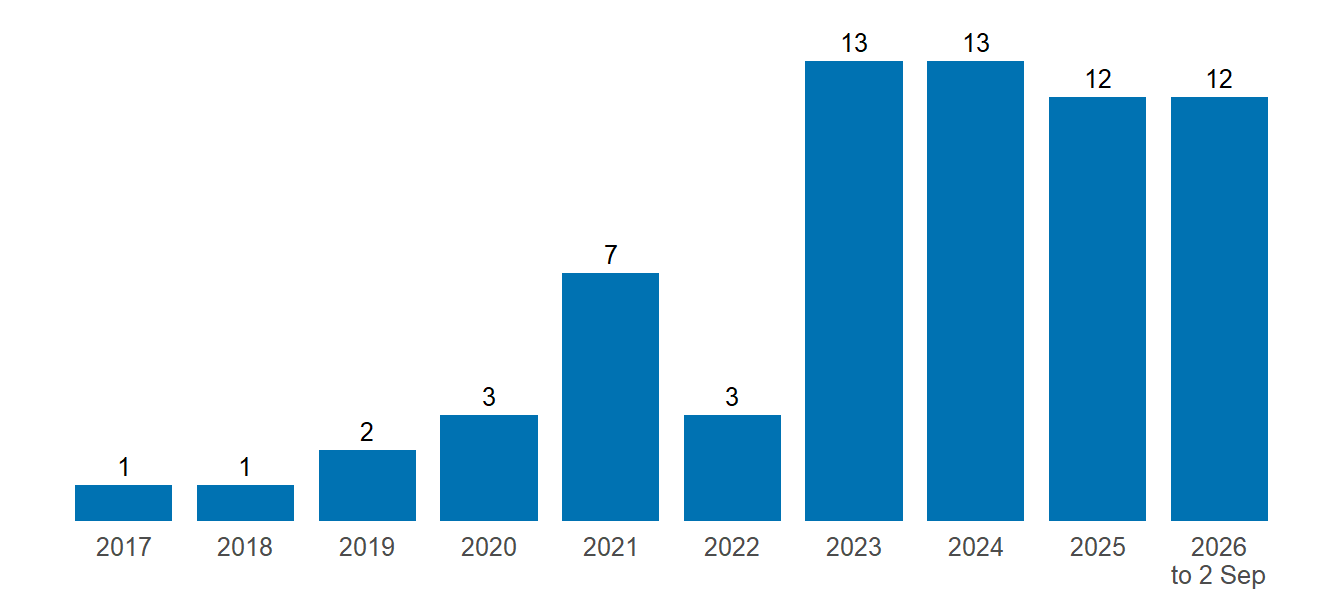
Figure 1: Publications per Year Whose Full Text Mentions allFit, According to Europe PMC and OpenAlex. The last bar stops at the date of the search.
Table 1 lists all the kept publications, the CRAN packages included, most recent first, with the sources in which each was found. Authors are given as the sources returned them. The two sources overlap in a minority of records, which reflects how differently they cover the literature.
short_authors <- function(a) {
  a <- ifelse(is.na(a), '', a)
  first <- sub('[;,].*$', '', a)
  ifelse(grepl('[;,]', a), paste(first, 'et al.'), first)
}
used_allfit |>
  transmute(Year = year,
            Authors = short_authors(authors),
            Title = title,
            Venue = venue,
            DOI = ifelse(is.na(doi) | doi == '', '',
                         sprintf('[%s](https://doi.org/%s)', doi, doi)),
            Sources = sources) |>
knitr::kable(caption = 'Candidate Publications Whose Full Text Mentions allFit, Most Recent First, With the Sources in Which Each Was Found.')| Year | Authors | Title | Venue | DOI | Sources |
|---|---|---|---|---|---|
| 2026 | Amalia Arvaniti et al. | Individual and Language Differences in Rhythm Grouping Preferences: The Iambic–Trochaic Law Revisited | Cambridge University Press eBooks | 10.1017/9781009295888.038 | OpenAlex, full text |
| 2026 | Anna Ly et al. | Fitting Generalized Linear Mixed-Effects Models using lme4 | arXiv (Cornell University) | OpenAlex, full text | |
| 2026 | Evelyn Milburn et al. | Native speakers kick buckets, but learners kick doors: A comparison of native and nonnative idiom comprehension | Memory & Cognition | 10.3758/s13421-025-01843-5 | OpenAlex, full text |
| 2026 | Guček NK et al. | Patient- and provider-level determinants of self-assessed health and well-being among adults with chronic conditions in Slovenian primary care. | Health Qual Life Outcomes | 10.1186/s12955-026-02538-4 | Europe PMC, full text |
| 2026 | Katriina Koivusalo | Tutti kasvojen mimiikan manipuloinnin välineenä: Tutin vaikutus kasvojen mimiikkaan ja emootioiden tunnistamiseen | Tampere University Institutional Repository (Tampere University) | OpenAlex, full text | |
| 2026 | Kauppi JJ et al. | Socioeconomic status influenced dispersal in early adulthood in Finland from 1760 to 1969. | iScience | 10.1016/j.isci.2026.115467 | Europe PMC, full text |
| 2026 | Manivasagam S et al. | Social learning of emotion and its implication for memory: an ERP study. | Sci Rep | 10.1038/s41598-026-42906-0 | Europe PMC, full text; OpenAlex, full text |
| 2026 | Milton Ali et al. | Intraspecific drought tolerance in Ugandan Coffea canephora for accelerated breeding selection | PLoS ONE | 10.1371/journal.pone.0349873 | OpenAlex, full text |
| 2026 | Renjaän D et al. | Emotion coupling across socialization contexts in adolescence: Differences in parent-child and peer interactions. | Dev Psychol | 10.1037/dev0001865 | Europe PMC, full text; OpenAlex, full text |
| 2026 | Sofie Decock et al. | Comprehensibility of gender-fair language among foreign language learners of German: an experimental study | Frontiers in Language Sciences | 10.3389/flang.2026.1806497 | OpenAlex, full text |
| 2026 | Taylor Pursell et al. | H5N1 influenza binding and cell entry via human class II MHC, and blocking by cross-reactive antibodies | bioRxiv (Cold Spring Harbor Laboratory) | 10.64898/2026.07.22.739677 | OpenAlex, full text |
| 2026 | Effects of Shared Word Order on Intrasentential Language Mixing in English-Dutch, Polish-Dutch, and Turkish-Dutch Bilingual Children | Behav Sci (Basel) | Europe PMC, full text | ||
| 2025 | Abboju Niranjan et al. | COVID-19 multilevel severity classification using FHGSO enabled DKN EfficientNet | International Journal of Advanced Mechatronic Systems | 10.1504/ijamechs.2025.10069510 | OpenAlex, full text |
| 2025 | Deyatima Ghosh et al. | First Evidence of Diverse Inhibitory Control Abilities in Pre‐ and Post‐Metamorphic Salamanders | Integrative Zoology | 10.1111/1749-4877.70030 | OpenAlex, full text |
| 2025 | Fong PY et al. | A double-blind replication attempt of offline 5Hz-rTUS-induced corticospinal excitability. | Imaging Neurosci (Camb) | 10.1162/imag.a.1046 | Europe PMC, full text; OpenAlex, full text |
| 2025 | Kamizela AE et al. | Timing and trajectory of BCR::ABL1-driven chronic myeloid leukaemia. | Nature | 10.1038/s41586-025-08817-2 | Europe PMC, full text |
| 2025 | Mazzini S et al. | Autistic individuals benefit from gestures during degraded speech comprehension. | Autism | 10.1177/13623613241286570 | Europe PMC, full text; OpenAlex, full text |
| 2025 | Parés-Pujolràs E et al. | Perceptual glimpses are locally accumulated and globally maintained at distinct processing levels | 10.1101/2025.04.30.651428 | Europe PMC, full text | |
| 2025 | Paula Orzechowska et al. | The Role of Phonological Factors in the Processing of Polish Phonotactics | Language and Speech | 10.1177/00238309251327671 | OpenAlex, full text |
| 2025 | Peter Stiling et al. | Prospects for the long‐term persistence of a severely endangered plant, Consolea corallicola (Cactaceae) | Conservation Science and Practice | 10.1111/csp2.70031 | OpenAlex, full text |
| 2025 | Tsaprouni E et al. | The Role of Aspect During Deverbal Word Processing in Greek. | J Psycholinguist Res | 10.1007/s10936-024-10112-6 | Europe PMC, full text; OpenAlex, full text |
| 2025 | Vargas TG et al. | Testing Moderators for Associations of Neighborhood Adversity With Psychopathology and Cognitive Outcomes. | Dev Sci | 10.1111/desc.70055 | Europe PMC, full text; OpenAlex, full text |
| 2025 | Zhang P et al. | Priming Adjuncts in Sentence and Discourse Production in Neurotypical Adults and Persons With Aphasia. | J Speech Lang Hear Res | 10.1044/2025_jslhr-24-00870 | Europe PMC, full text |
| 2025 | Zubizarreta-Arruti U et al. | Associations between air pollution and surrounding greenness with internalizing and externalizing behaviors among schoolchildren. | Child Adolesc Ment Health | 10.1111/camh.12772 | Europe PMC, full text |
| 2024 | Chelsea Andreozzi et al. | Influence of microclimate and forest management on bat species faced with global change | Conservation Biology | 10.1111/cobi.14246 | OpenAlex, full text |
| 2024 | Coffey JR et al. | It’s All in the Interaction: Early Acquired Words Are Both Frequent and Highly Imageable. | Open Mind (Camb) | 10.1162/opmi_a_00130 | Europe PMC, full text; OpenAlex, full text |
| 2024 | Colosimo G et al. | Hand grab or noose pole? Evaluating the least stressful practice for capture of endangered Turks and Caicos Rock Iguanas Cyclura carinata. | PeerJ | 10.7717/peerj.17171 | Europe PMC, full text; OpenAlex, full text |
| 2024 | Eszter Tóth-Fáber et al. | Longitudinal evidence for decreasing statistical learning abilities across childhood | 10.31234/osf.io/gj3hq | OpenAlex, full text | |
| 2024 | Kurinchi Selvan Gurusamy | EQUALSTATS: Algorithm Driven Statistical Analysis for Researchers without Coding Skills | 10.32614/cran.package.equalstats | OpenAlex, full text | |
| 2024 | Laura Sperl et al. | Context Matters: How Experimental Language and Language Environment Affect Mental Representations in Multilingualism | Languages | 10.3390/languages9030106 | OpenAlex, full text |
| 2024 | Marlijn ter Bekke et al. | Hand Gestures Have Predictive Potential During Conversation: An Investigation of the Timing of Gestures in Relation to Speech | Cognitive Science | 10.1111/cogs.13407 | OpenAlex, full text |
| 2024 | Qingfeng Xu et al. | Evaluation of forest ecosystem resilience to drought considering lagged effects of drought | Ecology and Evolution | 10.1002/ece3.70281 | OpenAlex, full text |
| 2024 | Rachael W. Cheung et al. | Better early than late: the temporal dynamics of pointing cues during cross-situational word learning | Language and Cognition | 10.1017/langcog.2024.39 | OpenAlex, full text |
| 2024 | Sophie H. Smith et al. | Mating preferences act independently on different elements of visual signals in Heliconius butterflies | Behavioral Ecology | 10.1093/beheco/arae056 | OpenAlex, full text |
| 2024 | Tan JL et al. | The species, density, and intra-plant distribution of mites on red raspberry (Rubus idaeus L.). | Exp Appl Acarol | 10.1007/s10493-024-00930-7 | Europe PMC, full text |
| 2024 | Ter Bekke M et al. | Gestures speed up responses to questions. | Lang Cogn Neurosci | 10.1080/23273798.2024.2314021 | Europe PMC, full text; OpenAlex, full text |
| 2024 | Ulrich R et al. | Mental association of time and valence. | Mem Cognit | 10.3758/s13421-023-01473-9 | Europe PMC, full text; OpenAlex, full text |
| 2024 | Yasamin Motamedi et al. | Language development beyond the here-and-now: Iconicity and displacement in child-directed communication | Child Development | 10.1111/cdev.14099 | OpenAlex, full text |
| 2023 | Carrie A.R. Reyden et al. | Impacts of seeding density on the oxidative stress response of the Greenshell™ mussel, Perna canaliculus | Aquaculture International | 10.1007/s10499-023-01078-8 | OpenAlex, full text |
| 2023 | Di Biase L et al. | Ellenberg Indicator Values Disclose Complex Environmental Filtering Processes in Plant Communities along an Elevational Gradient. | Biology (Basel) | 10.3390/biology12020161 | Europe PMC, full text; OpenAlex, full text |
| 2023 | Frederik Van Daele et al. | Habitat fragmentation affects climate adaptation in a forest herb | Journal of Ecology | 10.1111/1365-2745.14225 | OpenAlex, full text |
| 2023 | Jeon HS. | Exploring Variability in Compound Tensification in Seoul Korean. | Lang Speech | 10.1177/00238309221095479 | Europe PMC, full text |
| 2023 | Maximin Lange et al. | Could We Prescribe Jobs? Recommendation Accuracy of Job Recommender Systems Using Machine Learning: A Systematic Review and Meta-Analysis | SSRN Electronic Journal | 10.2139/ssrn.4499701 | OpenAlex, full text |
| 2023 | Melanie Wyld et al. | Life Years Lost in Children with Kidney Failure: A Binational Cohort Study with Multistate Probabilities of Death and Life Expectancy | Journal of the American Society of Nephrology | 10.1681/asn.0000000000000118 | OpenAlex, full text |
| 2023 | Moniek H. M. Hutschemaekers et al. | Social avoidance and testosterone enhanced exposure efficacy in women with social anxiety disorder: A pilot investigation | Psychoneuroendocrinology | 10.1016/j.psyneuen.2023.106372 | OpenAlex, full text |
| 2023 | Noor Seijdel et al. | Environmental noise affects audiovisual gain during speech comprehension in adverse listening conditions | 10.31219/osf.io/wbv9r | OpenAlex, full text | |
| 2023 | Sporrer JK et al. | Functional sophistication in human escape. | iScience | 10.1016/j.isci.2023.108240 | Europe PMC, full text |
| 2023 | Washington PN et al. | The contributions of proficiency and semantics to the bilingual sentence superiority effect. | Biling (Camb Engl) | 10.1017/s1366728922000748 | Europe PMC, full text; OpenAlex, full text |
| 2023 | Wehrli JM et al. | Effect of the Matrix Metalloproteinase Inhibitor Doxycycline on Human Trace Fear Memory. | eNeuro | 10.1523/eneuro.0243-22.2023 | Europe PMC, full text; OpenAlex, full text |
| 2023 | Yaoyao Lin et al. | An Enhanced Hunger Games Search Optimization with Application to Constrained Engineering Optimization Problems | Biomimetics | 10.3390/biomimetics8050441 | OpenAlex, full text |
| 2023 | Zhang Z et al. | Scalar Implicature is Sensitive to Contextual Alternatives. | Cogn Sci | 10.1111/cogs.13238 | Europe PMC, full text; OpenAlex, full text |
| 2022 | Chapin Czarnecki et al. | Reduced avian predation on an ultraviolet-fluorescing caterpillar model | The Canadian Entomologist | 10.4039/tce.2021.57 | OpenAlex, full text |
| 2022 | Hernán Anlló et al. | Effects of false statements on visual perception hinge on social suggestibility. | Journal of Experimental Psychology Human Perception & Performance | 10.1037/xhp0001024 | OpenAlex, full text |
| 2022 | Iago Giné-Vázquez | trouBBlme4SolveR: Troubles Solver for ‘lme4’ | 10.32614/cran.package.troubblme4solver | OpenAlex, full text | |
| 2022 | Murphy JI et al. | Accessible analysis of longitudinal data with linear mixed effects models. | Dis Model Mech | 10.1242/dmm.048025 | Europe PMC, full text; OpenAlex, full text |
| 2021 | Brown-Schmidt S et al. | The limited role of hippocampal declarative memory in transient semantic activation during online language processing. | Neuropsychologia | 10.1016/j.neuropsychologia.2020.107730 | Europe PMC, full text |
| 2021 | Douglas Roland et al. | The processing of pronominal relative clauses: Evidence from eye movements | Journal of Memory and Language | 10.1016/j.jml.2021.104244 | OpenAlex, full text |
| 2021 | Hernán Anlló et al. | Social steerability modulates perceptual biases | bioRxiv (Cold Spring Harbor Laboratory) | 10.1101/2021.04.28.441710 | OpenAlex, full text |
| 2021 | Jeffrey Martin Lees | Implicit attitudes matter for social judgments of others’ preference, but do not make those judgments more or less accurate | 10.31234/osf.io/sh3xz | OpenAlex, full text | |
| 2021 | Josje Verhagen et al. | Determinants of early lexical acquisition: Effects of word- and child-level factors on Dutch children’s acquisition of words | Journal of Child Language | 10.1017/s0305000921000635 | OpenAlex, full text |
| 2021 | Maseroli E et al. | Testosterone treatment is associated with reduced adipose tissue dysfunction and nonalcoholic fatty liver disease in obese hypogonadal men. | J Endocrinol Invest | 10.1007/s40618-020-01381-8 | Europe PMC, full text; OpenAlex, full text |
| 2021 | Sophie Jane Tudge et al. | The impacts of biofuel crops on local biodiversity: a global synthesis | Biodiversity and Conservation | 10.1007/s10531-021-02232-5 | OpenAlex, full text |
| 2020 | Adam Striegel | Control of Volunteer Corn in Enlist Corn and Economics of Herbicide Programs for Weed Control in Conventional and Multiple Herbicide-Resistant Soybean Across Nebraska | Lincoln (University of Nebraska) | OpenAlex, full text | |
| 2020 | Ramya Walsan | Comorbidity of serious mental illness and type 2 diabetes: do neighbourhoods matter? | Research Online (University of Wollongong) | OpenAlex, full text | |
| 2020 | Zimmerman J et al. | #foodie: Implications of interacting with social media for memory. | Cogn Res Princ Implic | 10.1186/s41235-020-00216-7 | Europe PMC, full text; OpenAlex, full text |
| 2019 | Rachel Ryskin et al. | Information Integration in Modulation of Pragmatic Inferences During Online Language Comprehension | Cognitive Science | 10.1111/cogs.12769 | OpenAlex, full text |
| 2019 | Roswell M et al. | Male and female bees show large differences in floral preference. | PLoS One | 10.1371/journal.pone.0214909 | Europe PMC, full text |
| 2018 | Benjamin M. Bolker et al. | broom.mixed: Tidying Methods for Mixed Models | 10.32614/cran.package.broom.mixed | OpenAlex, full text | |
| 2018 | Peter A. Cott et al. | Can traditional methods of selecting food accurately assess fish health? | Arctic Science | 10.1139/as-2017-0052 | OpenAlex, full text |
| 2017 | Jamal K. Mansour et al. | Are multiple-trial experiments appropriate for eyewitness identification studies? Accuracy, choosing, and confidence across trials | Behavior Research Methods | 10.3758/s13428-017-0855-0 | OpenAlex, full text |
| 2012 | Henrik Singmann et al. | afex: Analysis of Factorial Experiments | 10.32614/cran.package.afex | OpenAlex, full text |
The only hit of the proxy query, in Table 2, is an erratum notice that carries the abstract of the original article. A wider proxy query would be a reasonable place to look for further precedents, since studies that compared optimisers rarely name the function in a field that Scopus indexes.
records |>
  filter(source == 'Scopus, convergence proxy') |>
  transmute(Year = year, Authors = short_authors(authors), Title = title, Venue = venue,
            DOI = ifelse(is.na(doi) | doi == '', '',
                         sprintf('[%s](https://doi.org/%s)', doi, doi))) |>
knitr::kable(caption = 'The Single Record Returned by the Scopus Convergence Proxy Query.')| Year | Authors | Title | Venue | DOI |
|---|---|---|---|---|
| 2019 | Kiss K. | Erratum: Quantifier spreading: Children misled by ostensive cues (Glossa: A Journal of General Linguistics (2017) 2:1 (38) DOI: 10.5334/gjgl.147) | Glossa | 10.5334/gjgl.902 |
Discussion
The list is incomplete, because the searches miss part of the literature. Europe PMC holds full text mostly for open-access articles in journals within its scope, so a paywalled study in a linguistics or psychology journal is usually invisible to it unless a preprint or an accepted manuscript was deposited. OpenAlex holds the text of a subset of the literature that it does not fully document, and Scopus cannot see the methods section at all. None of the three can find a study that compared optimisers with its own loop or by calling the optimx package directly, or one that reported the comparison only in supplementary material. At the same time, a full-text match can be an article that uses the function for something other than a convergence check, or that mentions it only in a footnote. Records published before the function existed have been dropped, but the table has not otherwise been screened by hand, so some of the publications it lists may mention the function without having used it. A preprint and its published article are merged only when their titles match, so a study whose title changed on publication can still appear twice. The list is therefore a starting point for the reader who needs a precedent.
References
Barr, D. J., Levy, R., Scheepers, C., & Tily, H. J. (2013). Random effects structure for confirmatory hypothesis testing: Keep it maximal. Journal of Memory and Language, 68(3), 255–278. https://doi.org/10.1016/j.jml.2012.11.001
Bates, D., Kliegl, R., Vasishth, S., & Baayen, H. (2015). Parsimonious mixed models [Preprint]. arXiv. https://doi.org/10.48550/arXiv.1506.04967
Bates, D., Mächler, M., Bolker, B., & Walker, S. (2015). Fitting linear mixed-effects models using lme4. Journal of Statistical Software, 67(1), 1–48. https://doi.org/10.18637/jss.v067.i01
Bernabeu, P. (2026). scopusflow: A reproducible workflow layer for Scopus bibliographic searches (Version 0.4.0) [Computer software]. Comprehensive R Archive Network (CRAN). https://doi.org/10.32614/CRAN.package.scopusflow
Brauer, M., & Curtin, J. J. (2018). Linear mixed-effects models and the analysis of nonindependent data: A unified framework to analyze categorical and continuous independent variables that vary within-subjects and/or within-items. Psychological Methods, 23(3), 389–411. https://doi.org/10.1037/met0000159
Matuschek, H., Kliegl, R., Vasishth, S., Baayen, H., & Bates, D. (2017). Balancing Type I error and power in linear mixed models. Journal of Memory and Language, 94, 305–315. https://doi.org/10.1016/j.jml.2017.01.001
Singmann, H., & Kellen, D. (2019). An introduction to mixed models for experimental psychology. In D. Spieler & E. Schumacher (Eds.), New methods in cognitive psychology (pp. 4–31). Routledge. https://doi.org/10.4324/9780429318405-2
Comments are provided by Disqus and are not loaded automatically. Loading them connects your browser to Disqus, which may use cookies and process data under its privacy policy. See this site's privacy notice for details.